4Protocol Pioneers: The People Who Built the Internet
Biographical Profiles of Networking’s Most Important Innovators
fundamentals
history
protocol
pioneers
4.1 In 60 Seconds
The Internet was not invented by one person. Paul Baran made resilient packet routing thinkable; Vint Cerf and Bob Kahn made heterogeneous networks interoperate; Bob Metcalfe made local networking practical; Tim Berners-Lee made networked documents usable; and later pioneers shaped email, Ethernet loops, MQTT, IoT naming, IPv6 compression, and open standards governance. Modern IoT inherits those choices every time a sensor publishes MQTT over TCP/IP, a Thread device compresses IPv6, or a dashboard speaks HTTP.
4.2 Start With the Story
Start with one deployed device that needs a sensor, firmware, a gateway, a network, a cloud service, an operator, and someone accountable when it fails. The core idea in Protocol Pioneers: The People Who Built the Internet is simple: IoT is an ecosystem, so the useful question is not only what the device does, but who depends on each layer and how the layers stay interoperable. This page focuses that idea on Profiles the packet, TCP/IP, web, email, Ethernet, MQTT, IoT, 6LoWPAN, and standards pioneers behind modern IoT networking. In everyday IoT, maintenance plans, standards choices, data ownership, and lifecycle duties decide whether a pilot survives contact with the field. Start simple: name the actors, name the handoffs, and then add historical or governance detail where the handoff needs evidence.
4.3 Learning Objectives
By the end of this chapter, you will be able to:
Identify the key Internet pioneers: Classify 10+ individuals by their foundational contributions to networking and protocol development
Map people to protocols: Explain what each pioneer invented and justify why their design decisions still matter in modern IoT systems
Analyze collaborative innovation: Describe how the Internet emerged through open collaboration rather than any single inventor’s work
Trace ideas through generations: Illustrate how each pioneer’s work built on previous contributions and enabled subsequent innovations
Differentiate design motivations: Compare the real-world constraints (nuclear resilience, satellite bandwidth, store stockouts) that drove each protocol’s design choices
Apply Postel’s robustness principle: Evaluate how “be conservative in what you send, liberal in what you accept” enables interoperability across diverse IoT implementations
4.4 What To Watch For
No single inventor: Internet history is a chain of interoperable contributions, not a lone-genius story.
Constraints shaped protocols: Nuclear resilience, scarce satellite bandwidth, shared office printers, shelf stockouts, and tiny radio frames all left marks on protocol design.
Open architecture: The Internet grows because IP can ride over many link technologies and open RFCs let independent implementers interoperate.
Edge responsibility: Reliability, application meaning, and much protocol intelligence often sit at the endpoints rather than in the network core.
IoT lineage: MQTT, Thread, Matter, 6LoWPAN, dashboards, and device identities are easier to reason about when you know which older design problem they inherit.
4.5 Minimum Viable Understanding
Core Concept: The Internet and IoT protocols we use today are the result of collaborative work by hundreds of engineers over 60+ years. No single person “invented the Internet” – instead, each pioneer contributed a piece that enabled the next generation to build further.
Why It Matters: Understanding the human stories behind protocols helps you appreciate why they were designed the way they are. MQTT’s low overhead reflects Andy Stanford-Clark’s satellite bandwidth constraints. TCP’s robustness reflects Vint Cerf’s goal to connect any network to any other. Every protocol design decision has a human story.
Key Takeaway: When you use MQTT, TCP/IP, HTTP, or email today, you’re building on the work of specific, identifiable people who solved real problems. Learning their stories makes you a better engineer – you understand not just what protocols do, but why they were designed that way.
Chapter Roadmap
This chapter is a guided walk through protocol history:
First connect the big idea: no single person invented the Internet.
Then follow packet switching into TCP/IP, Ethernet, the Web, email, and loop-free switching.
Next connect governance and standards to Postel’s RFC and IANA work.
After that trace IoT-specific ideas through MQTT, the Internet of Things name, and 6LoWPAN.
Finally use the quizzes to map each pioneer back to the protocol layer or design constraint they changed.
Checkpoints recap the main lineage. Deep-dive and beginner callouts can be opened when you want more context.
4.6 Chapter Overview
Behind every Internet protocol – TCP, IP, HTTP, SMTP, MQTT – is a person or small team who identified a problem, proposed a solution, and convinced others to adopt it. This chapter profiles 11 key pioneers whose work directly enables the IoT systems you build today.
You’ll learn not just what they invented, but why they made specific design choices, what obstacles they overcame, and how their work enabled the next generation of innovation.
For Beginners: Why Learn About Protocol Pioneers?
Imagine you’re learning to cook. You could memorize recipes, or you could learn from the chefs who created them – understanding why they combined ingredients in specific ways, what problems they were solving, and how they adapted when things went wrong.
Learning about protocol pioneers is like learning from master chefs. When you understand that Vint Cerf designed TCP to work over any network (satellite, radio, wired) because he wanted the Internet to be universal, you understand why TCP has features like retransmission and flow control. When you know Andy Stanford-Clark created MQTT because satellite bandwidth was expensive, you understand why MQTT headers are so compact.
The simple version: Protocols weren’t handed down from the sky. Real people with specific problems created them. Understanding the people helps you understand the protocols.
Sensor Squad: The Inventors Club!
Imagine the Sensor Squad started an Inventors Club!
4.6.1 The Big Meeting
One day, Sammy the Sensor gathered his friends: Lila the Light Sensor, Max the Motion Detector, and Bella the Battery Manager. “You know what’s cool?” Sammy said. “The Internet wasn’t invented by one person – it was a team effort, like us!”
Lila pulled out a big poster board: “Let’s meet the Internet Inventors Club!”
The Inventors Club Members:
Mr. Packet (Paul Baran) - “Don’t put all your eggs in one basket! If I cut this phone line, your whole message fails. But if I break messages into PACKETS and send them on different paths, some will always get through!” He drew maps showing multiple roads to the same destination.
Sammy laughed: “That’s how I send sensor readings! If one path is busy, the network finds another way!”
The Dynamic Duo (Vint Cerf and Bob Kahn) - These two best friends worked together to create TCP/IP. Vint was hard of hearing, which made him extra passionate about communication technology. Bob said: “Our rule is simple: ANY computer should talk to ANY other computer, anywhere, anytime!”
Max added: “That’s why my ESP32 can talk to a giant cloud server! Mr. Cerf and Mr. Kahn made sure all devices speak the same language!”
The Web Wizard (Tim Berners-Lee) - Tim worked at a big physics lab called CERN. Scientists there couldn’t find each other’s research papers! So Tim invented the World Wide Web – a way to link documents together with clickable words. He gave it away FOR FREE.
Bella calculated: “If Mr. Berners-Lee had patented the Web, he could have been a billionaire! But he wanted everyone to use it.”
The Email Pioneer (Ray Tomlinson) - Ray sent the first email in 1971. He needed a way to separate the person’s name from the computer name, so he chose the @ symbol. “Why @?” he asked. “Because nobody was using it for anything else!”
Lila giggled: “sammy@iot-lab.com – that @ symbol is almost 60 years old!”
The Network Nurse (Radia Perlman) - Radia is called the “Mother of the Internet” (though she doesn’t like that title). She invented the Spanning Tree Protocol that stops network loops. Imagine if your school’s halls were a maze where you could walk in circles forever – Radia’s invention prevents that in networks!
Max observed: “Every switch in every building runs Ms. Perlman’s algorithm!”
The IoT Namer (Kevin Ashton) - In 1999, Kevin was working at a company that made soap and lipstick. He noticed: “Computers know what’s on the Internet, but they don’t know what’s on store shelves! What if things could tell computers about themselves?” He called this the “Internet of Things.”
Sammy beamed: “That’s ME! I’m part of the Internet of THINGS!”
4.6.2 The Big Lesson
Bella wrote on the poster: “Great inventions come from teamwork! Nobody built the Internet alone – they all helped each other!”
Key Words for Kids:
Word
What It Means
Protocol
Rules for how devices talk to each other (like saying “please” and “thank you”)
Packet
A small chunk of a message (like breaking a puzzle into pieces to mail it)
TCP/IP
The main language computers use to talk on the Internet
World Wide Web
The system of linked web pages you see in a browser
@ Symbol
The “at” sign in email addresses that separates person from computer
4.7 The Pioneer Timeline
Start with the timeline before the biographies. It gives you the order of ideas, so each profile can answer a sharper question: what problem was still unsolved at that moment?
Before diving into individual profiles, here’s when each pioneer made their key contributions:
Year
Pioneer
Achievement
1964
Paul Baran
Published packet switching concepts (RAND Corporation)
1971
Ray Tomlinson
Sent first networked email with @ symbol
1973
Bob Metcalfe
Invented Ethernet at Xerox PARC
1974
Vint Cerf & Bob Kahn
Published TCP/IP specification
1985
Radia Perlman
Invented Spanning Tree Protocol (STP)
1989
Tim Berners-Lee
Proposed World Wide Web at CERN
1999
Andy Stanford-Clark
Co-created MQTT for industrial IoT
1999
Kevin Ashton
Coined “Internet of Things” in P&G presentation
2000s
Geoff Mulligan
Led IETF 6LoWPAN standardization
1970s-98
Jon Postel
Edited most early RFCs, managed IANA
How It Works: The Generational Flow of Innovation
The big picture: Each pioneer’s work enabled the next generation. No invention happened in isolation – they built on each other’s foundations in a clear sequence.
Step-by-step progression:
Paul Baran (1964): Packet switching – messages can be broken into chunks and take different paths
Vint Cerf & Bob Kahn (1974): TCP/IP – different networks can connect using Baran’s packets as the unit of exchange
Bob Metcalfe (1973): Ethernet – local networks need a way to share a wire (complements TCP/IP’s network-to-network role)
Tim Berners-Lee (1989): HTTP and HTML – now that networks are connected, we need a way to link documents (runs over TCP/IP)
Andy Stanford-Clark (1999): MQTT – HTTP is too heavy for sensors on slow satellite links (lighter alternative for constrained devices)
Geoff Mulligan (2000s): 6LoWPAN – TCP/IP was designed for computers, but IoT needs it to work on tiny devices with 802.15.4 radios
Why this matters: When you debug a network issue, you’re thinking through this same stack. Understanding the progression helps you remember the layering: Ethernet (physical sharing) → IP (network-to-network) → TCP (reliable delivery) → HTTP/MQTT (application protocols). Each layer solves a problem the previous layer left open.
4.8 Paul Baran (1926-2011): Packet Switching Pioneer
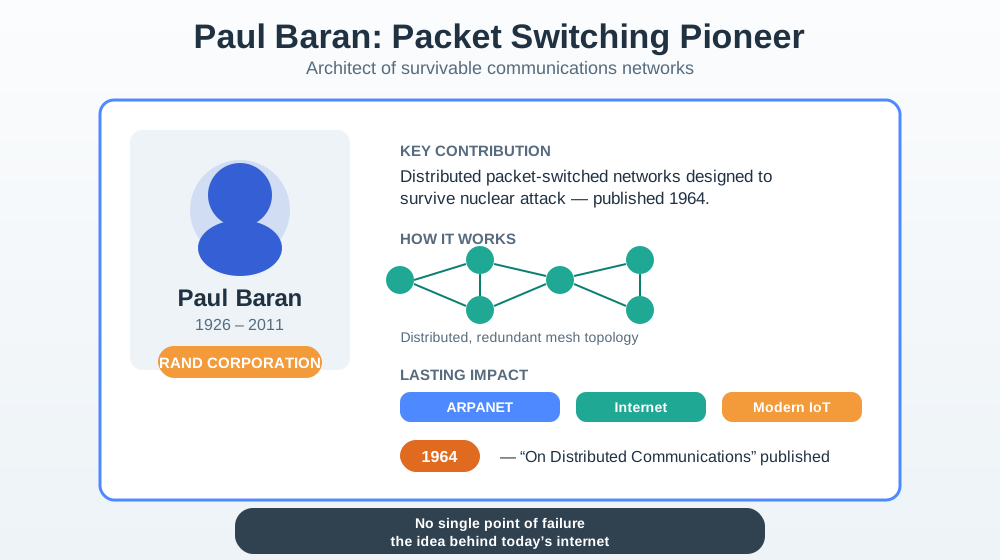
Figure 4.1: Paul Baran at RAND Corporation, where he pioneered distributed packet-switched networks that could survive nuclear attack.
4.8.1 The Problem He Solved
In the early 1960s, the U.S. military faced a critical vulnerability: all telephone communication relied on circuit-switched networks with central switching stations. If a Soviet nuclear strike destroyed a few key switching centers, the entire network would collapse. The Pentagon needed a communication system that could survive a nuclear war.
4.8.2 His Breakthrough: Distributed Packet Switching
Between 1960 and 1964, Paul Baran at the RAND Corporation developed the concept of packet switching with distributed routing. His key insights:
1. Break Messages Into Packets Instead of dedicating a circuit for an entire conversation (like telephone calls), break messages into small, independently-routable packets. Each packet knows its destination and finds its own way there.
2. Redundant Mesh Networks Build networks with multiple paths between nodes. If one path is destroyed, packets automatically route around the damage. This was revolutionary – telephone networks were designed as hierarchical trees, not redundant meshes.
3. Distributed Intelligence Put routing logic in every node, not in centralized switches. Each node makes local decisions about where to forward packets based on current network conditions. No single point of failure.
4.8.3 What AT&T Thought
In 1965, Baran presented his ideas to AT&T engineers. Their response: “It won’t work.”
AT&T’s engineers were the world’s foremost experts in circuit-switched telephony. They couldn’t imagine that chopping messages into pieces and sending them on unpredictable paths would be more reliable than dedicated circuits. This is paradigm blindness in action – expertise in the current system made them blind to the next paradigm.
Baran later reflected: “They didn’t understand digital technology. Their entire system was analog, and they saw packet switching as chaos.”
4.8.4 The Impact
Baran published his findings in an 11-volume report called On Distributed Communications (1964). Though AT&T rejected it, ARPA (Advanced Research Projects Agency) studied Baran’s work when designing ARPANET in the late 1960s. Packet switching became the foundation of the Internet.
4.8.5 What Baran Made Possible
Every packet that travels the Internet – whether it’s carrying a web page, an email, or an MQTT message from an IoT sensor – follows Baran’s distributed routing principle. When your smart thermostat sends data to the cloud, the packets might travel through dozens of routers, taking different paths, dynamically routing around congestion and failures. That resilience comes directly from Baran’s 1960s insight.
For IoT specifically: Mesh networking protocols like Zigbee and Thread are direct descendants of Baran’s distributed packet routing. Your smart home devices form a mesh where each device routes packets for others – exactly Baran’s vision of distributed intelligence and redundant paths.
Quick Check: Test your understanding of Baran’s packet switching and why established experts missed this paradigm shift:
4.8.6 Baran’s Design Philosophy
Baran’s work introduced three principles that define modern networking:
Principle
Traditional Networks
Baran’s Innovation
IoT Application
Routing
Centralized switches
Distributed intelligence in every node
Zigbee mesh: each light bulb routes for others
Reliability
Single high-quality path
Multiple redundant paths
LoRaWAN: packets can reach gateway via multiple hops
Failure Response
Network fails when switch fails
Automatic rerouting around damage
Thread: self-healing mesh re-forms after node loss
Checkpoint: Packet Switching
You now know:
Baran’s 1964 packet-switching work answered a resilience problem, not a convenience problem.
The central move was to break messages into packets and let redundant paths survive failures.
Modern mesh behavior in Zigbee and Thread inherits that same distributed-routing idea.
4.9 Vint Cerf (1943-) and Bob Kahn (1938-): The Fathers of the Internet
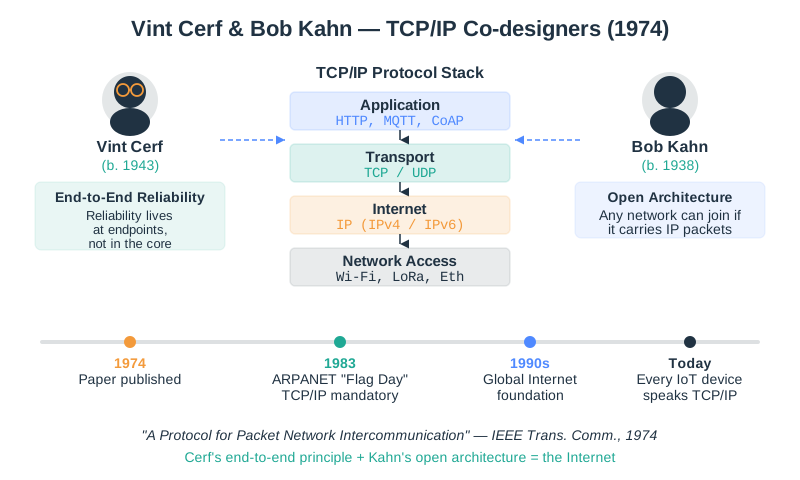
Figure 4.2: Vint Cerf and Bob Kahn, co-designers of TCP/IP, the protocol suite that enables the Internet.
4.9.1 The Problem They Solved
By the early 1970s, ARPANET connected a few dozen computers using the Network Control Protocol (NCP). But NCP had critical limitations:
Only worked on ARPANET – couldn’t connect to other networks (satellite, radio, Ethernet)
No error recovery – if a packet was lost, applications had to detect and retransmit
Assumed reliable links – didn’t handle packet reordering or corruption
ARPA wanted to connect heterogeneous networks – ARPANET, satellite links (SATNET), and packet radio networks (PRNET) – into a single inter-network. No existing protocol could do this.
4.9.2 Their Breakthrough: TCP/IP and the Open Architecture Principle
Baran showed that packet networks could be resilient. Cerf and Kahn’s next question was broader: how can different packet networks become one inter-network?
In 1974, Vint Cerf and Bob Kahn published “A Protocol for Packet Network Intercommunication” in IEEE Transactions on Communications. Their protocol had two revolutionary ideas:
1. The Open Architecture Principle (Kahn’s Insight) Any network – wired, wireless, satellite, smoke signals – can join the Internet if it can carry IP packets. The Internet doesn’t care how individual networks work internally. This is called network layer independence.
2. End-to-End Reliability (Cerf’s Insight) Don’t trust the network to be reliable. Instead, put reliability logic in the endpoints – the computers sending and receiving data. If a packet is lost, the receiving computer detects the gap (via sequence numbers) and asks the sender to retransmit.
This became the end-to-end principle: intelligence belongs at the edges, not in the network core. The network’s job is simple: forward packets. The endpoints handle everything else.
4.9.3 Cerf’s Personal Motivation
Vint Cerf is partially deaf from birth. This personal experience gave him a unique perspective on communication:
“I’ve always been interested in communication because I understand what it’s like when communication fails. The Internet is fundamentally about connecting people and ideas – making sure messages get through despite imperfect infrastructure.”
His passion for robust communication influenced TCP’s design. TCP doesn’t just detect errors – it corrects them, automatically retransmits lost packets, and reorders out-of-sequence packets. This robustness reflects Cerf’s personal understanding that communication cannot be taken for granted.
4.9.4 The Impact
TCP/IP became mandatory on ARPANET in 1983 (“Flag Day”). By the 1990s, it was the foundation of the global Internet. Today, every device – from supercomputers to $2 ESP32 microcontrollers – speaks TCP/IP.
What Cerf and Kahn Made Possible
Every device on the Internet – from your laptop to a $2 ESP32 sensor – uses Cerf and Kahn’s TCP/IP protocol. When your IoT temperature sensor sends data to AWS IoT Core, it’s using:
IP (Internet Protocol): Routes packets across multiple networks (your Wi-Fi → ISP → AWS)
TCP (Transmission Control Protocol): Ensures reliable, ordered delivery (retransmits lost packets)
Kahn’s open architecture principle is why IoT works at all – you can mix LoRaWAN sensors, Wi-Fi cameras, cellular trackers, and Zigbee switches in one system. They all use IP as the common language.
Cerf’s end-to-end reliability is why MQTT over TCP works even on terrible networks. TCP handles the retransmissions so your application code doesn’t have to.
Checkpoint: Internet Architecture
You now know:
TCP/IP, published in 1974, made heterogeneous networks interoperate instead of forcing every link to behave the same way.
IP keeps the network core simple: forward packets across whatever link is available.
TCP puts reliability at the endpoints, which is why MQTT over TCP can survive Wi-Fi, cellular, and satellite variation.
4.9.5 Cerf Today: Chief Internet Evangelist at Google
Vint Cerf continues to advocate for Internet expansion. As Google’s “Chief Internet Evangelist,” he works on:
Interplanetary Internet: Extending TCP/IP to work over multi-minute delays between Earth and Mars
Internet access as a human right: Advocating for global connectivity
IPv6 adoption: Ensuring enough addresses for billions of IoT devices (\(2^{128}\) addresses, vs. IPv4’s \(2^{32}\))
4.10 Tim Berners-Lee (1955-): World Wide Web Inventor
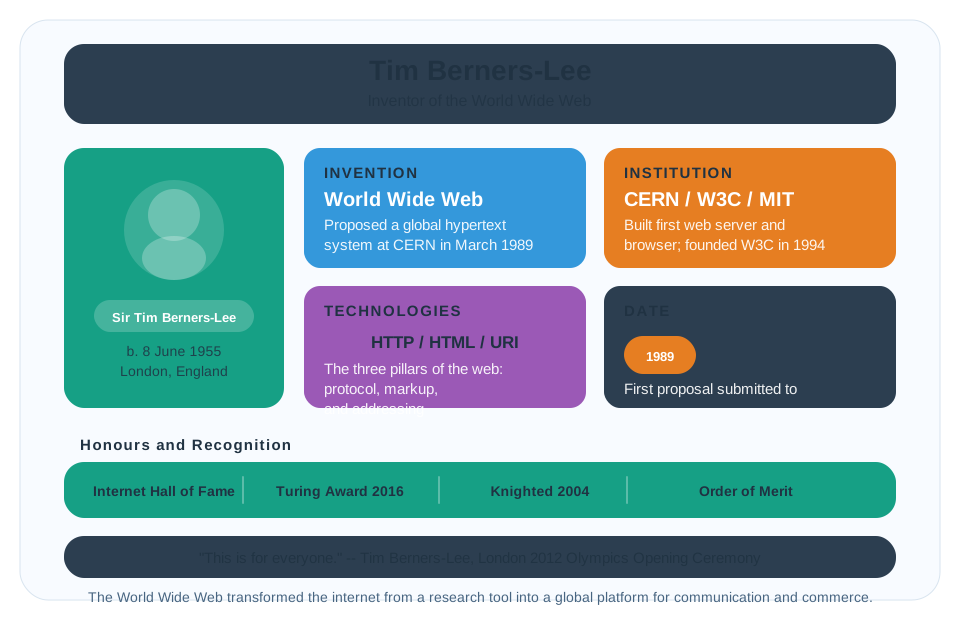
Figure 4.3: Tim Berners-Lee at CERN, where he invented HTML, HTTP, URLs, and the first web browser.
4.10.1 The Problem He Solved
In 1989, CERN (the European physics lab) had thousands of researchers generating papers, datasets, and software. But there was no easy way to link related documents across different computers. If you read a paper that referenced another paper, you had to manually search for it on a different system. Knowledge was siloed.
Berners-Lee, a British software engineer at CERN, had a vision: What if documents could link to each other across the network? Click a word, jump to a related document, regardless of which computer hosts it.
4.10.2 His Breakthrough: The World Wide Web
Between 1989 and 1991, Berners-Lee invented the three core technologies that make the Web work:
1. HTML (HyperText Markup Language) A simple way to format documents with hyperlinks – clickable text that references other documents by URL.
2. HTTP (HyperText Transfer Protocol) A lightweight protocol for requesting and serving documents over TCP/IP. HTTP is stateless – each request is independent, making it simple and scalable.
GET /related-paper.html HTTP/1.0
Host: example.com
3. URLs (Uniform Resource Locators) A standard way to address any resource on the Internet: http://server/path/to/file.
4. The First Web Browser (WorldWideWeb) Berners-Lee wrote the first browser and web server in 1990 on a NeXT computer. Both were free and open-source.
4.10.3 The Decision That Changed the World
In 1993, CERN faced a choice: patent the Web or release it freely?
Berners-Lee convinced CERN to release the Web into the public domain with no royalties, no restrictions. This decision made the Web universal. If CERN had patented it, the Web might have become a proprietary system like AOL or CompuServe – walled gardens that eventually died.
4.10.4 The Impact
By 2026, over 5 billion people use the Web. It has become the primary interface to the Internet. Berners-Lee was knighted by Queen Elizabeth II in 2004 for his contribution to humanity.
What Berners-Lee Made Possible
Every web-based IoT dashboard, every REST API, every cloud platform UI you use is built on Berners-Lee’s HTTP.
IoT Dashboards: When you view sensor data in a web browser (Grafana, ThingSpeak, AWS IoT console), you’re using HTTP to fetch data and HTML to display it
REST APIs: When your IoT device sends data to a web service (POST /sensor-data), it’s using HTTP as the application protocol
Webhooks: When AWS IoT triggers a webhook on sensor events, it’s using HTTP to notify your application
HTTP’s simplicity – stateless requests, plain text headers, easy to debug – made it ideal for IoT. That simplicity was Berners-Lee’s design choice, influenced by his goal to make the Web accessible to everyone, not just experts.
4.10.5 Berners-Lee Today: Fighting for an Open Web
Berners-Lee founded the World Wide Web Consortium (W3C) to maintain open web standards. Today, he’s working on Solid – a project to give users control over their personal data, addressing privacy concerns that have emerged 30+ years after the Web’s creation.
4.11 Ray Tomlinson (1941-2016): Email Inventor
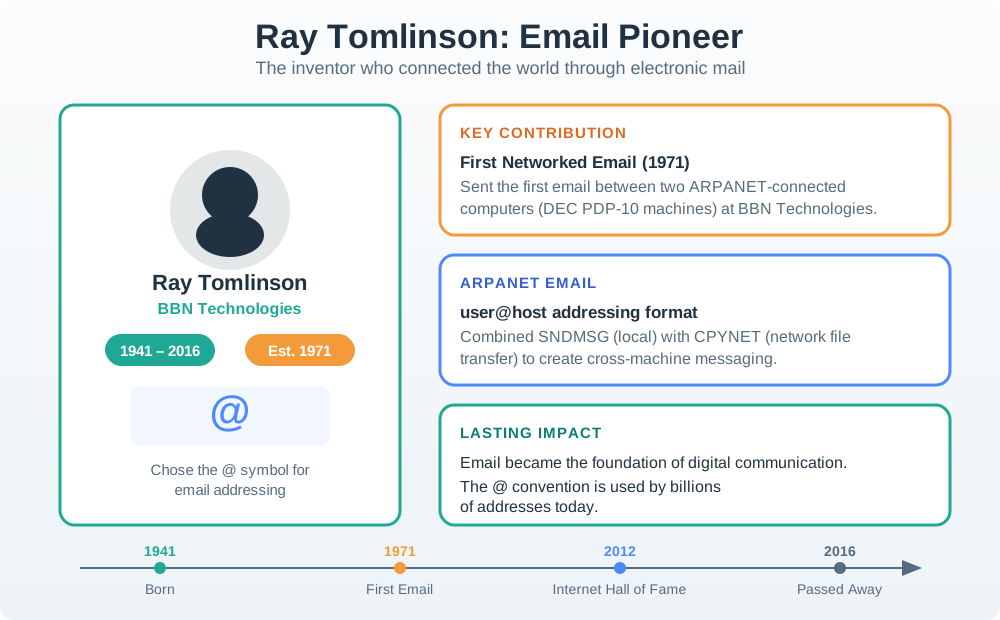
Figure 4.4: Ray Tomlinson, who sent the first networked email in 1971 and chose the @ symbol.
4.11.1 The Problem He Solved
In 1971, computers could run local messaging programs – users on the same computer could leave messages for each other. But ARPANET had connected computers at different sites. Tomlinson, working at BBN Technologies (the company building ARPANET), asked: What if people could send messages across the network to users on different computers?
4.11.2 His Breakthrough: Networked Email with the @ Symbol
Tomlinson wrote the first networked email program in 1971. His key innovation was the user@host addressing format:
tomlinson@bbn-tenexa
Why the @ symbol? Tomlinson needed a character that: - Wasn’t already used in usernames (so fred@host wouldn’t be confused with fred) - Indicated “at” in natural language - Was available on the Model 33 Teletype keyboard
The @ symbol was perfect. It was rarely used for anything else (outside accounting contexts), and it naturally read as “user at host.”
4.11.3 What Was the First Email?
Tomlinson sent the first networked email to himself – from one computer to another computer sitting right next to it. What did it say?
He doesn’t remember. In later interviews, he said it was probably something like:
QWERTYUIOP
– just testing the keyboard. The content didn’t matter. What mattered was that it worked.
4.11.4 The Impact
By 1973, email was 75% of ARPANET traffic. Today, billions of people use email, all following Tomlinson’s user@host format. The @ symbol has become one of the most recognized symbols in the world.
What Tomlinson Made Possible
The concept of user@host addressing influenced every messaging system:
MQTT Topics: sensors/building-a/floor-3/temperature – hierarchical addressing where slashes separate context levels, similar to how @ separates user from host
IoT Device IDs: Many systems use device@project or device.project formats for unique identification
DNS Naming: hostname.subdomain.domain.com – hierarchical naming influenced by email’s structure
For IoT specifically: When AWS IoT assigns devices unique IDs like thing-name.aws-iot.us-east-1.amazonaws.com, it’s following a pattern Tomlinson established 50+ years ago – separating the specific identifier (thing-name) from the context (where it belongs).
Checkpoint: Human-Readable Network Use
You now know:
Berners-Lee’s 1989 Web work made networked documents usable through HTTP, HTML, and URLs.
Tomlinson’s email work made user@host addressing memorable enough to survive into everyday life.
Both stories matter to IoT because dashboards, REST APIs, webhooks, device IDs, and topic names need human operators to understand them.
4.12 Radia Perlman (1951-): “Mother of the Internet”
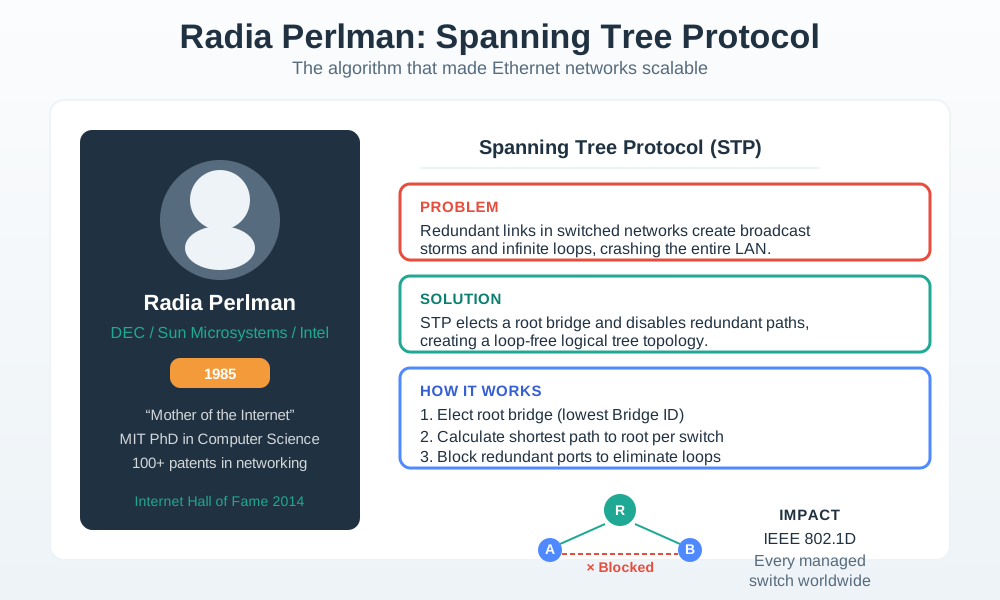
Figure 4.5: Radia Perlman, inventor of the Spanning Tree Protocol that prevents network loops.
4.12.1 The Problem She Solved
When you connect Ethernet switches together, you create a network graph. But graphs can have loops – paths that circle back on themselves. In a loop, a broadcast packet circulates forever, consuming all bandwidth. Within seconds, a single packet can multiply into a broadcast storm that crashes the entire network.
In the early 1980s, network engineers had to carefully plan network topologies to avoid loops. Redundancy was risky – if you added a backup link for resilience, you might accidentally create a loop that crashed everything.
4.12.2 Her Breakthrough: Spanning Tree Protocol (STP)
In 1985, while working at Digital Equipment Corporation (DEC), Radia Perlman invented the Spanning Tree Protocol. STP automatically detects and blocks loops in Ethernet networks:
How STP Works:
Switches exchange messages to discover the network topology
They elect a “root bridge” (the switch with the lowest ID)
Each switch calculates its shortest path to the root
Any link that would create a loop is automatically blocked (disabled)
If a link fails, STP recalculates and unblocks backup paths
This happens automatically. Network engineers can connect switches with redundant links for resilience, and STP ensures the active topology is always loop-free.
4.12.3 Why She Dislikes the “Mother of the Internet” Title
Media often calls Perlman the “Mother of the Internet” to parallel Vint Cerf’s “Father of the Internet” title. She dislikes this for two reasons:
Many people built the Internet – singling out individuals ignores collaborative effort
Gender-specific titles create false parallels – her contributions stand on their own merit, not as a female counterpart to a male pioneer
Perlman prefers to be known for her work: STP, TRILL (modern Ethernet routing), and network security research.
4.12.4 The Impact
Every Ethernet switch in every building runs Perlman’s algorithm. STP is standardized as IEEE 802.1D and has evolved into Rapid Spanning Tree (RSTP, 802.1w) and Multiple Spanning Tree (MSTP, 802.1s), but the core algorithm is Perlman’s 1985 invention.
What Perlman Made Possible
Every IoT gateway, industrial Ethernet switch, and building network uses Perlman’s Spanning Tree Protocol:
Smart Buildings: When you deploy PoE (Power over Ethernet) switches to power IP cameras and IoT sensors, STP allows redundant uplinks for resilience
Industrial IoT: Factory networks use STP to ensure a single cable cut doesn’t isolate machines
Home Networks: Managed switches in home labs use STP to prevent accidental loops when users connect cables
For IoT specifically: STP enabled the plug-and-play Ethernet experience. You can connect switches in any topology, add redundant links for failover, and STP ensures it just works. Without STP, every IoT deployment would require careful network topology planning to avoid loops – slowing deployment and increasing costs.
4.12.5 Perlman Today
Perlman holds over 100 patents and has taught at MIT and the University of Washington. Her textbook Interconnections is considered the definitive guide to network protocol design. She continues to work on network security and routing innovations.
4.13 Bob Metcalfe (1946-): Ethernet Inventor
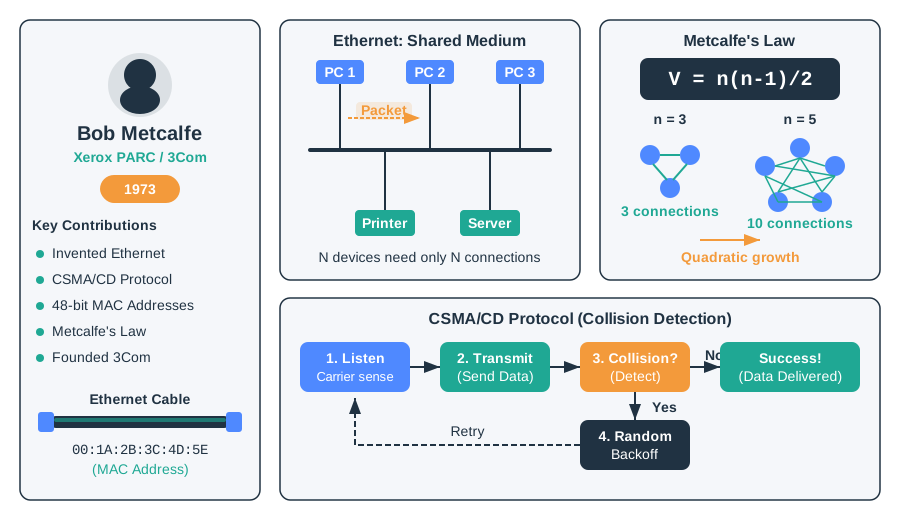
Figure 4.6: Bob Metcalfe, inventor of Ethernet and formulator of Metcalfe’s Law.
4.13.1 The Problem He Solved
In the early 1970s, Xerox PARC (Palo Alto Research Center) had dozens of computers and the world’s first laser printer. Researchers wanted to share the printer, but there was no good way to network the machines. Point-to-point cables didn’t scale – connecting \(N\) devices requires \(\frac{N(N-1)}{2}\) cables. For 20 devices, that’s 190 cables!
4.13.2 His Breakthrough: Ethernet
In 1973, Bob Metcalfe invented Ethernet – a way for multiple computers to share a single coaxial cable using a cleverly designed media access control protocol:
Key Innovations:
1. Shared Medium All devices connect to the same cable (like houses on a street sharing a postal system). This requires only \(N\) connections instead of \(\frac{N(N-1)}{2}\).
2. CSMA/CD (Carrier Sense Multiple Access with Collision Detection)
Carrier Sense: Before transmitting, listen to the cable. If someone else is talking, wait.
Collision Detection: If two devices start transmitting simultaneously (collision), both detect it and stop.
Exponential Backoff: After a collision, wait a random time before retrying. Each collision doubles the wait range.
3. 48-Bit MAC Addresses Every Ethernet device gets a globally unique address (like 00:1A:2B:3C:4D:5E). This addressing scheme is still used today.
4.13.3 Metcalfe’s Law: The Network Effect
Perlman made redundant Ethernet survivable by blocking loops. Metcalfe’s story explains why Ethernet then became valuable at scale: each compatible node made the shared ecosystem more useful.
Metcalfe formulated a key principle of network value:
\[
V \propto n^2
\]
Translation: A network’s value is proportional to the square of the number of users. Add one user, and you don’t just add one connection – you add connections to all existing users.
Example: A phone network with 10 people supports 45 possible calls (\(\frac{10 \times 9}{2}\)). Add one person (now 11), and you support 55 calls – a 22% increase in value from adding just one user (10% increase in users).
This explains why social networks grow explosively once they reach critical mass. It also explains why IoT platforms that achieve interoperability (allowing devices from many vendors to connect) are more valuable than proprietary ecosystems.
Putting Numbers to It
Let’s quantify Metcalfe’s Law (\(V \propto n^2\)) with concrete IoT ecosystem examples.
1995: Ethernet has 50× market share → self-reinforcing dominance
2000: Token Ring obsolete
The protocol with more nodes attracted more vendors, which attracted more users, which attracted more vendors - exponential feedback loop driven by Metcalfe’s Law.
Key IoT insight: Open protocols (MQTT, CoAP, Thread) grow ecosystems faster than proprietary ones (AWS IoT-only, Apple HomeKit-only) because every new vendor benefits all existing users, accelerating the \(n^2\) value curve.
Metcalfe founded 3Com Corporation in 1979 to commercialize Ethernet. By the 1990s, Ethernet had become the dominant LAN technology, beating out Token Ring, ARCNET, and others. Today, Ethernet variants include:
10BASE-T (10 Mbps over twisted pair)
100BASE-TX (Fast Ethernet, 100 Mbps)
1000BASE-T (Gigabit Ethernet, 1 Gbps)
10GBASE-T (10 Gigabit Ethernet, 10 Gbps)
Metcalfe won the Turing Award (computing’s Nobel Prize) in 2022 for inventing Ethernet.
What Metcalfe Made Possible
Ethernet connects nearly every wired IoT gateway and server:
Industrial IoT: Factory machines use Industrial Ethernet variants (EtherCAT, PROFINET, Ethernet/IP) – all descendants of Metcalfe’s invention
Building Automation: BACnet/IP and Modbus TCP run over Ethernet, connecting HVAC systems, lighting, and access control
IoT Gateways: Raspberry Pi, ESP32 Ethernet modules, and industrial gateways use Ethernet to connect to the cloud
Metcalfe’s Law in IoT: When Matter becomes widely adopted, enabling devices from Apple, Google, Amazon, Samsung, and 200+ vendors to interoperate, the ecosystem value grows as \(n^2\). A user with 5 Matter devices from 1 vendor has 10 possible interactions (\(\frac{5 \times 4}{2}\)). With 10 devices from 5 vendors, they have 45 interactions – and the ability to mix devices from different vendors creates combinatorial value that proprietary systems can’t match.
Checkpoint: Local Networks and Scale
You now know:
Perlman’s Spanning Tree Protocol lets Ethernet keep redundancy without broadcast loops.
Metcalfe’s Ethernet made local sharing practical, then Metcalfe’s Law explained why larger interoperable networks become more valuable.
This is the same economic reason Matter and other open IoT ecosystems can outgrow isolated proprietary islands.
4.14 Jon Postel (1943-1998): “God of the Internet”
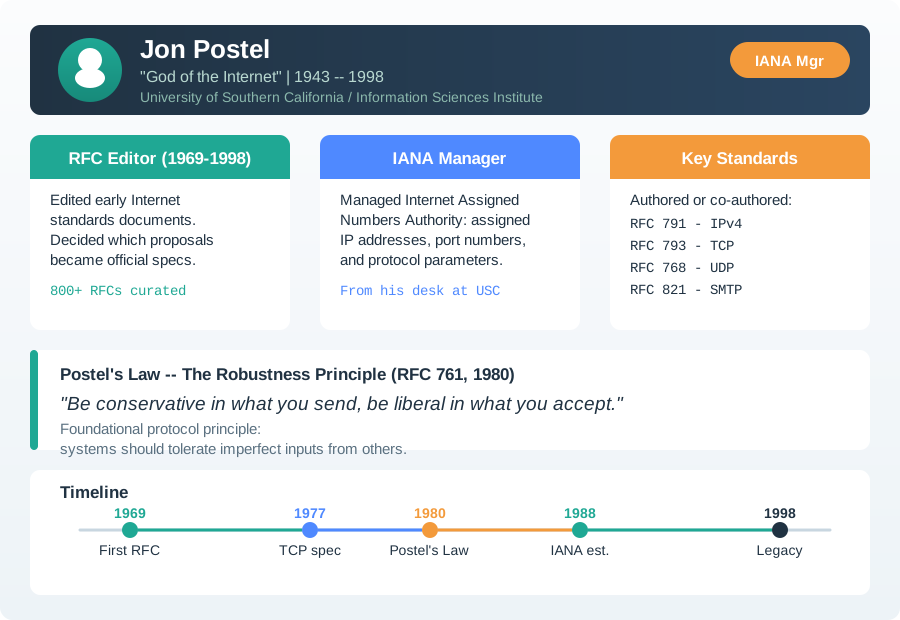
Figure 4.7: Jon Postel, editor of most early RFCs and manager of IANA from his desk at USC.
4.14.1 The Problem He Solved
The Internet needed someone to: - Document standards – write down how protocols work so everyone implements them the same way - Manage addresses – assign IP addresses and domain names so no two organizations use the same numbers - Resolve disputes – mediate when engineers disagreed on protocol design
No company or government controlled the Internet in the 1970s-80s. It was a research project funded by ARPA, built by academics and engineers who volunteered their time. Someone had to coordinate all this chaos.
4.14.2 His Role: Editor of RFCs and IANA Manager
RFC Editor (1969-1998) Jon Postel edited most of the early RFCs (Requests for Comments) – the documents that define Internet standards. He decided which proposals became official specifications and which were rejected. Over 30 years, he edited or authored hundreds of RFCs, including foundational specs like:
RFC 791: Internet Protocol (IP)
RFC 793: Transmission Control Protocol (TCP)
RFC 821: Simple Mail Transfer Protocol (SMTP)
RFC 959: File Transfer Protocol (FTP)
IANA Manager (1972-1998) Postel managed the Internet Assigned Numbers Authority (IANA) – the organization that assigns: - IP address blocks to ISPs and organizations - Protocol numbers (TCP = 6, UDP = 17, ICMP = 1) - Port numbers (HTTP = 80, HTTPS = 443, MQTT = 1883)
He did this from his desk at USC (University of Southern California) with minimal staff. The Internet community trusted him to make fair decisions, and he did.
4.14.3 Postel’s Law: The Robustness Principle
Postel formulated the most important principle in protocol design:
“Be conservative in what you send, liberal in what you accept.”
Translation:
Conservative sending: When you implement a protocol, strictly follow the spec. Don’t send malformed packets or ambiguous messages.
Liberal receiving: When you receive data, tolerate small deviations from the spec. If the message is understandable despite minor errors, process it anyway.
Why this matters: Networks are messy. Different vendors implement protocols slightly differently. If every device rejected messages with minor formatting errors, the Internet would fragment into incompatible islands. Postel’s Law keeps the Internet unified despite vendor diversity.
4.14.4 The 1998 Incident: Postel’s Authority
In 1998, Postel conducted a controversial test. He asked 8 of the 13 root DNS servers to temporarily redirect to a server he controlled – without asking the U.S. government for permission.
The test worked. For a few hours, Postel controlled the majority of the Internet’s root DNS infrastructure. He proved that IANA’s authority was personal – based on trust and technical competence, not legal ownership.
The U.S. government was not amused. Within months, oversight of DNS was transferred to ICANN (Internet Corporation for Assigned Names and Numbers), a new nonprofit. Postel’s era of informal, trust-based governance ended.
4.14.5 The Impact
Postel died suddenly in 1998 at age 55. The Internet Engineering Task Force (IETF) published RFC 2468 in his honor, titled “I Remember IANA”:
“Jon Postel was the Internet.”
Every protocol you use – IP, TCP, UDP, ICMP, DNS – was documented in RFCs that Postel edited. Every port number (:443, :1883, :8883) was assigned by Postel’s IANA. His influence is invisible but everywhere.
What Postel Made Possible
Postel’s robustness principle is still the guiding philosophy of protocol design – and explains why IoT devices can interoperate despite vendor differences:
MQTT Implementations: Different MQTT brokers (Mosquitto, HiveMQ, AWS IoT Core) tolerate minor client implementation differences. A client that sends a slightly malformed CONNECT packet might still connect if the broker can infer the intent.
HTTP Parsers: Web servers accept requests with minor formatting errors (extra spaces, missing headers) because Postel’s Law encourages tolerance.
JSON Parsers: IoT platforms accept JSON with trailing commas or unquoted keys, even though strict JSON forbids this, because being “liberal in what you accept” improves interoperability.
For IoT specifically: When you connect an ESP32 running Arduino MQTT client to AWS IoT Core, it works despite the client being a hobbyist implementation and AWS being an enterprise platform. That interoperability comes from both sides following Postel’s Law – AWS tolerates minor client deviations, and the Arduino library tries to be standards-compliant.
4.15 Andy Stanford-Clark: MQTT Co-creator
Postel’s standards work explains how the Internet stays coordinated. Stanford-Clark’s MQTT work shows what happens when those open-network foundations meet a severe IoT constraint: tiny messages over expensive links.
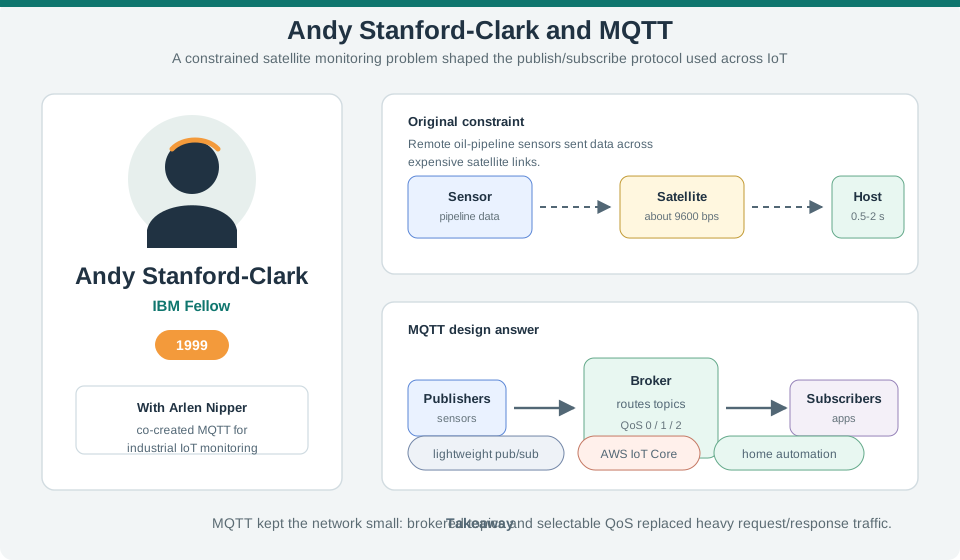
Figure 4.8: Andy Stanford-Clark, IBM Fellow and MQTT co-creator, shown with the 1999 oil-pipeline satellite constraints that led to lightweight publish/subscribe messaging, broker routing, QoS levels, AWS IoT Core, and home automation.
4.15.1 The Problem He Solved
In 1999, Andy Stanford-Clark (IBM) and Arlen Nipper (Arcom) were building a system to monitor oil pipelines across remote deserts. They needed to transmit sensor data via expensive satellite links with:
Very low bandwidth (9600 bps or less)
High latency (500 ms to 2 seconds)
Unreliable connections (frequent disconnections)
HTTP was too heavy – each HTTP request had 200+ bytes of headers. On a 9600 bps link, just the headers consumed about 167 ms. For thousands of sensors sending frequent updates, HTTP was unusable.
4.15.2 His Breakthrough: MQTT (Message Queuing Telemetry Transport)
Stanford-Clark and Nipper designed MQTT specifically for constrained networks:
Key Design Choices:
1. Minimal Protocol Overhead MQTT headers are just 2 bytes (vs. 200+ for HTTP). The fixed header contains: - Message type (4 bits) - QoS level (2 bits) - Remaining length (variable-length encoding)
2. Publish/Subscribe Pattern Instead of request/response (like HTTP), MQTT uses pub/sub: - Sensors publish to topics: sensors/building-a/temperature - Applications subscribe to topics they care about - A broker routes messages from publishers to subscribers
This decouples senders from receivers – sensors don’t need to know who’s listening.
3. Quality of Service (QoS) Levels MQTT offers three QoS levels: - QoS 0 (At most once): Fire and forget, no acknowledgment - QoS 1 (At least once): Acknowledged, may duplicate - QoS 2 (Exactly once): Guaranteed delivery, no duplicates
Sensors can choose the right tradeoff between reliability and overhead.
4. Last Will and Testament If a client disconnects unexpectedly (e.g., network failure), the broker automatically publishes a “last will” message the client specified during connection. This enables other devices to detect failures.
4.15.3 The Tweeting House
Stanford-Clark famously connected his home to the Internet in the early 2000s (before “smart home” was a thing):
His house tweeted when the washing machine finished
His doorbell sent him SMS messages
Temperature sensors posted to a web dashboard
This DIY smart home demonstrated MQTT’s versatility – it wasn’t just for industrial oil pipelines. Any system with sensors and actuators could use MQTT.
4.15.4 The Impact
MQTT became the de facto standard for IoT messaging:
AWS IoT Core: Uses MQTT as the primary protocol
Azure IoT Hub: Supports MQTT alongside AMQP
Google Cloud IoT: Supported MQTT (service deprecated 2023)
Home Assistant: MQTT is the standard integration protocol
Industrial IoT: MQTT is used in manufacturing, automotive, and logistics
In 2013, MQTT became an OASIS standard (not just an IBM project). In 2019, it became an ISO standard (ISO/IEC 20922).
What Stanford-Clark Made Possible
MQTT is the #1 IoT messaging protocol – used by AWS IoT, Azure IoT Hub, and millions of devices:
Smart Homes: Zigbee2MQTT, Tasmota, ESPHome all use MQTT to integrate devices with Home Assistant
Industrial IoT: Factory sensors publish data to MQTT brokers for real-time monitoring dashboards
Connected Vehicles: Tesla uses MQTT for vehicle-to-cloud communication
Agriculture: Soil moisture sensors in vineyards publish to MQTT topics for irrigation control
Stanford-Clark’s design choices directly address IoT constraints: - 2-byte headers work on low-bandwidth LoRaWAN networks (50-250 kbps) - QoS levels let battery-powered sensors use QoS 0 to save power, while critical alerts use QoS 1 - Last Will enables automatic detection of sensor failures (if a temperature sensor stops publishing, its Last Will alerts operators)
For ESP32 developers: When you use PubSubClient library to publish sensor data to sensors/room/temperature, you’re using the protocol Stanford-Clark designed for oil pipelines 25 years ago. It works just as well for your $5 hobby project as it did for million-dollar industrial deployments.
MQTT came from a 1999 oil-pipeline problem with about 9600 bps bandwidth and high latency.
Its 2-byte header directly answered HTTP’s 200+ byte overhead on constrained links.
6LoWPAN later solved a similar fit problem by compressing IPv6’s 40-byte header for 127-byte 802.15.4 frames.
4.16 Kevin Ashton (1968-): Coined “Internet of Things”
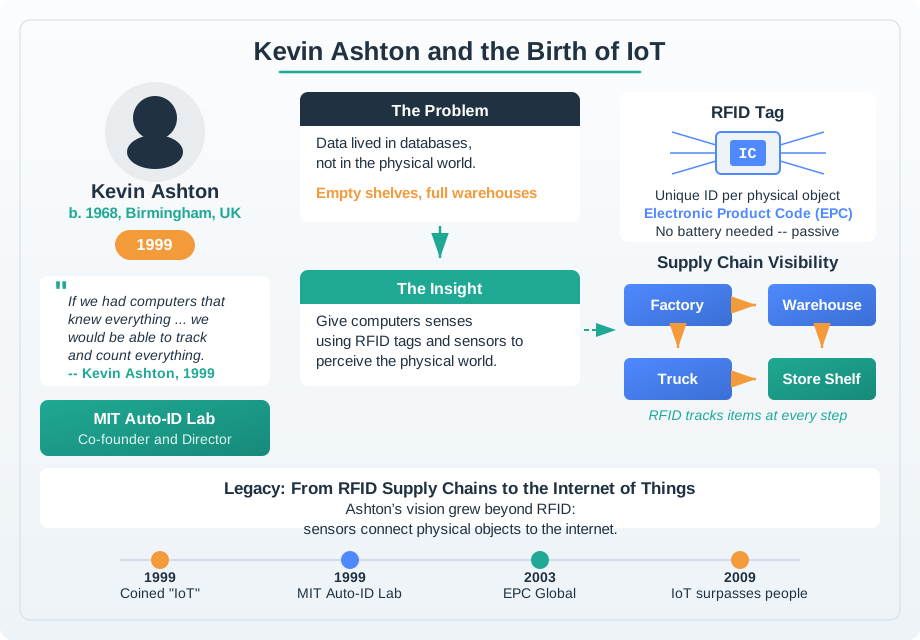
Figure 4.9: Kevin Ashton, who coined the term Internet of Things in a 1999 P&G presentation.
4.16.1 The Problem He Solved
In the 1990s, Kevin Ashton worked at Procter & Gamble in supply chain management. He noticed a frustrating pattern: stockouts – shelves ran out of popular products (like brown lipstick) while warehouses had plenty of inventory. Why?
The problem: Computers knew what inventory existed in databases, but they had no idea what was on store shelves. Humans had to manually count products and update systems. This was slow, error-prone, and expensive.
4.16.2 His Insight: Computers Need Their Own Senses
Ashton’s breakthrough insight in 1999:
“Computers need to sense the physical world directly, without depending on humans to input data. If things could identify themselves and report their location automatically, supply chains would fix themselves.”
He was experimenting with RFID (Radio Frequency Identification) tags – tiny chips that broadcast unique IDs when queried by a reader. Imagine if every lipstick had an RFID tag. Shelves could detect when stock was low and automatically reorder.
4.16.3 Coining “Internet of Things”
In 1999, Ashton gave a presentation to P&G executives about using RFID to track inventory. He needed a catchy phrase to capture the concept. He chose:
“Internet of Things”
The phrase stuck. It perfectly captured the vision: extend the Internet beyond computers to include everyday objects – thermostats, light bulbs, cars, containers, even lipstick.
Applications in every industry: healthcare, agriculture, manufacturing, transportation, energy, retail
Ashton didn’t invent the technology – RFID, sensors, and networking existed before 1999. But he articulated the vision and gave it a name that the industry rallied around.
What Ashton Made Possible
The entire IoT industry traces its identity to Ashton’s vision:
Smart Homes: When you buy a “smart thermostat” or “smart light,” you’re buying an “Internet of Things” device – a term Ashton coined
Industrial IoT: Manufacturing companies deploy “IIoT solutions” (Industrial Internet of Things) to monitor machines
Wearables: Fitness trackers and smartwatches are “IoT wearables”
Ashton’s core insight – “computers need their own senses” – drives IoT design philosophy: - Sensors as computer senses: Temperature, humidity, motion, light, sound, GPS – these are how computers perceive the physical world - Automated data collection: IoT systems reduce human labor by sensing the environment directly (no manual data entry) - Real-time awareness: With sensors, computers can react to physical changes in seconds instead of hours/days
For IoT developers: When you explain your project as an “IoT system,” you’re using Ashton’s framing. His insight that “computers need senses” is why IoT systems prioritize sensors and automation over human-in-the-loop processes.
4.17 Geoff Mulligan: 6LoWPAN Pioneer
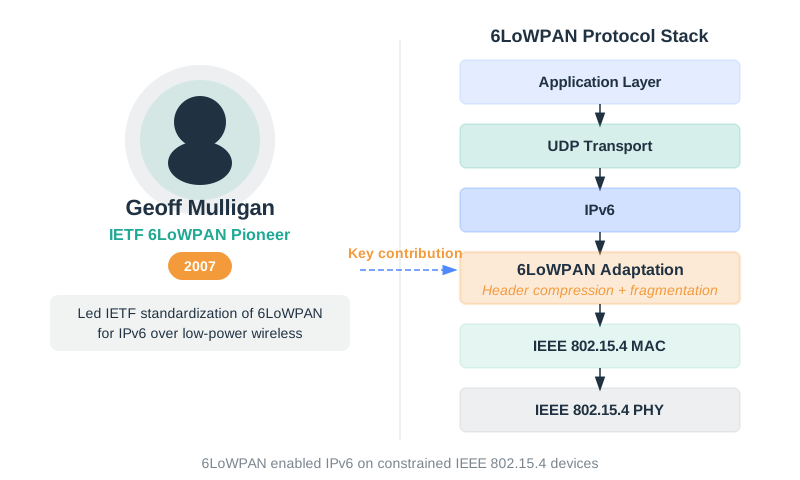
Figure 4.10: Geoff Mulligan, who led IETF standardization of 6LoWPAN for IPv6 over low-power wireless.
4.17.1 The Problem He Solved
By the 2000s, Vint Cerf’s TCP/IP was the universal Internet protocol – but it was designed for computers with megabytes of RAM and wired networks with low error rates. IoT devices had:
Kilobytes of RAM (not megabytes)
Low-power radios (IEEE 802.15.4: 127-byte max packet size)
High packet loss (10-30% in industrial environments)
IPv6 headers alone are 40 bytes – plus 8 bytes for UDP. On a 127-byte 802.15.4 packet, headers consumed 38% of capacity before any application data! This was unsustainable.
4.17.2 His Breakthrough: 6LoWPAN (IPv6 over Low-Power Wireless Personal Area Networks)
Geoff Mulligan led the IETF working group that created 6LoWPAN (RFC 4944, 2007), which makes IPv6 work on tiny devices:
Key Innovations:
1. Header Compression 6LoWPAN compresses IPv6’s 40-byte header down to as little as 2 bytes by: - Omitting predictable fields (version, flow label) - Using context to infer addresses (e.g., “the gateway” instead of full address) - Encoding common patterns efficiently
2. Fragmentation and Reassembly IPv6 packets can be 1280+ bytes, but 802.15.4 only allows 127 bytes. 6LoWPAN fragments large packets at the adaptation layer and reassembles them at the destination.
3. Mesh Routing Support 6LoWPAN enables mesh networks where devices route packets for each other, extending network range without infrastructure.
4.17.3 Why IPv6 for IoT?
Mulligan advocated for IPv6 (not IPv4) because:
Address space: IPv6 provides \(2^{128}\) addresses – enough for every grain of sand on Earth to have an IP address. IPv4’s \(2^{32}\) addresses (4.3 billion) aren’t enough for tens of billions of IoT devices.
End-to-end addressability: Every device gets a globally unique address, enabling direct communication without NAT (Network Address Translation) hacks.
Simplified routing: IPv6’s larger address space allows hierarchical addressing, making routing more efficient.
4.17.4 The Impact
6LoWPAN became the foundation for:
Thread: The mesh networking protocol for smart homes (used by Google Nest, Apple HomePod, Matter devices) is built on 6LoWPAN
Zigbee IP: Zigbee’s IP-based variant uses 6LoWPAN
Industrial IoT: Low-power sensor networks in factories use 6LoWPAN for IPv6 connectivity
What Mulligan Made Possible
Every Thread/Matter smart home device uses 6LoWPAN:
Matter Devices: When you buy a Matter-certified smart light or lock, it uses Thread, which runs 6LoWPAN over IEEE 802.15.4
Border Routers: Apple HomePod, Google Nest Hub, and other “border routers” translate 6LoWPAN to standard IPv6 for your home network
Battery Life: 6LoWPAN’s header compression reduces packet size, saving energy on battery-powered sensors
Mulligan’s insight – “IoT needs IPv6, but IPv6 needs compression to fit in IoT packets” – solved the tension between universal Internet connectivity (Cerf’s vision) and resource-constrained devices (IoT reality).
For developers: When you configure a Thread device with fd00::/64 addresses, you’re using IPv6 addresses that 6LoWPAN compresses from 40 bytes down to 2-6 bytes on the air. That compression is Mulligan’s contribution.
4.18 Concept Relationships: How Pioneers Built on Each Other
By this point, the chapter has moved from packet survival to Internet architecture, from human-facing protocols to IoT-specific constraints. The relationship table turns those profiles back into a design map.
The pioneers didn’t work in isolation – each contribution enabled the next:
Cerf & Kahn → TCP/IP to connect any networks (1974)
Metcalfe → Ethernet for local networks (1973)
Berners-Lee → HTTP over TCP/IP (1989)
Stanford-Clark → MQTT as lightweight HTTP alternative (1999)
Mulligan → 6LoWPAN to bring IPv6 to tiny devices (2007)
Each generation solved problems the previous generation left open.
4.19 Common Pitfalls
Do not equate the Web with the Internet: Berners-Lee’s Web runs on top of TCP/IP. The Internet existed before HTTP, HTML, browsers, and URLs.
Do not credit one person with the whole system: Baran, Cerf, Kahn, Metcalfe, Postel, Perlman, Berners-Lee, Tomlinson, Stanford-Clark, Ashton, Mulligan, and many others solved different parts of the stack.
Do not ignore the original constraint: MQTT’s small header, 6LoWPAN’s compression, Ethernet’s shared-medium logic, and Postel’s tolerance rules all make more sense when you remember the deployment problem they were designed to solve.
Do not treat openness as incidental: RFCs, royalty-free Web standards, and interoperable implementations are part of the technical architecture, not just project culture.
4.20 Knowledge Check
Quick Check: Test your understanding of TCP/IP’s end-to-end principle and its importance for IoT:
Quick Check: Test your understanding of MQTT’s design and how Stanford-Clark’s constraints shaped modern IoT protocols:
Quick Check: Match each protocol pioneer with their key contribution:
Quick Check: Place these networking innovations in the correct chronological order, from earliest to most recent:
4.21 Label the Diagram
4.22 Code Challenge
4.23 Deep Dive: How Internet Standards Become Interoperable
The pioneers who built the Internet did more than write code. They created a way to agree on open standards so machines from different makers could interoperate. Most core Internet protocols are published by the IETF (Internet Engineering Task Force) as RFCs (Requests for Comments), documents anyone can read and implement for free.
The IETF’s guiding motto, credited to David Clark, is “rough consensus and running code.” Standards are not decreed from above. They emerge when the community broadly agrees and working implementations prove the design. That culture is why the Internet, and IoT on top of it, is built from interoperable protocols rather than one vendor’s proprietary system.
Open RFCs plus rough consensus and running code produce protocols any vendor can implement. That is the governance layer behind multi-vendor IoT.
4.23.1 From Internet-Draft to RFC
A protocol travels a defined path before it becomes a standard. An author publishes an Internet-Draft; a working group discusses and revises it; if it reaches rough consensus it is published as an RFC with a permanent number. Foundational protocols carry famous numbers: IP is RFC 791, TCP is RFC 793, SMTP is RFC 821, and FTP is RFC 959.
RFCs also standardize how requirements are written. RFC 2119 defines the capitalized keywords MUST, SHOULD, and MAY, so a spec can state precisely what an implementation is required to do versus what is recommended or optional. That precision removes ambiguity that would otherwise break interoperability.
CoAP, the constrained-device web protocol, followed this route as RFC 7252 after years as Internet-Drafts in an IETF working group. Because it is an open RFC using RFC 2119 language, a sensor vendor and a cloud vendor can implement CoAP independently and still expect their products to interoperate. A proprietary protocol would offer no such guarantee across vendors.
4.23.2 Why Running Code Matters
The “running code” half of the motto protects against paper standards that look fine but cannot be built or do not interoperate. The IETF has historically wanted to see multiple independent implementations interoperate before a specification advances. A spec is only real when two teams who never coordinated can build it from the text alone and have it work.
This matters intensely for IoT, where devices from dozens of makers must coexist for a decade. A subtle ambiguity in a spec, such as an unclear default or under-specified error case, becomes thousands of incompatible devices in the field. Interoperability events, often called plugfests, and reference implementations flush out those ambiguities before the standard is final.
For example, two vendors might implement a new IoT protocol from its draft and discover they disagree on how to handle a missing option field. One implementation drops the message; the other assumes a default. Caught at a plugfest, the spec can be clarified before publication. Missed, the same ambiguity ships as a fleet-wide interoperability bug. Public RFCs, precise requirement language, and demonstrated running code are the machinery that lets a multi-vendor IoT ecosystem actually interoperate.
4.24 Summary
4.24.1 Key Takeaways
In this chapter, you learned:
The Internet has no single inventor – it’s the result of collaborative work by hundreds of engineers over 60+ years, with each pioneer building on previous contributions
Paul Baran’s packet switching (1964) introduced distributed routing and redundant paths, concepts now used in Zigbee and Thread mesh networks
Vint Cerf and Bob Kahn’s TCP/IP (1974) created the universal Internet protocol with the open architecture principle (any network can connect) and end-to-end reliability (intelligence at endpoints, not network core)
Tim Berners-Lee’s World Wide Web (1989-91) introduced HTTP, HTML, and URLs – freely given to the world, enabling web-based IoT dashboards and REST APIs
Ray Tomlinson’s email (1971) established the user@host addressing pattern that influenced hierarchical naming in IoT systems
Radia Perlman’s Spanning Tree Protocol (1985) prevents network loops and enables plug-and-play Ethernet – used in every building network and industrial IoT deployment
Bob Metcalfe’s Ethernet (1973) and Metcalfe’s Law (\(V \propto n^2\)) explain why interoperable IoT ecosystems (like Matter) are more valuable than proprietary ones
Jon Postel’s robustness principle (“be conservative in what you send, liberal in what you accept”) guides protocol design and explains why diverse IoT vendors can interoperate
Andy Stanford-Clark’s MQTT (1999) became the #1 IoT protocol by optimizing for constrained networks (2-byte headers, QoS levels, pub/sub pattern)
Kevin Ashton coined “Internet of Things” (1999) and articulated the vision that computers need their own senses (sensors) to understand the physical world
Geoff Mulligan’s 6LoWPAN (2007) compressed IPv6 headers to work on tiny devices, enabling Thread and Matter smart home ecosystems
4.24.2 The Human Element in Protocols
Behind every protocol is a person solving a real problem:
Apply web-style resource ideas to constrained IoT services
Recommended Next Step
If you are new to IoT and networking, proceed to Networking Basics Introduction to build foundational skills that apply to all the protocols discussed in this chapter.
If you are interested in how technologies succeed or fail, proceed to IoT History and Paradigm Shifts to examine paradigm shifts and the Innovator’s Dilemma.
 Checkpoint: Packet Switching