Physical Evidence
Placement, calibration, warm-up, drift, saturation, environmental exposure, and reference checks show whether the node can observe the condition it claims to observe.
Progress saves as you read. Mark sections complete as you go; your progress appears in the sidebar.
This section: Start With the Decision — A node can send valid-looking values that clash with its neighbours.
A node can send valid-looking values that clash with its neighbours. Review must test presence, plausibility, and consistency apart.
This section: Route Overview — This is part 2 of 2.
This is part 2 of 2. Review Node Behaviour: Evidence and Taxonomy for the preceding evidence.
This section: Learning Objectives
This section: Chapter Roadmap
This section: Plausible but Contradictory — Scenario: a storage area has several related condition readings.
Scenario: a storage area has several related condition readings. One node reports a value that is possible by itself, but it repeatedly contradicts nearby observations and the expected process state.
Observation
The node still sends complete messages. The value is not impossible, but it does not match related evidence.
Evidence check
Message presence passes. Plausibility passes. Consistency fails repeatedly.
Classification
Misleading for the affected decision.
Action
Reject that reading for the current decision, preserve it as evidence with a suspect validity state, and request a reference check or replacement review.
Residual concern
The failed consistency check does not prove the physical cause. The classification should stay evidence-bound and avoid claiming a root cause until a separate inspection supports it.
This section: Worked Review: Mixed Missing Evidence — Scenario: a gateway notices that one node’s current reading is missing.
Scenario: a gateway notices that one node’s current reading is missing. The node’s previous reading was accepted, but the expected message did not arrive during the current review window.
Concrete example: a storage-room humidity node reported normally during the last review window, but the dashboard refresh has no new message while nearby temperature and door-state nodes are still reporting.
First pass
The node is not immediately failed, selfish, or malicious. The strongest first label is silent because the expected message is absent.
Context check
The reviewer checks schedule, topology role, related nodes, and whether the node recently changed duty-cycle behavior. If nearby nodes are also missing, the label may stay silent or move into limited-capability recovery review. If only shared relay traffic is missing while the node’s own readings continue, selfish behavior may become a hypothesis.
Action
The current decision should not reuse the stale value as current. The review record marks the source unavailable for that decision, preserves the last accepted observation, and records what new message, related-node observation, or recovered data would reopen the label.
This section: Review Record — Before assigning a behavior label, inspect Figure 6.1 to see what evidence makes the decision reproducible and what must trigger a later review.
Before assigning a behavior label, inspect Figure 6.1 to see what evidence makes the decision reproducible and what must trigger a later review.
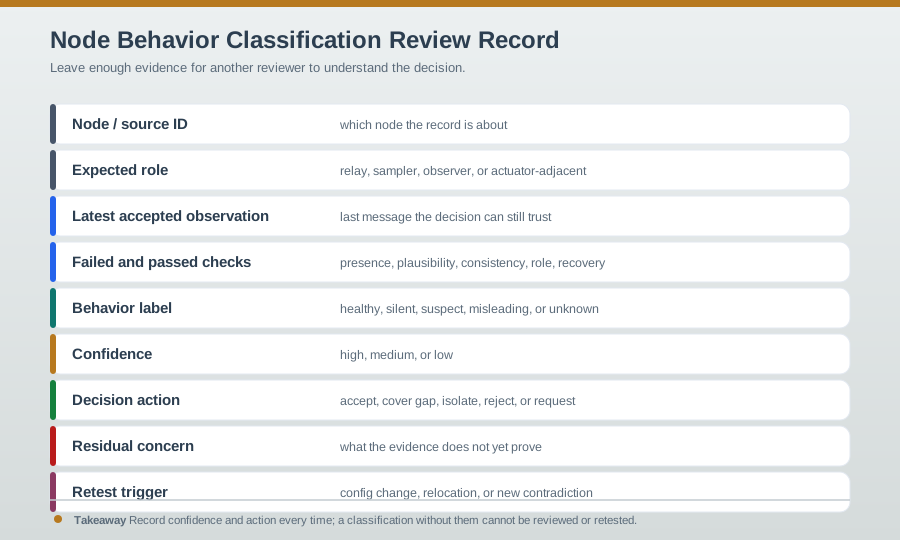
The route through the map at Figure 6.1 is Node / source ID to Expected role to Latest accepted observation. Respectively, they establishes the starting condition, adds a distinct review condition, and identifies the field observation. The route matters because node behavior review record listing nine fields: source identifier, expected role, latest accepted observation, failed and passed checks, behavior label, confidence, decision action, residual concern, and retest trigger. It leaves the review record claim with an explicit test boundary.
Record:
The retest trigger matters because node behavior can change. Repeat the classification after a configuration change, relocation, reference check, repeated missing state, or new contradiction.
This section: Common Mistakes — Treating silence and misleading data as the same failure.
Treating silence and misleading data as the same failure. Assuming a root cause from one symptom. Accepting plausible values without consistency evidence. Removing a node from every decision when only one decision path is affected. Hiding missing readings by reusing old values without a stale state. Classifying a node without recording confidence and action. Forgetting to retest after configuration or placement changes.
This section: Knowledge Check
This section: Matching Quiz
This section: Ordering Quiz — The round-aligned view in Figure 6.2 is a useful safeguard against labelling a healthy cluster head as an energy-anomalous node.
The round-aligned view in Figure 6.2 is a useful safeguard against labelling a healthy cluster head as an energy-anomalous node.

In Figure 6.2, Node A declines sharply during A aggregates + uplinks, while Node B declines after CH=B · new clusters. A classifier must therefore join energy evidence to round and role metadata: the same slope can be expected cluster-head behavior in one window and suspicious depletion in another.
This section: Sensor Node Characteristics
Firmware is the code that runs on a device. Picture a soil sensor placed at the edge of a field. Calling it a sensor node says very little. The useful first choice is its field role: what it senses, what it stores, when it speaks, what it may relay, and how long it must work alone.
Write a one-line role claim. Name the sensor, sample time, local work, radio path, store, power source, case, and service visit. Then test one full cycle from wake to accepted record. Try a wet probe, weak cell, full store, lost link, reset, and stale clock. Record what data stays sound and what state the next system can see.
A small node can save cost and power, but it may hide faults or lose useful proof. Extra logs can aid repair, but they use store, energy, and air time. A board list does not prove the node will stay fit in the field. For a node-behavior claim, write the role and evidence record; check sensing, timing, storage, radio, power, case, and reopen triggers before accepting the result.
Start with a single sensor node as a field worker with a job, limits, and proof obligations. It must sense, process, store, communicate, sleep, wake, diagnose itself, and survive service conditions well enough for the monitoring claim it supports.

A WSN sensor node is the field system that turns a physical condition into usable evidence. It includes the sensor element, processing, radio, storage, power source, enclosure, firmware, identity, diagnostics, calibration path, and service plan. A part list is only a starting point.
The same rule applies to very small motes such as Michigan Micro Mote-style boards: miniaturization is interesting only after the review ties sensing, radio, storage, power, firmware, and service behavior to a field role.
The next sensor node as field role claim rests on a relationship, not an isolated value. Inspect Role Claim and Sensing Path in Figure 6.3 before accepting it.
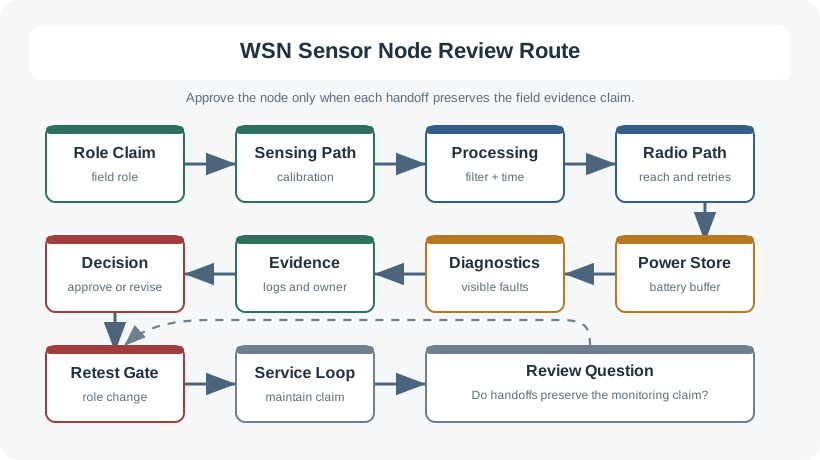
First isolate Role Claim on the figure at Figure 6.3; it defines what the design promises. Next pair Sensing Path (adds a distinct review condition) with calibration (adds a distinct review condition). Their pairing demonstrates that wSN sensor node review route connecting role claim, sensing path, processing, radio path, power storage, diagnostics, evidence, decision, retest trigger, and service loop. This is what the chapter needs before continuing sensor node as field role.
If you only need the intuition, this layer is enough: approve a sensor node for one written role claim. Name what it senses, how it reports, what power and service limits apply, what failure becomes visible, and what change forces a retest.
Placement, calibration, warm-up, drift, saturation, environmental exposure, and reference checks show whether the node can observe the condition it claims to observe.
Radio reach, retries, receive windows, routing burden, queue behavior, time labels, and gateway handoff show whether readings can leave the node with their meaning intact.
Battery threshold, enclosure access, firmware version, update behavior, diagnostics, identity, and maintenance ownership show whether the node can remain trustworthy after installation.
A useful record separates node subsystems from the claim they support. The goal is not to document every component detail. The goal is to preserve enough evidence that another reviewer can see why the node is acceptable, what it cannot prove, and who owns the next action when evidence weakens.
Role changes deserve explicit review. A relay node receives and forwards other nodes’ traffic. A cluster head schedules or aggregates. A gateway-adjacent node may carry concentrated traffic and command exposure. A mobile node changes contact, location meaning, and custody. None of those burdens is proven by a leaf-node sensing test.
Most weak sensor-node decisions fail at a boundary. The value may be measured correctly but timestamped badly. The packet may be sent but not acknowledged. The buffer may preserve data but replay it out of order. The firmware may recover but lose calibration state. The enclosure may protect the electronics but detune the antenna. The node may look healthy because diagnostics are missing.
Sensor output becomes evidence only after placement, calibration, timing, range, noise, drift, and quality flags are reviewed against the monitoring claim.
Once data enters firmware, queues, radio, routing, and gateway handoff, the record needs freshness, duplicate, missing-data, replay, and ownership evidence.
Remote commands, firmware updates, threshold changes, and actuator-adjacent decisions need stronger identity, authorization, rollback, and failure-state evidence.
Brownout is a useful example because it crosses several boundaries. A weak battery can corrupt timekeeping, reset firmware, shorten radio range, drop queue writes, or make diagnostics disappear. A resilient node review states how brownout is detected, how the node labels recovery, what data is discarded or preserved, and when service must act.
Diagnostics are the bridge between hidden device behavior and an operator decision. A good node exposes enough status to distinguish no event from no sample, no route from no power, no queue space from no gateway, and old calibration from a fresh observation. Without those labels, the backend may display a clean value while the node is actually outside its approved boundary.
That is why the evidence record should include negative states as well as successful measurements. Missing packets, low battery, stale timestamps, saturation, replacement, firmware rollback, and failed update attempts are not side notes. They are part of the proof that the node can tell the rest of the WSN when its own claim is no longer reliable.
The under-the-hood rule is to avoid accepting silent assumptions. If a node decision depends on calibration, time, state, route, queue, key, battery, enclosure, or owner, that dependency should appear in the evidence record with a known limit and retest trigger.
A WSN sensor node is a field role with sensing, processing, radio, storage, power, enclosure, firmware, identity, diagnostics, calibration, and service behavior. Node approval should start with a written role claim: leaf, relay, cluster head, mobile node, reference node, actuator-adjacent node, or gateway-adjacent node. Sensing evidence covers placement, calibration, sample timing, warm-up, drift, saturation, and visible quality flags. Processing, storage, and radio evidence must preserve freshness, ordering, replay, duplicate, loss, route, security, and diagnostic state. Power, enclosure, and service evidence determine whether the node can remain trustworthy after deployment. A changed sensor, firmware, antenna, gateway, topology, traffic load, enclosure, power source, service plan, or application claim should reopen the node review.
Approve sensor nodes by role and evidence boundary, not by board label. The reviewed claim must tie measurement, firmware, radio, storage, power, diagnostics, service owner, known limit, and retest trigger together.
Place node roles inside the wider topology, gateway path, backend boundary, operations owner, and retest record.
Trace message flow, retries, aggregation, route behavior, gateway handoff, and communication evidence.
Classify silent, suspect, misleading, limited, or healthy node behavior from observable evidence.
Review power states, duty cycle, dominant drains, service margin, and battery or harvesting retest triggers.
This section: Summary — Sensor node behavior classification is an evidence review, not a guess about what broke.
Sensor node behavior classification is an evidence review, not a guess about what broke. Healthy, silent, suspect, misleading, and unknown labels help teams separate missing data from active but untrustworthy data. The classification is strongest when it records message presence, plausibility, consistency, role behavior, recovery state, confidence, action, and retest trigger.
This section: Key Takeaway — Node-behavior classification helps separate normal, degraded, selfish, malicious, and recovering nodes so the architecture can respond appropriately.
Node-behavior classification helps separate normal, degraded, selfish, malicious, and recovering nodes so the architecture can respond appropriately.
This section: Concept Relationships — Behavior Taxonomy defines the broader behavior categories used before this classification step.
Behavior Taxonomy defines the broader behavior categories used before this classification step. Selfish & Malicious Nodes extends classification to nodes that intentionally withhold, distort, or abuse network roles. Limited-Capability And Recovery Cases focuses on response patterns when a node cannot provide rich diagnostic evidence. Duty-Cycling and Topology Management explains why expected schedules and topology roles affect behavior evidence.
This section: What’s Next — Next, move from fault-style behavior labels to intent and incentive questions in Selfish & Malicious Nodes.
Next, move from fault-style behavior labels to intent and incentive questions in Selfish & Malicious Nodes. Keep the same evidence discipline: label the behavior from observations, state confidence, and avoid claiming motives that the evidence does not support.
This section: Continue Your Route — This is the last part of this chapter.
This is the last part of this chapter. Return to Node Behaviour: Evidence and Taxonomy or continue from the wsn module index.
3 reviewed answers.
Open the module page from the sidebar to see its chapters in order. Use the module map to return to a topic you need.
Modules and pathsReviewed
Check the symptom, then work through the diagnostic steps. Keep the error message and the smallest example that reproduces it.
When you are stuckReviewed
Use the interactive guide to check how examples and simulations work before changing your project.
Interactive examples guideReviewed