7 Selfish and Malicious Nodes

More
Depth: Practitioner
Progress saves as you read. Mark sections complete as you go; your progress appears in the sidebar.
7.1 Start With the Field Story
This section: Start With the Field Story — Picture five battery nodes passing readings toward a base.
Picture five battery nodes passing readings toward a base. One node sends its own data but often fails to pass a neighbor’s data. That pattern matters, yet it does not reveal intent by itself.
Record what can be seen first. Compare sent and passed messages, energy, link quality, route changes, time, and identity. Check sleep, damage, overload, and weak radio before calling the node selfish or hostile.
Choose a safe, limited response while doubt remains. A route around the node may protect delivery but use more energy. Removing it may stop harm but also remove the only path. A warning may be safer than a final label.
This five-node story cannot prove motive from missing packets. It does not set fair relay work or show which defense fits every attack. Those choices need repeated evidence and a review rule.
Use the Practitioner sections to build the behavior record and response path. Use Under the Hood for route tricks, identity signs, incentives, and confidence. The deeper work sharpens the label without undoing the evidence-first rule.
Run a fair check. Send known test messages. Count what each node hears. Count what each node passes. Check its own traffic. Check its battery. Check both link ends. Check the route table. Check the clock. Move one node. Add radio noise. Repeat the test. Lower its spare energy. Repeat again. Look for false names. Look for false routes. Look for changed data. Save each sign alone. Do not infer intent early. Route urgent work around risk. Keep a safe return path. Review the node later. Restore trust only with proof.
A bad node is not just a security word. In a WSN it may save its own battery, drop other nodes packets, impersonate neighbors, attract routes, or tunnel traffic through a false shortcut. Start by naming the behavior you can observe before choosing a defense.
7.2 In 60 Seconds
This section: In 60 Seconds — Selfish and malicious nodes can look similar at first because both can withhold, delay, or distort traffic.
Selfish and malicious nodes can look similar at first because both can withhold, delay, or distort traffic. The difference is not proven by a single missing message. It is a classification question: what behavior is visible, what benign explanation has been checked, and what action protects the affected decision while uncertainty remains?
A selfish-node hypothesis fits when a node continues to protect its own traffic but avoids shared work such as relaying, route participation, or cooperative sensing. A malicious-node hypothesis fits when the evidence shows active disruption, identity inconsistency, false route claims, or data manipulation that is not explained by ordinary limits.
Selfishness is easier to review honestly once its incentive is named rather than treated as pure misbehavior. Every relay-capable node sits between two extremes: if it accepted every relay request from every neighbor, it would burn through its own limited energy relaying other nodes’ traffic and fail early; if it accepted none, the network’s overall throughput would collapse because no node’s readings could travel past one hop. Real deployments live between those extremes by design — rotation, incentive, or reputation schemes exist precisely because pure total cooperation and pure total non-cooperation are both bad outcomes. That framing does not excuse a node that free-rides past its fair share of relay duty, but it does mean the review should ask what cooperation level the deployment actually expects before labeling a below-average relay rate as selfish rather than as an untuned but honest energy trade-off.
7.3 Learning Objectives
This section: Learning Objectives
By the end of this chapter, you will be able to:
- Distinguish selfish behavior from malicious behavior using observable evidence.
- Build a review record for forwarding, route, identity, and data-integrity concerns.
- Check benign explanations before assigning an intent-heavy label.
- Choose a bounded mitigation that matches the evidence rather than the most dramatic possibility.
- Define retest triggers that confirm whether the classification should stand, change, or close.
7.4 Quick Check: Selfish & Malicious Nodes
This section: Quick Check: Selfish & Malicious Nodes
7.5 Minimum Viable Understanding
This section: Minimum Viable Understanding — Selfish and malicious labels are hypotheses supported by evidence, not guesses about motive.
Selfish and malicious labels are hypotheses supported by evidence, not guesses about motive. Selfish behavior usually preserves the node’s own traffic while avoiding shared duties. Malicious behavior usually introduces active disruption, false claims, identity conflict, or data manipulation. Classification should record the expected role, observed behavior, corroborating views, benign checks, action, confidence, and retest trigger. The response should be narrow enough to protect the affected decision without turning a weak signal into a permanent label.
7.6 Prerequisites
This section: Prerequisites
- Sensor Node Behavior Classification: the evidence-first method used before assigning behavior labels.
- WSN Energy and Duty Cycling: why expected schedules and topology roles matter when judging missing relay behavior.
- WSN Sensor Nodes: sensor-node constraints and maintenance context.
7.7 Classification Scope
This section: Classification Scope — This chapter is about behavior classification: separating a harmful outcome from a proven intent.
This chapter is about behavior classification: separating a harmful outcome from a proven intent. Calling a node selfish or malicious too early pushes the team toward the wrong fix, because battery pressure, congestion, identity confusion, or measurement error can produce the same symptoms. It does not try to cover every harmful pattern, and it does not prescribe a full operational playbook. Keep the review focused on the evidence the system can observe:
- expected role and message obligations;
- own-traffic behavior compared with relay behavior;
- route claims compared with independent path evidence;
- identity consistency across messages and neighbors;
- value integrity and whether related evidence contradicts the data;
- changes after monitoring, schedule changes, or reduced relay duty;
- remaining uncertainty and the next evidence that should reopen the review.
The label should be useful to the next routing or validation decision. If the evidence is thin, use a suspect or unknown label from the broader classification chapter instead of claiming intent.
7.8 Evidence Map
This section: Evidence Map — Use the same evidence record for both selfish and malicious hypotheses.
Use the same evidence record for both selfish and malicious hypotheses. The difference is how the evidence fits together.
For Evidence Map, inspect Figure 7.1 before deciding how Selfish and Malicious Evidence Map constrains Expected role. That labelled relationship grounds the structure behind Evidence Map.
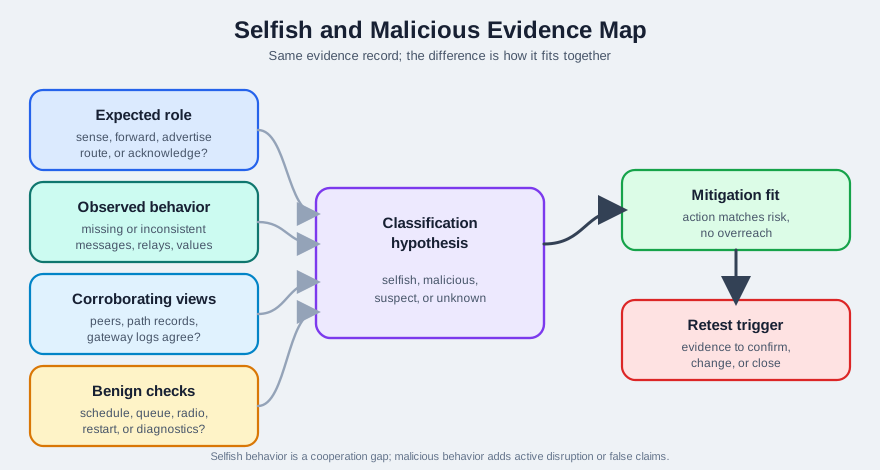
Figure Figure 7.1 keeps both hypotheses on one evidence path. Compare the node’s expected role with the messages, relays, or values it actually supplies. Peer reports, path records, and gateway logs can corroborate the pattern. Before calling it deliberate harm, check schedule, queue, radio, restart state, and diagnostic limits as possible causes. The resulting hypothesis may be selfish, malicious, suspect, or unknown. The chosen mitigation must fit the observed risk, and a retest trigger states what could confirm or change the label. This keeps a cooperation gap separate from active disruption or false claims.
Expected role: Was the node expected to sense, forward, advertise a route, acknowledge receipt, or validate a neighbor? Observed behavior: Which expected messages, relays, acknowledgements, or values are missing or inconsistent? Corroborating views: Do related nodes, path records, or gateway logs support the same pattern? Benign checks: Could schedule, queue pressure, radio conditions, restart state, or limited diagnostics explain the behavior? Classification hypothesis: Does the evidence fit selfish behavior, malicious behavior, suspect behavior, or unknown? Mitigation fit: Does the chosen action address the observed risk without assuming more than the record supports? Retest trigger: What new evidence should confirm, change, or close the label?
7.9 Distinguishing Selfish From Malicious
This section: Distinguishing Selfish From Malicious — Selfish behavior is a cooperation problem.
Selfish behavior is a cooperation problem. The node may still report its own readings and may still use the network for its own messages, but it avoids duties that mostly benefit others. Reviewers should look for asymmetry: own traffic succeeds while relay duties, shared sensing, or route participation are repeatedly weak.
Malicious behavior is a harmful-interference problem. The node may make claims that conflict with independent evidence, change data that should remain stable, present inconsistent identity information, or attract traffic without supporting the promised role. Reviewers should look for contradiction and active harm rather than ordinary absence.
Useful distinctions include:
- Own traffic versus shared duty: Selfish behavior often preserves own traffic while avoiding shared work. Malicious behavior may disrupt either own or shared traffic if it advances the harmful pattern.
- Response to observation: Selfish behavior may improve when relay obligations are visible or when shared load is reduced. Malicious behavior may continue despite those checks.
- Evidence shape: Selfish behavior often appears as repeated non-participation. Malicious behavior often appears as false claims, identity conflict, selective distortion, or route manipulation.
- Benign explanation: Both hypotheses require a check for ordinary causes before the label is assigned.
Do not make motive the first step. Start with behavior, then decide which hypothesis best explains the record.
7.10 Cooperation Incentives and Enforcement
This section: Cooperation Incentives and Enforcement — Selfish forwarding is a cooperation problem.
Selfish forwarding is a cooperation problem. A node can save energy by dropping relay traffic while still using other nodes to carry its own packets. If enough nodes do that, the multi-hop network loses the shared forwarding capacity it depends on.
That means detection alone is not a complete control. A watchdog can overhear that a next hop did not forward, and a pathrater can route around that next hop. That protects the affected path, but it can also reward the free rider if the node is now excused from relay work while its own traffic still moves through other neighbors. Deterrence requires a consequence that makes cooperation the better local choice.
To decide whether cooperation incentives and enforcement is defensible, first locate Expected Role and forward, sense, in the figure at Figure 7.2. They expose the two conditions that the surrounding argument must keep together.
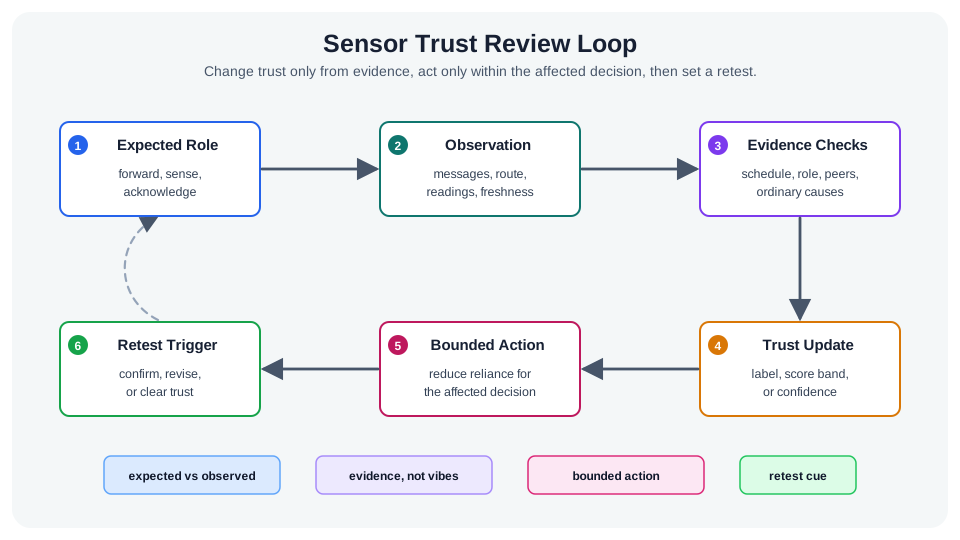
Find Expected Role on Figure 7.2; it adds a distinct review condition. Now contrast forward, sense,, which identifies the field observation, with acknowledge, which adds a distinct review condition. That contrast is the visual’s teaching load: Sensor behavior trust review loop from expected role through observations, evidence checks, trust update, bounded action, and retest trigger. The chapter can now use cooperation incentives and enforcement without dropping the conditions shown here.
Common cooperation mechanisms differ in what they make visible:
| Mechanism | What it observes | What changes |
|---|---|---|
| Watchdog | A neighbor overhears whether the next hop forwards a packet it received. | The review gains evidence about relay compliance. |
| Pathrater | Routing uses watchdog evidence to avoid persistent non-forwarders. | Traffic can move around a weak relay path. |
| Reputation or trust score | Repeated forwarding, acknowledgements, role evidence, and benign checks update a local score. | Low-trust nodes lose service or are avoided for the affected role. |
| Credit or virtual currency | A node earns credit by forwarding and spends credit to send its own traffic. | Forwarding becomes a prerequisite for using the network. |
Keep the counts separate: own packets sent, relay packets received, relay packets overheard as forwarded, link-quality samples, queue-full events, restart evidence, and sleep-state evidence. If a node has 30 relay opportunities, forwards 4, and still delivers 12 of 12 own packets while link and queue records stay normal, reputation should fall for the relay role. If the same node has a low-battery alarm and queue overflow during a known interference window, the safer label may remain suspect until the pattern repeats after recovery.
Credit systems make the incentive arithmetic explicit. A policy might charge one credit to inject an own packet and award one credit for forwarding a neighbor’s packet. A node that wants to send 20 of its own messages must forward roughly 20 qualifying packets or receive a documented maintenance allowance. That does not prove honesty, but it removes the free-rider option where a node consumes network service while contributing nothing to shared routing.
Malicious behavior needs stronger controls because an attacker may accept personal cost to damage the network. A sinkhole or wormhole can forward enough traffic to preserve reputation while bending topology or observing data. Pair cooperation enforcement with route-metric validation, authenticated identities, multipath checks for critical traffic, and time-decayed evidence so old good behavior cannot permanently mask recent harm.
7.11 Knowledge Check: Cooperation Enforcement
This section: Knowledge Check: Cooperation Enforcement
7.12 Common Attacks and Effects
This section: Common Attacks and Effects — Behind the behavior labels are a handful of well-known node attacks.
Behind the behavior labels are a handful of well-known node attacks. Name them so you can recognize the evidence pattern each one leaves.
Selfish (free-riding). The node uses the network for its own traffic but skips relay duty to save energy — it silently drops packets it was supposed to forward. Evidence: own messages succeed while relay counts stay low. Defense: a watchdog (neighbors overhear whether a node actually forwards) feeding a reputation/trust score that routes around persistent free-riders.
Blackhole. The node advertises an attractive route — often “shortest path to the sink” — to pull traffic toward itself, then drops everything it should forward. Evidence: high advertised route quality but near-zero delivery through it. Defense: multipath routing, a watchdog, and end-to-end acknowledgements.
Sinkhole. A variant that lures a whole region’s traffic by advertising an unusually good link to the base station, making itself a routing hub — usually a setup for dropping or tampering. Defense: authenticated routing metrics and geographic routing that does not trust advertised cost alone.
Selective forwarding (gray-hole). The subtlest: the node forwards most packets to look healthy but drops targeted ones — e.g. alarm messages — so simple delivery-rate checks miss it. Defense: multipath so critical messages have a second route, plus per-flow acknowledgement monitoring.
Sybil. One physical node fabricates many identities to stuff reputation votes, win routing decisions, or defeat redundancy (every “replica” you trusted is really one attacker). Defense: bind identity to a key, or a radio-resource test so one node cannot cheaply mint many.
Wormhole. Two colluding nodes open an out-of-band tunnel and replay each other’s packets, so distant nodes believe they are neighbors — distorting the topology and hijacking routes. Defense: packet leashes (geographic or tightly time-synced bounds) that reject links that are “too far, too fast” to be real.
On-off (conflict) behavior. A node behaves well long enough to earn trust, then attacks intermittently. Defense: time-decayed reputation, so old good behavior cannot indefinitely mask recent harm.
7.13 Review Workflow
This section: Review Workflow — The review loop keeps classification conservative.
The review loop keeps classification conservative. It starts with what the system expected, checks what actually happened, and ends with a retest trigger rather than a permanent judgment.
Use Figure 7.3 to separate observed forwarding failures from a premature claim about a node’s intent.
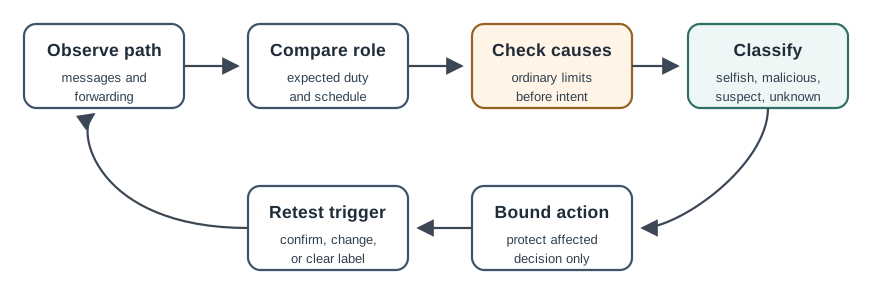
The reference window shows 30 forwards from 30 relay requests, or 100%. In the observed window, the node forwards 4 of 30, so its relay delivery ratio is 4 ÷ 30 × 100 = 13.3%. The same node delivers all 12 of its own packets while link and queue records look normal. That gap supports a selfishness hypothesis because shared relay work is weak while its own traffic succeeds. It does not prove motive or set a universal threshold. Keep the window, forwarding counts, own-traffic result, and link checks together before choosing a bounded response or retest.
Observe path: Record the messages, relays, acknowledgements, route claims, and data values seen by the monitor. Compare role: Check those observations against the node’s assigned role and expected schedule. Check benign causes: Look for ordinary explanations such as scheduled sleep, restart, queue pressure, weak link evidence, or limited diagnostics. Classify behavior: Assign selfish, malicious, suspect, or unknown with confidence and evidence. Choose bounded action: Reduce reliance, avoid the relay path, request corroboration, or quarantine the affected data path as appropriate. Retest trigger: State the next observation that would confirm, downgrade, or clear the label.
7.14 Production Trust Record
This section: Production Trust Record — The merged production-review material turns classification into a release gate.
The merged production-review material turns classification into a release gate. A behavior rule is ready only when its evidence, label, action boundary, owner, and retest trigger can be reviewed together.
A production trust record should state:
decision context: route, data path, validation rule, or alert that depends on the label. expected role: forwarding, acknowledging, sensing, corroborating, or reporting status. observations and related checks, including stale, missing, contradictory, or corroborating evidence. benign explanations considered before assigning an intent-heavy label. local trust state, confidence band, or score rule if one is used. bounded action, such as reduce reliance, request corroboration, avoid a route, hold a value, or start recovery review. retest trigger that would restore, revise, downgrade, or close the decision.
A score is not proof of motive, and a local threshold is not a universal property of sensor networks. Keep the action scoped to the affected decision while preserving unrelated evidence when it remains valid.
7.15 Worked Review: Relay Concern
This section: Worked Review: Relay Concern — Consider a node assigned as a relay for nearby sensors.
Consider a node assigned as a relay for nearby sensors. The monitor sees that the node continues to send its own readings, but several neighbor paths show missing forwarded messages. Neighbor observations agree that the node receives relay requests. The schedule record shows no expected sleep period, and there is no recent role change.
Concrete example: in a warehouse mesh, a pallet-zone node reports its own temperature records on time but repeatedly fails to forward neighboring door and vibration records that it acknowledged receiving. That pattern supports a relay-behavior review; it does not by itself prove motive, tampering, or permanent exclusion.
The first review should not jump directly to intent. A review record should ask:
- Did the node receive the messages it was expected to forward?
- Did it forward some sources but not others?
- Are its own readings still current and accepted?
- Do related nodes see the same relay gap?
- Does the pattern change when relay load is reduced or when forwarding is watched?
- Is there conflicting identity, route, or value evidence?
A selfish-node hypothesis fits if the node protects its own traffic, avoids relay work, and improves when shared obligations are made visible or reduced. A malicious-node hypothesis fits if the node makes unsupported route claims, changes or withholds selected traffic in a way that does not fit ordinary constraints, or presents identity evidence that conflicts across observers.
The action should match the confidence. With moderate evidence, the review may route around the node for the affected traffic and keep collecting corroboration. With weak evidence, the better action may be a suspect label and a retest trigger.
7.16 Common Review Findings
This section: Common Review Findings — Own readings remain present while relay work is repeatedly missing.
Selfish behavior likely
Own readings remain present while relay work is repeatedly missing. The node avoids route participation but continues to depend on other nodes. Behavior improves after the monitor makes relay obligations explicit. Reduced shared load changes the behavior in a way that fits resource preservation.
Malicious behavior likely
Route claims conflict with independent path evidence. Identity information is inconsistent across observers. The node receives traffic but selectively alters, suppresses, or redirects it. Behavior does not improve after ordinary constraints are checked and controlled.
Still suspect or unknown
The observation window is too short. Related nodes disagree about what happened. Schedule, role, or restart records are incomplete. The system cannot tell whether the node received the messages it failed to forward.
7.17 Limited-Capability And Recovery Cases
This section: Limited-Capability And Recovery Cases — Some weak behavior is not selfish or malicious.
Some weak behavior is not selfish or malicious. A simple sensor node may be silent, recently restarted, unable to expose rich diagnostics, or returning with stored readings after a gap. Treat that as limited diagnostic evidence until the record supports a stronger label.
A recovery review should preserve:
- the expected role and message schedule;
- the last accepted observation and why it was accepted;
- the missed-message evidence and whether the silence is isolated or shared;
- any buffered data, including observation time, receive time, ordering, duplicates, and gaps;
- the bounded recovery action;
- the retest trigger that would clear, change, or escalate the label.
Useful recovery actions include waiting within a documented recovery window, retrying or requesting status, using fallback evidence while marking the original source unavailable, collecting stored data with freshness checks, or escalating review when the missing state outlasts the rule.
7.17.1 Worked Review: Silent Simple Node
Scenario: a simple condition node sends periodic readings to a gateway. The gateway stops receiving messages.
Concrete example: a bin-fill node has no rich diagnostics; it normally sends a fill-level record and battery flag to a gateway. When the record stops arriving, the recovery review should preserve the last accepted reading and show the current source as unavailable until a complete new record or validated stored record arrives.
Observation
The current reading is missing. The last accepted reading is no longer fresh enough for the application decision.
Evidence check
The monitor confirms the expected schedule, records the last accepted observation, and checks related sources. Related sources remain available, so the silence appears isolated.
Recovery action
The dashboard marks this source unavailable and uses a fallback evidence path for the affected decision. It does not reuse the stale reading as if it were current.
Retest trigger
Retest when the node sends a new complete reading, returns with buffered records, changes role, changes schedule, or remains silent past the review rule.
7.17.2 Returned Stored Records
Scenario: a simple node returns after a silent interval and sends stored readings.
Observation
The node is communicating again, but the records cover an interval when the gateway had no live messages.
Evidence check
The reviewer checks observation time, receive time, sequence order, duplicate handling, and missing intervals.
Recovery action
Fresh records may update the current decision. Older records update the history only if their validity checks pass. Missing intervals remain marked as missing.
Retest trigger
Retest if the node returns late again, if sequence gaps repeat, if duplicate handling changes, or if the recovered data conflicts with related evidence.
7.18 Knowledge Check
This section: Knowledge Check
7.19 Matching Quiz
This section: Matching Quiz
7.20 Ordering Quiz
This section: Ordering Quiz
7.21 Summary
This section: Summary — Selfish and malicious node labels are useful only when they stay evidence-bound.
Selfish and malicious node labels are useful only when they stay evidence-bound. Selfish behavior usually preserves the node’s own traffic while avoiding shared duties. Malicious behavior usually introduces active disruption, false claims, identity conflict, or data manipulation. Both labels require benign checks, corroboration, confidence, bounded action, and a retest trigger.
The safest review pattern is to classify behavior from what the system can observe, avoid claiming motive from a single symptom, and keep the action scoped to the affected routing or data-validity decision.
7.22 Key Takeaway
This section: Key Takeaway — Selfish and malicious behavior must be handled through trust, monitoring, isolation, and recovery controls rather than assuming every node cooperates.
Selfish and malicious behavior must be handled through trust, monitoring, isolation, and recovery controls rather than assuming every node cooperates.
7.23 Concept Relationships
This section: Concept Relationships — Behavior Taxonomy provides the broader vocabulary for healthy, suspect, selfish, malicious, and limited-evidence behavior.
Behavior Taxonomy provides the broader vocabulary for healthy, suspect, selfish, malicious, and limited-evidence behavior. Sensor Node Behavior Classification supplies the evidence-first process used before intent-heavy labels are assigned. Limited-Capability And Recovery Cases handles nodes with limited or missing diagnostic evidence rather than intentional behavior evidence. WSN Energy and Duty Cycling explains why schedules and topology roles matter when judging missing relay behavior.
7.24 What’s Next
This section: What’s Next — Previous: Sensor Node Behavior Classification for the evidence-first classification method that supports this chapter.
Previous: Sensor Node Behavior Classification for the evidence-first classification method that supports this chapter.
Next: Limited-Capability And Recovery Cases for review actions when a node is simple, silent, or unable to expose enough diagnostic evidence.
Find help
3 reviewed answers.
Where should I start in a module?
Open the module page from the sidebar to see its chapters in order. Use the module map to return to a topic you need.
Modules and pathsReviewed
What can I try when a project does not work?
Check the symptom, then work through the diagnostic steps. Keep the error message and the smallest example that reproduces it.
When you are stuckReviewed
How do interactive examples work?
Use the interactive guide to check how examples and simulations work before changing your project.
Interactive examples guideReviewed