31  IoT Reference Models

Key Concepts
  • IoT Reference Model: A standardised architecture that defines functional layers, interfaces, and data flows for IoT systems, mapping real-world IoT stacks to abstract layers
  • Perception Layer: The bottom IoT layer containing physical sensors, actuators, and RFID readers that interact with the physical world
  • Network Layer (IoT): The middle tier connecting perception devices to the application tier via gateways, routers, and wireless protocols
  • Application Layer (IoT): The top tier hosting user-facing services, data analytics, and device management platforms
  • Three-Layer IoT Model: A simplified model with perception, network, and application layers; the most common introductory framework
  • Five-Layer IoT Model: An extended model adding business and processing layers to the three-layer model, providing more granular separation of concerns
  • Mapping to OSI/TCP-IP: Connecting the IoT reference model layers to the OSI or TCP/IP layer model to identify which standard protocols apply at each tier

31.1 In 60 Seconds

IoT systems extend traditional networking models with additional layers for edge computing, data accumulation, and business logic – recognizing that IoT does far more than move data. The Cisco 7-Level IoT Reference Model is the most practical framework, showing that roughly 80% of IoT data should be processed at the edge (Level 3) before reaching the cloud, which directly affects latency, bandwidth costs, and system reliability.

31.2 Learning Objectives

By the end of this chapter, you will be able to:

  • Explain why IoT needs specialized reference models: Differentiate IoT networking requirements from traditional networking models
  • Describe the ITU IoT Reference Model: Identify the four layers and cross-cutting concerns
  • Apply the Cisco 7-Level IoT Model: Map IoT system components to appropriate levels
  • Compare IoT protocol stacks: Analyze how Wi-Fi, Zigbee, and LoRaWAN implement layered models differently
  • Design edge computing strategies: Determine where data processing should occur in an IoT architecture

A reference model is like a blueprint for building a house – it shows you how all the pieces fit together. In IoT, reference models map out where your sensors collect data, where that data gets processed (close to the device or in the cloud), and how everything connects. Think of it as a recipe that tells engineers which layers of technology to stack on top of each other.

“Imagine our IoT system is a seven-story building,” said Max the Microcontroller, drawing on a whiteboard. “Sammy, you live on the ground floor – Floor 1 – where physical things happen, like detecting temperature.”

Sammy the Sensor nodded. “So my readings go upstairs? What happens on each floor?” Max continued, “Floor 2 is where your raw data gets connected to the network. Floor 3 is the Edge Computing floor – this is where most of the action happens! About 80% of your data gets filtered and processed RIGHT HERE, before it ever goes higher.”

“Why not send everything to the top floor?” asked Lila the LED. “Because,” Bella the Battery explained, “sending data up all seven floors uses tons of my energy! If we can figure out on Floor 3 that the temperature is normal and nothing needs to change, why bother sending it all the way to the cloud on Floor 7? It is like deciding you do not need to call the fire department just because you checked the stove and it is off.”

Max wrapped up: “The top floors – 4 through 7 – handle data storage, analytics, and business decisions. The Cisco IoT Reference Model shows us exactly which floor each job belongs on, so we build smart systems instead of wasteful ones!”

MVU: Minimum Viable Understanding

Core concept: IoT extends traditional networking models with additional layers for edge computing, data accumulation, and business processes - recognizing that IoT systems do much more than just move data.

Why it matters: Understanding where to process data (device, edge, or cloud) affects latency, bandwidth costs, privacy, and system reliability. The wrong architecture choice can make your IoT project fail.

Key takeaway: The Cisco 7-Level model is practical for IoT design - it shows that 80% of data should be processed at the edge (Level 3) before reaching the cloud (Levels 4-7).

31.3 Prerequisites


31.4 Why IoT-Specific Reference Models?

While OSI and TCP/IP models apply to IoT, IoT has unique requirements that traditional networking models don’t address:

  • Resource-constrained devices (limited CPU, memory, power)
  • Massive scale (billions of devices)
  • Edge computing needs (process before sending)
  • Data processing pipelines (filter, aggregate, analyze)
  • Application-specific services (analytics, ML, business rules)
  • Cross-layer security (device to cloud)

31.4.1 IoT Protocol Stack Comparison

Different IoT technologies implement the layered model differently. This comparison shows how common IoT protocols map to the TCP/IP layers:

Comparison of Wi-Fi, Zigbee, and LoRaWAN protocol stacks mapped to TCP/IP layers, showing how each technology implements Application, Transport, Network, and Link layers differently
Figure 31.1: Comparison of protocol stacks across three common IoT technologies showing different approaches to implementing the layered model.

Key Observations:

  • Wi-Fi IoT: Uses standard TCP/IP stack - easy integration but power-hungry
  • Zigbee: Custom network layer optimized for mesh - requires gateway for IP connectivity
  • LoRaWAN: Minimal stack for long-range, low-power - extremely simple but limited bandwidth
Tradeoff: Native IP Stack vs Proprietary Protocol Stack

Option A: Use native IP stack (Wi-Fi, Thread, Cellular) - direct internet connectivity, standard tools and libraries, no translation needed at gateway

Option B: Use proprietary/optimized stack (Zigbee, LoRaWAN, Z-Wave) - lower power consumption, optimized for constrained devices, requires protocol translation at gateway

Decision Factors: Choose native IP when devices need direct cloud connectivity, when using standard HTTP/REST APIs, or when development speed is critical. Choose proprietary stacks when battery life is paramount (years vs months), when devices are severely constrained (<64KB RAM), or when mesh networking is required. Hybrid approaches are common: proprietary stack on edge devices, IP translation at gateway. Consider total cost including gateway complexity and cloud integration effort.


31.5 ITU IoT Reference Model

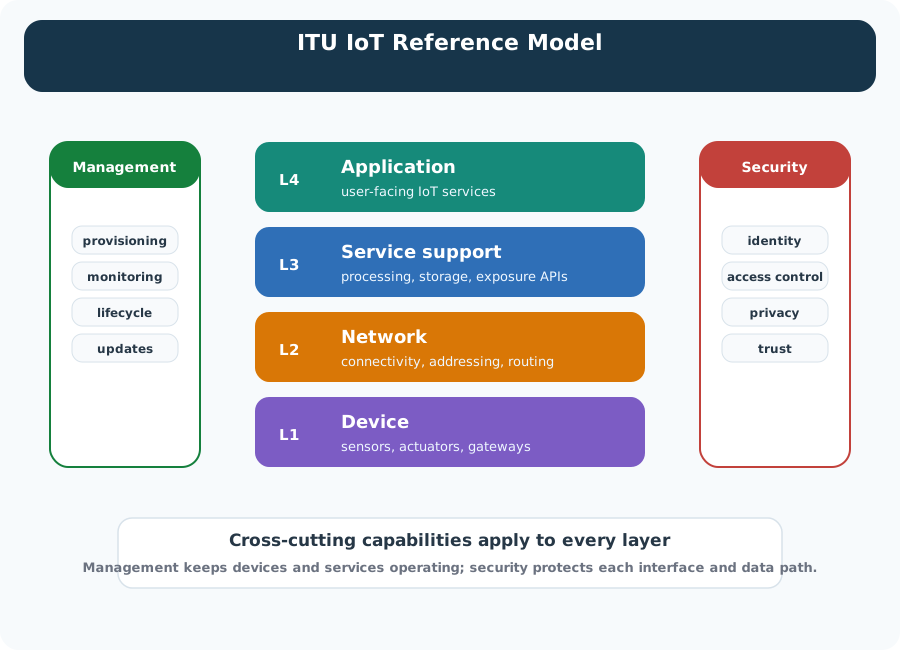
The International Telecommunication Union (ITU) developed a general four-layer model for IoT:

ITU IoT reference model diagram with four layers: Device (Layer 1), Network (Layer 2), Service Support (Layer 3), and Application (Layer 4), plus cross-cutting Management and Security capabilities spanning all layers
Figure 31.2: ITU IoT reference model showing the four-layer architecture with cross-cutting Management and Security capabilities
Detailed ITU IoT reference model showing Application, Service Support, Network, and Device layers with their functions and interactions, including cross-cutting Management and Security concerns
Figure 31.3: Detailed ITU IoT reference model for standardized IoT architecture

31.5.1 ITU Model Layers

Layer Name Function
4 Application Smart home, healthcare, industrial applications
3 Service Support Data processing, storage, middleware
2 Network Connectivity (Wi-Fi, cellular, LoRa)
1 Device Physical devices, sensors, actuators, gateways

31.5.2 Cross-Cutting Capabilities

The ITU model emphasizes Management and Security that span all layers:

  • Management: Device provisioning, firmware updates, monitoring
  • Security: Authentication, encryption, access control at every level


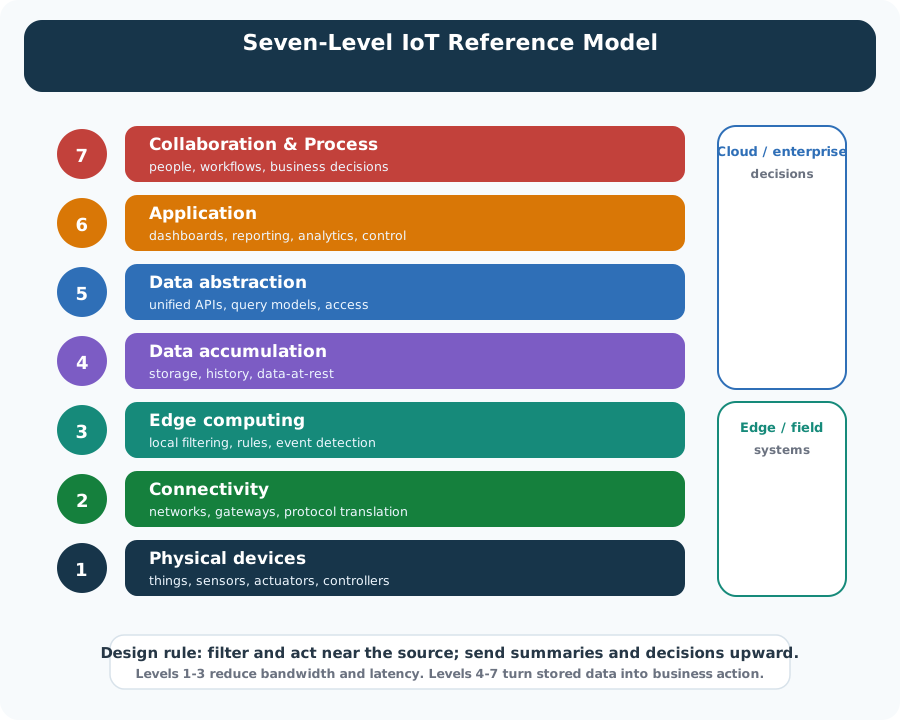
31.6 Cisco 7-Level IoT Reference Model

A more applied approach showing functionality and challenges at each level:

Cisco 7-Level IoT Reference Model diagram showing all seven levels: Level 1 Physical Devices and Controllers, Level 2 Connectivity, Level 3 Edge Computing, Level 4 Data Accumulation, Level 5 Data Abstraction, Level 6 Application, and Level 7 Collaboration and Processes
Figure 31.4: Cisco 7-Level IoT Reference Model overview showing the seven layers from Physical Devices to Collaboration and Processes
Comprehensive 7-level IoT reference model from bottom to top: Physical Devices and Controllers, Connectivity, Edge Computing, Data Accumulation, Data Abstraction, Application, and Collaboration and Processes layers
Figure 31.5: Comprehensive 7-level IoT reference model showing complete IoT stack from Physical Devices and Controllers through Collaboration and Processes

31.6.1 Level 1: Physical Devices and Controllers

Purpose: Endpoint devices that generate and receive data

Components:

  • Sensors (temperature, humidity, motion, pressure)
  • Actuators (motors, valves, relays)
  • Controllers (microcontrollers, PLCs)

Functions:

  • Analog-to-digital conversion
  • Data generation
  • Remote query/control capability

IoT Examples:

  • ESP32 temperature sensor
  • Smart light bulbs
  • Industrial pump controllers
  • Security cameras

31.6.2 Level 2: Connectivity

Purpose: Reliable, timely information transmission

Functions:

  • Communication between devices and network
  • Reliable delivery across networks
  • Protocol implementation and translation
  • Switching and routing
  • Network-level security

IoT Protocols:

  • Wi-Fi, Bluetooth, Zigbee, LoRaWAN
  • Ethernet, cellular (4G/5G)
  • Gateway translation (non-IP to IP)

Key point: IoT uses existing networks, doesn’t require separate infrastructure


31.6.3 Level 3: Edge (Fog) Computing

Purpose: Convert network data flows into information suitable for storage and processing

Functions:

  • Data filtering, cleanup, aggregation
  • Packet content inspection
  • Thresholding and event generation
  • Combination of network and data analytics

Processing Examples:

  • Evaluation: Should this data go to cloud?
  • Formatting: Standardize data structure
  • Expanding: Add context (sensor location, timestamp)
  • Reduction: Summarize to reduce network load
  • Assessment: Does this trigger an alert?

Why at the edge? Process data as close to source as possible to: - Reduce network bandwidth - Enable real-time decisions - Decrease cloud costs - Improve privacy (data stays local)

The 80/20 Rule of Edge Computing

A well-designed IoT system processes 80% of data at the edge and sends only 20% to the cloud. Raw sensor data rarely needs to leave the local network - summaries, alerts, and exceptions are what matter.

Example: A factory with 500 vibration sensors at 1 kHz with 16-bit resolution generates 1 MB/s of raw data. After edge processing: ~1 MB/hour of alerts and hourly summaries.

How much bandwidth and cloud cost does edge processing save? Let’s quantify the 80/20 rule with a real industrial IoT scenario.

Scenario: 500 vibration sensors sampling at 1 kHz with 16-bit resolution.

Raw data generation: \(\text{Data rate} = 500\text{ sensors} \times 1{,}000\text{ samples/sec} \times 2\text{ bytes/sample}\) \(= 1{,}000{,}000\text{ bytes/sec} = 1\text{ MB/s}\)

Cloud cost without edge processing (all data sent to cloud): \(\text{Daily data} = 1\text{ MB/s} \times 86{,}400\text{ s/day} = 86.4\text{ GB/day}\) \(\text{Annual data} = 86.4 \times 365 = 31{,}536\text{ GB/year}\) \(\text{Cloud ingress cost} = 31{,}536 \times \$0.05/\text{GB} = \$1{,}577/\text{year}\) \(\text{Storage cost} = 31{,}536\text{ GB} \times \$0.023/\text{GB-month} = \$725/\text{month} = \$8{,}700/\text{year}\)

With edge processing (Level 3: 80% filtered, only anomalies sent): - Edge filters normal vibration, detects anomalies (FFT analysis) - Sends only hourly summaries + alerts: ~1 MB/hour \(\text{Daily data} = 1\text{ MB/hour} \times 24 = 24\text{ MB/day}\) \(\text{Annual data} = 24 \times 365/1000 = 8.76\text{ GB/year}\) \(\text{Cloud cost} = 8.76 \times \$0.05 = \$0.44/\text{year}\) \(\text{Storage cost} = 8.76 \times \$0.023 \times 12 = \$2.42/\text{year}\)

Savings: \(\text{Bandwidth reduction} = \frac{31{,}536 - 8.76}{31{,}536} \times 100\% = 99.97\%\) \(\text{Annual cost savings} = (\$1{,}577 + \$8{,}700) - (\$0.44 + \$2.42) \approx \$10{,}274/\text{year}\)

Key insight: Edge computing transforms an infeasible architecture (500 sensors producing 1 MB/s with $10K/year cloud cost) into a scalable one (1 MB/hour totaling $3/year). The 80/20 rule is not optional for high-frequency IoT - it’s the difference between a viable product and a failed pilot.

Try It: Edge Computing Cost Calculator

Adjust the parameters below to see how edge computing affects bandwidth and cloud costs for your own IoT deployment.


31.6.4 Level 4: Data Accumulation

Purpose: Make network data usable by applications

Key Transition:

  • Data-in-motion to Data-at-rest
  • Network packets to Database tables
  • Event-based to Query-based

Functions:

  • Persist data to storage (file system, database, big data system)
  • Filter and selectively store
  • Recombine with historical data
  • Bridge real-time and non-real-time worlds

Storage Types:

  • Time-series databases (InfluxDB, TimescaleDB)
  • NoSQL databases (MongoDB, Cassandra)
  • Big data systems (Hadoop, Spark)

31.6.5 Level 5: Data Abstraction

Purpose: Reconcile multiple data sources and formats for applications

Challenges:

  • Data spread across multiple locations
  • Different formats and schemas
  • Geographically distributed processing
  • Mix of IoT and non-IoT data

Functions:

  • Reconcile multiple data formats
  • Ensure consistent semantics
  • Confirm data completeness
  • Data virtualization (access without moving)
  • Authentication and authorization
  • Indexing for fast access

Example: Smart retail chain - Local store: real-time inventory - Regional: aggregated sales trends - Corporate: enterprise analytics

All must be accessible through unified interface!


31.6.6 Level 6: Application

Purpose: Information interpretation, reporting, and control

Software at this level:

  • Interacts with Level 5 (data at rest)
  • Does NOT operate at network speed
  • Varies by vertical market and business needs

Application Types:

  • Monitoring: Dashboard showing device status
  • Control: Adjusting actuators remotely
  • Analytics: Business intelligence reports
  • Management: System configuration

IoT Examples:

  • Smart home automation dashboard
  • Industrial SCADA system
  • Fleet management platform
  • Healthcare patient monitoring

31.6.7 Level 7: Collaboration and Processes

Purpose: Connect applications to people and business processes

Beyond Technology:

  • People using applications
  • Multi-step business workflows
  • Cross-application collaboration
  • Decision-making and actions

Key Insight: IoT systems are only valuable when they yield action!

Example Workflow:

  1. Alert: Temperature sensor detects overheating
  2. Notification: Maintenance manager receives alert
  3. Collaboration: Manager consults with engineer
  4. Decision: Schedule emergency maintenance
  5. Action: Technician dispatched to repair
  6. Documentation: Work order closed, data logged

This transcends multiple applications and requires human collaboration.


31.7 Practical Application: Where to Process?

Use the Cisco 7-Level model to decide where data processing should occur:

Processing Need Best Level Rationale
Sensor calibration Level 1 (Device) Requires hardware knowledge
Data filtering Level 3 (Edge) Reduce bandwidth early
Real-time alerts Level 3 (Edge) Low latency required
Historical trends Level 4 (Accumulation) Needs stored data
Cross-site analytics Level 5 (Abstraction) Multiple data sources
Dashboards Level 6 (Application) User-facing
Workflow automation Level 7 (Collaboration) Human-in-the-loop

31.8 Worked Example: Mapping a Cold-Chain Monitoring System to the Cisco 7-Level Model

Scenario: A pharmaceutical distributor ships temperature-sensitive vaccines across a 6-warehouse, 200-truck fleet covering 14 states. Regulations (FDA 21 CFR Part 211) require continuous temperature logging with 15-minute granularity, immediate alerting if any shipment exceeds 2-8 degrees Celsius, and a complete audit trail accessible within 24 hours. The engineering team must map their system design to the Cisco 7-Level model to ensure no layer is missed.

System Mapping:

Cisco Level Cold-Chain Component Key Design Decisions
Level 1: Physical Devices TI CC1352R SoC with SHT40 temperature/humidity sensor, GPS module, and 3.7V LiPo battery in each shipping container Sensor accuracy: +/- 0.1 degrees C. Sampling every 60 seconds but only reporting every 15 minutes to conserve battery. 2,400 sensor units across fleet.
Level 2: Connectivity BLE 5.0 from sensor to truck-mounted gateway; LTE-M from gateway to cloud (Quectel BG96 modem) BLE chosen over Wi-Fi for 3x lower power. LTE-M chosen over LoRaWAN because trucks need cellular handover across state lines at highway speeds.
Level 3: Edge Computing Truck gateway (Raspberry Pi CM4) runs local threshold checks Gateway compares each reading against 2-8 degrees C range. If violated, sends immediate alert via LTE-M without waiting for the 15-minute batch. Also performs local data compression (CBOR encoding) reducing payload from 120 bytes JSON to 34 bytes. Processes 80% of readings locally – only anomalies and 15-minute summaries reach the cloud.
Level 4: Data Accumulation TimescaleDB on AWS, partitioned by warehouse region Ingests ~230,000 readings/day (2,400 sensors x 96 readings/day). 90-day hot storage, 7-year cold archive on S3 Glacier for FDA compliance. Time-series partitioning enables fast range queries for audit reports.
Level 5: Data Abstraction GraphQL API unifying sensor data, truck GPS tracks, and warehouse inventory system The warehouse management system (SAP) stores shipment IDs, while sensor data uses device UUIDs. Data abstraction layer joins these via a shipment-device mapping table, so a pharmacist querying “show me the temperature history for Shipment #VX-2847” gets a unified view across 3 trucks and 2 warehouses the shipment traversed.
Level 6: Application Web dashboard for logistics managers; mobile app for truck drivers; automated FDA compliance report generator Dashboard shows real-time fleet map with color-coded temperature status (green/yellow/red). FDA report generator produces 21 CFR Part 11 compliant audit trails in PDF format with electronic signatures.
Level 7: Collaboration Alert escalation: sensor alarm triggers driver notification (mobile push), if unresolved in 10 minutes triggers warehouse manager SMS, if unresolved in 30 minutes triggers quality director phone call This level connects technology to human decision-making. A temperature excursion does not just generate data – it triggers a decision chain: reroute the truck to the nearest warehouse, inspect the refrigeration unit, potentially quarantine and destroy compromised vaccines (average cost: $47,000 per destroyed shipment).

Key Insight from the Mapping Exercise:

Without Level 3 (edge computing), every reading from every sensor would travel over LTE-M to the cloud. The data volume would be:

Without edge: 2,400 sensors x 1 reading/min x 120 bytes = 17.3 MB/hour
  LTE-M cost at $0.50/MB: $8.64/hour = $75,686/year

With edge (15-min batches, CBOR, anomaly-only alerts):
  Batch size: 15 readings x 34 bytes = 510 bytes per sensor per 15 min
  2,400 sensors x 4 batches/hour x 510 bytes = 4.9 MB/hour
  Plus ~5% anomaly alerts: 0.24 MB/hour
  Total: 5.14 MB/hour = $2.57/hour = $22,517/year

Annual savings from edge processing: $53,169

The Cisco model makes this optimization visible by explicitly separating Level 2 (connectivity) from Level 3 (edge computing). Teams that skip the reference model exercise often send raw data straight to the cloud, discovering the cost problem only after the first monthly bill arrives.


Common Pitfalls

IoT reference models define functional responsibilities, not protocol boundaries. A single protocol (e.g., MQTT) may span two IoT model layers. Fix: use IoT models to understand functional roles, and use OSI/TCP-IP to identify protocol positions.

The IoT “network layer” includes gateways, protocol bridging, and wide-area connectivity — far broader than OSI Layer 3 (IP addressing and routing). Fix: always specify which model you are referencing when using the word “network layer.”

Studying the reference model without connecting it to real products (sensors, gateways, cloud platforms) leaves the framework abstract and difficult to apply. Fix: for each IoT model layer, name at least two real commercial products or protocols that operate there.

31.9 Summary

This chapter covered IoT-specific reference models that extend traditional networking:

  • IoT requires specialized models beyond OSI/TCP-IP because of unique requirements: constrained devices, massive scale, edge processing needs, and business process integration
  • Different IoT technologies implement layers differently: Wi-Fi uses standard TCP/IP, Zigbee has custom network layers, LoRaWAN has minimal protocol overhead
  • The ITU IoT Reference Model provides four layers (Device, Network, Service Support, Application) with cross-cutting Management and Security capabilities
  • The Cisco 7-Level IoT Model is practical for system design, covering Physical Devices, Connectivity, Edge Computing, Data Accumulation, Data Abstraction, Application, and Collaboration
  • Edge computing (Level 3) is critical - process 80% of data locally to reduce bandwidth, enable real-time decisions, decrease costs, and improve privacy
  • IoT systems are only valuable when they yield action - Level 7 (Collaboration) connects technology to people and business processes

31.10 What’s Next

Apply your understanding of IoT reference models with hands-on implementation and deeper architectural study:

Topic Chapter Description
Layered Models Labs Layered Models: Labs and Implementation Hands-on MAC addresses, IPv4/IPv6 addressing, subnet masks, ARP protocol, and Python implementations
Layered Models Review Layered Models: Review Comprehensive knowledge checks covering all layering concepts from OSI through IoT reference models
IoT Reference Architectures IoT Reference Models Multi-layer IoT system architectures in detail with real-world deployment patterns
Edge and Fog Computing Edge and Fog Computing Fundamentals Deep dive into Level 3 edge computing, fog nodes, and distributed processing strategies
Application Protocols Application Protocols Application layer protocols (MQTT, CoAP, HTTP) that sit at Levels 5-6 of the Cisco model
Network Addressing Networking Addressing and Subnetting IP addressing, subnet masks, and CIDR notation used at Level 2 connectivity

31.11 Knowledge Check


Deep Dives:

IoT Reference Architectures:

Protocol Stack Components:

Addressing:

Learning: