24  Architectural Enablers: Fundamentals

In 60 Seconds

Four converging technologies made IoT viable: cheap computing (sub-dollar MCUs), miniaturization (MEMS sensors under 2mm), energy management (10-year battery life with duty cycling), and diverse wireless protocols (BLE to 5G). If your sensor costs 0, annual battery and connectivity costs should stay under .

24.1 Learning Objectives

By the end of this chapter, you will be able to:

  • Classify Architectural Enablers: Categorize the four foundational technologies that made IoT economically viable and explain their interdependencies
  • Analyze Enabler Convergence: Justify how computing power, miniaturization, energy management, and communications converged in the 2010s to enable billion-device networks
  • Trace IoT Evolution: Sequence the five phases of Internet evolution from connected computers to IoT, explaining how each phase built on the previous
  • Differentiate Product Types: Contrast embedded, connected, and true IoT products using architectural criteria
  • Evaluate IoT Feasibility: Assess whether a proposed IoT system is viable by systematically checking each enabler dimension against deployment requirements
Minimum Viable Understanding
  • Four enablers made IoT possible: cheap computing, miniaturization, long-lasting batteries, and diverse wireless protocols converged in the 2010s to make billion-device networks economically viable.
  • IoT products differ from connected products because they incorporate intelligent optimization, autonomous decision-making, and data-driven learning – not just remote notification.
  • Feasibility depends on all four enablers: if any one dimension (compute, size, power, connectivity) fails to meet requirements, the entire IoT deployment becomes impractical.

Sammy the Sensor gathered the team for a big announcement: “Friends, do you know why we can all work together today? It is because of four superheroes!”

Lila the LED asked: “Who are they?”

Sammy explained: “First, there is Captain Compute – he made our brains tiny and powerful. Imagine shrinking a whole library into a single grain of rice! That is what happened to computer chips.”

Max the Motor added: “Then there is Mini-Me the Miniaturizer! She made everything smaller and cheaper. A sensor that once cost $500 and filled a shoebox now costs $5 and fits on your fingertip.”

Bella the Buzzer chimed in: “Do not forget Battery Belle! She figured out how to make us sleep most of the time so our batteries last for years instead of days. It is like hibernating bears – we wake up, do our job, and go right back to sleep.”

Sammy finished: “And Wireless Wendy gave us different ways to talk to each other – Bluetooth for whispering nearby, Wi-Fi for chatting in the house, and LoRa for shouting across the whole farm!”

Real-world connection: Just like how you need legs, arms, eyes, AND a brain to play sports, IoT devices need all four superheroes working together. Take away any one, and the whole system falls apart!

Think of building a house. You need several things to come together: affordable materials, skilled workers, good tools, and a way to get supplies to the building site. If lumber costs a fortune or there are no roads to your plot, you simply cannot build.

IoT systems work the same way. Four technologies had to become good enough AND cheap enough at the same time:

Enabler What It Means Everyday Analogy
Computing Power Tiny, powerful chips A library that fits in your pocket
Miniaturization Small, cheap sensors A camera that went from the size of a room to the tip of a pen
Energy Management Long battery life A flashlight that runs for years instead of hours
Communications Wireless connectivity Different ways to send messages: texting (Bluetooth), calling (Wi-Fi), satellite phone (cellular)

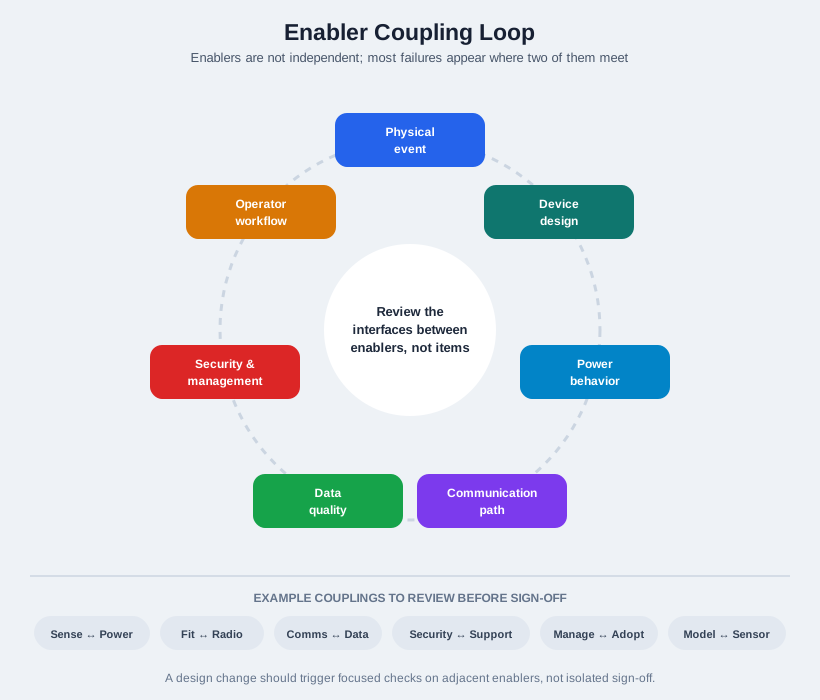
Why “convergence” matters: Each enabler existed individually before IoT. What changed in the 2010s is that ALL FOUR became affordable simultaneously. That is the convergence that launched the IoT revolution.

Quick test: If someone proposes an IoT system, ask four questions: 1. Is there enough processing power on the device? 2. Is the device small and cheap enough to deploy at scale? 3. Will the battery last long enough (or can it harvest energy)? 4. Can it reliably communicate its data?

If ANY answer is “no,” the system is not yet viable.

Key Concepts

  • IoT Enabler: A foundational technology that, through cost reduction or capability maturation, made practical large-scale IoT deployment possible — the six enablers are computing, miniaturization, energy, communications, development resources, and human factors
  • Moore’s Law: The empirical observation that transistor density doubles approximately every two years, reducing MCU prices from hundreds of dollars in the 1990s to under one dollar today
  • Miniaturization: The progressive reduction in electronic component size through semiconductor scaling and MEMS fabrication, enabling sensor nodes small enough to embed in clothing, pills, and structural materials
  • MEMS (Micro-Electro-Mechanical Systems): Microscale mechanical and electrical components fabricated using semiconductor processes, enabling accelerometers, gyroscopes, and pressure sensors under 2 mm in a single package
  • Duty Cycling: The power management technique of alternating between active sensing/transmitting periods and deep sleep states to extend battery lifetime from hours to years on a fixed energy budget
  • API Economy: The ecosystem of cloud and platform APIs enabling developers to integrate third-party ML, mapping, messaging, and analytics capabilities without building from scratch, accelerating IoT application development

24.2 Introduction

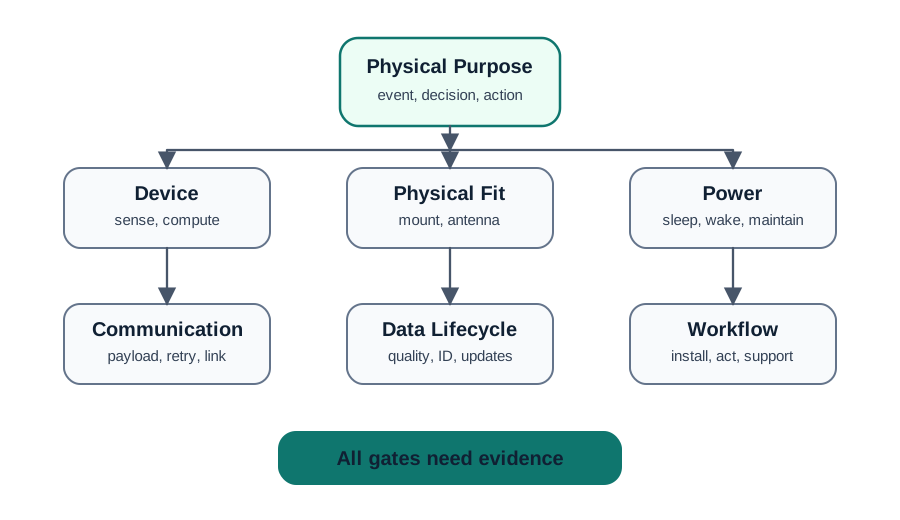
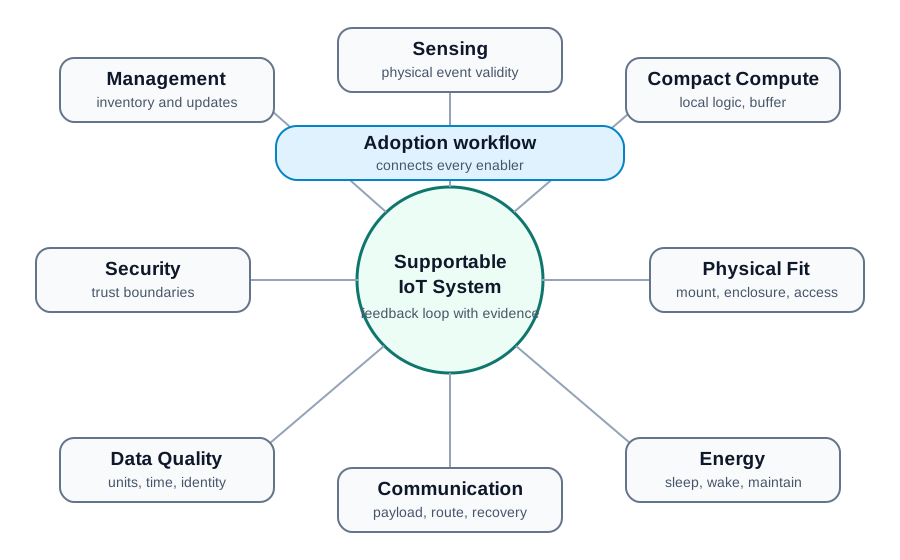
The Internet of Things did not emerge from a single breakthrough. Instead, it became viable when four foundational technologies – computing power, miniaturization, energy management, and communications – converged to make billion-device networks economically practical. These four technologies are called architectural enablers because they form the foundation upon which all IoT architectures are built.

This chapter provides a unified overview of these enablers. For detailed coverage, each enabler is explored in depth across the Architectural Enablers series:

  1. IoT Evolution and Enablers Overview – History, product evolution, core enablers
  2. IoT Communications Technology – PAN/LAN/MAN/WAN protocols
  3. Technology Selection and Energy Management – Decision frameworks, power budgets
  4. Labs and Assessment – Hands-on practice, exam prep

24.3 The Evolution That Led to IoT

The Internet has transformed through five distinct phases, each expanding the scope of what is connected:

Timeline diagram showing five phases of Internet evolution: Phase 1 connected computers via networks, Phase 2 created the World Wide Web with millions of sites, Phase 3 brought mobile internet through smartphones, Phase 4 enabled social internet with online identities, and Phase 5 extends connectivity to physical objects in the Internet of Things

Each phase built on the previous one. Without the World Wide Web, there would be no mobile Internet. Without mobile connectivity, there would be no infrastructure for IoT devices to leverage. The IoT phase is distinguished by extending connectivity beyond human-operated devices to autonomous physical objects that sense, communicate, and act.

24.4 The Four Core Enablers

At the heart of every IoT system lie four foundational technologies. Their simultaneous maturation in the 2010s created the conditions for IoT to become practical and affordable.

Diagram showing the four core IoT enablers as interconnected pillars: Computing Power (cheap microcontrollers and edge processing), Miniaturization (MEMS sensors from credit card to grain of rice size), Energy Management (duty cycling and energy harvesting for years-long battery life), and Communications (Bluetooth to LoRaWAN to 5G protocols)

24.4.1 1. Computing Power

Modern microcontrollers deliver significant processing in remarkably small packages. A $5 ESP32 chip today has more computing power than a 1990s supercomputer. This means IoT devices can:

  • Process data locally (edge computing) instead of sending everything to the cloud
  • Run machine learning models for anomaly detection and pattern recognition
  • Make autonomous decisions without constant network connectivity

The key metric is the performance-per-watt ratio, which has improved by roughly 1000x over the past two decades.

24.4.2 2. Miniaturization and Cost Reduction

Moore’s Law – the observation that transistor density doubles approximately every 18-24 months – has driven relentless shrinkage and cost reduction:

Era Sensor Package Size Typical Cost Example
2000 Credit card $100-500 Industrial temperature sensor
2010 Postage stamp $10-50 MEMS accelerometer
2020 Grain of rice $0.50-5 BME280 environmental sensor
2025 Dust particle $0.10-1 Smart dust research

This cost reduction is what enables deploying thousands of sensors where previously only a handful were economically justified.

24.4.3 3. Energy Management

Battery life is often the single greatest constraint in IoT deployments. Three techniques have extended device lifetimes from days to years:

  • Duty cycling: Devices sleep 99%+ of the time, waking briefly to sense and transmit. A sensor consuming 50 mA when active but only 5 uA in sleep mode can last years on a coin cell battery.
  • Energy harvesting: Solar panels, thermoelectric generators, piezoelectric vibration harvesters, and RF energy capture can supplement or replace batteries entirely.
  • Ultra-low-power design: Modern microcontrollers operate at sub-threshold voltages, and communication protocols like BLE and LoRa are designed for minimal energy expenditure.

24.4.4 4. Communications

IoT demands connectivity options tailored to diverse requirements. No single protocol fits all scenarios:

Communication protocol range and power comparison diagram showing PAN (Bluetooth, Zigbee at 10m, ultra-low power), LAN (Wi-Fi at 100m, moderate power), MAN (LoRaWAN, NB-IoT at kilometers, low power), and WAN (Cellular at global range, high power) with trade-offs illustrated

The choice of communication protocol depends on three primary factors: range, power budget, and data rate requirements. See Communications Technology for detailed protocol comparisons.

24.5 From Embedded to IoT: Product Evolution

Not every connected device qualifies as an IoT product. Understanding the distinction helps clarify what makes IoT architecturally different:

Product evolution diagram showing three generations: Embedded products (standalone devices with fixed logic), Connected products (internet-enabled with remote notification capability), and IoT products (intelligent devices with optimization, learning, and autonomous decision-making powered by all four architectural enablers)

Category Example Key Capability
Embedded Washing machine with timer Stops when cycle ends (fixed logic)
Connected Washing machine with app alerts Sends phone notification when done
IoT Smart washing machine Optimizes cycle based on energy price, load weight, fabric type, and learns user preferences

The architectural difference is that IoT products require all four enablers working together: computing power for intelligence, miniaturization for cost-effective sensors, energy management for autonomous operation, and communications for data exchange.

How It Works: The Four Enablers in Practice

When you deploy an IoT system, all four enablers must work together seamlessly. Let’s trace how they interact in a real sensor deployment:

1. Computing Power enables edge intelligence: The microcontroller processes raw sensor readings locally (converting ADC values to calibrated measurements), applies threshold logic (only transmit when moisture drops below 30%), and formats efficient payloads (50 bytes instead of raw kilobytes).

2. Miniaturization makes deployment economical: A complete sensor node (MCU + radio + moisture probe + battery) fits in a 50mm enclosure and costs $18 in materials. This size and cost enable deploying 500 units across 200 hectares – something impossible with 2000-era technology at 10x the size and $500 per unit.

3. Energy management extends operational lifetime: By sleeping 99.7% of the time (active only 2 seconds per 15 minutes), average current drops from 120mA to 0.27mA. This 444x reduction transforms battery life from 17 hours to 11,000 hours (1.26 years) – and that’s with no solar panel yet.

4. Communications provide connectivity at scale: LoRaWAN reaches 2-15km on sub-GHz frequencies that penetrate foliage, using only 30-50mA during the brief transmission window. Two gateways cover 200 hectares with zero recurring connectivity costs (private network).

The convergence: Remove any one enabler and the system fails. Without miniaturization, sensors cost too much. Without energy management, batteries drain in days. Without long-range low-power communications, infrastructure costs explode. Without edge computing, you waste bandwidth sending raw data. IoT became viable when all four reached threshold performance simultaneously in the 2010s.

24.6 Worked Example: Smart Agriculture Sensor Network

Scenario: A farm operator wants to deploy 500 soil moisture sensors across 200 hectares to optimize irrigation and reduce water usage by 30%.

Step 1 – Check Computing Power: Each sensor needs to process raw ADC readings into calibrated moisture percentages, apply a threshold algorithm, and format a LoRa payload. An ARM Cortex-M0+ microcontroller at $2 provides more than sufficient processing power. Edge processing reduces data transmitted by 90% (only sends when moisture crosses thresholds).

Step 2 – Check Miniaturization: The complete sensor node (microcontroller + soil moisture probe + LoRa radio + battery holder) fits in a 50mm x 30mm x 20mm waterproof enclosure. Bill of materials cost: $18 per unit. At 500 units, total hardware cost is $9,000 – economically viable for a commercial farm.

Step 3 – Check Energy Management:

  • Active current (sensing + LoRa TX): 120 mA for 2 seconds every 15 minutes
  • Sleep current: 5 uA
  • Average current: (120 mA x 2s + 0.005 mA x 898s) / 900s = 0.272 mA
  • Battery: 2x AA lithium (3,000 mAh) = 3,000 / 0.272 = 11,029 hours = 1.26 years
  • Verdict: Acceptable for seasonal replacement during planting.

Step 4 – Check Communications:

  • Range needed: up to 2 km from sensor to gateway
  • Data rate: 50 bytes per reading, 96 readings/day = 4.8 KB/day
  • Protocol: LoRaWAN (range up to 15 km, ideal for rural low-data-rate applications)
  • Infrastructure: 2 LoRa gateways cover the entire 200-hectare farm
  • Annual connectivity cost: $0 (private LoRaWAN network)

Result: All four enablers check out. The system is feasible at $9,000 hardware + $500 gateway infrastructure = $9,500 total. The 30% water savings (estimated at $15,000/year) yields a payback period under 8 months.

Common Pitfalls When Evaluating Enablers
  1. Ignoring sleep current: Many designs focus on active power consumption but forget that devices spend 99%+ of their time sleeping. A sleep current of 50 uA vs. 5 uA can reduce battery life by 10x.

  2. Assuming Wi-Fi is always best: Wi-Fi offers high bandwidth but consumes 100-300 mA during transmission. For a sensor sending 50 bytes every 15 minutes, LoRa at 30 mA is a far better choice. Match the protocol to the data pattern, not the familiarity.

  3. Underestimating environmental effects: Battery capacity degrades 20-40% in extreme cold (-20C). Solar harvesting varies 5x between summer and winter at high latitudes. Always design for worst-case conditions.

  4. Forgetting total cost of ownership: A $2 sensor node that requires annual battery replacement across 10,000 devices costs $20,000/year in labor alone. Spending $5 more per node for energy harvesting may eliminate this entirely.

  5. Choosing protocols before defining requirements: Start with the application requirements (range, data rate, latency, power budget), then select the protocol. Never start with “we will use Wi-Fi” and work backward.

  6. Conflating connected with IoT: Adding a Wi-Fi module to a device does not make it an IoT product. True IoT requires intelligent processing, autonomous operation, and data-driven optimization – not just remote access.

24.7 Code Example: IoT Feasibility Calculator

This Python tool automates the four-enabler feasibility check from the worked example above. It evaluates whether a proposed IoT deployment meets computing, size, energy, and connectivity requirements:

class IoTFeasibilityChecker:
    """Evaluate IoT deployment feasibility across four enabler dimensions."""

    def __init__(self, project_name):
        self.project = project_name
        self.checks = {}

    def check_energy(self, active_ma, active_sec, sleep_ua, cycle_sec,
                     battery_mah, target_years):
        """Calculate battery life and compare against target."""
        sleep_sec = cycle_sec - active_sec
        avg_ma = (active_ma * active_sec + (sleep_ua/1000) * sleep_sec) / cycle_sec
        life_years = (battery_mah / avg_ma) / 8760
        self.checks["energy"] = {
            "avg_current_ma": round(avg_ma, 4),
            "battery_life_years": round(life_years, 2),
            "pass": life_years >= target_years,
        }

    def check_cost(self, bom_per_unit, num_devices, annual_connectivity,
                   annual_maintenance, target_roi_years, annual_savings):
        """Evaluate total cost of ownership vs expected savings."""
        hardware_total = bom_per_unit * num_devices
        annual_ops = (annual_connectivity + annual_maintenance) * num_devices
        payback = hardware_total / max(annual_savings - annual_ops * num_devices, 0.01)
        self.checks["cost"] = {
            "payback_years": round(payback, 1),
            "pass": payback <= target_roi_years,
        }

    def check_connectivity(self, range_needed_m, protocol, protocol_range_m,
                           data_bytes_per_reading=50, readings_per_day=96):
        """Verify chosen protocol meets range and throughput needs."""
        self.checks["connectivity"] = {
            "protocol": protocol,
            "pass": protocol_range_m >= range_needed_m,
        }

    def summary(self):
        all_pass = all(r["pass"] for r in self.checks.values())
        for dim, r in self.checks.items():
            print(f"  [{'PASS' if r['pass'] else 'FAIL'}] {dim.upper()}: {r}")
        print(f"  Verdict: {'FEASIBLE' if all_pass else 'NOT FEASIBLE'}")

Usage – smart agriculture feasibility check from the worked example above:

checker = IoTFeasibilityChecker("Smart Agriculture - 500 Sensors")
checker.check_energy(active_ma=120, active_sec=2, sleep_ua=5,
                     cycle_sec=900, battery_mah=3000, target_years=1)
checker.check_cost(bom_per_unit=18, num_devices=500,
                   annual_connectivity=0, annual_maintenance=2,
                   target_roi_years=2, annual_savings=15000)
checker.check_connectivity(range_needed_m=2000, protocol="LoRaWAN",
                           protocol_range_m=15000)
checker.summary()
# [PASS] ENERGY: avg_current_ma=0.2716, battery_life_years=1.26
# [PASS] COST: payback_years=0.6
# [PASS] CONNECTIVITY: protocol=LoRaWAN
# Verdict: FEASIBLE

The tool surfaces hidden issues early: changing sleep_ua from 5 to 50 drops battery life from 1.26 years to 0.51 years, turning a PASS into a FAIL. This matches the “Common Pitfall #1” about ignoring sleep current.

24.8 Knowledge Checks

Test your understanding of architectural enablers with these questions:

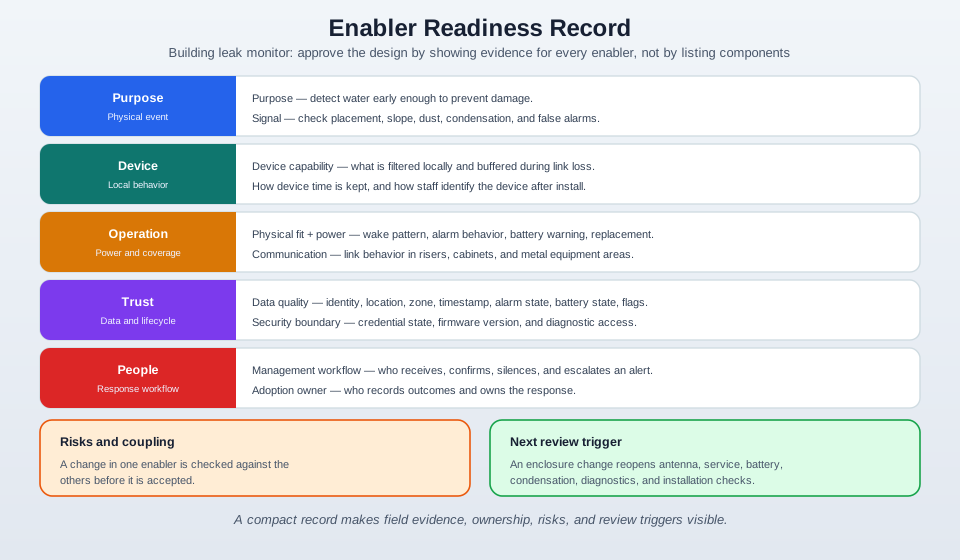
Before committing resources to an IoT project, systematically evaluate all four enablers. Failure in ANY dimension makes deployment impractical.

Enabler 1 - Computing Power:

  • Red flag: “We’ll send all raw data to cloud” without considering bandwidth/cost at scale

Enabler 2 - Miniaturization & Cost:

  • Red flag: “Cost doesn’t matter for MVP” – it matters at 10,000 units

Enabler 3 - Energy Management:

  • Red flag: “We’ll figure out power later” – power budget drives all hardware decisions

Enabler 4 - Communications:

  • Red flag: “We’ll use 5G because it’s latest” – massive overkill for 50-byte sensor readings

Quick Go/No-Go Assessment:

Project Example Computing Size Power Comms Verdict
Soil moisture sensor (farm, 5-year battery) ✓ Simple (ESP32) ✓ Buried (50mm) ✓ 1.2 years calc ✓ LoRa 10km GO
Video doorbell (mains power, AI face detection) ✓ Pi 4 (Linux + ML) ✓ Outdoor rated ✓ Mains available ✓ Wi-Fi in-home GO
GPS pet collar (weekly charge, real-time tracking) ✓ nRF52 BLE + GPS ✓ Wearable (30mm) ✗ 2-day battery only ✓ Cellular + BLE NO-GO (power)
Industrial vibration monitor (permanent install) ✓ STM32 + FFT ✓ DIN rail mount ✓ Mains + backup ✓ Modbus RS-485 GO

For the pet collar example (NO-GO):

  • Problem: GPS (30 mA) + Cellular (200 mA peak) = 8 mA average with aggressive duty cycling → 2000 mAh / 8 mA = 10 days maximum, not 7 days with margin
  • Solutions: (1) Use BLE + phone app (offload GPS to phone) = 0.5 mA average = 160 days, (2) Use LoRa + gateway at home = 0.2 mA average = 400 days, or (3) Accept daily charging requirement

GPS power budget breakdown for 5-minute tracking intervals:

\[ I_{\text{avg}} = \frac{t_{\text{GPS}} \times I_{\text{GPS}} + t_{\text{TX}} \times I_{\text{TX}} + t_{\text{sleep}} \times I_{\text{sleep}}}{t_{\text{total}}} \]

GPS fix (30s at 30 mA) + Cellular TX (10s at 200 mA) + Sleep (260s at 0.01 mA):

\[ I_{\text{avg}} = \frac{(30 \times 30) + (10 \times 200) + (260 \times 0.01)}{300} = \frac{900 + 2000 + 2.6}{300} = 9.67 \text{ mA} \]

Battery life: \(2000 / 9.67 = 207\) hours \(= 8.6\) days (fails 7-day weekly charge requirement).

BLE solution: \(I_{\text{avg}} = 0.5\) mA → \(2000 / 0.5 = 4{,}000\) hours \(= 166\) days ✓

Common Failure Modes:

  1. Overengineering computing: Using Raspberry Pi ($50, 2.5W) when ESP32 ($5, 0.01W sleep) suffices
  2. Underestimating power: Assuming 99% sleep time without measuring actual wake duration
  3. Wrong protocol selection: Wi-Fi for outdoor sensors (30m range) vs LoRa (10km range)
  4. Ignoring scale economics: $10 component acceptable at 100 units, catastrophic at 10,000 units

Best Practice: Build this assessment into project kickoff. If any enabler fails, STOP and redesign before writing code.

Practice applying the four-enabler framework to real-world scenarios. For each scenario, identify which enabler (if any) fails, and propose a solution.

Scenario 1: Wildlife Tracking Collar

  • GPS location every 5 minutes
  • Cellular connectivity for real-time tracking
  • Collar weight < 200g (for medium-sized mammals)
  • Budget: $150 per collar
  • Battery life target: 6 months

What to analyze:

  1. Calculate power budget: GPS (30 mA warm-up for 30s) + cellular (200 mA transmit for 3s) every 5 minutes = ? average mA
  2. Battery capacity needed for 6 months at that current = ? mAh
  3. Battery weight for that capacity (lithium: ~15 mAh per gram) = ? grams
  4. Does the battery fit in the 200g weight budget?
  5. If not, what enabler fails (miniaturization/energy) and what’s the fix (longer transmit interval, WiFi tracking zones, energy harvesting)?

Scenario 2: Smart Parking Sensor

  • Detects car presence (ultrasonic or magnetic sensor)
  • Reports occupancy changes immediately (< 1 second latency)
  • Embedded in pavement (no solar, 10-year battery target)
  • Range: 100m to gateway
  • Cost target: $20 per sensor

What to analyze:

  1. Why does “immediate reporting” conflict with “10-year battery”? (Hint: radio must stay on to receive commands)
  2. Which communication protocol supports low power + 100m range + < 1s latency? (BLE? LoRa? Zigbee?)
  3. Can you achieve 10-year battery with immediate response, or must you compromise to “report within 30 seconds”?
  4. Calculate: if sleeping 99.9% at 10 uA and waking every 30s to check for changes, how does battery life compare to always-listening mode at 15 mA?

Expected insight: These exercises reveal that enabler constraints often force design tradeoffs. True IoT systems balance all four dimensions rather than optimizing one.

Concept Relationship Connected Concept
Duty Cycling Reduces average current by Sleep Modes – devices sleep 99%+ of time, waking briefly for sensing/transmission
Edge Processing Minimizes bandwidth by Data Reduction – process raw readings into actionable summaries before transmitting
LoRaWAN Enables long-range coverage via Sub-GHz Radio – 868/915 MHz frequencies penetrate obstacles better than 2.4 GHz
Miniaturization Lowers deployment cost through System-on-Chip Integration – combining CPU, radio, sensors on single die reduces BOM count
Energy Harvesting Extends operational lifetime by Solar/Thermal/Vibration – converting ambient energy eliminates battery replacement
Protocol Selection Must balance trade-offs between Range, Power, Data Rate – no single protocol optimizes all three simultaneously

24.9 See Also

24.10 Chapter Summary

This chapter introduced the foundational concepts behind IoT architectural enablers:

  • IoT evolved through five Internet phases: from connecting computers (1960s-80s) through the World Wide Web, mobile Internet, and social Internet to the Internet of Things (2015+), each phase building on the infrastructure of the previous one.

  • Four core enablers made IoT viable: computing power (tiny, powerful processors), miniaturization (small, cheap sensors), energy management (multi-year battery life), and communications (diverse wireless protocols). Their simultaneous convergence in the 2010s created the conditions for billion-device networks.

  • IoT products are architecturally distinct from embedded and connected products. True IoT requires intelligent optimization, autonomous decision-making, and data-driven learning – capabilities that depend on all four enablers working together.

  • Feasibility depends on checking all four dimensions: any IoT system proposal should be evaluated against computing, size/cost, energy, and connectivity requirements. If any single enabler falls short, the deployment becomes impractical.

  • Total cost of ownership matters more than component cost: battery replacement labor, connectivity fees, and maintenance schedules can dwarf initial hardware costs. Energy harvesting and protocol selection decisions have long-term financial consequences.

24.11 What’s Next

Direction Chapter Focus
Next IoT Evolution and Enablers Overview Detailed history, product type comparisons, and real-world case studies
Related IoT Communications Technology PAN, LAN, MAN, and WAN protocol deep dives with comparison tables
Related Technology Selection and Energy Management Decision frameworks, power budget calculations, and energy harvesting design
Related Labs and Assessment Hands-on labs for technology selection, energy system design, and UART implementation