9 Reference Architecture Intro
9.1 Learning Objectives
By the end of this chapter, you will be able to:
- Define what a reference architecture is and justify why it matters for IoT systems
- Compare 3-layer and 5-layer architecture approaches using coordination cost analysis
- Determine when to use different architectural complexity levels based on team size and scale
- Apply the blueprint analogy to reason about architecture pattern selection
9.2 Prerequisites
Before diving into this chapter, you should be familiar with:
- IoT Reference Models: Understanding the Seven-Level IoT Reference Model provides a foundation for comparing different reference architectures and their layer organizations
- Architectural Enablers: Familiarity with the enabling technologies (compute, miniaturisation, energy, connectivity) helps you reason about trade-offs when choosing a reference architecture
Key Concepts
- Reference Architecture: A validated, reusable architectural template providing standard component definitions and interaction patterns for a class of IoT systems, reducing design risk and enabling best-practice adoption
- Layered Architecture: An architectural style organizing IoT system components into horizontal layers (perception, network, platform, application) each with defined responsibilities and standardized interfaces to adjacent layers
- IoT Gateway: A device bridging constrained IoT devices to cloud infrastructure, providing protocol translation, local processing, device management, and security boundary enforcement
- Data Pipeline: The sequence of processing stages (ingestion, filtering, transformation, storage, analytics) through which IoT sensor data flows from device to actionable insight
- Interoperability: The ability of IoT devices, gateways, and platforms from different vendors to exchange data and commands using standardized protocols and data models without custom integration
- Architectural Constraint: A requirement that limits IoT design options — latency budgets rule out cloud processing for real-time control, bandwidth budgets rule out raw video streaming over LPWAN, power budgets rule out always-on cellular
9.3 Getting Started (For Beginners)
9.3.1 What’s Next
| If you want to… | Read this |
|---|---|
| See key IoT reference models compared | Key IoT Reference Models |
| Learn how to select the right architecture | Architecture Selection Framework |
| Explore real-world application architectures | Architecture Applications |
| Study common architectural mistakes | Common Pitfalls and Best Practices |
| Go deeper on IoT reference models | IoT Reference Models |
9.4 Choosing Between 3-Layer and 5-Layer Architectures
Decision context: When designing an IoT system, choosing between simpler (3-layer) and more detailed (5-layer) reference architectures affects development complexity, team communication, and system modularity.
| Factor | 3-Layer Architecture | 5-Layer Architecture |
|---|---|---|
| Layers | Perception, Network, Application | Perception, Transport, Processing, Application, Business |
| Complexity | Lower - easier to understand and implement | Higher - more detailed separation of concerns |
| Team Size | Small teams (2-5 developers) | Large teams (10+ developers with specialists) |
| Modularity | Coarse-grained - tightly coupled components | Fine-grained - independent, replaceable layers |
| Documentation | Minimal layer interfaces needed | Extensive interface specifications required |
| Flexibility | Less flexible - changes ripple across layers | More flexible - isolated layer modifications |
Choose 3-Layer Architecture when:
- Building prototypes or MVPs with small teams
- System scope is well-defined and unlikely to change
- Time-to-market is critical
- Team members are generalists who handle multiple concerns
Choose 5-Layer Architecture when:
- Building enterprise or production systems at scale
- Multiple teams work on different system components
- Requirements are complex with distinct processing and business logic
- System needs to evolve with independent layer upgrades
- Regulatory compliance requires clear separation (e.g., data processing vs. business rules)
Default recommendation: Start with 3-Layer Architecture for prototypes and small deployments. Migrate to 5-Layer Architecture when your system grows beyond what a single team can manage, or when you need to replace individual components (e.g., swap cloud providers, change analytics engines) without affecting other layers.
Scenario: A logistics company plans to track 2,500 delivery trucks with GPS sensors reporting location every 30 seconds. They need a system operational in 4 months with a team of 6 developers (4 full-stack, 1 data scientist, 1 DevOps). The platform must display real-time truck locations, analyze historical routes for optimization, and send alerts when trucks deviate from planned routes.
Requirements Analysis:
| Requirement | Impact on Architecture |
|---|---|
| Real-time display | Application layer needs immediate data access |
| Route optimization | Separate analytics processing (ML models) |
| Alert generation | Business logic for rule-based actions |
| 4-month deadline | Time constraint favors simpler architecture |
| 6 developers, generalists | Team can handle integrated approach |
| 2,500 devices | Moderate scale, doesn’t require horizontal scaling yet |
Option A: 3-Layer Architecture
Layer 1 - Perception: GPS sensors in trucks
Layer 2 - Network: Cellular (LTE) → Cloud MQTT broker
Layer 3 - Application: Combined processing + UI
  - Single codebase handles: data ingestion, route analysis,
    alerts, and dashboard
- ML models embedded in application servicesPros: 6 developers can work together, shared codebase reduces integration work, 4-month timeline achievable, simpler deployment (single application stack).
Cons: Updating ML models requires full application redeployment, scaling analytics independently not possible, tight coupling between components.
Option B: 5-Layer Architecture
Layer 1 - Perception: GPS sensors in trucks
Layer 2 - Transport: Cellular (LTE) → Cloud MQTT broker
Layer 3 - Processing: Dedicated analytics service
  - Independent ML pipeline for route optimization
Layer 4 - Application: UI and data visualization services
Layer 5 - Business: Alert rules and dispatch logicPros: ML team works independently, analytics scale separately from UI, business rules evolve without touching transport layer.
Cons: 3 separate teams needed (likely split the 6 developers, reducing velocity), inter-service communication adds latency, 4-month timeline becomes 6-8 months due to integration overhead.
Decision: Choose 3-Layer for this scenario. The moderate scale (2,500 trucks), tight timeline (4 months), and generalist team (6 developers) align perfectly with a monolithic approach. The company can refactor to 5-layer architecture in Year 2 when they scale to 25,000 trucks and hire specialized teams.
What to Observe: Monitor development velocity. If the team starts blocking on shared codebase (e.g., ML scientist waiting for DevOps to deploy model updates), that’s the signal to split into a 5-layer architecture. Target trigger point: when one service (analytics) needs redeployment more than 2x per week.
Let’s quantify the coordination overhead of 5-layer vs 3-layer architecture for the fleet tracking scenario.
Coordination cost formula: For N layers requiring integration, the number of interface contracts is:
\[C = \frac{N(N-1)}{2}\]
3-Layer Architecture:
\[C_{3} = \frac{3 \times 2}{2} = 3\text{ interfaces}\]
Interfaces: Perception↔︎Network, Network↔︎Application, Application-internal APIs
5-Layer Architecture:
\[C_{5} = \frac{5 \times 4}{2} = 10\text{ interfaces}\]
Interfaces include all layer pairs: Perception↔︎Transport, Transport↔︎Processing, Processing↔︎Application, Application↔︎Business, plus cross-cutting concerns (Perception→Processing for raw data, Transport→Business for alerts).
Integration overhead per interface: ~2 person-weeks (API design, testing, documentation)
\[T_{3} = 3 \times 2\text{ weeks} = 6\text{ person-weeks} = 1.5\text{ months (with 4 developers)}\]
\[T_{5} = 10 \times 2\text{ weeks} = 20\text{ person-weeks} = 5\text{ months (with 4 developers)}\]
Time to MVP: 3-layer = 4 months baseline + 1.5 months integration = 5.5 months. 5-layer = 4 months baseline + 5 months integration = 9 months (64% longer!).
Conclusion: For a 6-developer team with 4-month deadline, the 5-layer architecture’s 3.5-month penalty makes it infeasible. The formula \(C = \frac{N(N-1)}{2}\) explains why complexity grows quadratically—adding 2 layers increases interfaces from 3 to 10 (233% more work).
The Mistake: A startup with 3 developers building a smart home MVP chooses a 5-layer architecture because “enterprise systems use microservices.” They create separate Docker containers for device management, data ingestion, processing, application logic, and business rules. Result: 9 months to MVP instead of 3 months, excessive complexity for 150 initial devices, and 80% of engineering time spent on Kubernetes configuration rather than features.
Why It Happens: Developers read about microservices benefits (Netflix, Amazon) and assume they apply at all scales. They confuse “production-ready” with “enterprise-scale.” Management sees the word “scalable” and assumes it means better.
How to Avoid: Apply the 10x Rule — you need a 5-layer architecture when you’re planning to scale 10x in the next 12 months OR when you have 10+ developers working on the codebase. Below these thresholds, the coordination overhead of multiple layers exceeds the benefits. Start with 3 layers for prototypes and small production systems (up to 10,000 devices). Refactor when you hit concrete pain points (team coordination blockers, scaling limits), not based on theoretical future needs.
Fix Path: If you’ve already over-engineered, consolidate layers gradually. Merge Business + Application layers first (reduces services from 5 to 4), then merge Processing into Application if it’s not independently scaled. Track deployment frequency and latency — if services deploy together 90% of the time, they should BE together.
9.5 Real-World Example: Smart City Architecture
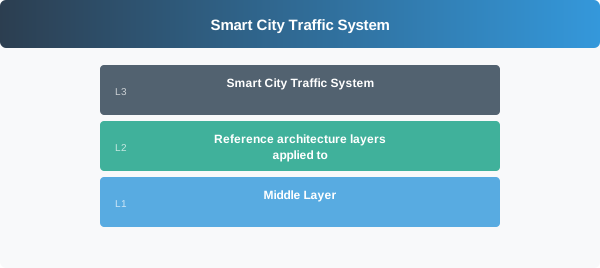
How do these architectures help? Consider a smart city traffic system:
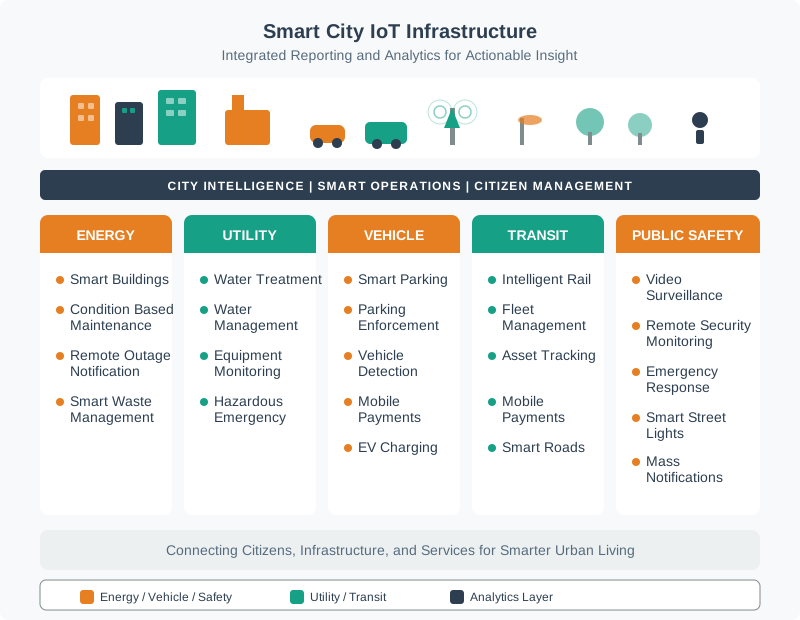
Source: Stanford University IoT Course - Smart City integrated architecture demonstrating how IoT reference models map to real-world urban deployments across multiple domains
9.6 Self-Check: Understanding the Basics
Before continuing, make sure you can answer:
- What is a reference architecture? → A standardized framework/blueprint for building IoT systems
- Why not just design ad-hoc? → Leads to incompatibility, poor scalability, and security gaps
- What does ITU-T focus on? → Telecom-oriented IoT (smart cities, 5G integration)
- How many layers does WSN typically use? → Three layers (Perception, Network, Application)
In one sentence: Reference architectures like ITU-T, IoT-A, and WSN provide proven blueprints that ensure interoperability, clear security boundaries, and scalable design - choosing the right one depends on your focus (telecom, enterprise, or sensor networks).
Remember this rule: Always select a reference architecture before designing your IoT system - ad-hoc designs lead to vendor lock-in, integration nightmares, and security gaps that are expensive to fix later.
IoT Architecture is like building a team where everyone has a special job!
9.6.1 The Sensor Squad Adventure: Building the Ultimate Treehouse
Imagine the Sensor Squad wants to build the most amazing smart treehouse ever! But they quickly realize they need a plan - a blueprint - so everyone knows what to do.
Sunny the Light Sensor says, “I’ll watch for daylight and turn on the treehouse lights when it gets dark!” Thermo the Temperature Sensor adds, “I’ll check if it’s too hot or cold inside!” Motion Mo the Motion Detector wants to guard the entrance: “I’ll let everyone know when friends arrive!” But wait - how will they all talk to each other? That’s where Signal Sam the Communication Expert comes in: “I’ll make sure everyone’s messages get to the right place!” And Power Pete the Battery Manager reminds everyone: “Don’t forget - we need to save energy so our batteries last all day!”
The Sensor Squad learned that building something amazing works best when you have a reference architecture - a master plan that shows where everyone fits. Just like a sports team has positions (goalkeeper, midfielder, striker), an IoT system has layers (sensors, network, application). Without a plan, Sunny might try to do Thermo’s job, messages would get lost, and the whole treehouse would be chaos!
9.6.2 Key Words for Kids
| Word | What It Means |
|---|---|
| Reference Architecture | A master plan that shows how all the parts of an IoT system work together |
| Layer | A group of team members who do similar jobs, like all the sensors being on one “team” |
| Interoperability | When different devices can talk to each other and work together, like friends who speak the same language |
9.6.3 Try This at Home!
Draw your own “smart room” blueprint! On a piece of paper, make three sections (layers):
- Bottom layer - The Sensors: Draw circles for things that sense (thermometer, light bulb, motion sensor)
- Middle layer - The Messengers: Draw lines showing how sensors send messages to a central hub (like a walkie-talkie)
- Top layer - The Brain: Draw a computer or phone that receives all the information and makes decisions
Now you’ve created your own reference architecture! Show a family member and explain what each layer does.
Understanding how data flows between architectural layers prevents common integration mistakes.
Layer Interface Contract (using ITU-T Y.2060 as example):
Device Layer → Network Layer:
- Device Layer provides: Raw sensor readings (JSON/binary), device metadata (ID, type, location)
- Network Layer expects: Standardized message format with timestamp, units, quality indicators
- Interface: MQTT topic
devices/{deviceId}/telemetrywith payload{"temp": 22.5, "unit": "C", "ts": 1704067200}
Network Layer → Service Support Layer:
- Network Layer provides: Reliable message delivery, protocol translation (MQTT → HTTP)
- Service Support Layer expects: Messages in cloud-native format (protobuf, Avro) with authentication tokens
- Interface: REST API
POST /api/v1/telemetrywith OAuth2 bearer token in header
Service Support Layer → Application Layer:
- Service Support Layer provides: Aggregated data, business rules applied, alerts generated
- Application Layer expects: High-level events (not raw sensor data) with context
- Interface: Webhook
POST /webhooks/temperature-alertwith payload{"location": "Zone A", "severity": "high", "action": "dispatch_technician"}
Key Insight: Each layer speaks a different “language” (protocol + data model). Clean layer boundaries require explicit translation at each interface. Violating this (e.g., embedding MQTT topic names directly in application code) creates brittle systems that break when network layer changes.
Anti-pattern Example: Hard-coding AWS IoT ARNs in device firmware (from Layer 1 directly accessing Layer 4 details) prevents switching cloud providers without firmware updates to thousands of devices.
Objective: Map a smart greenhouse system to a 3-layer reference architecture.
System Requirements:
- 50 soil moisture sensors (I2C, report hourly)
- 10 temperature/humidity sensors (I2C, report every 5 minutes)
- 5 water valve actuators (GPIO, receive on-demand commands)
- Farmer’s mobile app (iOS/Android, view sensor data + control valves)
Your Task: Fill in this architecture mapping:
Layer 1 - Perception (Physical Devices):
- Sensors: _____
- Actuators: _____
- Gateways: _____
Layer 2 - Network (Connectivity):
- Sensor-to-gateway protocol: _____
- Gateway-to-cloud protocol: _____
- Topology: _____
Layer 3 - Application (Business Logic):
- Data storage: _____
- Business rules (e.g., “Open valve when soil moisture < 30%”): _____
- User interface: _____
What to Observe:
- If you change from Wi-Fi to LoRaWAN in Layer 2, does Layer 1 or Layer 3 need to change? (Answer: No, if clean interfaces!)
- If you swap from AWS IoT to Azure IoT Hub in Layer 3, does Layer 1 need firmware updates? (Answer: No, only Layer 2 gateway config changes)
Extension: Now try mapping the same system to a 5-layer architecture (Perception, Transport, Processing, Application, Business). Where does the “soil moisture < 30% → open valve” rule go in 5-layer? (Answer: Processing Layer, not Application!)
Common Pitfalls
Reference architectures like the IoT-A and ITU-T Y.2060 are guidance frameworks, not specifications. Implementing them verbatim without adapting to your specific constraints (budget, latency, connectivity) leads to over-engineered systems. Use them as starting checklists and customize the layers that matter most for your use case.
The 3-layer model (Perception, Network, Application) is a teaching abstraction; the 5-layer model adds Processing and Business layers for production systems. Using the 3-layer model for a production deployment omits critical concerns like edge processing and business rule management. Choose the granularity that matches your operational complexity.
Many IoT protocols (Zigbee, BLE, LoRa) cannot connect directly to cloud services and require a gateway. Architects who overlook the gateway layer end up with ungrouped sensors that cannot report data. Map every device’s connectivity stack and ensure each protocol has a gateway or concentrator in the architecture.
A 3-layer architecture routing all data to the cloud works for low-frequency data from a few hundred sensors, but fails for high-frequency industrial data from thousands of sensors. Edge processing (adding a 4th layer) can reduce cloud traffic by 90%+ through local aggregation and filtering. Evaluate data volume and latency requirements before choosing cloud-first.
9.7 Summary
Reference architectures are essential blueprints for building IoT systems that can grow, interoperate, and remain secure. The key points from this introduction:
- Reference architectures provide standardized patterns that ensure devices from different vendors can work together
- 3-layer architectures are ideal for small teams and prototypes; 5-layer architectures suit enterprise deployments
- The three major frameworks (ITU-T, IoT-A, WSN) each address different deployment contexts
- Starting with a reference architecture - even a simplified one - makes future scaling dramatically easier
9.8 Concept Relationships
| Concept | Relationship | Connected Concept |
|---|---|---|
| 3-Layer Architecture | Suitable for | Small teams (2-5 developers) and well-defined scope prototypes |
| 5-Layer Architecture | Required when | Multiple teams (10+) need independent component evolution |
| Reference Architecture | Provides | Common vocabulary for cross-team communication and vendor interoperability |
| Layer Boundaries | Enable | Independent upgrades (swap cloud provider without changing device firmware) |
| ITU-T Y.2060 | Optimized for | Telecom-integrated deployments (5G, LTE-M, NB-IoT connectivity) |
| IoT-A | Excels at | Multi-stakeholder systems with complex access control (hospitals, smart cities) |
| WSN Architecture | Focuses on | Energy-efficient routing and duty cycling for battery-powered sensor networks |
9.9 See Also
Architecture Deep Dives:
- Key Reference Models - Detailed exploration of ITU-T, IoT-A, and WSN architectures
- Architecture Selection Framework - Systematic criteria for choosing the right architecture
- Real-World Applications - Industrial, environmental, and smart city case studies
System Design:
- Edge-Fog Computing - Multi-tier processing architectures and layer placement decisions
- IoT Reference Models - Seven-layer IoT model providing additional perspective on layer responsibilities
Avoiding Mistakes:
- Common Pitfalls and Best Practices - Layer boundary violations and architecture rigidity anti-patterns
9.10 Knowledge Check
9.11 What’s Next
| If you want to… | Read this |
|---|---|
| Explore key IoT reference models in depth | Key IoT Reference Models |
| Learn how to select the right architecture | Architecture Selection Framework |
| Study the seven-layer IoT reference model | IoT Reference Models |
| See real-world application architectures | Architecture Applications |
| Learn from common architectural mistakes | Common Pitfalls and Best Practices |