Frame the application
State the purpose, users, operating environment, response needs, data lifecycle, and failure tolerance before naming technology.
Progress saves as you read. Mark sections complete as you go; your progress appears in the sidebar.
This section: Start With the System Someone Must Run — Picture a team that must run a sensor service after the demo ends.
Picture a team that must run a sensor service after the demo ends. Someone must own each alert, update, data path, and repair.
First, write the user task and the few flows that make it work. Then map each job to a clear owner and a check that can prove it.
A broad model can reveal missing work, but it can also hide local needs. A narrow model is easy to read, but it may leave out a key risk.
Assign each layer and owner from the application flow and local constraints, then record where the reference map changes.
Use the Practitioner section to turn the model into a testable record. Use Under the Hood to inspect overlays, drift, and hidden bounds in more depth.
Plain check
A reference architecture matters when it helps someone operate the system after the demo. Imagine a facilities team that must onboard devices, watch alerts, patch gateways, answer audit questions, and explain why a command did or did not run.
Use application examples to connect architecture patterns to those operating jobs. The point is not to copy a smart-home, factory, healthcare, or city diagram. The point is to see which responsibilities repeat and which evidence must be present before the pattern is trustworthy.
This section: Model to Application Decision — A reference architecture is a reusable way to discuss responsibilities.
A reference architecture is a reusable way to discuss responsibilities. An application architecture is the decision record that says how those responsibilities work in a specific building, factory, field deployment, fleet, or shared platform.
The practical move is to start from the application, not from the diagram. Name what the system senses, controls, reports, and maintains. Then choose the smallest reference model that makes device, connectivity, edge, data, application, and operations responsibilities visible.
For a soil-moisture system, the same reference layers mean different things than they do in a smart building. Sparse coverage makes buffering and freshness limits part of the architecture. Technician alerts make ownership and escalation part of the architecture. Battery replacement and sensor calibration make maintenance evidence part of the architecture. The model helps only after those application pressures are named.
The overview record should therefore state the application outcome, the flows that prove it, and the condition that would force the team to revisit the mapping.
That condition prevents silent drift.
If you only need the overview, remember this: a useful application architecture connects the user workflow to layer ownership, flow evidence, and a trigger for reopening the decision when conditions change.
Make the model to application decision premise visible in the diagram Figure 5.1: Apply the reference model by framing the application workflow, choosing the smallest useful model, adding domain pressure, assigning layer owners, tracing operating flows, and recording the evidence and reopen trigger. Begin by distinguishing Turn The Reference Model Into An Application Record from Device, network, edge, data.
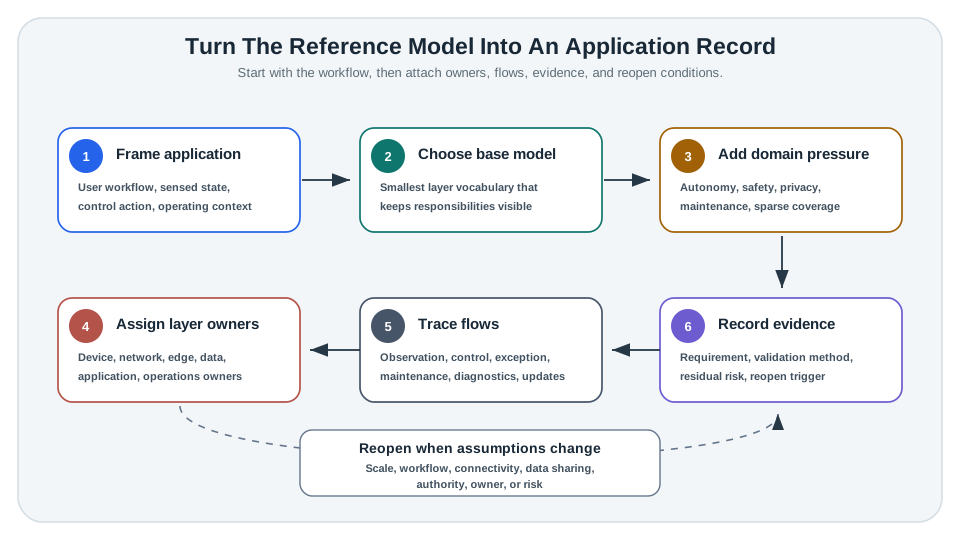
Before using this part of the method, inspect Figure 5.1 to make model to application decision concrete. The visual is worth pausing on because its caption identifies the intended design point: Apply the reference model by framing the application workflow, choosing the smallest useful model, adding domain pressure, assigning layer owners, tracing operating flows, and recording the evidence and reopen trigger.
Read Figure 5.1 as an ordered review, not as decoration. Start at the first input or condition, follow the arrows through each intermediate responsibility, and finish at the evidence, decision, or operating outcome. In concrete terms, look for Six-step route from application workflow framing through base-model choice, domain pressure, layer ownership, flow tracing, evidence recording, and assumption-based reopening. That sequence explains why Apply the reference model by framing the application workflow, choosing the smallest useful model, adding domain pressure, assigning layer owners, tracing operating flows, and recording the evidence and reopen trigger. Carry the result into the running narrative by recording the claim, boundary, evidence, owner, and next recheck in the architecture record.
State the purpose, users, operating environment, response needs, data lifecycle, and failure tolerance before naming technology.
Use the simplest model that explains the important responsibilities and boundaries without hiding a major risk.
Capture domain pressure such as autonomy, safety, privacy, maintenance access, sparse connectivity, or shared ownership.
Link the architecture choice to a requirement, owner, validation method, residual risk, and reopen trigger.
This section: Application Architecture Record — The practitioner task is to turn the model into a concise record that another reviewer can use.
The practitioner task is to turn the model into a concise record that another reviewer can use. The record should be specific enough to test, but small enough to maintain as the system evolves.
Start with a flow inventory. Telemetry, alerting, commands, configuration, diagnostics, updates, and operator workflows often need different placement. One application can legitimately mix local control, gateway buffering, cloud analytics, and enterprise reporting.
Write each flow as a responsibility chain rather than a technology chain. For occupancy-to-HVAC control, the chain might be sensor quality, local occupancy state, climate rule, actuator command, cloud summary, operator override, and incident review. The record should say which links can fail independently and which layer owns the proof for each link.
That chain becomes the review checklist.
Before using this part of the method, inspect Figure 5.2 to make application architecture record concrete. The visual is worth pausing on because its caption identifies the intended design point: Different application domains reuse the same layer vocabulary while changing the response need, data proof, owner boundary, risk trigger, and review evidence.
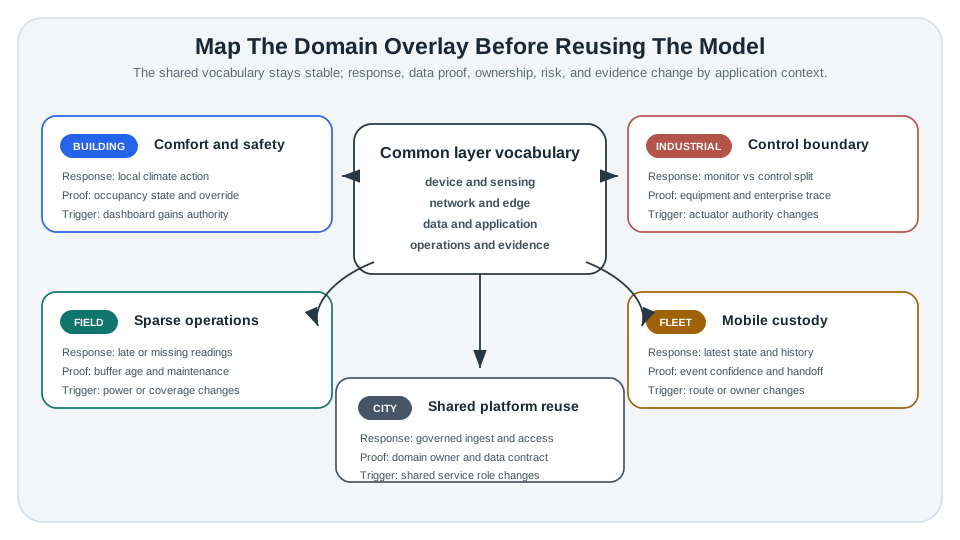
Read Figure 5.2 as an ordered review, not as decoration. Start with the headings or compared options, scan the rows or panels in their presented order, and finish by checking which evidence or constraint changes the decision. In concrete terms, look for Domain overlay map for applying an IoT reference architecture across smart building, industrial, field monitoring, fleet, and city platform contexts. That sequence explains why Different application domains reuse the same layer vocabulary while changing the response need, data proof, owner boundary, risk trigger, and review evidence. Carry the result into the running narrative by recording the claim, boundary, evidence, owner, and next recheck in the architecture record.
Physical measurement to gateway validation, ingestion, storage, abstraction, dashboard, and review record.
User, automation, or rule decision to command validation, dispatch, actuator action, confirmation, and rollback path.
Fault, missing data, threshold breach, suspicious state, or late message to triage, escalation, and closure evidence.
Configuration, calibration, firmware update, device replacement, access-policy change, and audit record.
This section: Boundaries, Overlays, and Evidence Drift — The hard part of applying a reference architecture is that one deployed component may carry several logical responsibilities.
The hard part of applying a reference architecture is that one deployed component may carry several logical responsibilities. A gateway might validate measurements, buffer outages, run local rules, translate protocols, enforce identity, and forward evidence. The review should follow responsibilities, not just boxes.
Domain overlays make those responsibilities visible. A smart building overlay highlights comfort and safety behavior. An industrial overlay separates monitoring from control authority. A field-monitoring overlay exposes power, sparse connectivity, late data, and maintenance intervals. A fleet overlay handles mobile coverage and event confidence. A city platform overlay separates shared services from departmental ownership.
Concrete deployments show why the overlay distinction matters. A smart-home deployment can connect Matter devices over Wi-Fi, Ethernet, or Thread, expose Zigbee or Z-Wave devices through a supported bridge, and use Bluetooth Low Energy for setup; the architecture review should identify controller, border-router, bridge, security, and patching responsibilities for the chosen products. A city-platform overlay adds structure at the opposite scale: service domains such as electrical power, traffic control, and emergency or medical services reach a shared IP core network through border routers, a firewall, and an intrusion-prevention system before landing in a data center or cloud and an operations center that several departments share. The industrial overlay is a different pressure again. Industrial IoT (IIoT) applies connected sensing, communication, and control to industrial assets and operations, including facilities and distributed infrastructure. Its architecture often emphasizes efficiency, safety, security, and machine-to-machine communication. An industrial overlay should identify which system has monitoring and control authority, while a smart-home overlay should also name any safety-critical control boundary.
Evidence drift happens when one of those overlays changes without a matching architecture review. A dashboard may gain command authority, a gateway may start making local decisions, a data pipeline may drop quality flags, or a support team may inherit a workflow it did not design. The under-the-hood record should preserve the logical responsibility even when the physical component stays the same, so reviewers can see when a new behavior has crossed an old boundary.
That separation is what lets one gateway remain acceptable while one of its responsibilities needs a new test.
Before using this part of the method, inspect Figure 5.3 to make boundaries, overlays, and evidence drift concrete. The visual is worth pausing on because its caption identifies the intended design point: The base model stays useful only when the application overlay names the pressure that changes placement, evidence, ownership, and the condition for reopening the review.
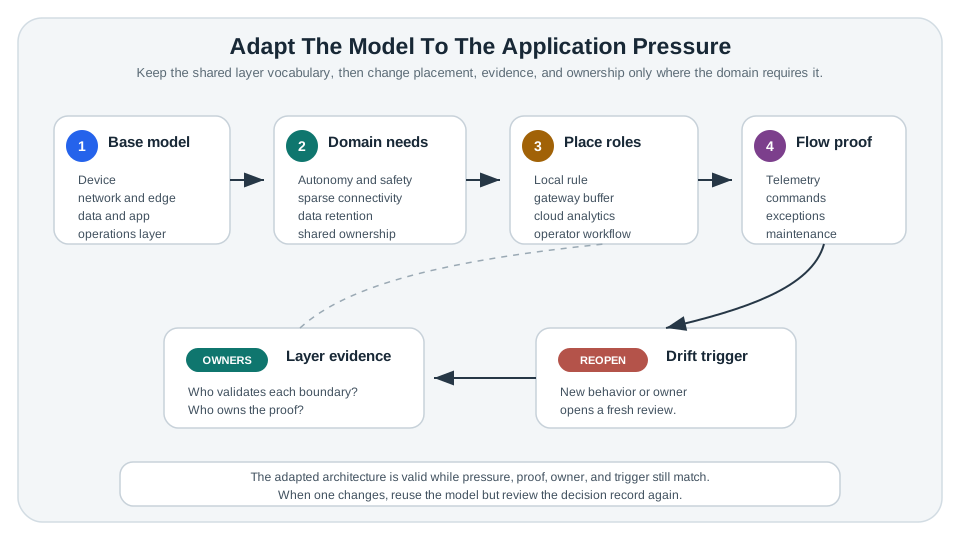
Read Figure 5.3 as an ordered review, not as decoration. Start at the first input or condition, follow the arrows through each intermediate responsibility, and finish at the evidence, decision, or operating outcome. In concrete terms, look for Application architecture adaptation flow showing the base model, domain pressure, placement choice, flow proof, layer evidence, and reopen trigger. That sequence explains why The base model stays useful only when the application overlay names the pressure that changes placement, evidence, ownership, and the condition for reopening the review. Carry the result into the running narrative by recording the claim, boundary, evidence, owner, and next recheck in the architecture record.
A responsibility moves when a gateway gains local rules, a cloud workflow gains authority, or a shared service changes data meaning.
A validation record becomes stale when device behavior, scale, connectivity, ownership, data sharing, or failure assumptions change.
Different teams may use different model names; keep a mapping from local terms to device, network, edge, data, application, and operations responsibilities.
A dashboard, automation rule, or integration should not become a control authority without an explicit boundary review.
Before using this part of the method, inspect Figure 5.4 to make authority drift concrete. The visual is worth pausing on because its caption identifies the intended design point: An evidence record keeps the application architecture reviewable by tying local requirements, owners, boundary decisions, validation evidence, residual risk, and reopen triggers to the drift checks that appear as requirements, owners.
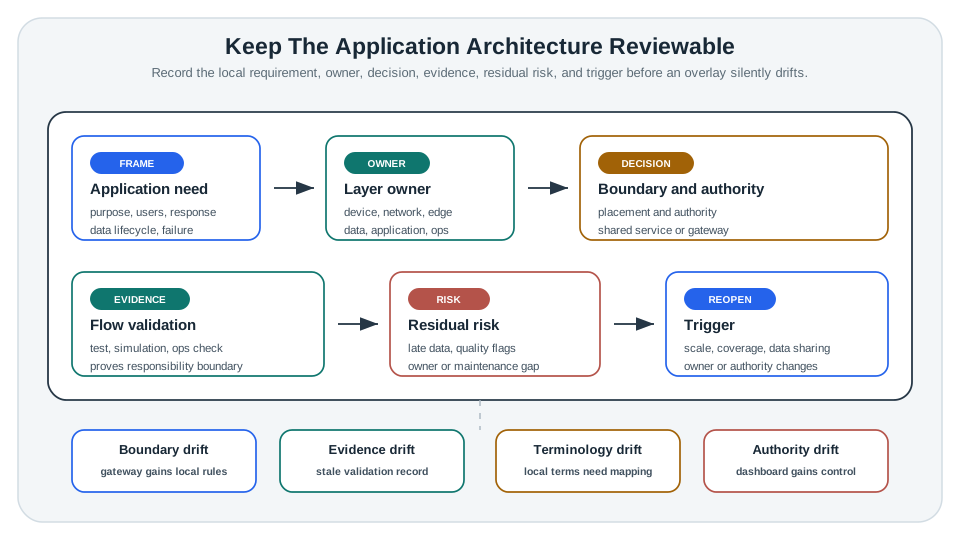
Read Figure 5.4 as an ordered review, not as decoration. Start at the first input or condition, follow the arrows through each intermediate responsibility, and finish at the evidence, decision, or operating outcome. In concrete terms, look for Application architecture evidence record linking the application frame, layer owner, boundary and authority decision, flow validation, residual risk, and reopen trigger while checking boundary, evidence, terminology, and authority drift. That sequence explains why An evidence record keeps the application architecture reviewable by tying local requirements, owners, boundary decisions, validation evidence, residual risk, and reopen triggers to the drift checks that appear as requirements, owners. Carry the result into the running narrative by recording the claim, boundary, evidence, owner, and next recheck in the architecture record.
This section: Summary — Reference architecture applications turn a reusable model into a reviewable design record.
Reference architecture applications turn a reusable model into a reviewable design record. The model supplies layer vocabulary, but the application frame supplies purpose, users, response needs, data handling, operating context, and failure behavior. A useful review adds the domain overlay, assigns layer owners, traces the important flows, and records the evidence that proves each boundary is working.
This section: Key Takeaway
Apply the model to the application before approving the diagram: frame the workflow, map responsibilities, validate the flows that matter, and record the trigger that will reopen the decision.
This section: See Also
3 reviewed answers.
Open the module page from the sidebar to see its chapters in order. Use the module map to return to a topic you need.
Modules and pathsReviewed
Check the symptom, then work through the diagnostic steps. Keep the error message and the smallest example that reproduces it.
When you are stuckReviewed
Use the interactive guide to check how examples and simulations work before changing your project.
Interactive examples guideReviewed