IEEE Link Contract
Review channel use, frame limits, medium access, link addressing, join behavior, sleeping devices, local retries, and link-layer security hooks.
Progress saves as you read. Mark sections complete as you go; your progress appears in the sidebar.
This section: Start With the Certification Question — Imagine a team using an approved radio part in a new home monitor.
Match Each Mark to the Claim It Really Covers
Imagine a team using an approved radio part in a new home monitor. The mark may cover that part in one tested setup. It may not cover the enclosure, whole product, data use, or later software change.
Trace what an approved radio part does and does not prove for the home monitor.

A home monitor uses a radio part that already carries an approval mark.
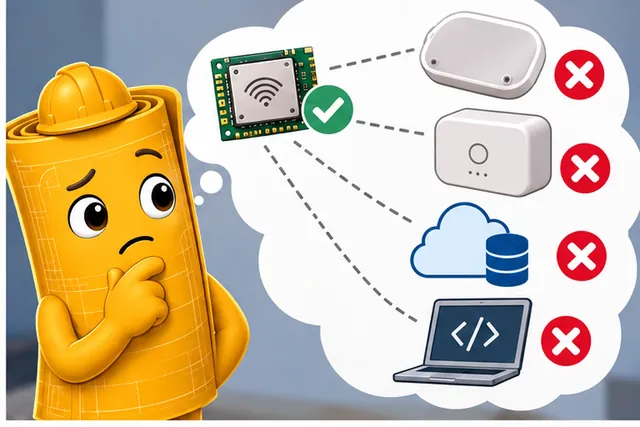
That mark may not cover the case, full product, data use, or later code.

Record each claim, version, test, gap, owner, and recheck trigger.

A changed antenna, case, or built-in software reopens the right proof.
The first panel shows the marked radio part. The second places it beside the case, full product, data use, and code that the mark may not cover. The checklist panel turns each claim into a version, test, gap, owner, and recheck trigger. The last panel changes the antenna, case, or built-in software to show why proof must be checked again. Use that sequence when you fill in the claim table below.
Write the claim and boundary first. A gateway is a unit that links one device group to another network or service. Firmware is the built-in software that controls a device. Telemetry means facts sent so a system can be observed. A broker is a service that receives and routes messages. Message Queuing Telemetry Transport, or MQTT, is a set of rules for sending named messages through a broker. Each part can have a different proof owner.
Make a short table of claim, version, test, result, gap, owner, and recheck trigger. Change the antenna, enclosure, firmware, gateway rule, market, or device profile in a trial copy. Ask which evidence still holds.
The table does not replace a certification body or current legal advice. Practitioner builds the route from shortlist to release. Under the Hood follows changes, inherited evidence, and product-owned gaps across the full life of the system.
Certification planning starts with a simple question: what claim must an outside party be able to trust? It may be interoperability, radio behavior, security posture, safety, privacy, energy performance, or conformance to a domain profile.
Work backward from that claim. The architecture should show which standard applies, which tests generate evidence, which implementation choices affect the result, and what must be preserved when hardware, firmware, network, or cloud components change.
This section: Selection Starts With Boundaries — Standard selection is an architecture decision, not a popularity contest.
Standard selection is an architecture decision, not a popularity contest. A team first names the behavior in scope, the device and network constraints, the ecosystem it must join, and the claim that must be true before release. Certification planning then records what kind of proof is needed for that claim.
The common error is to treat a standard name, profile badge, or certified module as proof for the whole product. Those signals can be useful, but they only apply to the tested feature, version, profile, product boundary, or program scope. The architecture record has to say what remains project-owned.
For example, a smart-building gateway might use a certified radio module, speak BACnet or Modbus toward building systems, expose MQTT telemetry to a cloud service, and support a Matter bridge for selected devices. Those choices are not one decision. The radio evidence may apply to the module and antenna configuration, the building protocol evidence may apply to specific object mappings, the cloud evidence may apply to topic authorization and payload schema, and the ecosystem evidence may apply to a particular device profile and controller version.
A good standards record separates those boundaries before the release plan hardens. It says which team owns each claim, which test or trace proves it, which optional features are excluded, and which changes reopen review. That prevents a late surprise such as a new enclosure affecting radio behavior, a firmware update enabling an optional feature, a bridge changing semantic meaning, or a target market requiring a different proof lane.
The first useful artifact is a short selection table, not a long standards catalogue. Each row should contain the candidate standard or profile, the system boundary it covers, the constraint that made it attractive, the evidence already available, and the remaining project-owned proof. That table makes rejection reasons visible and stops teams from treating "standards-based" as a substitute for architecture evidence.
At selection starts with boundaries, Standards Selection and Certification Route makes the architecture testable. In Figure 9.1, Release Gate frames this claim: Make the route explicit: boundary, proof lane, release gate, record, and recheck trigger. Read it against Standards Selection and Certification Route.
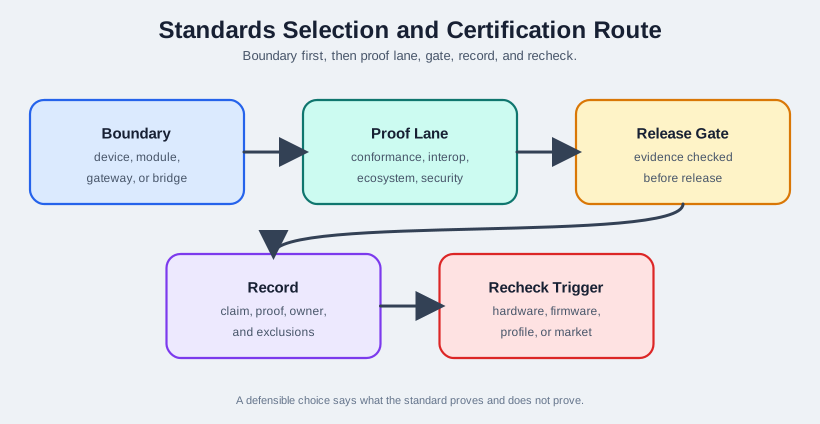
The diagram Figure 9.1 first names Standards Selection and Certification Route, then separates Release Gate from profile, or market. Carry checkpoints Release Gate and profile, or market into selection starts with boundaries with Standards Selection and Certification Route. Their combined proposition is: Make the route explicit: boundary, proof lane, release gate, record, and recheck trigger.
State whether the claim covers a device, radio module, gateway, data model, profile, cloud interface, bridge, or operations workflow.
Check power, memory, timing, payload size, topology, installation environment, update path, and maintainability before preference matters.
Decide whether the selected standard matches the controller, broker, resource model, data model, device profile, and support workflow.
Name the evidence lane, owner, open gap, and change that reopens the selection or certification decision.
If you only need the intuition, this layer is enough: select standards by project boundary and proof scope. A defensible choice explains what the standard proves, what it does not prove, and when the decision must be checked again.
This section: Shortlist to Certification Plan — The practical workflow is to narrow candidate standards before the release gate.
The practical workflow is to narrow candidate standards before the release gate. First remove options that do not fit the device, network, data, ecosystem, or lifecycle constraints. Then decide which proof lane is needed for each surviving claim. A conformance result, interoperability trace, ecosystem profile, security assurance result, or market-access record answers a different question.
The funnel in Figure 9.2 narrows standards before a release claim is made. First name the device, module, gateway, data-model, or bridge boundary. Power, memory, timing, payload, and topology then remove candidates that cannot serve it. Ecosystem fit asks whether the controller, broker, profile, and data model can work together; evidence availability asks which tests, traces, or labs can prove that fit. A release owner and recheck trigger complete the shortlist. Keep a reason for every rejection so a later product or profile change can reopen the choice without repeating an undocumented preference debate.
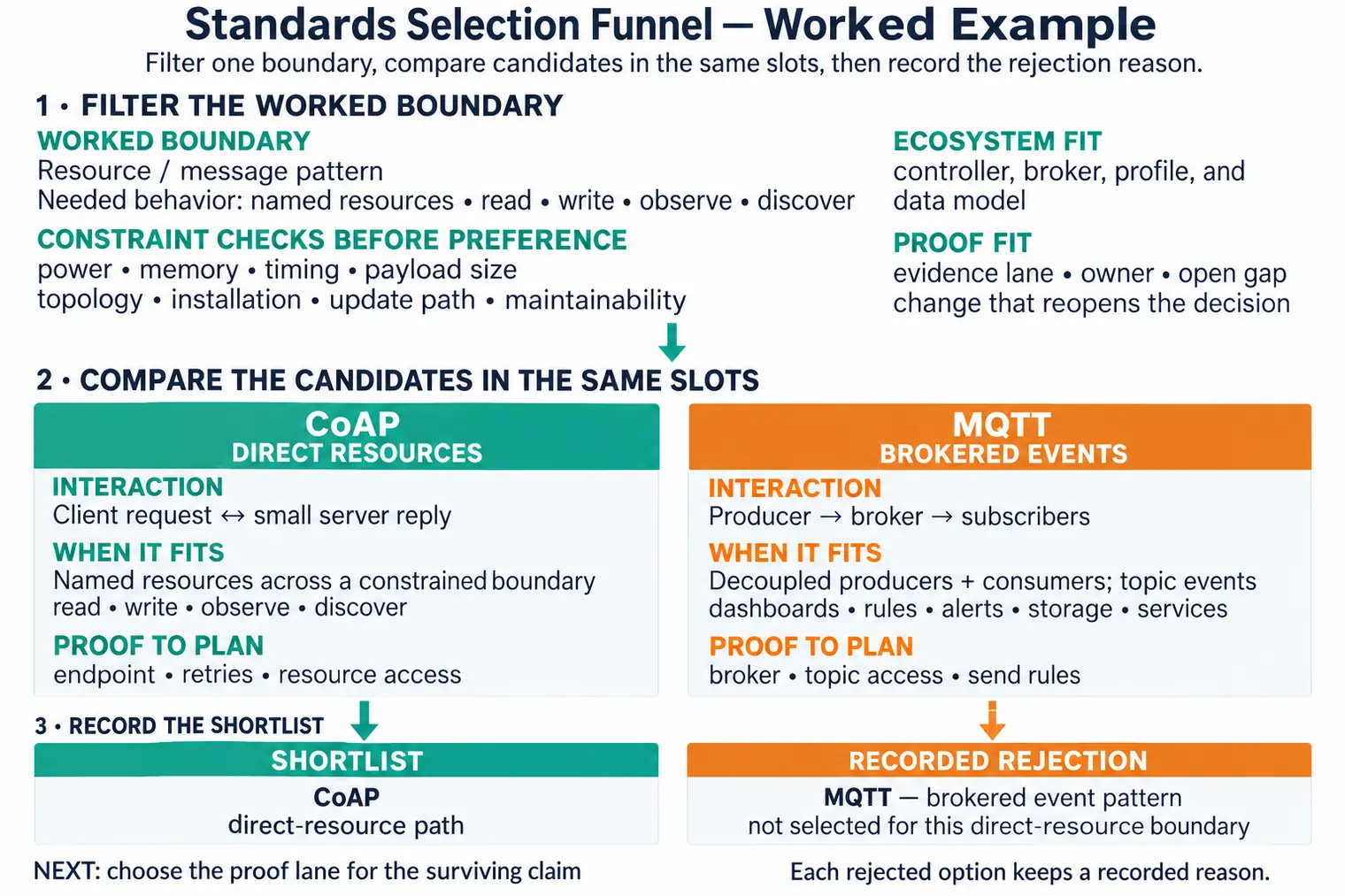
The funnel in Figure 9.2 cuts poor standards from the list; record why each one fails.
The chapter needs visual evidence for shortlist to certification plan. Figure 9.3 provides it: Separate lanes prevent one kind of proof from being stretched across unrelated claims. Examine Certification Evidence Lanes together with correct in the.
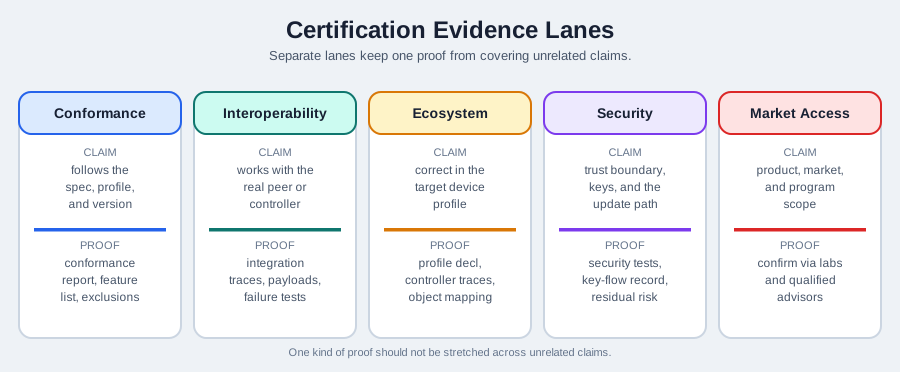
Map Certification Evidence Lanes to the current requirement in Figure 9.3. Map correct in the to the next duty and advisors to the later proof. This continues shortlist to certification plan: Separate lanes prevent one kind of proof from being stretched across unrelated claims.
Market-access obligations depend on product type, target market, radio behavior, integration model, and program scope. Record the need early, then confirm details through qualified advisors, accredited labs, and current program documentation.
This section: Certification Lifecycle Claims — Certification planning remains useful after launch because the claim can drift.
Certification planning remains useful after launch because the claim can drift. Hardware substitutions, firmware changes, optional-feature changes, profile updates, new markets, gateway bridges, and support-process changes can make yesterday's evidence too narrow for today's architecture claim.
The mechanism is versioned scope. A release record should identify the hardware bill of materials, radio module, antenna path, firmware build, protocol stack version, selected profile, optional-feature list, peer or controller versions, data-schema version, gateway bridge rules, and market or program boundary. When one of those fields changes, the team can tell whether the old proof still applies, whether a focused regression is enough, or whether a fresh conformance, interoperability, security, ecosystem, or market-access check is needed.
Consider a gateway that originally passed integration testing for a fixed BACnet object map and a cloud MQTT topic schema. If a later release adds a new object type, changes unit conversion, changes retained-message behavior, or enables a Matter bridge for a new device class, the old evidence may still prove the original path but not the new claim. The recheck trigger turns that difference into an engineering decision instead of an argument at the release gate.
The release system should therefore store evidence identifiers, not just prose. Useful identifiers include lab report IDs, test-suite versions, firmware hashes, profile declarations, controller trace names, bridge-rule versions, security-test tickets, and accepted limitations. When the product changes, those identifiers let reviewers compare the new claim against the evidence set that actually shipped. They also show whether a customer-facing claim, an internal architecture assumption, and a submitted certification package still describe the same product boundary.
Figure 9.4 checks a gateway’s current claims against the supporting material shipped with it.
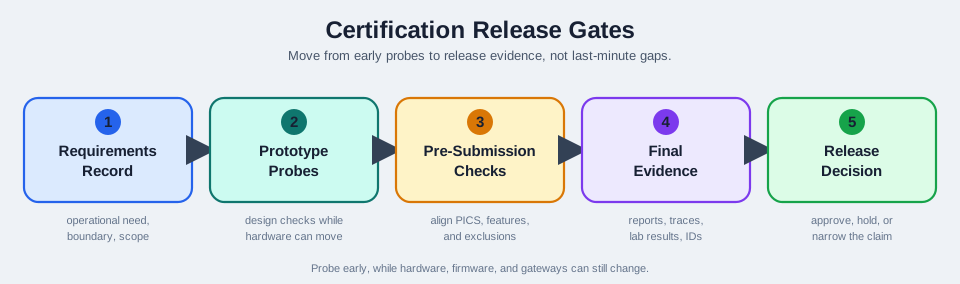
The first tests cover a fixed BACnet object map and a cloud MQTT topic schema. Those two rows pass the old-evidence check. A new object type, changed unit conversion, changed retained-message behavior, and a Matter bridge each fail it. “Fail” means the shipped proof does not cover the changed claim; the original path may still pass. The footer names lab reports, test-suite versions, firmware hashes, and controller traces to compare. Check each changed claim against those records before release. This keeps the decision tied to the product that will ship.
A proof result for one feature, profile, module, or release candidate gets reused for a broader product or deployment claim.
A firmware, hardware, profile, library, peer implementation, or gateway bridge changes while the old record is still being cited.
A product relies on module-level or lab-level proof while the real risk sits at the product, integration, data, or operations boundary.
No one is responsible for noticing when a standards claim, ecosystem profile, security assumption, or market condition changes.
For certification lifecycle claims, inspect Figure 9.5 at Standards Selection Record. Its visible premise is: The record keeps a standards claim tied to proof and to the condition that reopens it. Then compare Proof.
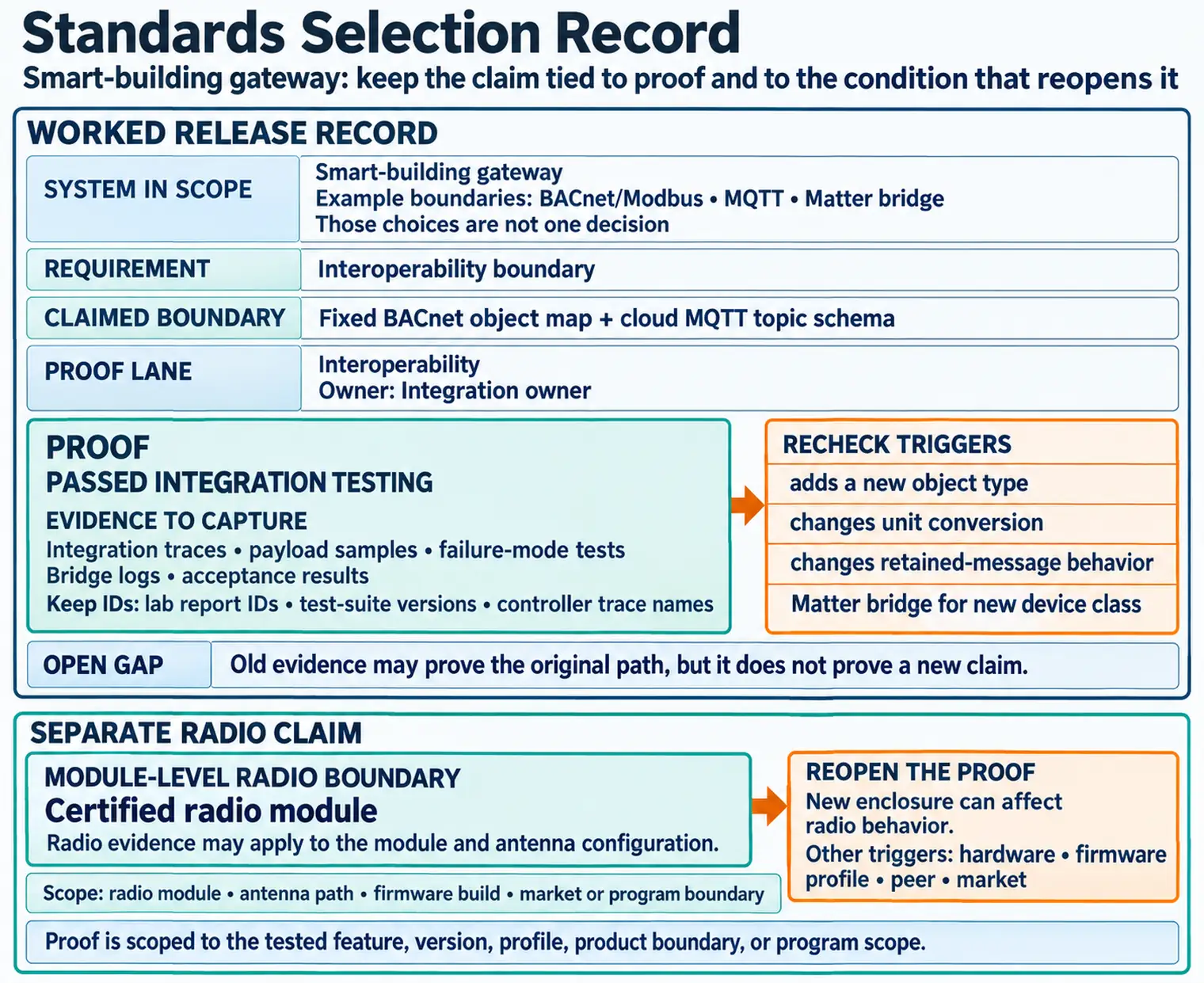
For certification lifecycle claims, the diagram Figure 9.5 uses Standards Selection Record as the entry and Proof as a later checkpoint. Finish at hardware, firmware, profile, peer, or market change. The full reading conveys: The record keeps a standards claim tied to proof and to the condition that reopens it.
Assemble the release record from requirement to recheck. Fix the operational or interoperability boundary, name the exact standard profile and optional features, choose the relevant proof lanes, and attach the resulting reports or traces. Then preserve what the evidence does not cover and the hardware, firmware, market, peer, or lifecycle change that reopens it. This order prevents a certification label from becoming a universal deployment claim.
Use different evidence for different claims. Conformance shows behavior against a specification, interoperability shows behavior with named peers, ecosystem and market records show acceptance constraints, and deployment tests show field operation. A strong release decision identifies which lanes are mandatory, which gaps remain owned, and what change invalidates each artifact.
This section: IEEE and IETF IoT Standards
Start With the Boundary, Not the Logo
Picture two teams buying parts that each claim to follow a respected standard. The radio can move a message, but the service rejects its address and data shape. A badge did not prove that the same rules covered the boundary between the parts.
A protocol is a shared set of rules for exchanging messages. Internet Protocol is a family of network rules. IPv6 is version 6 of those rules and provides large addresses and common packet handling. A payload is the useful data carried inside a message. For each boundary, name the senders, fields, timing, failure behavior, security duty, and exact document version that both sides claim to follow.
Build one small exchange and save evidence from each side. Change a required field, delay the reply, use an old version, and restart one part. The result should show which rule rejected the case and who owns the repair.
Standards reduce disagreement; they do not remove design choices or prove every product. The deeper sections map the roles of the main standards bodies and show how to review overlap, version drift, and missing implementation evidence.
Standards become practical when two parts of a system must meet without guessing. A radio frame, an IP packet, a discovery exchange, a security handshake, or a management object is a contract between teams, devices, vendors, and tools.
Start with the interface that must remain stable. IEEE and IETF work helps define how bits move, how networks interoperate, and how evidence can be checked when one component changes but the rest of the architecture must keep working.
IEEE and IETF standards answer different architecture questions in an IoT system. IEEE specifications often define local link behavior such as radio operation, frames, medium access, and local addressing. IETF specifications define Internet behavior such as IPv6 adaptation, routing, transport, resource access, discovery, and security bindings across constrained networks.
The design review mistake is to treat one standards name as proof that the whole system interoperates. A low-power radio standard does not prove IP reachability. IPv6 reachability does not prove payload meaning. A messaging protocol does not prove ownership, diagnostics, or release readiness.
Split the claim into layers before deciding whether it is strong. A radio link claim might need packet captures, join behavior, sleep behavior, retries, and local security checks. An IP adaptation claim might need header compression, fragmentation, route repair, and border-router diagnostics. A resource or messaging claim might need method definitions, topic ownership, authorization, stale-data handling, and payload examples. The standards names help the review only when each one is tied to the boundary it actually governs.
For a building sensor, this means the link review can pass while the payload review is still open. The device may join correctly and route packets, but the project still has to prove temperature units, freshness flags, alarm ownership, and support diagnostics. Those are separate contracts.
At overview: standards are layer contracts, IEEE Link makes the architecture testable. In Figure 9.6, Messaging frames this claim: Use the standards route to separate link behavior, Internet behavior, interaction pattern, and evidence records. Read it against IEEE Link.
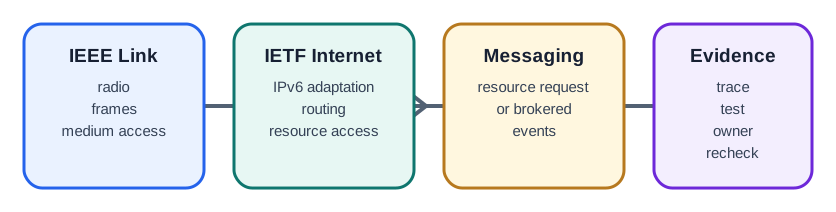
Three concrete diagram labels organize Figure 9.6: IEEE Link, Messaging, and recheck. Between them, the overview: standards are layer contracts relationship becomes visible: Use the standards route to separate link behavior, Internet behavior, interaction pattern, and evidence records.
Review channel use, frame limits, medium access, link addressing, join behavior, sleeping devices, local retries, and link-layer security hooks.
Review constrained IPv6 adaptation, routing, transport assumptions, resource methods, discovery behavior, and security at the constrained boundary.
Review payload meaning, gateway translation, operations ownership, diagnostics, lifecycle policy, conformance evidence, and recheck triggers.
Name the layer before naming the standard. A standard can be correct at one layer while leaving another layer unresolved.
The practical work is to inspect the boundary where a local link, IP adaptation layer, resource or message pattern, gateway, broker, and operations process meet. This is where architecture claims usually become ambiguous.
Start by writing one row per boundary. The device link row should not inherit the evidence from the broker row, and the broker row should not inherit the evidence from the operator workflow. Each row needs its own contract, trace, owner, open gap, and recheck condition.
That separation keeps the review auditable.
At review standards boundaries, IEEE physical and link contract makes the architecture testable. In Figure 9.7, Resource or message contract frames this claim: Layer contracts become useful when the review records what each layer proves and what it leaves open. Read it against IEEE physical and link contract.
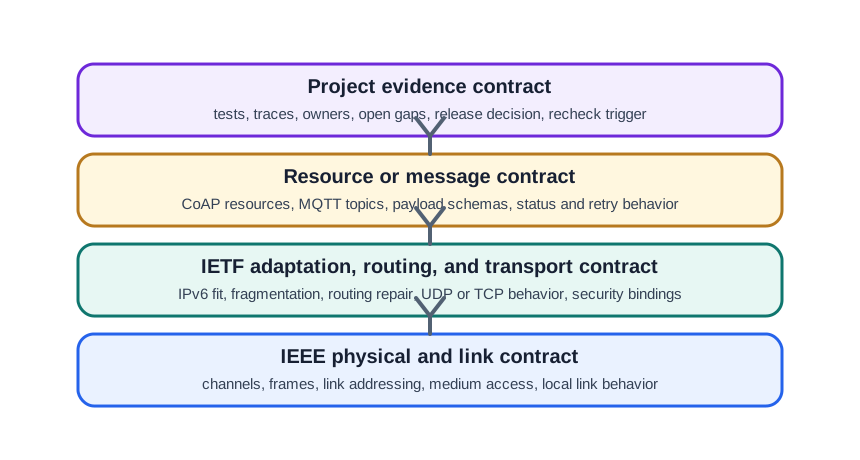
The stack in Figure 9.7 shows that a pass at one standard boundary does not approve the next. IEEE physical and link work covers frames, join, sleep, and recovery, supported by radio traces and site tests. IETF adaptation and routing add compression, fragmentation, reachability, and repair evidence. A resource or message contract then needs payload samples, retry, stale-data, and authorization checks. Project evidence still names owners, open gaps, release decision, and recheck trigger. A working low-power link cannot by itself prove IPv6 reachability; an IP packet arriving cannot prove the application understands its units or quality state.
Compare the two paths in Figure 9.8 before choosing a protocol from familiarity alone.
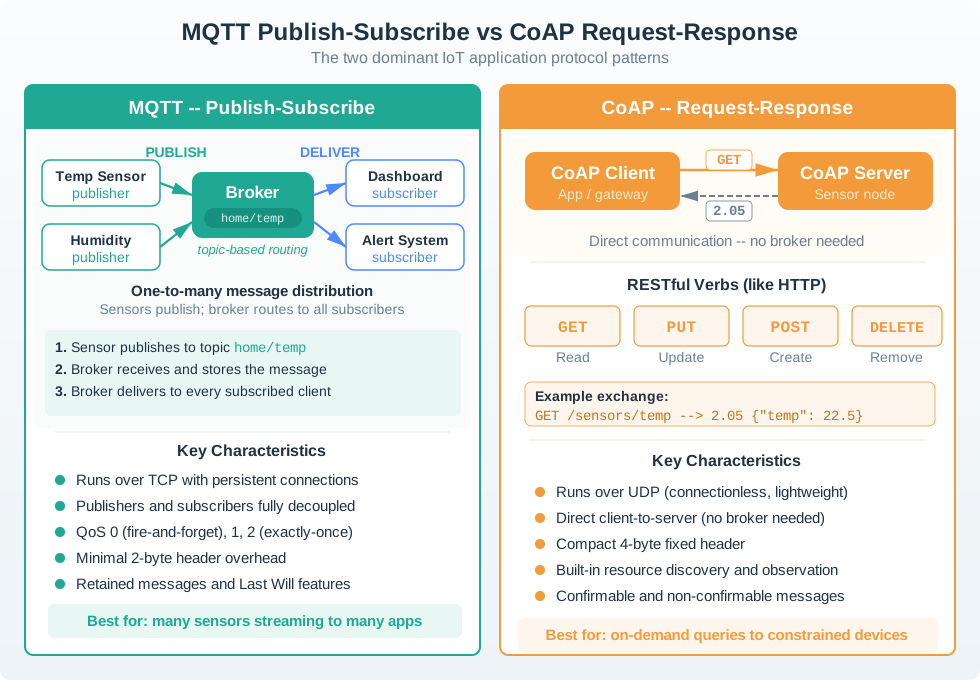
Follow the MQTT path through the broker. Senders and readers do not need a direct link, and a kept message or Last Will can hold useful service state. Next follow CoAP from a client request to a small server reply. It suits reads and set commands without a broker. The two shapes need different proof. MQTT tests must cover the broker, topic access, and send rules. CoAP tests must cover the end point, retries, and resource access. A review should test the path that will run in the field, not treat the two app protocols as the same transport.
The device exposes named resources and clients need read, write, observe, or discover behavior across a constrained boundary.
Producers and consumers should be decoupled and topics carry events to dashboards, rules, alerts, storage, or downstream services.
Payload schema, duplicate messages, stale data, authorization, lifecycle ownership, observability, and failure recovery.
A durable IEEE/IETF review record is short, layered, and owned. It should show the exact boundary being claimed, the standard or profile being used at that boundary, the evidence that supports it, the gap that remains outside the standard, and the trigger that reopens the decision.
The record should also say what the standard does not decide. It may not define the business meaning of a payload field, the support response to a failed device, the dashboard freshness rule, the gateway translation owner, or the release process for changed firmware. Those project responsibilities are not weaknesses in the standard; they are architecture gaps that need named owners.
The packet path in Figure 9.9 starts at a sensor on a constrained link. Adaptation may compress an IPv6 header and split a packet into link frames before a border router carries it toward wider IP and application services. Route hints and failure diagnostics help explain how the packet crossed that boundary when a path changes or fails. Ask for compression behavior, fragmentation handling, route repair traces, and a border-router capture. Those artifacts can support an IP-adaptation claim. Commissioning, device management, and the cloud API contract still need separate project proof; they are not inherited from a successful local packet trace.
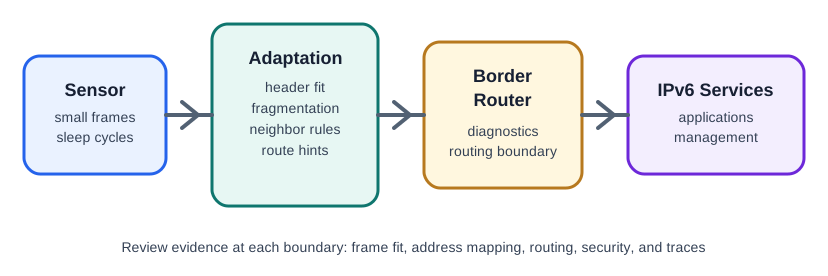
Map Sensor to the current requirement in Figure 9.9. Map route hints to the next duty and management to the later proof. This continues build standards evidence: Constrained links need adaptation and diagnostics before IP behavior is meaningful beyond the local network.
A checklist alone cannot settle build standards evidence. Inspect Figure 9.10 for this relationship: The evidence record keeps standards claims from becoming vague architecture labels. Compare Layer with Resource.
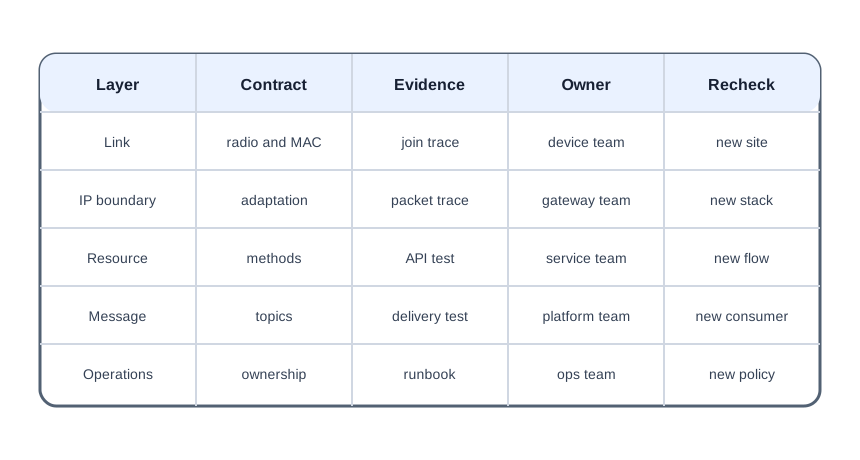
Interrogate Layer first, then find Resource in Figure 9.10. Apply the Resource review question before new policy. Those answers support build standards evidence; the figure states: The evidence record keeps standards claims from becoming vague architecture labels.
A room-monitoring system might use a low-power link for sensors, an IP adaptation boundary at a border router, CoAP for local device resources, and MQTT upstream for dashboard distribution. The record is acceptable only if it says what is translated, what is preserved, what is logged, who owns each contract, and what change forces a new review.
The phrase "standards-based" is too broad to be evidence. Replace it with a boundary-specific claim, such as link join behavior tested in the target environment, IPv6 adaptation traced through the border router, resource names documented with payload examples, or broker topics governed by an owner.
IEEE and IETF standards are strongest when they are used as precise layer contracts. IEEE specifications often define local link behavior, while IETF specifications define Internet behavior across constrained and heterogeneous networks. CoAP and MQTT represent different interaction patterns, and IP adaptation connects constrained links to routable networks. A useful architecture review names the boundary, states the exact contract, gathers evidence, records open gaps, assigns ownership, and defines when the decision must be reopened.
Do not treat “standards-based” as an architecture proof. Treat each standard as a boundary claim that needs evidence, an owner, and a recheck trigger.
This section: Summary — Standards selection and certification planning turn architecture requirements into scoped release claims.
Standards selection and certification planning turn architecture requirements into scoped release claims. The durable pattern is to name the boundary, filter candidate standards by constraints, map each claim to the right proof lane, collect evidence at the release boundary, and keep the record alive with an owner and recheck trigger.
This section: Key Takeaway
A certification mark, profile name, or standard reference is useful only when the architecture record states the exact boundary, proof scope, open gaps, owner, and condition that reopens the decision.
This section: See Also
3 reviewed answers.
Open the module page from the sidebar to see its chapters in order. Use the module map to return to a topic you need.
Modules and pathsReviewed
Check the symptom, then work through the diagnostic steps. Keep the error message and the smallest example that reproduces it.
When you are stuckReviewed
Use the interactive guide to check how examples and simulations work before changing your project.
Interactive examples guideReviewed