Layer Lens
Best when the main question is where device, network, processing, data, application, and workflow responsibilities belong.
Progress saves as you read. Mark sections complete as you go; your progress appears in the sidebar.
This section: Start With the Mismatch — Picture two teams drawing the same connected factory.
Picture two teams drawing the same connected factory. One drawing shows layers from device to business. The other shows services and owners. Both can be useful, but they answer different review questions.
Name the question first. Ask whether the risk concerns a data path, a service handoff, a user view, a small device, or a domain rule. Choose the drawing that makes that duty easiest to see and test.
Then look for what the chosen view hides. A clean layer stack can hide the team that removes access. A service map can hide energy and radio limits. Adding a second view helps, but too many views can blur the decision.
This factory story cannot crown one model as the truth. It does not prove that every box has an owner or that every link works. The model still needs evidence from the real system.
Use the Practitioner sections to choose the main and companion views. Use Under the Hood to compare boundaries, duties, and missing evidence. The deeper work qualifies the drawing without forcing the system into it.
Try one review question. Ask who removes a lost device. Mark the device view. Mark the link view. Mark the service view. Mark the staff view. Pick the clearest view first. Add one view for the hidden duty. Name the owner. Name the proof. Stop when the question is clear.
An alternative reference model usually becomes useful when the first model does not explain the system cleanly. A tiny battery network, an industrial cell, a service platform, and a city-scale deployment may all need different lenses even when they share sensors, gateways, and cloud services.
Start with the mismatch instead of forcing the diagram. Ask what the current model hides: constrained energy, service ownership, stakeholder views, certification, or domain rules. Then choose the model that makes the hidden responsibility visible enough to test.
This section: Alternative Models Are Review Lenses — Alternative IoT reference models are not competing truths about the same system.
Alternative IoT reference models are not competing truths about the same system. They are lenses that make different boundaries easier to inspect. One lens may emphasize layers, another services, another viewpoints, another constrained devices, and another domain operations.
Figure Figure 4.1 applies two review lenses to the same connected factory. The seven-level model provides an end-to-end layer vocabulary, while the service lens makes shared functions and ownership easier to inspect.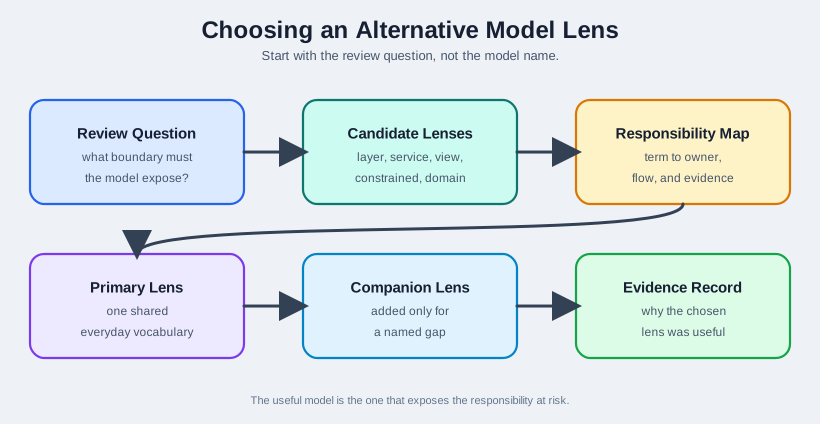
Read Figure 4.1 from the review question to the two lenses, then to the exposed duty: remove access. The point is not that one model is universally correct; the useful lens is the one that makes the hidden responsibility visible enough to name an owner and proof.
Best when the main question is where device, network, processing, data, application, and workflow responsibilities belong.
Best when registration, discovery, messaging, device management, data handling, and support functions need clean boundaries.
Best when functional, information, and deployment-and-operation views need different reviewers.
Best when power state, intermittent links, local storage, retry windows, and maintenance cadence drive the design.
Best when domain operations, safety expectations, asset hierarchy, support workflow, or data stewardship shape the architecture.
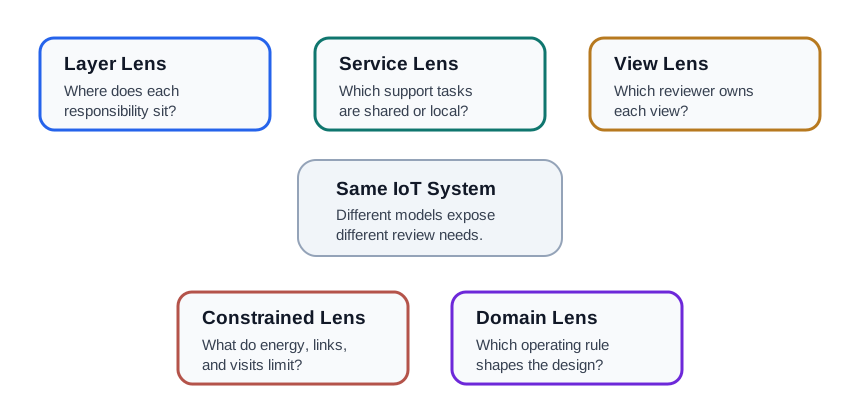
The same system sits at the center of Figure 4.2, while each lens asks a different review question. A layer lens locates responsibility; a service lens asks which functions are shared or local. A view lens separates what different reviewers must approve. A constrained lens brings energy, lossy links, buffers, and service visits into the record, while a domain lens exposes operating or safety rules. The choice should follow the hidden risk in the current architecture, not a preference for more boxes. Keep one primary vocabulary and add a companion lens only when it makes a named boundary or owner easier to test.
For example, a seven-level model is useful when a reviewer needs an end-to-end path from physical devices to collaboration processes. An IoT-A style view model is useful when different reviewers need functional, information, and deployment-and-operation views. A constrained-device lens is useful when sleepy nodes, lossy links, small buffers, and maintenance visits dominate risk. A service lens is useful when shared functions such as identity, device registry, digital twins, command routing, telemetry storage, and support access need named owners.
The ITU-T Y.2060 model is a second named layer lens worth recognizing on sight, because vendors and standards documents cite it as often as the seven-level model. It groups responsibility into four layers instead of seven: a device layer (device and gateway capabilities), a network layer (networking and transport capabilities), a service support and application support layer (generic and specific support capabilities), and an application layer. Management capabilities and security capabilities run alongside all four layers as general and specific cross-cutting concerns rather than as their own layer. The practical difference from the seven-level lens is granularity, not disagreement: the ITU model places device and gateway capabilities in its device layer and shared data processing and storage in service support, rather than naming edge work, accumulation, and abstraction as three separate layers. Use the four-layer lens when a reviewer needs a compact, standards-referenced map to compare against a vendor's own architecture documentation; use the seven-level lens when the review needs to inspect edge, accumulation, and abstraction as separate testable boundaries.
The practical test is whether the lens changes the review conversation. If a farm soil node fails because a retry window drains the battery, a generic cloud diagram hides the issue. If a hospital gateway translates proprietary bed-state events into FHIR Observations, a service and information lens may expose provenance and clinical-workflow boundaries better than a simple layer stack.
This section: Choose a Primary Lens — In practical architecture work, the safest pattern is to choose one primary vocabulary for everyday communication.
In practical architecture work, the safest pattern is to choose one primary vocabulary for everyday communication. Add a companion lens only when the primary one hides a specific boundary, such as constrained outdoor operation, service ownership, data stewardship, or deployment responsibility.
Why pause at choose a primary lens? Beside Reference-Model Translation Map, the diagram Figure 4.3 makes Layer Lens explicit within this relationship: A translation map prevents terminology drift when different teams use different model vocabularies.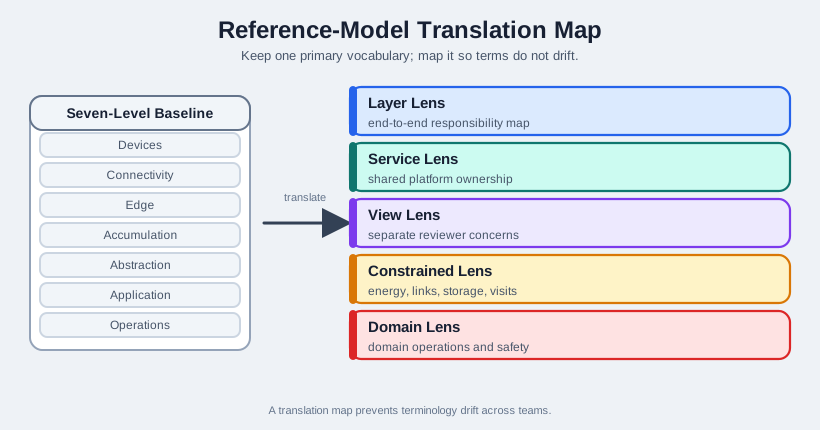
Keep Reference-Model Translation Map, Layer Lens, and A translation map prevents terminology drift across teams separate while reading Figure 4.3. The diagram makes Reference-Model Translation Map a visible choose a primary lens cue; its Layer Lens relationship advances the claim: A translation map prevents terminology drift when different teams use different model vocabularies.
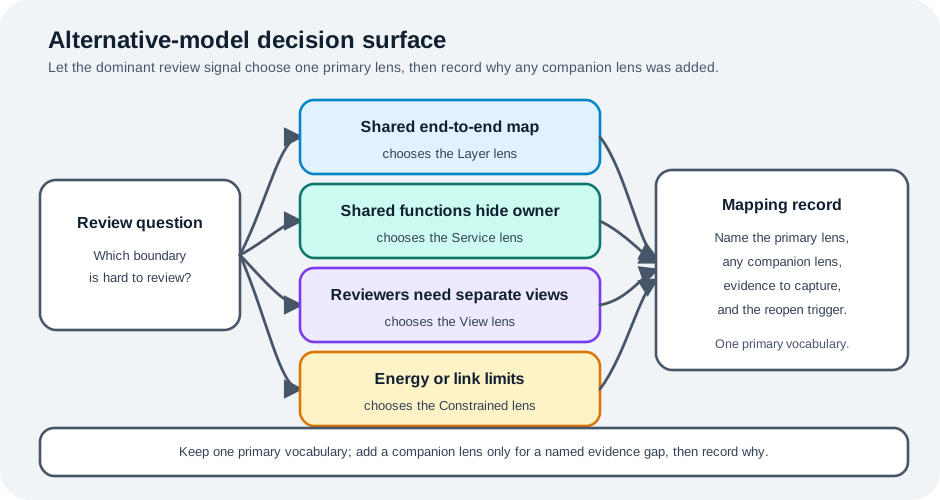
The worked question in Figure 4.4 is who removes a lost device. Device, link, service, and staff views reveal different parts of that recovery path, so the figure selects a view lens as the primary vocabulary. The mapping record then asks for functional, information, deployment, and operations evidence. If operations owns recovery, the trail should show alert, acknowledgement, escalation, repair note, and retest. The reopen trigger is a reviewer who still cannot validate the design from the chosen view. This makes a companion lens a response to a specific evidence gap, rather than a new diagram added by habit.
A useful mapping table should be operational enough for design review. For an outdoor asset tracker, the seven-level primary lens might keep the team aligned on devices, connectivity, edge processing, accumulation, abstraction, application, and operations. The constrained companion lens then records wake interval, GNSS fix budget, LoRaWAN confirmed-message policy, local flash queue length, backoff rule, battery replacement interval, service-window owner, and what evidence proves those assumptions. For a shared platform, the companion service lens might name who owns device identity, certificate rotation, data retention, schema versioning, command authorization, and support impersonation. The table should also identify the test artifact, such as a field log, gateway trace, battery model, or support ticket sample.
This section: Preserve Semantic Integrity — The hard part of alternative-model use is not drawing more boxes.
The hard part of alternative-model use is not drawing more boxes. It is preserving semantic integrity: each term in each model must map to a responsibility, flow, owner, and evidence source. If the same word means different things to different teams, the architecture needs a glossary and a review record before implementation depends on it.
Do not apply preserve semantic integrity until its premise is visible near Alternative-Model Review Record in Figure 4.5: The review record is the control point that keeps an alternative model from becoming vague diagram decoration. Inspect the span to flow, and evidence.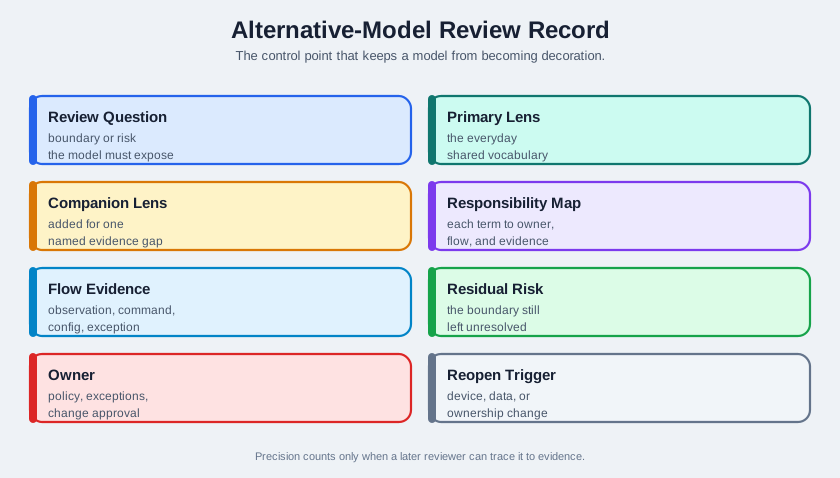
The fields in Figure 4.5 keep a model tied to behavior. The review question names the boundary or risk; the primary lens gives the team a shared vocabulary. A companion lens is added only for a named gap. The responsibility map links each term to an owner, flow, and evidence source, while flow evidence covers observation, commands, configuration, and exceptions. Residual risk and change approval stay with a named owner. A device, data, or ownership change reopens the record. This structure helps a later reviewer see whether two teams mean the same thing by a layer or service name before implementation depends on it.
Physical, connectivity, local processing, data lifecycle, application, and workflow terms should point to observable system behavior.
For each boundary, record who owns policy, exceptions, data quality, operation, and change approval.
Check observation, command, configuration, exception, and maintenance flows rather than only happy-path telemetry.
Record the device, data, ownership, operating, or constraint change that forces a model review.
Preserving integrity usually means storing a small translation record beside the architecture decision. The record can map "edge," "gateway," "service," "view," or "platform" to actual components, APIs, data stores, roles, and tests. In a building or industrial deployment, that might connect BACnet or OPC UA adapters, MQTT topics, a time-series database, a device registry, role-based dashboard access, and a maintenance workflow. When a term changes owner or implementation, the record shows which flows, tests, and agreements must be reviewed again.
That record should also include negative evidence. If the chosen service lens says identity is centralized, the test should show what happens when a device presents an expired certificate or an unknown serial number. If the chosen view lens says operations owns recovery, the review should show the alert, acknowledgement, escalation, repair note, and retest event. Those checks keep the model grounded in system behavior rather than vocabulary preference.
This section: Summary — Alternative IoT reference models are useful because each one makes a different boundary easier to review.
Alternative IoT reference models are useful because each one makes a different boundary easier to review. The goal is not to memorize every model family or mix every vocabulary. The goal is to choose a primary lens, add companion lenses only when they expose real evidence gaps, and keep mappings clear enough that the architecture remains reviewable.
This section: Key Takeaway
Choose the model lens from the review question. A useful alternative model names the responsibility at risk, maps vocabulary back to shared system behavior, captures evidence, and records when the decision must be reopened.
This section: See Also
Introduction to IoT Reference Models - foundation for why models help.
Seven-Level IoT Reference Model - the baseline layer model used in this course.
Practical Application and Assessment - applying model choices to review tasks.
Key IoT Reference Models - broader model-lens comparison.
3 reviewed answers.
Open the module page from the sidebar to see its chapters in order. Use the module map to return to a topic you need.
Modules and pathsReviewed
Check the symptom, then work through the diagnostic steps. Keep the error message and the smallest example that reproduces it.
When you are stuckReviewed
Use the interactive guide to check how examples and simulations work before changing your project.
Interactive examples guideReviewed