25  IoT Evolution and Enablers Overview

In 60 Seconds

IoT evolved through five Internet phases: connected computers (1990s), connected content (2000s), connected commerce (2010s), connected people (social media), and connected things (IoT). True IoT products differ from merely connected products by incorporating intelligent optimization – a thermostat that learns patterns versus one that only enables remote reading.

Minimum Viable Understanding
  • IoT became viable when four technologies converged: cheap computing (edge processing), miniaturization (Moore’s Law shrinking sensors), long-lasting batteries (duty cycling, energy harvesting), and diverse wireless protocols (Bluetooth to 5G).
  • IoT products differ from connected products by incorporating intelligent optimization and analytics – a “smart” thermostat that learns occupancy patterns versus one that simply sends temperature readings remotely.
  • Cost rule of thumb: if your sensor costs $20, your annual battery and connectivity costs should stay under $2, otherwise you have selected the wrong technology stack.

Long ago, before the Sensor Squad existed, computers were HUGE and could only talk to each other through thick cables.

Phase 1 – Connecting Computers: “Back then, I was the size of a room!” said an old mainframe. Two computers learned to send messages to each other.

Phase 2 – World Wide Web: Millions of computers joined together. “We could share information with anyone!” said the web browser.

Phase 3 – Mobile Internet: Smartphones arrived. “Now people could connect from ANYWHERE!” said the smartphone.

Phase 4 – Social Internet: People put their identities online. “We connected people to people,” said the social network.

Phase 5 – Internet of Things: Finally, THINGS started connecting! Sammy the Sensor, Lila the LED, Max the Microcontroller, and Bella the Battery all came together as the Sensor Squad.

“But what made US possible?” asked Sammy. Four magical inventions: - Tiny Chips: Max became small enough to fit on a coin (miniaturization) - Smart Power: Bella learned to sleep 99% of the time and last for years (energy management) - Cheap Brains: Max got super smart for only $5 (computing power) - Wireless Voices: Everyone learned to talk without wires using Bluetooth, Wi-Fi, and LoRa (communications)

“Without ALL FOUR of these together,” said Max, “the Sensor Squad could never have been formed!”

25.1 Learning Objectives

By the end of this chapter, you will be able to:

  • Analyse IoT Evolution: Explain the progression from connected computers through mobile/social internet to IoT and its driving forces
  • Identify IoT Enablers: Classify the foundational technologies (computing, miniaturisation, energy, connectivity) that make IoT possible
  • Distinguish Product Types: Differentiate between embedded, connected, and true IoT products with concrete examples
  • Evaluate Enabler Convergence: Justify how the convergence of four key technologies made billion-device IoT networks economically viable
Key Concepts
  • Architectural Enablers: The foundational technologies and capabilities that make IoT systems possible, including computing power, miniaturization, energy management, and communications
  • Computing Power: The availability of compact, energy-efficient processors that enable edge processing and reduce dependence on centralized cloud systems
  • Miniaturization: The trend toward smaller, more efficient sensors and devices at reduced costs, enabling large-scale IoT deployments
  • Energy Management: Battery technology and energy harvesting techniques that extend IoT device operational lifespan in remote locations
  • Communication Protocols: Diverse connectivity options (Zigbee, LoRa, Wi-Fi, 4G/5G) tailored to specific IoT application requirements

25.2 Prerequisites

Before diving into this chapter, you should be familiar with:

  • Overview of IoT: A high-level understanding of what IoT systems are and where they are used will help you see why these enabling technologies matter
  • Applications of Sensors: Seeing concrete sensing applications across smart cities, industry, agriculture, and health makes it easier to connect enablers to real-world use cases
  • Networking Basics: Fundamental networking concepts are helpful background for understanding how different connectivity options (Zigbee, LoRa, Wi-Fi, cellular) support IoT architectures
How This Chapter Fits Into the Enablers Series

This is the first chapter in the Architectural Enablers series:

  1. IoT Evolution and Enablers Overview (this chapter) - History and convergence of enabling technologies
  2. Communications Technology - PAN/LAN/MAN/WAN protocols and selection
  3. Technology Selection and Energy - Decision frameworks and power management
  4. Labs and Assessment - Hands-on practice and exam preparation

After completing this series, continue to IoT Reference Models and IoT Reference Architectures.

Key Takeaway

In one sentence: IoT became viable when four technologies converged - cheap computing, miniaturization, long-lasting batteries, and diverse wireless protocols - enabling billion-device networks at costs impossible a decade ago.

Remember this: If your sensor costs $20, your annual battery and connectivity costs should be under $2 - otherwise you have chosen the wrong technology stack.

25.3 Evolution of Internet of Things Systems

~15 min | Foundational | P04.C08.U01

Why can we have IoT today when it wasn’t possible 20 years ago? Four key technological advances made it happen:

1. Computing Power Got Tiny and Cheap: Remember when computers filled entire rooms? Today, a $5 chip has more power than 1990s supercomputers. This means sensors can process data locally instead of sending everything to distant servers.

2. Everything Got Smaller (Miniaturization): Moore’s Law-transistor count doubles every 18-24 months while getting cheaper. A fitness tracker smaller than a coin contains: processor, memory, sensors (heart rate, GPS, accelerometer), Bluetooth radio, and battery. Twenty years ago, this would require a backpack.

3. Batteries Lasted Longer: Old wireless sensors died in weeks. Modern ultra-low-power designs last years-some harvest energy from sunlight or vibrations, never needing battery replacement.

4. Communication Got Better: Wi-Fi, Bluetooth, cellular networks, and specialized IoT protocols (LoRa, NB-IoT) provide options for every scenario-from wearables (Bluetooth) to farm sensors miles apart (LoRaWAN).

Term Simple Explanation
Moore’s Law Observation that computer chips double in power/halve in cost every ~2 years
Energy Harvesting Collecting power from environment (solar, vibration, heat) to eliminate battery changes
Edge Computing Processing data on the device itself instead of sending to cloud (faster, more private)
Duty Cycling Sensor sleeps 99% of time, wakes briefly to sense/transmit (extends battery from days to years)
Protocol Language devices use to communicate (like Bluetooth for wireless earbuds)

Why this matters: These enablers converged to make billion-device IoT networks economically viable. Without miniaturization, sensors would be too big/expensive. Without energy efficiency, batteries would die daily. Without communication standards, devices couldn’t talk to each other.

Example: A modern soil moisture sensor costs $20, runs 5 years on batteries, sends data 10km to a farm gateway via LoRa, and the farmer monitors 200 sensors from a smartphone. In 2000, this would have required $500 per sensor, weekly battery changes, and professional installation-economically impossible.

Real-World Example: Smart City Parking - Enablers in Action

Copenhagen’s Smart Parking System demonstrates how all four enablers converge:

1. Miniaturization - Each parking sensor (10cm x 10cm x 3cm) contains: ultrasonic distance sensor, LoRa radio, microcontroller, battery, all integrated into weatherproof housing mounted in pavement

2. Computing Power - Edge processing detects car presence locally (avoiding false positives from pedestrians) using 32-bit ARM Cortex-M0+ running at 48 MHz, consuming only 15 uA in sleep mode

3. Energy Management - 10-year battery life achieved through: - Duty cycling: Sleep 99.9% of time, wake every 5 minutes to sense - Transmit only on state change (car arrives/leaves), not continuous reporting - Result: Average 45 uA from 3.6V/19Ah battery = 10.4 years

4. Communications - LoRaWAN chosen over alternatives: - Range: 15 gateways cover 90 km2 city center (vs. 900+ Wi-Fi APs needed) - Cost: $0/month per sensor (private network) vs. $2/month for cellular = $480,000/year saved for 20,000 sensors - Reliability: 99.7% uptime even with cars blocking direct line-of-sight

Results: 95% driver satisfaction, 30% reduction in “searching for parking” traffic, 20,000 sensors deployed, 2.4M EUR annual savings in reduced congestion. None of this was possible in 2010 - LoRa didn’t exist, battery life would have been weeks not years, and costs would have been 10x higher.

Battery life calculation for 10-year target (20,000 sensors):

\[ I_{\text{avg}} = \frac{t_{\text{sense}} \times I_{\text{sense}} + t_{\text{TX}} \times I_{\text{TX}} + t_{\text{sleep}} \times I_{\text{sleep}}}{t_{\text{cycle}}} \]

Sense every 5 min (3s at 15 mA) + TX on change (2s at 45 mA) + Sleep (295s at 10 µA):

\[ I_{\text{avg}} = \frac{(3 \times 15) + (2 \times 45) + (295 \times 0.01)}{300} = \frac{45 + 90 + 2.95}{300} = 0.46 \text{ mA} \]

Required capacity for 10 years: \(C = 0.46 \times 24 \times 365 \times 10 = 40{,}296\) mAh.

This worst-case average (TX every sensing cycle) gives \(19{,}000 / 0.46 / 24 / 365 = 4.7\) years. Since the sensor only transmits on state change (car arrives/leaves), roughly 14% of cycles include a TX event. With selective TX, the average current drops to \(\approx 0.22\) mA, giving \(19{,}000 / 0.22 / 24 / 365 \approx 9.8\) years — close to the 10-year target.

Stanford IoT course slide titled 'More Connected Things Than People' showing the dramatic growth of IoT devices: LEFT side shows TODAY with traditional devices (smartwatch, laptop, tablet, smartphone) totaling 10 radios per person and 70 billion radios globally. RIGHT side shows 2030 projections with diverse IoT devices (fitness bands, smart shoes, pet translators, connected cars, medical devices, wearables, home appliances) projecting 100 radios per person and 800 billion radios worldwide, representing a $100B+ silicon opportunity. The visual demonstrates the paradigm shift from human-driven world to data-driven world enabled by architectural advances.

IoT device growth projection showing evolution from 10 radios per person today to 100 radios per person by 2030

Source: Stanford University IoT Course - Projection showing how architectural enablers (miniaturization, energy efficiency, connectivity) are driving explosive growth from 70 billion to 800 billion connected devices by 2030

25.4 Evolution of Internet of Things Systems

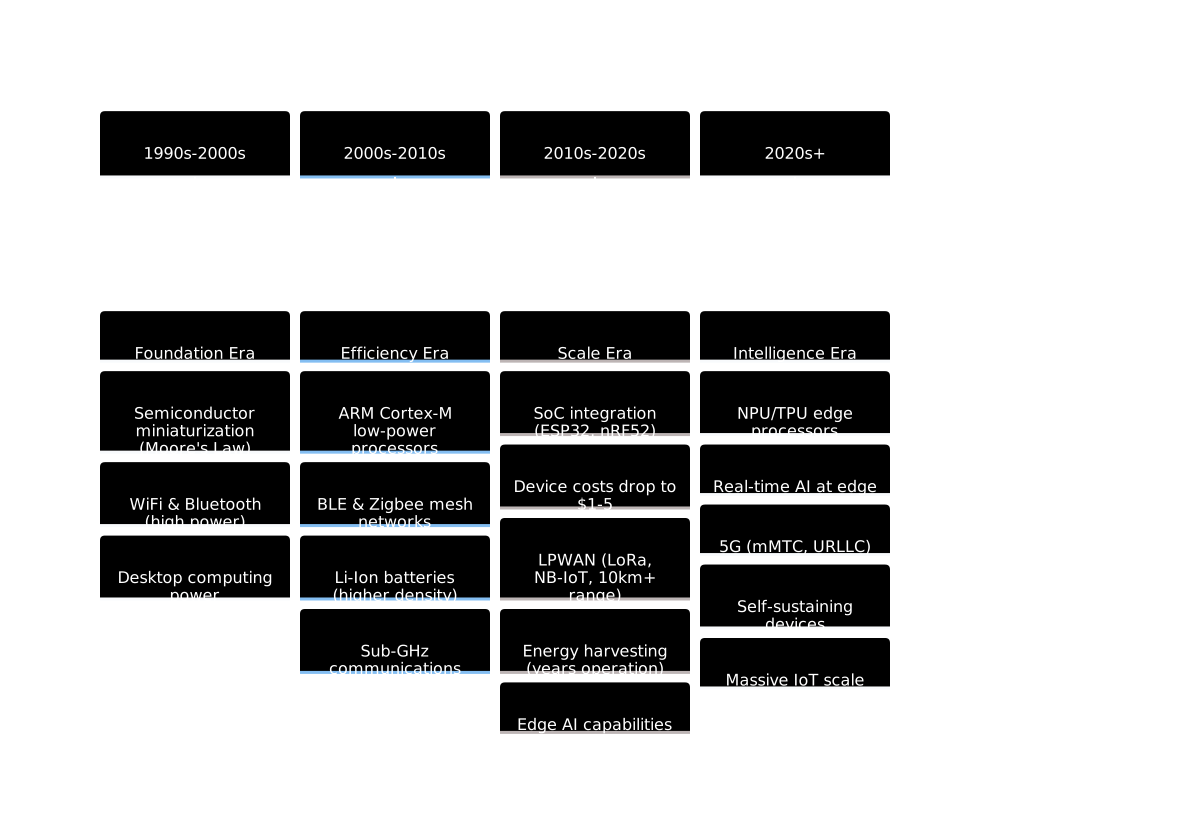
The Internet has undergone several transformative phases, each expanding its scope and capabilities. Understanding the evolution of the Internet helps contextualize the emergence of the Internet of Things (IoT). Here are the key phases:

  1. Connecting Computers: The initial phase involved the basic connection of two computers. This laid the groundwork for networked communication.
  2. World Wide Web: This phase saw the creation of a global network connecting millions of computers, enabling widespread information sharing and communication.
  3. Mobile Internet: The advent of mobile devices connected to the Internet marked this phase, leading to the proliferation of smartphones and mobile connectivity.
  4. Social Internet: Social networks brought people’s identities online, facilitating social interaction and connectivity on a global scale.
  5. Internet of Things (IoT): The current phase extends the Internet to everyday objects, allowing physical devices to communicate and interact over the Internet.
Timeline showing five phases of Internet evolution: 1) Connecting Computers, 2) World Wide Web connecting millions, 3) Mobile Internet with smartphones, 4) Social Internet with online identities, 5) Internet of Things connecting everyday objects
Figure 25.1: Evolution of Internet of Things Systems

25.5 Comparing Embedded, Connected, and IoT Products

IoT has evolved from earlier forms of technology, including embedded and connected products:

  • Embedded Products: These are standalone devices with built-in computational capabilities for specific tasks. For example, a washing machine with a timer that stops the machine when the washing is complete. While useful, these devices operate independently and offer limited value beyond their immediate function.

  • Connected Products: These devices not only perform specific tasks but also connect to other devices or the Internet for enhanced functionality. An example is a washing machine that sends a notification to a smartphone when the laundry cycle is complete. Although connected products offer more value than embedded products, their functionality is still somewhat limited.

  • IoT Products: These products integrate advanced computational models and communication capabilities to offer highly optimized and intelligent functions. For example, a smart washing machine that can optimize its operation based on energy costs, user preferences, and water usage patterns. IoT products provide significant value by leveraging data and connectivity to improve efficiency and user experience.

Comparison diagram showing evolution from Embedded Products (standalone devices with limited functionality) to Connected Products (devices communicating via internet) to IoT Products (intelligent devices with advanced analytics and optimization)
Figure 25.2: Historical Comparison of IoT

25.6 Key Architectural Enablers of IoT

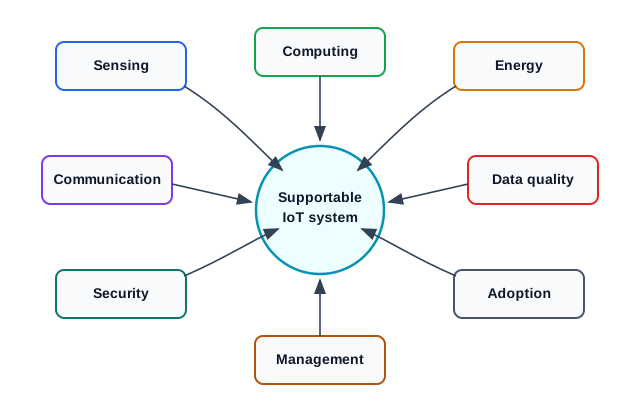
The Internet of Things (IoT) is an interconnected network of devices capable of communicating with each other and with the physical world to provide intelligent services. The rapid adoption of IoT technologies is driven by several key enablers that collectively contribute to its evolution. Understanding these enablers provides insight into how IoT systems are designed, developed, and deployed.

25.6.1 Computing Power

~8 min | Foundational | P04.C08.U02

The surge in computational power available in compact and energy-efficient processors has been a cornerstone of IoT development. Modern single-board computers, such as the Raspberry Pi, integrate significant processing capabilities into a small form factor. These devices allow developers to perform complex tasks such as data analysis and machine learning at the edge of the network, reducing latency and dependence on centralized cloud systems.

25.6.2 Miniaturization and Cost Reduction

~6 min | Foundational | P04.C08.U03

Advances in hardware miniaturization have enabled the creation of smaller, more efficient sensors and devices at a reduced cost. This trend has made IoT devices more accessible, allowing for their deployment at scale across industries. Furthermore, the integration of multiple sensors into a single package enhances the functionality of IoT systems without increasing their physical footprint.

25.6.3 Batteries and Energy Management

~7 min | Intermediate | P04.C08.U04

Energy efficiency and battery technology are critical for IoT devices, especially those deployed in remote or hard-to-access locations. Innovations in energy harvesting, low-power wireless communication, and battery management systems extend the operational lifespan of IoT devices, ensuring reliable performance with minimal maintenance.

25.6.4 Communications

~12 min | Intermediate | P04.C08.U05

IoT systems rely on robust communication protocols and standards to enable seamless data exchange. Technologies such as Zigbee, LoRa, Sigfox, Wi-Fi, and 4G/5G provide diverse options for connectivity, tailored to specific applications and requirements. These communication solutions address challenges like range, data rate, and power consumption, ensuring interoperability among heterogeneous devices.

25.6.5 Development Resources

~5 min | Foundational | P04.C08.U06

The availability of open-source platforms and development tools has democratized IoT innovation. Platforms like Arduino and Raspberry Pi offer accessible development environments for prototyping and experimentation, while vibrant online communities support knowledge sharing and collaboration. These resources lower the barrier to entry, fostering rapid development and deployment of IoT solutions.

25.6.6 Human Cost

~4 min | Foundational | P04.C08.U07

The human factor is a critical consideration in IoT adoption. Effective training, skill development, and awareness campaigns are essential to bridge the gap between technological capabilities and human usability. Additionally, economic factors such as the cost of labor and the development of technical expertise influence the adoption and scalability of IoT solutions.

25.7 Worked Example: Enabler Convergence Cost Analysis – Soil Moisture Sensor (2010 vs 2025)

Scenario: A vineyard owner wants to deploy 200 soil moisture sensors across a 50-hectare property in Napa Valley, California. Let’s compare what this would cost in 2010 versus 2025 to see how enabler convergence transformed feasibility.

2010 Deployment (Before Enabler Convergence):

Component Per Unit 200 Units
Sensor module (Decagon 5TM) $250 $50,000
Microcontroller (PIC18, no wireless) $15 $3,000
ZigBee radio module $25 $5,000
ZigBee mesh routers (every 30 m) $120 x 50 units $6,000
Gateway (custom, cellular) $800 x 2 $1,600
Cellular data plan (per gateway) $50/month x 2 $1,200/year
Battery (AA, replaced every 3 months) $2 x 4/year $1,600/year
Professional installation $100/sensor $20,000
Year 1 total $88,400
Annual recurring $2,800

2025 Deployment (After Enabler Convergence):

Component Per Unit 200 Units
Capacitive sensor + ESP32-S3 SoC $8 $1,600
LoRaWAN radio (integrated) included $0
LoRaWAN gateway (covers entire property) $300 x 1 $300
Network cost (TTN or Helium, free tier) $0 $0/year
Battery (CR123A, 5-year life via duty cycling) $3 $600
DIY stake-mount installation $5/sensor $1,000
Year 1 total $3,500
Annual recurring $0

Impact of each enabler:

Enabler 2010 Limitation 2025 Capability Cost Reduction
Miniaturization Sensor $250 + MCU $15 + radio $25 = $290/node SoC with sensor interface, radio, MCU = $8/node 36x cheaper
Energy management 3-month battery; quarterly site visits at $20/visit 5-year battery via 10 uA deep sleep + duty cycling $1,600/year saved
Communications ZigBee mesh (50 routers at $120 each) + cellular gateway 1 LoRaWAN gateway covers 50 hectares, free network $7,600 to $300
Computing Minimal edge; raw data to cloud ESP32 runs on-device calibration + anomaly detection Reduces cloud costs

Bottom line: The same deployment dropped from $88,400 to $3,500 (25x cheaper) with zero recurring costs versus $2,800/year. This is why precision agriculture adoption grew from <1% of farms in 2010 to 25% by 2025 – it only became economically rational when all four enablers converged.

25.8 Chapter Summary

This chapter introduced the fundamental architectural enablers that have made the Internet of Things revolution possible:

  • IoT Evolution: The Internet has progressed through five phases - connecting computers, World Wide Web, mobile Internet, social Internet, and now IoT - each expanding connectivity scope
  • Product Evolution: IoT products differ from embedded and connected products by incorporating intelligent optimization and autonomous decision-making capabilities
  • Four Core Enablers: Computing power, miniaturization, energy management, and communications technology converged to make IoT economically viable
  • Real-World Impact: Modern deployments like smart parking systems demonstrate how these enablers work together to create practical solutions

Understanding these enablers prepares you to explore specific communication technologies, selection frameworks, and hands-on implementation in the following chapters.

25.9 Knowledge Check

25.10 What’s Next

Direction Chapter Description
Next Communications Technology PAN, LAN, MAN, and WAN protocols for IoT connectivity
Next Technology Selection and Energy Decision frameworks and power management strategies
Related IoT Reference Models Standardised layer models for IoT architecture

Common Pitfalls

Adding Wi-Fi to an existing sensor and declaring it “IoT” without rethinking data flow, security, and device management. True IoT requires cloud integration, fleet management, security at scale, and analytics pipelines — not just wireless connectivity.

Deploying technically sound IoT systems that users don’t understand or trust. A smart building occupancy system with 95% accuracy but confusing dashboards will be disabled by occupants. User experience and change management are as critical as technical enablers.

Estimating IoT network value linearly when Metcalfe’s Law predicts quadratic growth. A network of 100 sensors provides 10,000 units of value; 1,000 sensors provides 1,000,000 — 100× the devices but 100× the value increase. Architecture must account for non-linear scaling.

Specifying a “connected product” that is really just an embedded system with Bluetooth pairing. True IoT requires cloud connectivity, remote manageability, and analytics — verify all three before labeling a product “IoT.”