10 Industry Consortium Profiles
More
Depth: Practitioner
Progress saves as you read. Mark sections complete as you go; your progress appears in the sidebar.
10.1 Check the Consortium Profile Claim
This section: Check the Consortium Profile Claim — Imagine a buyer wants a light, switch, hub, and building tool from several firms to work as one system.
Imagine a buyer wants a light, switch, hub, and building tool from several firms to work as one system. The team must decide what an industry profile truly proves at each join. A protocol is an agreed set of rules for an exchange. A gateway is a device or service that links one network or system to another.
The buyer’s light, switch, hub, and building tool meet at more than one boundary. A consortium profile can specify shared commands and tests for a particular pairing, but the team must check the version, chosen options, and bridge before promising that the whole system works together.
10.1.1 Trace the Product Join
- Which two products or systems must exchange an action?
- What profile version and optional features do both support?
- Does conformance evidence cover that exact pairing and behaviour?
- Which bridge or project-owned test covers the remaining gap?
Name the profile, products, options, conformance artifact, observed end result, and owner of any bridge. Keep the accepted claim as narrow as the test, including setup and fault behaviour.
10.1.2 Where the Badge Stops
Treat a badge as evidence for a defined profile scope. It does not establish the deployment’s cross-vendor setup and recovery paths. Check the exact products, profile version, selected options, and behavior covered by the conformance artefact. Installation, override, fault reporting, and bridge behavior may still require project-owned tests.
Where a bridge joins ecosystems, record which commands and data meanings it preserves, transforms, or drops. Keep traces, payloads, bridge logs, and observed end results with the accepted claim. The Practitioner record names the ecosystem boundary, uncovered joins, and the owner responsible for each gap. Define recheck triggers for changes to firmware, profiles, gateways, or support arrangements so the claim remains tied to the operated system.
10.2 Start With the Ecosystem Boundary
This section: Start With the Ecosystem Boundary — Industry frameworks matter when the architecture crosses organizational boundaries.
Industry frameworks matter when the architecture crosses organizational boundaries. A factory cell, smart building, energy site, or connected product may need devices, gateways, cloud platforms, analytics tools, and operators from different ecosystems to make the same assumptions.
Start by naming that boundary. Consortium models help clarify roles, profiles, vocabulary, certification paths, and integration evidence so a team can decide whether it is joining an ecosystem or building a one-off island.
10.3 Standards as Contracts
This section: Standards as Contracts — Industry consortiums help IoT products interoperate by narrowing broad standards into deployable profiles, data models, bridge rules, conformance programs, and governance expectations.
Industry consortiums help IoT products interoperate by narrowing broad standards into deployable profiles, data models, bridge rules, conformance programs, and governance expectations. They are useful because real projects need more than a protocol name: they need a scoped claim about device behavior, data meaning, testing, ownership, and lifecycle change.
The architecture mistake is to treat a consortium badge or membership statement as proof that the whole deployment will interoperate. A profile may cover one device type, one information model, one transport binding, or one bridge behavior while leaving diagnostics, lifecycle support, optional features, security integration, and operations to the project.
Review the profile as an ecosystem contract. First name the boundary: device-to-controller, gateway-to-platform, data model, bridge, or certification release. Then name what the profile actually covers at that boundary: required attributes, allowed commands, event meanings, optional features, conformance tests, version limits, or bridge rules. Finally name what remains outside it, such as local commissioning, field diagnostics, identity lifecycle, vendor firmware updates, support procedures, or safety behavior.
This keeps a useful consortium claim from becoming overbroad. A badge can help procurement and integration, but the architecture still needs evidence that this product, profile version, optional-feature set, and gateway path preserve the behavior the deployment depends on.
For example, a lighting profile may make on/off state and brightness meaning portable, while the project still owns installer workflow, emergency behavior, local override, fault reporting, and the bridge record into a building-management platform. The profile narrows the integration problem; it does not remove the project-specific release evidence.
That evidence should name the owner who will retest the profile claim when the product or ecosystem changes.
The lighting case in Figure 10.1 starts at the exact join between light, switch, hub, and building tool. A profile may make on/off state and brightness meaning portable, but the project still owns installation, emergency action, override, fault reporting, and bridge behavior. The review matrix separates device behavior, data meaning, bridge translation, and conformance scope. For each area, keep profile version, optional features, test result, payload or trace, and the gap the project must close. A badge cannot prove the whole deployment. When firmware, gateway, profile, or support path changes, the owner repeats the tests at the affected join.
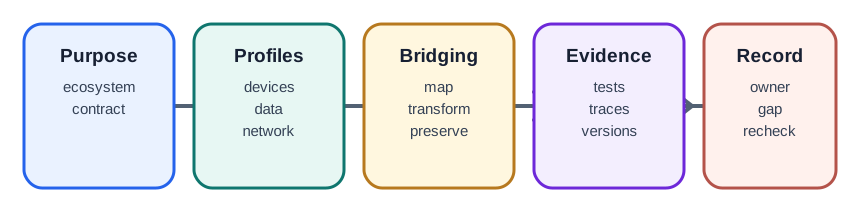
The route in Figure 10.1 starts with the link gap; check which group profile can help.
Device Profile
Defines required behavior, optional capabilities, commands, states, events, setup expectations, and user-facing device roles.
Information Model
Defines units, identifiers, object relationships, attributes, event meaning, diagnostics, and domain vocabulary.
Conformance Evidence
Defines tests, reference behavior, version claims, optional-feature handling, and what a profile statement actually proves.
Bridge Contract
Defines how one ecosystem is represented inside another, including what is preserved, transformed, dropped, or project-owned.
If you only need the intuition, this layer is enough: use consortium profiles as scoped interoperability claims. Record the exact boundary, the behavior in scope, the evidence that proves it, and the gaps the project still owns.
10.4 Consortium Review Record
This section: Consortium Review Record — The practical move is to write down the profile claim before accepting it.
The practical move is to write down the profile claim before accepting it. "Uses a consortium profile" is too vague. A useful profile statement names the interoperability boundary, selected profile, device or resource scope, optional features, bridge path, conformance artifact, and project-owned gap.
The reason to inspect consortium review record is concrete. Figure 10.2 depicts: Consortium profiles sit above base standards by packaging choices, test expectations, and ecosystem rules. Distinguish Base standards from Conformance and bridge evidence.
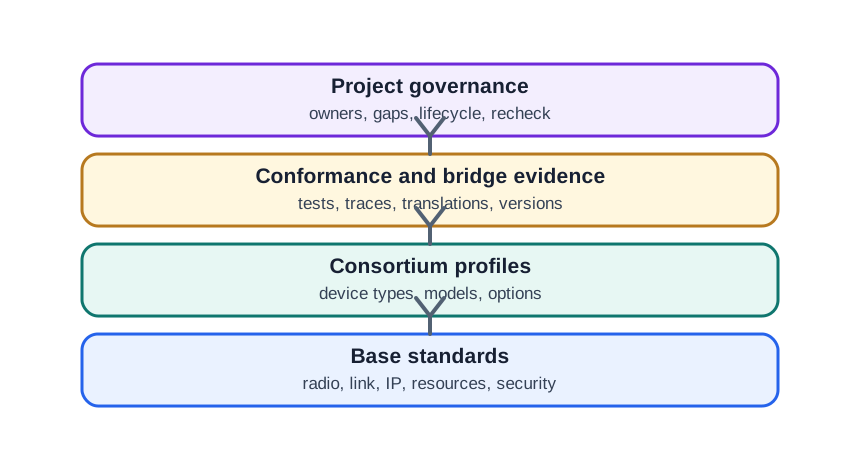
For consortium review record, the diagram Figure 10.2 uses Base standards as the entry and Conformance and bridge evidence as a later checkpoint. Finish at owners, gaps, lifecycle, recheck. The full reading conveys: Consortium profiles sit above base standards by packaging choices, test expectations, and ecosystem rules.
Do Not Approve a Name-Only Claim
A familiar consortium name may signal ecosystem support, but it is not a substitute for a scoped profile claim, bridge review, conformance evidence, and a list of open responsibilities.
10.5 Interoperability Lifecycle
This section: Interoperability Lifecycle — Consortium interoperability is not frozen at design time.
Consortium interoperability is not frozen at design time. Profiles evolve, optional features differ, certification scopes can be narrow, devices are replaced, bridge firmware changes, and operations teams discover edge cases. A strong architecture treats the consortium decision as a lifecycle claim that must be kept true.
Optional features are a common source of drift. Two products may both claim the same profile while one exposes a diagnostic state, schedule type, or fault reason that the other does not. A gateway may translate the basic on/off command but drop battery condition, calibration state, installer metadata, or a warning event. A conformance report may prove a reference interaction but not the local security policy, support workflow, or recovery behavior. The architecture record should make those limits visible before release.
The lifecycle record should therefore include profile version, implementation version, conformance artifact, optional features used, bridge behavior, known losses, project-owned gaps, and the trigger for retest. Triggers include firmware updates, profile revisions, new device classes, changed security policy, gateway replacement, field diagnostics that the profile does not cover, and any support incident where profile behavior and project behavior disagree. That record lets the team keep interoperability true instead of assuming the original badge still covers the operated system.
Under the hood, this is a configuration-management problem as much as an interoperability problem. The accepted profile claim must be tied to the shipped firmware, the gateway translator, the controller behavior, the support playbook, and the release notes. When any of those change, the consortium decision needs fresh evidence.
Inspect Figure 10.3 before judging interoperability lifecycle; it depicts: A bridge must say what it preserves, what it changes, and what the project owns after translation. Focus first on Consortium Bridge Boundary, then on Preserved Meaning.
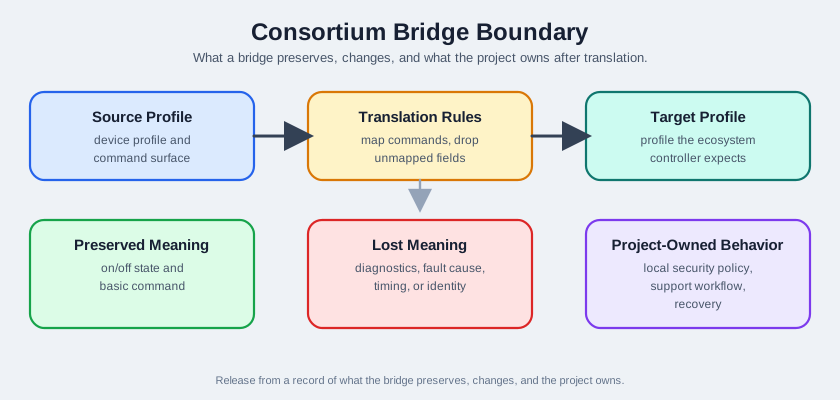
The bridge in Figure 10.3 translates selected Zigbee behavior into a Matter view. On/off and level control may map cleanly, but scenes, groups, diagnostics, and reporting edge cases can be lost or represented differently. The Matter fabric trusts the bridge to speak for Zigbee devices, which makes identity and support ownership part of the boundary. A bridge record should mark what meaning was preserved, transformed, approximated, or dropped, with logs and round-trip tests for the important commands and states. Retest after a profile, bridge firmware, device class, or controller change so the earlier interoperability claim still matches the operated system.
What Usually Breaks First
Optional Feature Drift
Two products can both claim a profile while relying on different optional behavior, device classes, or command surfaces.
Semantic Loss
A bridge may preserve an on/off state while dropping diagnostics, fault causes, timing assumptions, or identity meaning.
Evidence Scope Mismatch
A conformance result may cover a narrow profile subset while the project assumes broader operational readiness.
Governance Change
Profile updates, ecosystem policy changes, vendor firmware changes, and gateway releases can reopen an earlier decision.
One relationship governs interoperability lifecycle. The diagram Figure 10.4 states it as: The review record keeps ecosystem claims tied to evidence and future change triggers. Study Consortium Review Record and Bridge Impact.
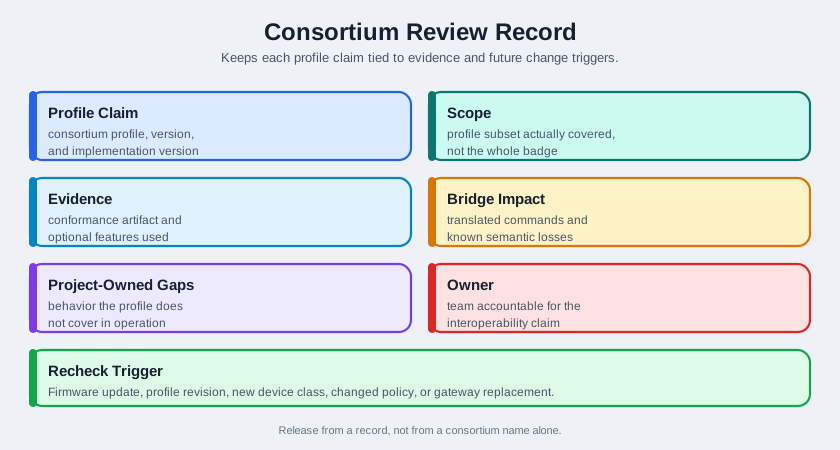
Map Consortium Review Record to the current requirement in Figure 10.4. Map Bridge Impact to the next duty and Release from a record, not from a consortium name alone to the later proof. This continues interoperability lifecycle: The review record keeps ecosystem claims tied to evidence and future change triggers.
Release Gate
Do not release from a consortium name alone. Release from a record that lists profile scope, test evidence, bridge behavior, project-owned gaps, owner, and recheck trigger.
10.6 Summary
This section: Summary — Industry consortiums help IoT projects turn broad standards into ecosystem-specific contracts.
Industry consortiums help IoT projects turn broad standards into ecosystem-specific contracts. They define profiles, data models, conformance expectations, bridge behavior, and governance rules. The safe architecture habit is to treat each profile as a scoped interoperability claim with evidence, an owner, project-owned gaps, and a recheck trigger.
10.7 Key Takeaway
This section: Key Takeaway
A consortium profile is useful when it proves scoped interoperability: exact boundary, selected profile, conformance artifact, bridge impact, explicit gaps, and a named owner.
10.8 See Also
This section: See Also
Find help
3 reviewed answers.
Where should I start in a module?
Open the module page from the sidebar to see its chapters in order. Use the module map to return to a topic you need.
Modules and pathsReviewed
What can I try when a project does not work?
Check the symptom, then work through the diagnostic steps. Keep the error message and the smallest example that reproduces it.
When you are stuckReviewed
How do interactive examples work?
Use the interactive guide to check how examples and simulations work before changing your project.
Interactive examples guideReviewed