4 6LoWPAN Architecture: Addressing and Forwarding Decisions

More
Depth: Practitioner
Progress saves as you read. Mark sections complete as you go; your progress appears in the sidebar.
6LoWPAN is the adaptation architecture that lets IPv6 packets cross IEEE 802.15.4 radio links. It does not replace IPv6, and it does not make constrained radios behave like Ethernet. It gives a constrained network a disciplined way to compress headers, decide when a packet must be fragmented, carry neighbor-discovery evidence, and hand packets between low-power devices and ordinary IPv6 networks.
This chapter treats the fundamentals as an architecture review. A good 6LoWPAN explanation names the layer boundary, shows which fields can be reconstructed, keeps fragmentation as an exception path, identifies the router roles, and records the evidence a later reviewer would need before calling the design ready.
4.1 Start With the Decision
This section: Start With the Decision — A constrained node can rebuild an IPv6 address, the label that lets an Internet packet reach a device, from link context.
A constrained node can rebuild an IPv6 address, the label that lets an Internet packet reach a device, from link context. 6LoWPAN adapts IPv6 packets for IEEE 802.15.4, a low-power radio link. The network must then choose who forwards each packet and where.
4.2 Route Overview
This section: Route Overview — This is part 2 of 2.
This is part 2 of 2. Review 6LoWPAN Architecture: Compression and Fragmentation for the preceding evidence.
4.3 Learning Objectives
This section: Learning Objectives
- Reconstruct IPv6 addresses from 6LoWPAN context.
- Compare route-over and mesh-under forwarding.
4.4 Chapter Roadmap
This section: Chapter Roadmap
- Stateless Address Reconstruction
- Forwarding Roles
- Route-Over And Mesh-Under
- Thread Relationship
- Worked Architecture Reviews
- Building Telemetry
- Commissioning And Discovery
- Diagnostic Payload
- Common Mistakes
- Release Checklist
- Encapsulation Header Formats
- Fragment and Mesh Header Fields
- Summary
- Key Takeaway
- Concept Relationships
- What’s Next
- Knowledge Check: Architecture Role
- Knowledge Check: Fragmentation Boundary
- Concept Match
- Architecture Order
4.5 Stateless Address Reconstruction
This section: Stateless Address Reconstruction — 6LoWPAN keeps configuration low by deriving IPv6 interface identifiers from IEEE 802.15.4 identities when the deployment context permits it.
6LoWPAN keeps configuration low by deriving IPv6 interface identifiers from IEEE 802.15.4 identities when the deployment context permits it. A node can form a link-local address from the link-local prefix plus an interface identifier derived from its 64-bit extended address, or from a configured short address under controlled assumptions. The architecture review should name which method is used and where uniqueness is checked.
This derivation also explains why IPHC can remove so many bytes. If the receiver already knows the link-layer source, link-layer destination, prefix context, and compression mode, it can reconstruct omitted IPv6 address fields instead of receiving two full 128-bit addresses in every packet. The saving is not cosmetic: omitting address fields can recover dozens of bytes in a frame whose useful payload budget may be only tens of bytes.
The risk is context drift. If a prefix, short-address assignment, commissioning state, or border-router context changes without a matching capture or log record, a packet can still decode but mean the wrong thing. Good architecture evidence therefore pairs every compression assumption with ownership, rollout, and retest rules.
4.6 Forwarding Roles
This section: Forwarding Roles — Use Figure 4.1 to separate device roles from protocol slogans.
Use Figure 4.1 to separate device roles from protocol slogans.
Inspect Figure 4.1 to ask where an ordinary host stops and a 6LoWPAN router begins to carry packets for its neighbours.
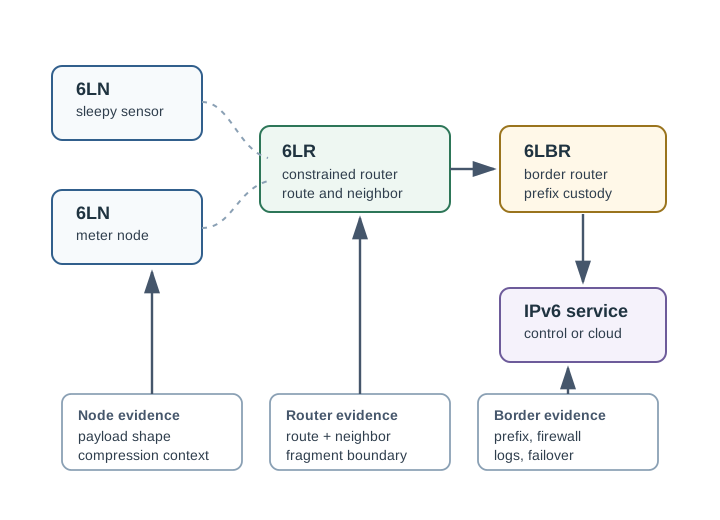
Read Figure 4.1 from the constrained meter node toward a 6LoWPAN router, then to the border router and wider IPv6 network. An ordinary host originates or consumes packets without forwarding for neighbours. A 6LR forwards within the low-power mesh and must maintain enough availability and state for that duty. The 6LBR joins the mesh prefix and external IPv6 domain, so it owns a distinct routing boundary. Address compression does not erase these roles; troubleshooting should record which node formed the address, which router forwarded it, and where the external route began.
The same radio technology can appear in several roles. A sleepy sensor may only originate or receive application traffic. A router forwards traffic for other nodes and needs stable power, route state, and monitoring. A border router connects the constrained network to the larger IPv6 domain and becomes an operations boundary.
4.7 Route-Over And Mesh-Under
This section: Route-Over And Mesh-Under — Forwarding can be described as route-over or mesh-under.
Forwarding can be described as route-over or mesh-under. The review should avoid treating either phrase as automatically better.
Route-over means IPv6 routing decisions are made at the network layer, often with RPL in a low-power and lossy network. It keeps per-hop routing evidence visible. Mesh-under means the adaptation or link layer hides mesh forwarding beneath IPv6. Thread uses mesh-under forwarding rather than RPL route-over. Mesh-under can simplify the IPv6 view but can make fragment handling and per-hop evidence harder to inspect.
Use these decision checks:
The routing chapter examines RPL behavior in more detail. At the fundamentals level, the important point is that forwarding mode is an architecture boundary, not a label to add after the network is already built.
4.8 Thread Relationship
This section: Thread Relationship — Thread uses IEEE 802.15.4 and 6LoWPAN concepts to support IPv6 in a managed low-power mesh.
Thread uses IEEE 802.15.4 and 6LoWPAN concepts to support IPv6 in a managed low-power mesh. It also adds requirements and behavior above the raw 6LoWPAN adaptation layer, including commissioning, mesh-link management, security model, role behavior, and integration expectations for modern smart-home ecosystems.
That means the relationship should be stated carefully:
This distinction keeps the course from mixing Zigbee, Thread, 6LoWPAN, Matter, and generic IEEE 802.15.4 into one vague “short-range mesh” category.
4.9 Worked Architecture Reviews
This section: Worked Architecture Reviews — The following reviews show how to apply the fundamentals without turning the chapter into brittle packet arithmetic.
The following reviews show how to apply the fundamentals without turning the chapter into brittle packet arithmetic.
4.10 Building Telemetry
This section: Building Telemetry
Scenario: Battery-powered room sensors report temperature, humidity, and occupancy status to a building controller through a border router.
Review: The design is a strong 6LoWPAN candidate only if ordinary reports stay small after security and compression overhead, the border router owns prefix and monitoring evidence, and route changes do not create hidden data gaps. Fragmented support logs should be treated as a maintenance path, not normal telemetry.
Decision: Release normal telemetry only after packet captures, neighbor-state snapshots, route recovery tests, and border-router health alerts are available.
4.11 Commissioning And Discovery
This section: Commissioning And Discovery
Scenario: A new device joins a constrained IPv6 mesh and needs address configuration, service discovery, and security setup.
Review: Joining traffic is not the same as steady-state telemetry. It may involve larger exchanges, more multicast-like behavior, temporary credentials, and route changes. The architecture must show how the network avoids discovery storms and how failed joins are visible to operators.
Decision: Treat commissioning as a named traffic class with its own timeout, retry, security, and operator-status evidence.
4.12 Diagnostic Payload
This section: Diagnostic Payload
Scenario: A support engineer wants a node to upload a diagnostic record after repeated route failures.
Review: A diagnostic record may be larger than steady telemetry. The design should first ask whether it can be summarized or chunked at the application layer. If the constrained link must carry it, fragmentation evidence and reassembly limits belong in the release record.
Decision: Approve only the bounded diagnostic path, not a general assumption that large support payloads are safe.
4.13 Common Mistakes
This section: Common Mistakes
4.14 Release Checklist
This section: Release Checklist
Before accepting a 6LoWPAN architecture, require evidence for each item:
4.15 Encapsulation Header Formats
This section: Encapsulation Header Formats — 6LoWPAN uses a chain of small, orthogonal headers rather than one fixed adaptation header.
6LoWPAN uses a chain of small, orthogonal headers rather than one fixed adaptation header. Read the chain from the IEEE 802.15.4 payload inward. A header is present only when that frame needs its job.
| Delivery case | Adaptation-layer order | What is deliberately absent |
|---|---|---|
| One link hop, one frame | LOWPAN_IPHC dispatch/encoding, optional LOWPAN_NHC, application payload | Mesh and fragmentation headers |
| Mesh-under, one frame | Mesh addressing, LOWPAN_IPHC, optional LOWPAN_NHC, payload | Fragmentation header |
| One link hop, fragmented | FRAG1 then compressed datagram start in the first frame; FRAGN then the appropriate datagram slice in later frames | Mesh header |
| Mesh-under and fragmented | Mesh addressing first, then FRAG1 or FRAGN, then that fragment’s datagram content | Nothing: both optional jobs are needed |
The ordering matters. A mesh-under forwarder must see originator, final destination, and hops left before interpreting the fragment. A reassembly endpoint must see datagram identity before interpreting the compressed IPv6 content. Only the first fragment begins the compressed header chain; later fragments carry continuing pieces of the datagram rather than restarting IPHC.
The dispatch bits at the front of each present header identify what parser comes next. For fragmentation, the first five bits distinguish the two forms:
| Header | Leading bits and fields | Total size |
|---|---|---|
| First fragment, FRAG1 | 11000 + 11-bit Datagram Size + 16-bit Datagram Tag | 4 octets |
| Later fragment, FRAGN | 11100 + 11-bit Datagram Size + 16-bit Datagram Tag + 8-bit Datagram Offset | 5 octets |
The 11-bit size can represent the IPv6 minimum MTU of 1280 octets. Under the RFC 6282 compression rules, Datagram Size describes the IPv6 datagram before header compression, so the receiver can allocate the final reassembly buffer. Datagram Tag is incremented by the sender for successive fragmented datagrams and, together with link origin, destination, and size, separates interleaved datagrams. It is not a global message identifier and wraps after 65535.
4.16 Fragment and Mesh Header Fields
This section: Fragment and Mesh Header Fields — Datagram Offset is absent from FRAG1 because the first fragment begins at offset zero.
Datagram Offset is absent from FRAG1 because the first fragment begins at offset zero. FRAGN encodes the offset in units of eight octets:
For an uncompressed teaching example, if the first fragment carries the first 80 octets of the datagram, the next fragment uses offset . Every fragment except the last must end on an 8-octet boundary so that a following offset is representable. An arbitrary 11-bit byte offset is therefore replaced by an 8-bit count of eight-byte blocks. Reject overlapping slices, inconsistent sizes, impossible offsets, and reassembly timeouts rather than handing ambiguous bytes to IPv6.
Mesh addressing begins with this one-octet control field:
bits:       7 6 | 5 | 4 | 3 2 1 0
meaning:    1 0 | V | F | Hops Left
V=0 means the originator address is an extended 64-bit address; V=1 means it is a short 16-bit address. F applies the same choice to the final destination. The shortest base mesh header is therefore octets, and the longest is octets. Mixed modes give 11 octets. If the four-bit Hops Left field is 0xF, an extra Deep Hops Left octet follows the control byte, extending those sizes by one.
Each mesh-under forwarder decrements Hops Left before forwarding. If the result is zero, it drops the frame. Link-layer source and destination addresses can change at every radio hop, while the mesh originator and final-destination fields remain the endpoints of the layer-2 mesh path. That distinction is what lets reassembly use a stable datagram identity across forwarders.
Work the overhead before choosing fragmentation. With 16-bit originator and final addresses, FRAGN adds a 5-octet mesh header plus a 5-octet fragmentation header: 10 octets before compressed datagram bytes, in addition to the 802.15.4 MAC overhead and any security fields. With both extended addresses, that adaptation overhead rises to 22 octets. Short addresses save airtime, but only if address assignment and lifecycle remain trustworthy.
4.17 Summary
This section: Summary — 6LoWPAN is best understood as a constrained IPv6 architecture, not as a single compression trick.
6LoWPAN is best understood as a constrained IPv6 architecture, not as a single compression trick. It sits between IPv6 and IEEE 802.15.4, compresses fields that can be reconstructed, fragments packets only when necessary, adapts neighbor discovery to a low-power mesh, and relies on clear node, router, and border-router responsibilities.
The architecture is strong when the evidence is visible: packet captures, context rules, route state, neighbor state, fragment behavior, border-router custody, and recovery tests. It is weak when it relies on slogans such as “native IP,” “low power mesh,” or “Thread uses it” without showing the operating record.
4.18 Key Takeaway
This section: Key Takeaway — 6LoWPAN Fundamentals and Architecture Evidence should connect IPv6 adaptation, compression, fragmentation, routing, security, constrained-device limits, and deployment evidence.
6LoWPAN Fundamentals and Architecture Evidence should connect IPv6 adaptation, compression, fragmentation, routing, security, constrained-device limits, and deployment evidence.
4.19 Concept Relationships
This section: Concept Relationships
4.20 What’s Next
This section: What’s Next
Continue with these chapters:
- 6LoWPAN Header Compression, to inspect IPHC and compressed UDP behavior in detail.
- 6LoWPAN Fragmentation, to review FRAG1, FRAGN, reassembly, timeout, and large-packet policy.
- 6LoWPAN Routing with RPL, to study route-over mesh behavior and recovery evidence.
- 6LoWPAN Deployment Evidence Framework, to turn the architecture into a deployable plan.
- Thread Introduction, to see how Thread builds a managed product network on constrained IPv6 foundations.
4.21 Knowledge Check: Architecture Role
This section: Knowledge Check: Architecture Role
4.22 Knowledge Check: Fragmentation Boundary
This section: Knowledge Check: Fragmentation Boundary
4.23 Concept Match
This section: Concept Match — Match each 6LoWPAN architecture concept with the evidence it should provide.
Match each 6LoWPAN architecture concept with the evidence it should provide.
4.24 Architecture Order
This section: Architecture Order — Place the architecture review steps in the strongest order.
Place the architecture review steps in the strongest order.
4.25 Continue Your Route
This section: Continue Your Route — This is the last part of this chapter.
This is the last part of this chapter. Return to 6LoWPAN Architecture: Compression and Fragmentation or continue from the zigbee-thread module index.
Find help
3 reviewed answers.
Where should I start in a module?
Open the module page from the sidebar to see its chapters in order. Use the module map to return to a topic you need.
Modules and pathsReviewed
What can I try when a project does not work?
Check the symptom, then work through the diagnostic steps. Keep the error message and the smallest example that reproduces it.
When you are stuckReviewed
How do interactive examples work?
Use the interactive guide to check how examples and simulations work before changing your project.
Interactive examples guideReviewed