5 Sensor Node Behavior Classification
sensor node behavior classification, failed node, bad data node, node evidence review, IoT node diagnostics
5.1 Start With the Field Story
Imagine one node that still sends packets, but the packets no longer make sense. Classification starts by separating silence, selfish forwarding, faulty readings, malicious behavior, and recovery state so the team knows whether to repair hardware, change routing, quarantine data, or investigate an attack.
5.2 In 60 Seconds
Sensor node behavior classification turns scattered symptoms into a reviewable decision. A node can be healthy, silent, suspect, or actively misleading. The classification should be based on evidence that the system can observe: recent messages, plausible values, consistency with related nodes, role behavior, recovery state, and the effect on downstream decisions.
The most important distinction is between a node that is unavailable and a node that continues to send untrustworthy data. Silence is usually easier to detect. Misleading readings require validation checks, comparison evidence, and a clear action record.
5.3 Learning Objectives
By the end of this chapter, you will be able to:
- Separate healthy, silent, suspect, and misleading node behavior.
- Classify a node from observable symptoms rather than assumptions.
- Choose evidence checks for message presence, value plausibility, consistency, and role behavior.
- Write a review record that states confidence, action, residual concern, and retest trigger.
- Avoid overreacting to a single weak signal when the evidence is incomplete.
5.4 Sensor Node Behavior Review
5.5 Minimum Viable Understanding
- Classification begins with observations, not guesses about root cause.
- A silent node is unavailable; a misleading node is more dangerous because it can still affect decisions.
- Plausibility checks catch impossible readings, but consistency checks catch readings that are possible yet wrong for the current context.
- A classification is not complete until it names the evidence, confidence, action, and retest trigger.
5.6 Prerequisites
- Wireless Sensor Networks: network roles and sensor-node context.
- Duty-Cycling and Topology Management: how node schedules and topology roles affect what the monitor expects to see.
- WSN Sensor Nodes: sensor-node structure, power, and maintenance evidence.
5.7 Classification Frame
A node behavior label should answer three questions:
- What did the monitor observe?
- What does that evidence support?
- What action is safe while uncertainty remains?
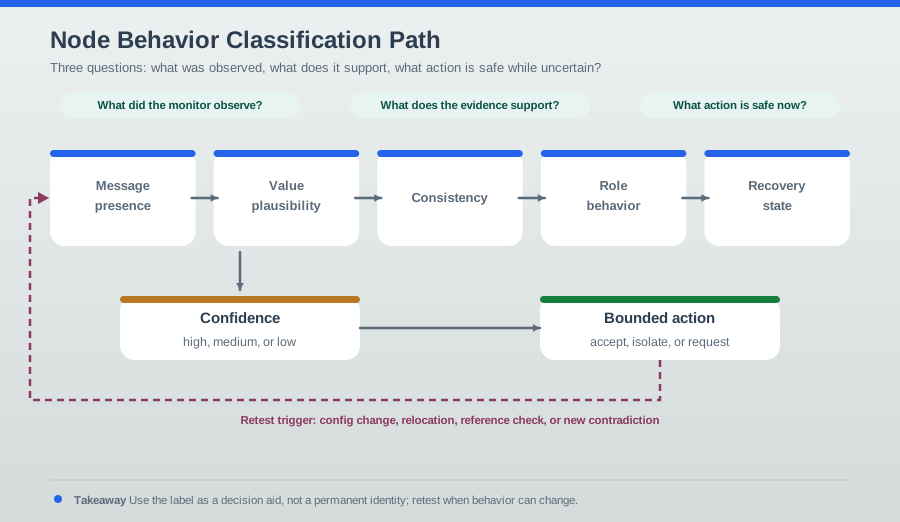
Use the label as a decision aid, not as a permanent identity. A node can move from suspect to healthy after a reference check, or from healthy to misleading after repeated contradictions appear.
5.8 Behavior Labels
Use a small label set so the review stays consistent.
Healthy
The node sends expected messages, the readings are plausible for the context, related evidence agrees, and the node performs its assigned role.
Silent
The monitor no longer receives expected messages. The classification should record the last accepted message, expected schedule, affected data path, and action to cover the missing evidence.
Suspect
The node has weak or conflicting evidence. It may be late, noisy, inconsistent, or missing metadata. Suspect means “do not rely on this reading without more evidence,” not “remove the node from every decision.”
Misleading
The node continues to send data, but the data should not be trusted for the current decision. Evidence may include impossible values, repeated contradictions with nearby or related observations, invalid metadata, or role behavior that conflicts with the protocol record.
Unknown
The monitor cannot classify the node from available evidence. Unknown is a useful label when the review must request another observation, a reference check, or a configuration audit.
5.9 Behavior Taxonomy
The broader taxonomy treats every label as a current evidence state rather than a permanent identity.
Selfish
The node appears to preserve its own traffic while avoiding shared work such as forwarding, route participation, or cooperative sensing. This label needs evidence of asymmetry, not just one missing relay.
Malicious
The node appears to introduce active harm such as false claims, identity conflict, route manipulation, selective distortion, or data tampering that is not explained by ordinary limits. This label needs corroboration and careful confidence language.
Dumb or limited-capability
The node has limited diagnostic evidence. It may be simple, temporarily silent, or unable to explain its local state. The safe response is recovery review, stale-data protection, and a clear retest trigger.
Use the strongest label that the record can support. If the record is thin, unknown or suspect is more honest than a dramatic label that the evidence cannot defend.
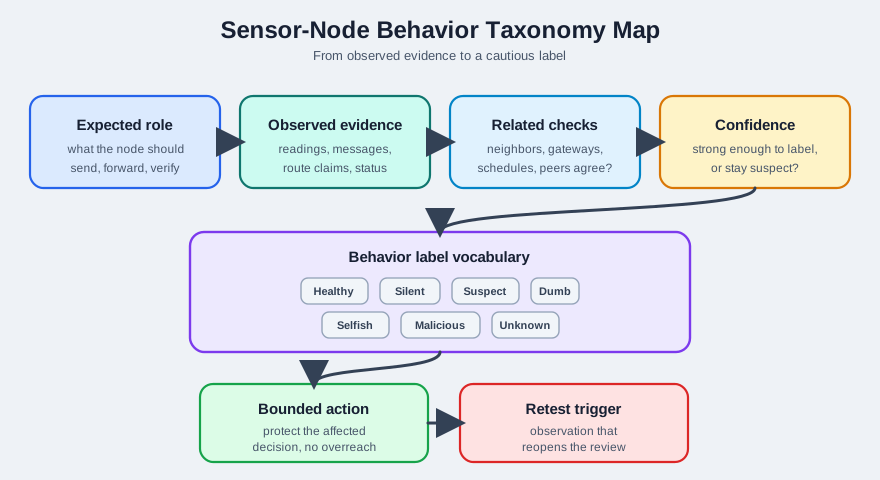
Figure 5.2 treats classification as a review loop. Start with the expected role, compare observed evidence with related checks, state confidence, choose a bounded label and action, then name the retest trigger that can reopen the decision.
Use a small evidence window before assigning intent. Suppose a gateway expects one health packet every 60 seconds from node N17. In a five-minute window N17 should produce five packets, but the monitor receives zero while two neighbouring nodes continue to report and the parent still forwards other traffic. The immediate label is silent or suspect, not malicious: the evidence proves absence from this decision path, but it does not yet prove deliberate harm. The safe action is to mark N17’s value stale, route decisions through related nodes, and clear the label only after current packets with valid metadata return.
A different window supports a different label. If N17 sends all five of its own readings but a watchdog overhears it forward 0 of 20 packets for children while nearby relays forward most observed packets, the pattern is self-serving rather than merely absent. If the same node also advertises false routing state or rewrites readings, the record can move toward malicious. Keep the label scoped to the observed role: a selfish relay label does not automatically invalidate a still-plausible local temperature report.
5.10 Label-To-Action Guide
The action should match the evidence.
- Healthy: use the node for the current decision while keeping normal monitoring and retest rules.
- Silent: mark the current source unavailable or stale for affected decisions; check schedule, role, related nodes, and recovery evidence before assigning a cause.
- Suspect: reduce confidence, request corroboration, or route the decision through additional evidence.
- Selfish: avoid relying on the node for shared work while collecting relay or cooperation evidence; do not treat it as malicious unless the record supports active harm.
- Malicious: protect the affected route, identity, or data path with narrow quarantine, corroboration, or exclusion bounded to the evidence record.
- Dumb or limited-capability: preserve last-good evidence, handle buffered data carefully, and name the condition that would reopen or clear the recovery review.
- Unknown: hold a conservative state, collect missing evidence, and avoid irreversible labels.
5.11 Evidence Checks
Classification improves when each check has a narrow purpose.
Message presence
Ask whether the node has sent an expected message recently enough for the current decision. Record whether the missing state is temporary, repeated, or unexplained.
Value plausibility
Ask whether the value is possible under the known context. Plausibility checks catch impossible readings, unit mistakes, stuck values, and readings outside the accepted band.
Consistency
Ask whether the reading agrees with related evidence. Related evidence may come from a nearby node, a repeated sample, a reference observation, or a process signal that should change together.
Role behavior
Ask whether the node is behaving consistently with its assigned role. A relay, sampler, actuator-adjacent node, or observer may have different expectations.
Recovery state
Ask whether the node recently restarted, rejoined, changed configuration, or lost required metadata. Recovery evidence can explain a temporary suspect state, but it should not automatically restore trust.
5.12 Node Behavior Patterns
Behavior monitoring gives evidence; classification interprets it. A watchdog can overhear whether a neighbour actually forwards packets it was given, while a reputation record can aggregate observations over time. The same missing forward can mean very different things depending on whether the node is also missing its own reports, preserving only its own traffic, or actively corrupting route or data state.
| Behavior pattern | Evidence signature | Typical response |
|---|---|---|
| Cooperative | The node sends its own reports, forwards expected relay traffic, and passes plausibility and consistency checks. | Keep normal monitoring and retest rules. |
| Faulty | The node fails indiscriminately: own reports, relay traffic, metadata, or readings are missing or erratic. | Use fault tolerance: stale-state protection, redundancy, route repair, and replacement review. |
| Selfish | The node reliably sends its own traffic but avoids shared work such as forwarding or cooperative sensing. | Avoid relying on shared work from that node while collecting cooperation evidence or applying incentive/reputation controls. |
| Malicious | The node introduces active harm such as false claims, identity conflict, route manipulation, selective distortion, or data tampering. | Protect the affected route, identity, or data path with narrow quarantine, corroboration, or exclusion. |
Keep separate counters for own reports, relay opportunities, overheard forwards, failed plausibility checks, and contradictory peer evidence. A soil-moisture node that reports 44%, 45%, and 44% while adjacent nodes report 43% and 46% is probably cooperative for that decision. A node that reports 99% for six samples while adjacent probes remain near 45% is available but suspect or misleading. A relay that sees 18 child packets and forwards only one, yet sends its own five packets on time, is a selfish hypothesis until more evidence proves a fault or active attack.
The response should be as narrow as the evidence. Mark a stale sensor unavailable for the affected dashboard rather than removing it from every network function. Down-weight a contradictory reading until a reference check or repeated sample resolves the conflict. Quarantine a routing participant only when the record shows harmful route or identity behaviour. A simple two-window rule often helps: warn on the first weak window, act only when the second window repeats the same pattern.
5.13 Dropped Packets Need Denominators
“Dropped a packet” is weak evidence unless the record states how many chances the node had, what the monitor could overhear, and whether the same radio link carried the node’s own traffic. A watchdog that observes 20 relay opportunities, hears only 2 forwards, and also sees the node send 10 of 10 own reports has a different case from a monitor that missed one forward during a noisy interval.
Reputation systems usually smooth these observations across windows, age old evidence down, and separate role-specific scores so a poor relay score does not automatically condemn a temperature reading that still passes plausibility and peer checks.
5.14 Selfish Forwarding Evidence
5.15 Classification Matrix
The matrix connects evidence to a bounded action.
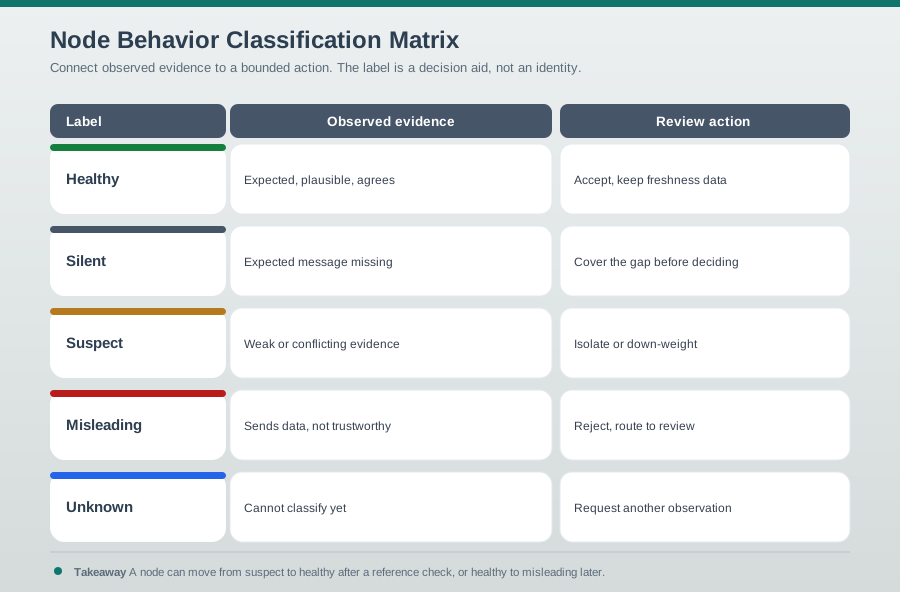
Read the matrix row by row:
- Healthy evidence can be accepted, but the record should still keep freshness and validity metadata.
- Silent evidence requires a missing-data action before the decision continues.
- Suspect evidence should be isolated or down-weighted until an additional check resolves it.
- Misleading evidence should be rejected for the affected decision and routed to review.
- Unknown evidence should trigger a request for the missing observation rather than a confident label.
5.16 Worked Review: Silent Temperature Node
Scenario: a room condition dashboard expects periodic temperature readings from a node. The node has stopped sending messages.
Concrete example: a classroom comfort dashboard expects a temperature and humidity packet from each room node every review interval. If one room stops reporting while nearby rooms continue, the current room value should be marked missing instead of being copied forward as a fresh reading.
Observation
The last accepted message is old enough that the dashboard can no longer treat the value as current.
Evidence check
Message presence fails. There is no current reading, and the data record should not silently reuse the last value.
Classification
Silent.
Action
Mark the current reading unavailable, show the affected room state as missing, and request a node health review. Do not infer a temperature trend from stale data.
Residual concern
The silence may hide a local issue that the application still needs to handle, so the decision record should state how missing evidence changes the downstream rule.
5.17 Plausible but Contradictory
Scenario: a storage area has several related condition readings. One node reports a value that is possible by itself, but it repeatedly contradicts nearby observations and the expected process state.
Observation
The node still sends complete messages. The value is not impossible, but it does not match related evidence.
Evidence check
Message presence passes. Plausibility passes. Consistency fails repeatedly.
Classification
Misleading for the affected decision.
Action
Reject that reading for the current decision, preserve it as evidence with a suspect validity state, and request a reference check or replacement review.
Residual concern
The failed consistency check does not prove the physical cause. The classification should stay evidence-bound and avoid claiming a root cause until a separate inspection supports it.
5.18 Worked Review: Mixed Missing Evidence
Scenario: a gateway notices that one node’s current reading is missing. The node’s previous reading was accepted, but the expected message did not arrive during the current review window.
Concrete example: a storage-room humidity node reported normally during the last review window, but the dashboard refresh has no new message while nearby temperature and door-state nodes are still reporting.
First pass
The node is not immediately failed, selfish, or malicious. The strongest first label is silent because the expected message is absent.
Context check
The reviewer checks schedule, topology role, related nodes, and whether the node recently changed duty-cycle behavior. If nearby nodes are also missing, the label may stay silent or move into limited-capability recovery review. If only shared relay traffic is missing while the node’s own readings continue, selfish behavior may become a hypothesis.
Action
The current decision should not reuse the stale value as current. The review record marks the source unavailable for that decision, preserves the last accepted observation, and records what new message, related-node observation, or recovered data would reopen the label.
5.19 Review Record
A classification should leave enough evidence for another reviewer to understand the decision.
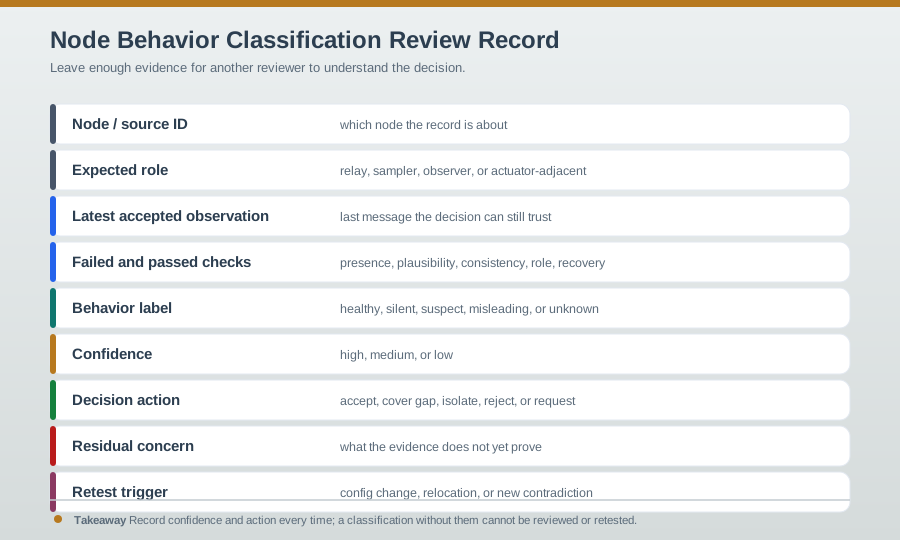
Record:
- node or source identifier;
- expected role;
- latest accepted observation;
- failed and passed checks;
- behavior label;
- confidence;
- decision action;
- residual concern;
- retest trigger.
The retest trigger matters because node behavior can change. Repeat the classification after a configuration change, relocation, reference check, repeated missing state, or new contradiction.
5.20 Common Mistakes
- Treating silence and misleading data as the same failure.
- Assuming a root cause from one symptom.
- Accepting plausible values without consistency evidence.
- Removing a node from every decision when only one decision path is affected.
- Hiding missing readings by reusing old values without a stale state.
- Classifying a node without recording confidence and action.
- Forgetting to retest after configuration or placement changes.
5.21 Knowledge Check
5.22 Matching Quiz
5.23 Ordering Quiz
5.24 Summary
Sensor node behavior classification is an evidence review, not a guess about what broke. Healthy, silent, suspect, misleading, and unknown labels help teams separate missing data from active but untrustworthy data. The classification is strongest when it records message presence, plausibility, consistency, role behavior, recovery state, confidence, action, and retest trigger.
5.25 Key Takeaway
Node-behavior classification helps separate normal, degraded, selfish, malicious, and recovering nodes so the architecture can respond appropriately.
5.26 Concept Relationships
- Behavior Taxonomy defines the broader behavior categories used before this classification step.
- Selfish & Malicious Nodes extends classification to nodes that intentionally withhold, distort, or abuse network roles.
- Limited-Capability And Recovery Cases focuses on response patterns when a node cannot provide rich diagnostic evidence.
- Duty-Cycling and Topology Management explains why expected schedules and topology roles affect behavior evidence.
5.27 What’s Next
Next, move from fault-style behavior labels to intent and incentive questions in Selfish & Malicious Nodes. Keep the same evidence discipline: label the behavior from observations, state confidence, and avoid claiming motives that the evidence does not support.