6 Protocol Pioneers: Web, Email, and Routing
More
Depth: Practitioner
Progress saves as you read. Mark sections complete as you go; your progress appears in the sidebar.
6.1 Start With the Decision
This section: Start With the Decision — TCP/IP is the shared rule set that carries packets, or units of data, between networks.
TCP/IP is the shared rule set that carries packets, or units of data, between networks. People still needed useful ways to work through those networks, so the web and email grew. Loop-free routing keeps a packet’s path from circling back on itself.
6.2 Route Overview
This section: Route Overview — This is part 2 of 2.
This is part 2 of 2. Review Protocol Pioneers: Packets and Internetworking for the preceding evidence.
6.3 Learning Objectives
This section: Learning Objectives
- Connect Cerf and Kahn’s TCP/IP work to the web.
- Compare the roles of Berners-Lee, Tomlinson, and Perlman.
6.4 Chapter Roadmap
This section: Chapter Roadmap
- Checkpoint: Packet Switching
- Vint Cerf (1943-) and Bob Kahn (1938-): The Fathers of the Internet
- What Cerf and Kahn Made Possible
- Checkpoint: Internet Architecture
- Tim Berners-Lee (1955-): World Wide Web Inventor
- What Berners-Lee Made Possible
- Ray Tomlinson (1941-2016): Email Inventor
- What Tomlinson Made Possible
- Checkpoint: Human-Readable Network Use
- Radia Perlman (1951-): “Mother of the Internet”
- What Perlman Made Possible
- Continue to Part 2
 Checkpoint: Packet Switching
You now know:
- Baran’s 1964 packet-switching work answered a resilience problem, not a convenience problem.
- The central move was to break messages into packets and let redundant paths survive failures.
- Modern mesh behavior in Zigbee and Thread inherits that same distributed-routing idea.
6.5 Vint Cerf (1943-) and Bob Kahn (1938-): The Fathers of the Internet
This section: Vint Cerf (1943-) and Bob Kahn (1938-): The Fathers of the Internet — Inspect Figure 6.1 and look for how endpoint reliability and an open network core solve different parts of internetworking.
Inspect Figure 6.1 and look for how endpoint reliability and an open network core solve different parts of internetworking.
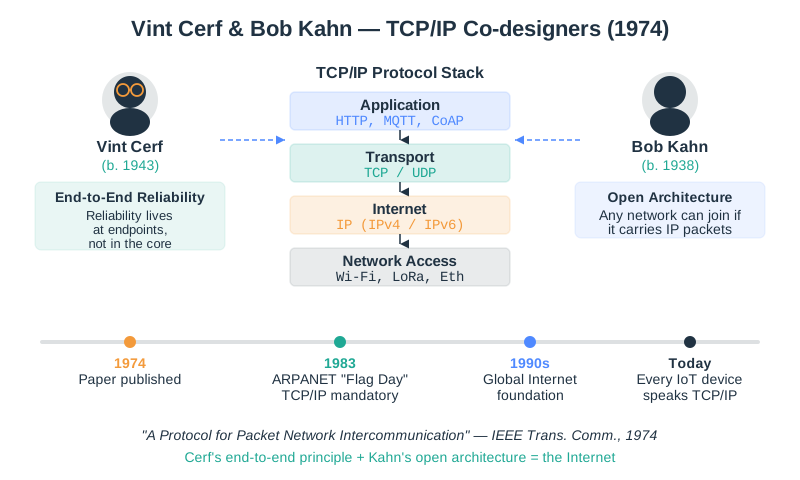
Start Figure 6.1 with Cerf’s end-to-end idea. TCP at each end orders data and sends a lost packet again. The network core can stay more simple. Kahn’s open design lets Wi-Fi, cell, or satellite links take part if they forward IP. The lower stack splits the jobs. MQTT gives the app meaning. TCP gives ordered and sound delivery. IP finds a route across the link at hand. TCP/IP did not need one common physical network. It gave the ends and the internet layer a stable pact across networks with different tools and owners.
6.5.1 The Problem They Solved
By the early 1970s, ARPANET connected a few dozen computers using the Network Control Protocol (NCP). But NCP had critical limitations:
- Only worked on ARPANET — couldn’t connect to other networks (satellite, radio, Ethernet)
- No error recovery — if a packet was lost, applications had to detect and retransmit
- Assumed reliable links — didn’t handle packet reordering or corruption
ARPA wanted to connect heterogeneous networks — ARPANET, satellite links (SATNET), and packet radio networks (PRNET) — into a single inter-network. No existing protocol could do this.
6.5.2 Their Breakthrough: TCP/IP and the Open Architecture Principle
Baran showed that packet networks could be resilient. Cerf and Kahn’s next question was broader: how can different packet networks become one inter-network?
In 1974, Vint Cerf and Bob Kahn published “A Protocol for Packet Network Intercommunication” in IEEE Transactions on Communications. Their protocol had two revolutionary ideas:
1. The Open Architecture Principle (Kahn’s Insight) Any network — wired, wireless, satellite, smoke signals — can join the Internet if it can carry IP packets. The Internet doesn’t care how individual networks work internally. This is called network layer independence.
2. End-to-End Reliability (Cerf’s Insight) Don’t trust the network to be reliable. Instead, put reliability logic in the endpoints — the computers sending and receiving data. If a packet is lost, the receiving computer detects the gap (via sequence numbers) and asks the sender to retransmit.
This became the end-to-end principle: intelligence belongs at the edges, not in the network core. The network’s job is simple: forward packets. The endpoints handle everything else.
6.5.3 Cerf’s Personal Motivation
Vint Cerf is partially deaf from birth. This personal experience gave him a unique perspective on communication:
“I’ve always been interested in communication because I understand what it’s like when communication fails. The Internet is fundamentally about connecting people and ideas — making sure messages get through despite imperfect infrastructure.”
His passion for robust communication influenced TCP’s design. TCP doesn’t just detect errors — it corrects them, automatically retransmits lost packets, and reorders out-of-sequence packets. This robustness reflects Cerf’s personal understanding that communication cannot be taken for granted.
6.5.4 The Impact
TCP/IP became mandatory on ARPANET in 1983 (“Flag Day”). By the 1990s, it was the foundation of the global Internet. Internet-connected devices use IP; constrained sensors may instead communicate through a gateway.
An IP-connected laptop or ESP32 uses the Internet protocol suite. When an IP-connected IoT temperature sensor sends data to AWS IoT Core, it’s using:
- IP (Internet Protocol): Routes packets across multiple networks (your Wi-Fi → ISP → AWS)
- TCP (Transmission Control Protocol): Ensures reliable, ordered delivery (retransmits lost packets)
Kahn’s open architecture principle is why IoT works at all — you can mix LoRaWAN sensors, Wi-Fi cameras, cellular trackers, and Zigbee switches in one system. They all use IP as the common language.
Cerf’s end-to-end reliability is why MQTT over TCP works even on terrible networks. TCP handles the retransmissions so your application code doesn’t have to.
Checkpoint: Internet Architecture
You now know:
- TCP/IP, published in 1974, made heterogeneous networks interoperate instead of forcing every link to behave the same way.
- IP keeps the network core simple: forward packets across whatever link is available.
- TCP puts reliability at the endpoints, which is why MQTT over TCP can survive Wi-Fi, cellular, and satellite variation.
6.5.5 How to Use: Cerf Today: Chief Internet Evangelist at Google
Vint Cerf continues to advocate for Internet expansion. As Google’s “Chief Internet Evangelist,” he works on:
- Interplanetary Internet: Extending TCP/IP to work over multi-minute delays between Earth and Mars
- Internet access as a human right: Advocating for global connectivity
- IPv6 adoption: Ensuring enough addresses for billions of IoT devices ( addresses, vs. IPv4’s )
6.6 Tim Berners-Lee (1955-): World Wide Web Inventor
This section: Tim Berners-Lee (1955-): World Wide Web Inventor — The Web did not arrive as a single black box or proprietary product.
The Web did not arrive as a single black box or proprietary product. Figure 6.2 connects Berners-Lee’s 1989 hypertext problem at CERN to a working browser and server, then to W3C stewardship of an interoperable Web. Use the timeline to distinguish the problem, the end-to-end implementation, and the standards duty that kept independent systems connected.
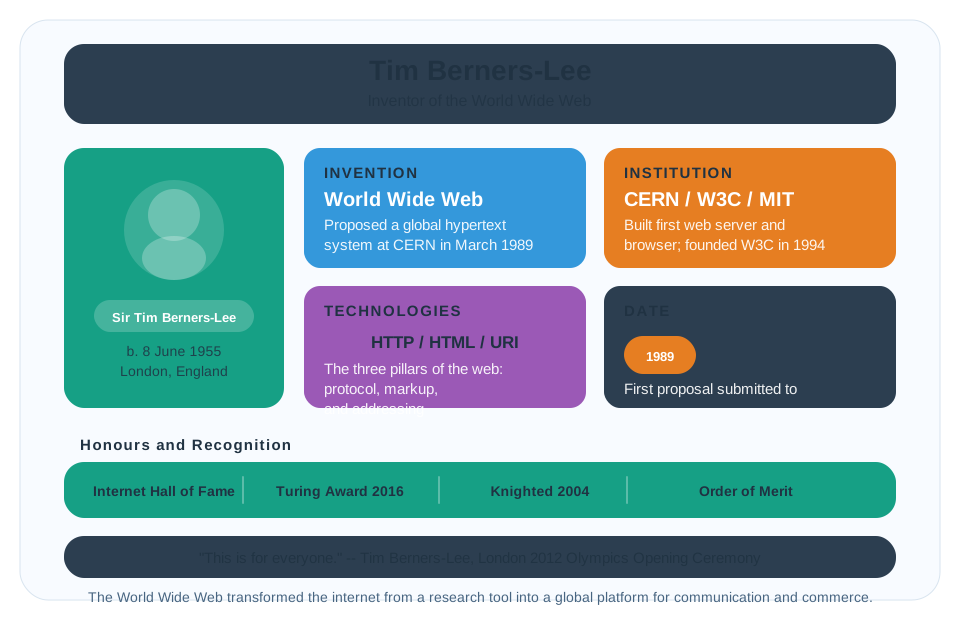
In Figure 6.2, HTML marks linked documents, HTTP requests and returns them, and a URL or URI gives each resource a name. Those three open conventions made the first end-to-end Web work; open standards then let independent browsers and servers share it. The figure’s recognition panel matters because the lasting contribution is not celebrity alone, but a globally linkable design that remains interoperable.
6.6.1 The Problem He Solved
In 1989, CERN (the European physics lab) had thousands of researchers generating papers, datasets, and software. But there was no easy way to link related documents across different computers. If you read a paper that referenced another paper, you had to manually search for it on a different system. Knowledge was siloed.
Berners-Lee, a British software engineer at CERN, had a vision: What if documents could link to each other across the network? Click a word, jump to a related document, regardless of which computer hosts it.
6.6.2 His Breakthrough: The World Wide Web
Between 1989 and 1991, Berners-Lee invented the three core technologies that make the Web work:
1. HTML (HyperText Markup Language) A simple way to format documents with hyperlinks — clickable text that references other documents by URL.
<a href="https://www.w3.org/History/1989/proposal.html">Original Web Proposal</a>2. HTTP (HyperText Transfer Protocol) A lightweight protocol for requesting and serving documents over TCP/IP. HTTP is stateless — each request is independent, making it simple and scalable.
GET /related-paper.html HTTP/1.0
Host: example.com
3. URLs (Uniform Resource Locators)
A standard way to address any resource on the Internet: http://server/path/to/file.
4. The First Web Browser (WorldWideWeb) Berners-Lee wrote the first browser and web server in 1990 on a NeXT computer. CERN later placed the Web software in the public domain in April 1993.
6.6.3 The Decision That Changed the World
In 1993, CERN faced a choice: patent the Web or release it freely?
Berners-Lee convinced CERN to release the Web into the public domain with no royalties, no restrictions. This decision made the Web universal. If CERN had patented it, the Web might have become a proprietary system like AOL or CompuServe — walled gardens that eventually died.
6.6.4 The Impact
The ITU estimated 6 billion Internet users in 2025; that figure measures Internet use, not Web use specifically. ITU Facts and Figures 2025 Berners-Lee was knighted by Queen Elizabeth II in 2004 for his contribution to humanity.
Every web-based IoT dashboard, every REST API, every cloud platform UI you use is built on Berners-Lee’s HTTP.
- IoT Dashboards: When you view sensor data in a web browser (Grafana, ThingSpeak, AWS IoT console), you’re using HTTP to fetch data and HTML to display it
- REST APIs: When your IoT device sends data to a web service (
POST /sensor-data), it’s using HTTP as the application protocol - Webhooks: When AWS IoT triggers a webhook on sensor events, it’s using HTTP to notify your application
HTTP’s simplicity — stateless requests, plain text headers, easy to debug — made it ideal for IoT. That simplicity was Berners-Lee’s design choice, influenced by his goal to make the Web accessible to everyone, not just experts.
6.6.5 Berners-Lee Today: Fighting for an Open Web
Berners-Lee founded the World Wide Web Consortium (W3C) to maintain open web standards. Today, he’s working on Solid — a project to give users control over their personal data, addressing privacy concerns that have emerged 30+ years after the Web’s creation.
6.7 Ray Tomlinson (1941-2016): Email Inventor
This section: Ray Tomlinson (1941-2016): Email Inventor — The portrait in Figure 6.3 links a person to a change in addressing.
The portrait in Figure 6.3 links a person to a change in addressing. Its 1971 marker names the first networked email, sent between ARPANET-connected computers at BBN. The @ panel shows the user@host form, which distinguishes a mailbox from the computer that receives it. That distinction mattered because earlier local messages could stay on one machine, while Tomlinson’s combined tools carried a message across machines. Read the contribution panel beside the @ symbol, then compare it with the local-messaging problem in the section below. The figure gives a concrete reason that an address needed both a user and a host.
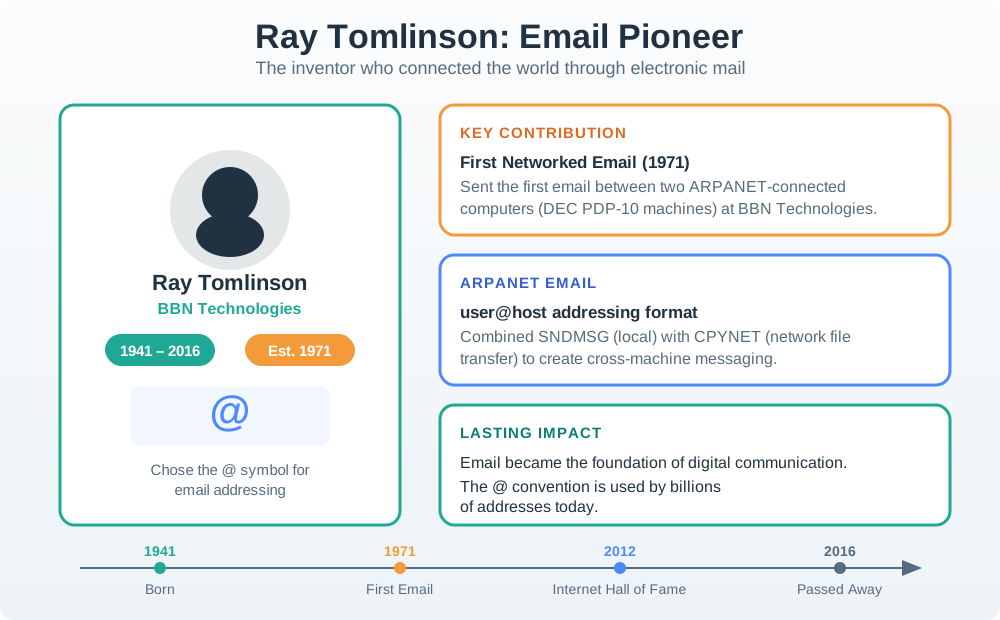
Start beside Tomlinson’s portrait in Figure 6.3, where the @ symbol introduces email addressing. Read the panels on the right to follow the move from local messages to delivery between networked computers.
6.7.1 The Problem He Solved
In 1971, computers could run local messaging programs — users on the same computer could leave messages for each other. But ARPANET had connected computers at different sites. Tomlinson, working at BBN Technologies (the company building ARPANET), asked: What if people could send messages across the network to users on different computers?
6.7.2 His Breakthrough: Networked Email with the @ Symbol
Tomlinson wrote the first networked email program in 1971. His key innovation was the user@host addressing format:
tomlinson@bbn-tenexaWhy the @ symbol? Tomlinson needed a character that:
- Wasn’t already used in usernames (so
fred@hostwouldn’t be confused withfred) - Indicated “at” in natural language
- Was available on the Model 33 Teletype keyboard
The @ symbol was perfect. It was rarely used for anything else (outside accounting contexts), and it naturally read as “user at host.”
6.7.3 What Was the First Email?
Tomlinson sent the first networked email to himself — from one computer to another computer sitting right next to it. What did it say?
He doesn’t remember. In later interviews, he said it was probably something like:
QWERTYUIOP— just testing the keyboard. The content didn’t matter. What mattered was that it worked.
6.7.4 The Impact
By 1973, email accounted for well over half of ARPANET traffic, according to the Computer History Museum. Source Today, billions of people use email, all following Tomlinson’s user@host format. The @ symbol has become one of the most recognized symbols in the world.
The concept of user@host addressing influenced every messaging system:
- Email:
user@domain.com(still uses Tomlinson’s format) - MQTT Topics:
sensors/building-a/floor-3/temperature— hierarchical addressing where slashes separate context levels, similar to how @ separates user from host - IoT Device IDs: Many systems use
device@projectordevice.projectformats for unique identification - DNS Naming:
hostname.subdomain.domain.com— hierarchical naming influenced by email’s structure
For IoT specifically: When AWS IoT assigns devices unique IDs like thing-name.aws-iot.us-east-1.amazonaws.com, it’s following a pattern Tomlinson established 50+ years ago — separating the specific identifier (thing-name) from the context (where it belongs).
Checkpoint: Human-Readable Network Use
You now know:
- Berners-Lee’s 1989 Web work made networked documents usable through HTTP, HTML, and URLs.
- Tomlinson’s email work made
user@hostaddressing memorable enough to survive into everyday life. - Both stories matter to IoT because dashboards, REST APIs, webhooks, device IDs, and topic names need human operators to understand them.
6.8 Radia Perlman (1951-): “Mother of the Internet”
This section: Radia Perlman (1951-): “Mother of the Internet” — Inspect Figure 6.4 and look for how spanning tree keeps a backup link without allowing a broadcast loop.
Inspect Figure 6.4 and look for how spanning tree keeps a backup link without allowing a broadcast loop.
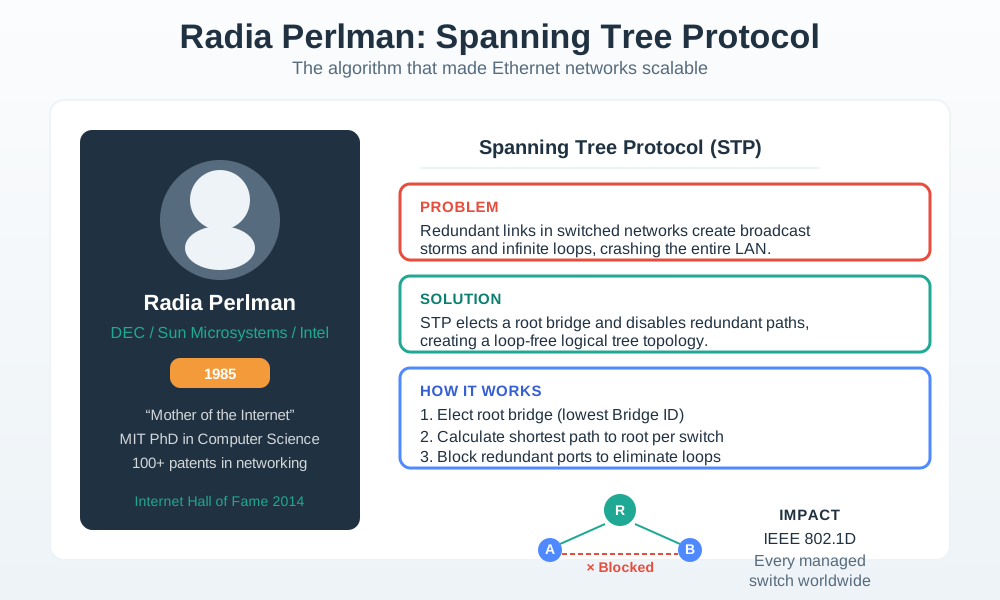
Start Figure 6.4 with the extra-link problem. More than one path can aid recovery, but an Ethernet broadcast can loop and grow. STP makes switches find their peers and elect a root bridge. Each switch finds its best path to that root. The link that would close a loop stays blocked. If a live link fails, the switches can open a backup path. The blocked link is spare capacity, not wasted hardware. Safe redundancy needs one loop-free forwarding tree, a way to change it after failure, and a measured recovery time that meets the service need.
6.8.1 The Problem She Solved
When you connect Ethernet switches together, you create a network graph. But graphs can have loops — paths that circle back on themselves. In a loop, a broadcast packet circulates forever, consuming all bandwidth. Within seconds, a single packet can multiply into a broadcast storm that crashes the entire network.
In the early 1980s, network engineers had to carefully plan network topologies to avoid loops. Redundancy was risky — if you added a backup link for resilience, you might accidentally create a loop that crashed everything.
6.8.2 Her Breakthrough: Spanning Tree Protocol (STP)
In 1985, while working at Digital Equipment Corporation (DEC), Radia Perlman invented the Spanning Tree Protocol. STP automatically detects and blocks loops in Ethernet networks:
How STP Works:
- Switches exchange messages to discover the network topology
- They elect a “root bridge” (the switch with the lowest ID)
- Each switch calculates its shortest path to the root
- Any link that would create a loop is automatically blocked (disabled)
- If a link fails, STP recalculates and unblocks backup paths
Network engineers can connect switches with redundant links for resilience. After convergence, STP selects an active loop-free topology; failures and reconvergence still need testing.
6.8.3 Why She Dislikes the “Mother of the Internet” Title
Media often calls Perlman the “Mother of the Internet” to parallel Vint Cerf’s “Father of the Internet” title. She dislikes this for two reasons:
- Many people built the Internet — singling out individuals ignores collaborative effort
- Gender-specific titles create false parallels — her contributions stand on their own merit, not as a female counterpart to a male pioneer
Perlman prefers to be known for her work: STP, TRILL (modern Ethernet routing), and network security research.
6.8.4 The Impact
Every Ethernet switch in every building runs Perlman’s algorithm. STP is standardized as IEEE 802.1D and has evolved into Rapid Spanning Tree (RSTP, 802.1w) and Multiple Spanning Tree (MSTP, 802.1s), but the core algorithm is Perlman’s 1985 invention.
Every IoT gateway, industrial Ethernet switch, and building network uses Perlman’s Spanning Tree Protocol:
- Smart Buildings: When you deploy PoE (Power over Ethernet) switches to power IP cameras and IoT sensors, STP allows redundant uplinks for resilience
- Industrial IoT: Factory networks use STP to ensure a single cable cut doesn’t isolate machines
- Home Networks: Managed switches in home labs use STP to prevent accidental loops when users connect cables
For IoT specifically: STP enabled the plug-and-play Ethernet experience. You can connect switches in any topology, add redundant links for failover, and STP ensures it just works. Without STP, every IoT deployment would require careful network topology planning to avoid loops — slowing deployment and increasing costs.
6.8.5 Perlman Today
Perlman holds over 100 patents and has taught at MIT and the University of Washington. Her textbook Interconnections is considered the definitive guide to network protocol design. She continues to work on network security and routing innovations.
6.9 Continue to Part 2
This section: Continue to Part 2 — Continue with Protocol Pioneers: Ethernet, MQTT, and IoT.
Continue with Protocol Pioneers: Ethernet, MQTT, and IoT.
6.10 Continue Your Route
This section: Continue Your Route — This is the last part of this chapter.
This is the last part of this chapter. Return to Protocol Pioneers: Packets and Internetworking or continue from the fundamentals module index.
Find help
3 reviewed answers.
Where should I start in a module?
Open the module page from the sidebar to see its chapters in order. Use the module map to return to a topic you need.
Modules and pathsReviewed
What can I try when a project does not work?
Check the symptom, then work through the diagnostic steps. Keep the error message and the smallest example that reproduces it.
When you are stuckReviewed
How do interactive examples work?
Use the interactive guide to check how examples and simulations work before changing your project.
Interactive examples guideReviewed