5 Protocol Pioneers: Packets and Internetworking

More
Depth: Practitioner
Progress saves as you read. Mark sections complete as you go; your progress appears in the sidebar.
5.1 Start With the Decision
This section: Start With the Decision — Paul Baran proposed dividing messages into small blocks that a network could send separately and route around damaged links.
Paul Baran proposed dividing messages into small blocks that a network could send separately and route around damaged links. A network connects devices through links; to route a block is to choose its next path toward the receiver. The approach helped make networks resilient. These blocks later became known as packets.
5.2 Route Overview
This section: Route Overview — This is part 1 of 2.
This is part 1 of 2. Continue with Protocol Pioneers: Web, Email, and Routing.
5.3 Part Objectives
This section: Part Objectives
- Explain Baran’s packet switching design.
- Trace the step from packet networks to open internetworking.
5.4 Overview
This section: Overview — This first route follows the people who established packet switching, open internetworking, the web, email, and loop-free network foundations.
This first route follows the people who established packet switching, open internetworking, the web, email, and loop-free network foundations.
This is part 1 of 2. Continue with Protocol Pioneers: Ethernet, MQTT, and IoT for the second focused route.
5.5 In 60 Seconds
This section: In 60 Seconds — Picture a farm sensor that must reach a weather service through a small radio and a field bridge.
Follow One Idea Into a Working Network
Picture a farm sensor that must reach a weather service through a small radio and a field bridge. That path exists because many people solved separate problems, then agreed on rules that let their work connect. History matters when it explains why those rules still shape a design.
Firmware means software stored on a device. A gateway means the bridge between a local device group and a wider network. Telemetry is the measurements and state a device reports over the network. Transmission Control Protocol (TCP) means a stream that checks order and delivery. Hypertext Transfer Protocol (HTTP) means a request-and-response format used by web systems. Internet Protocol means the addressing rules used to move network packets. IPv6 means version 6 of those rules. 6LoWPAN means a way to carry IPv6 over small low-power radios. Message Queuing Telemetry Transport (MQTT) means a lightweight message method for devices.
Trace one weather reading across that chain. Break a link, repeat a packet, restart the gateway, and delay the reply. Record which old idea governs each recovery step and which result reaches the service.
This runway does not credit every contributor or settle each historical debate. The deeper timeline shows how the inventions, standards, and trade-offs connect to decisions engineers still make.
The Internet was not invented by one person. Paul Baran made resilient packet routing thinkable; Vint Cerf and Bob Kahn made heterogeneous networks interoperate; Bob Metcalfe made local networking practical; Tim Berners-Lee made networked documents usable; and later pioneers shaped email, Ethernet loops, MQTT, IoT naming, IPv6 compression, and open standards governance. Modern IoT inherits those choices every time a sensor publishes MQTT over TCP/IP, a Thread device compresses IPv6, or a dashboard speaks HTTP.
5.6 Start With the Story
This section: Start With the Story — You will connect packet-switching and internetworking pioneers to the design problems their work addressed.
You will connect packet-switching and internetworking pioneers to the design problems their work addressed. Start by separating network survivability from the challenge of joining different networks.
Follow the review table across four beats to connect separate networking contributions into the route a modern IoT message uses.
-

Architect Bina: “Modern IoT inherits many separate networking contributions.”
-

Packet Pete: “A packet, cable, radio, web, and message service do not form a route by themselves.”
-

Test Tessa: “Map each contribution to the handoff it makes possible.”
-

The team: “The complete route shows why standards and the people behind them still matter.”
5.7 Learning Objectives
This section: Learning Objectives
By the end of this chapter, you will be able to:
- Identify the key Internet pioneers: Classify 10+ individuals by their foundational contributions to networking and protocol development
- Map people to protocols: Explain what each pioneer invented and justify why their design decisions still matter in modern IoT systems
- Analyze collaborative innovation: Describe how the Internet emerged through open collaboration rather than any single inventor’s work
- Trace ideas through generations: Illustrate how each pioneer’s work built on previous contributions and enabled subsequent innovations
- Differentiate design motivations: Compare the real-world constraints (nuclear resilience, satellite bandwidth, store stockouts) that drove each protocol’s design choices
- Apply Postel’s robustness principle: Evaluate how “be conservative in what you send, liberal in what you accept” enables interoperability across diverse IoT implementations
5.8 What To Watch For
This section: What To Watch For
- No single inventor: Internet history is a chain of interoperable contributions, not a lone-genius story.
- Constraints shaped protocols: Nuclear resilience, scarce satellite bandwidth, shared office printers, shelf stockouts, and tiny radio frames all left marks on protocol design.
- Open architecture: The Internet grows because IP can ride over many link technologies and open RFCs let independent implementers interoperate.
- Edge responsibility: Reliability, application meaning, and much protocol intelligence often sit at the endpoints rather than in the network core.
- IoT lineage: MQTT, Thread, Matter, 6LoWPAN, dashboards, and device identities are easier to reason about when you know which older design problem they inherit.
5.9 Minimum Viable Understanding
This section: Minimum Viable Understanding — Core Concept: The Internet and IoT protocols we use today are the result of collaborative work by hundreds of engineers over 60+ years.
Core Concept: The Internet and IoT protocols we use today are the result of collaborative work by hundreds of engineers over 60+ years. No single person “invented the Internet” — instead, each pioneer contributed a piece that enabled the next generation to build further.
Why It Matters: Understanding the human stories behind protocols helps you appreciate why they were designed the way they are. MQTT’s low overhead reflects Andy Stanford-Clark’s satellite bandwidth constraints. TCP’s robustness reflects Vint Cerf’s goal to connect any network to any other. Every protocol design decision has a human story.
Key Takeaway: When you use MQTT, TCP/IP, HTTP, or email today, you’re building on the work of specific, identifiable people who solved real problems. Learning their stories makes you a better engineer — you understand not just what protocols do, but why they were designed that way.
- Overview
- In 60 Seconds
- Start With the Story
- What To Watch For
- Minimum Viable Understanding
- Chapter Overview
- The Pioneer Timeline
- How It Works: The Generational Flow of Innovation
- Paul Baran (1926-2011): Packet Switching Pioneer
5.10 Chapter Overview
This section: Chapter Overview — Behind every Internet protocol — TCP, IP, HTTP, SMTP, MQTT — is a person or small team who identified a problem, proposed a solution, and convinced others to adopt it.
Behind every Internet protocol — TCP, IP, HTTP, SMTP, MQTT — is a person or small team who identified a problem, proposed a solution, and convinced others to adopt it. This chapter profiles 11 key pioneers whose work directly enables the IoT systems you build today.
You’ll learn not just what they invented, but why they made specific design choices, what obstacles they overcame, and how their work enabled the next generation of innovation.
Imagine you’re learning to cook. You could memorize recipes, or you could learn from the chefs who created them — understanding why they combined ingredients in specific ways, what problems they were solving, and how they adapted when things went wrong.
Learning about protocol pioneers is like learning from master chefs. When you understand that Vint Cerf designed TCP to work over any network (satellite, radio, wired) because he wanted the Internet to be universal, you understand why TCP has features like retransmission and flow control. When you know Andy Stanford-Clark created MQTT because satellite bandwidth was expensive, you understand why MQTT headers are so compact.
The simple version: Protocols weren’t handed down from the sky. Real people with specific problems created them. Understanding the people helps you understand the protocols.
Imagine the Sensor Squad started an Inventors Club!
5.10.1 The Big Meeting
One day, Temperature Terry gathered his friends: Light Lucy, Motion Marley, and the battery-management controller. “You know what’s cool?” Sammy said. “The Internet wasn’t invented by one person — it was a team effort, like us!”
Lila pulled out a big poster board: “Let’s meet the Internet Inventors Club!”
The Inventors Club Members:
Mr. Packet (Paul Baran) - “Don’t put all your eggs in one basket! If I cut this phone line, your whole message fails. But if I break messages into PACKETS and send them on different paths, some will always get through!” He drew maps showing multiple roads to the same destination.
Sammy laughed: “That’s how I send sensor readings! If one path is busy, the network finds another way!”
The Dynamic Duo (Vint Cerf and Bob Kahn) - These two best friends worked together to create TCP/IP. Vint was hard of hearing, which made him extra passionate about communication technology. Bob said: “Our rule is simple: ANY computer should talk to ANY other computer, anywhere, anytime!”
Max added: “That’s why my ESP32 can talk to a giant cloud server! Mr. Cerf and Mr. Kahn made sure all devices speak the same language!”
The Web Wizard (Tim Berners-Lee) - Tim worked at a big physics lab called CERN. Scientists there couldn’t find each other’s research papers! So Tim invented the World Wide Web — a way to link documents together with clickable words. He gave it away FOR FREE.
Bella calculated: “If Mr. Berners-Lee had patented the Web, he could have been a billionaire! But he wanted everyone to use it.”
The Email Pioneer (Ray Tomlinson) - Ray sent the first email in 1971. He needed a way to separate the person’s name from the computer name, so he chose the @ symbol. “Why @?” he asked. “Because nobody was using it for anything else!”
Lila giggled: “sammy@iot-lab.com — that @ symbol is almost 60 years old!”
The Network Nurse (Radia Perlman) - Radia is called the “Mother of the Internet” (though she doesn’t like that title). She invented the Spanning Tree Protocol that stops network loops. Imagine if your school’s halls were a maze where you could walk in circles forever — Radia’s invention prevents that in networks!
Max observed: “Every switch in every building runs Ms. Perlman’s algorithm!”
The IoT Namer (Kevin Ashton) - In 1999, Kevin was working at a company that made soap and lipstick. He noticed: “Computers know what’s on the Internet, but they don’t know what’s on store shelves! What if things could tell computers about themselves?” He called this the “Internet of Things.”
Sammy beamed: “That’s ME! I’m part of the Internet of THINGS!”
5.10.2 The Big Lesson
Bella wrote on the poster: “Great inventions come from teamwork! Nobody built the Internet alone — they all helped each other!”
Key Words for Kids:
| Word | What It Means |
|---|---|
| Protocol | Rules for how devices talk to each other (like saying “please” and “thank you”) |
| Packet | A small chunk of a message (like breaking a puzzle into pieces to mail it) |
| TCP/IP | The main language computers use to talk on the Internet |
| World Wide Web | The system of linked web pages you see in a browser |
| @ Symbol | The “at” sign in email addresses that separates person from computer |
5.11 The Pioneer Timeline
This section: The Pioneer Timeline — Start with the timeline before the biographies.
Start with the timeline before the biographies. It gives you the order of ideas, so each profile can answer a sharper question: what problem was still unsolved at that moment?
Before diving into individual profiles, here’s when each pioneer made their key contributions:
| Year | Pioneer | Achievement |
|---|---|---|
| 1964 | Paul Baran | Published packet switching concepts (RAND Corporation) |
| 1971 | Ray Tomlinson | Sent first networked email with @ symbol |
| 1973 | Bob Metcalfe | Invented Ethernet at Xerox PARC |
| 1974 | Vint Cerf & Bob Kahn | Published TCP/IP specification |
| 1985 | Radia Perlman | Invented Spanning Tree Protocol (STP) |
| 1989 | Tim Berners-Lee | Proposed World Wide Web at CERN |
| 1999 | Andy Stanford-Clark | Co-created MQTT for industrial IoT |
| 1999 | Kevin Ashton | Coined “Internet of Things” in P&G presentation |
| 2000s | Geoff Mulligan | Led IETF 6LoWPAN standardization |
| 1970s-98 | Jon Postel | Edited most early RFCs, managed IANA |
The big picture: Each pioneer’s work enabled the next generation. No invention happened in isolation — they built on each other’s foundations in a clear sequence.
Step-by-step progression:
- Paul Baran (1964): Packet switching — messages can be broken into chunks and take different paths
- Vint Cerf & Bob Kahn (1974): TCP/IP — different networks can connect using Baran’s packets as the unit of exchange
- Bob Metcalfe (1973): Ethernet — local networks need a way to share a wire (complements TCP/IP’s network-to-network role)
- Tim Berners-Lee (1989): HTTP and HTML — now that networks are connected, we need a way to link documents (runs over TCP/IP)
- Andy Stanford-Clark (1999): MQTT — HTTP is too heavy for sensors on slow satellite links (lighter alternative for constrained devices)
- Geoff Mulligan (2000s): 6LoWPAN — TCP/IP was designed for computers, but IoT needs it to work on tiny devices with 802.15.4 radios
Why this matters: When you debug a network issue, you’re thinking through this same stack. Understanding the progression helps you remember the layering: Ethernet (physical sharing) → IP (network-to-network) → TCP (reliable delivery) → HTTP/MQTT (application protocols). Each layer solves a problem the previous layer left open.
5.12 Paul Baran (1926-2011): Packet Switching Pioneer
This section: Paul Baran (1926-2011): Packet Switching Pioneer — Before Paul Baran (1926-2011): Packet Switching Pioneer, inspect the figure Figure 5.1.
Before Paul Baran (1926-2011): Packet Switching Pioneer, inspect the figure Figure 5.1. Compare Paul Baran: Packet Switching Pioneer with Paul Baran; their difference reveals Paul Baran at RAND Corporation, where he pioneered distributed packet-switched networks that could survive nuclear attack. This gives Paul Baran (1926-2011): Packet Switching Pioneer evidence to revisit.
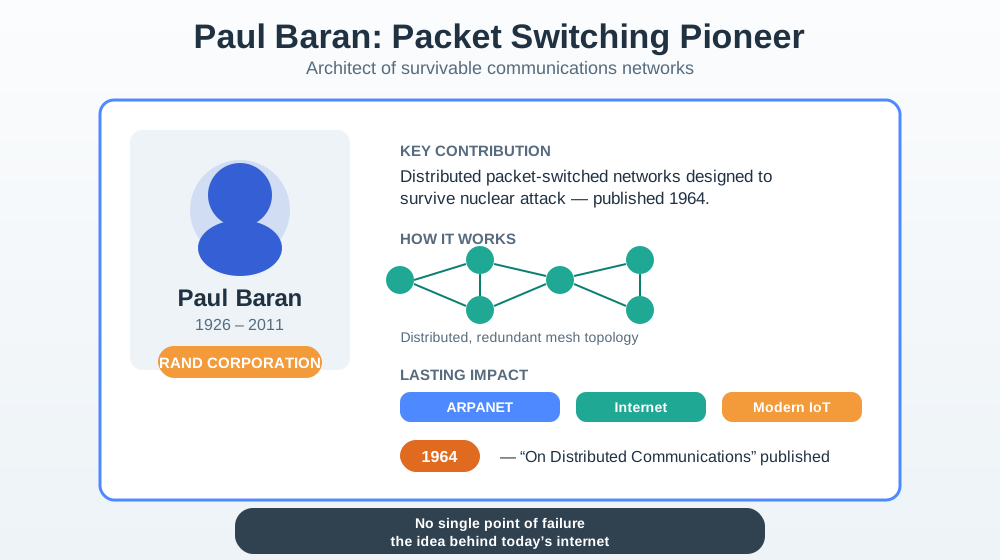
Read from Paul Baran’s profile into the contribution panel of Figure 5.1, then inspect the redundant mesh beneath it. Multiple connections provide alternative routes instead of relying on one central point. The impact row links this survivability idea to later networks, giving a concrete reason for studying the historical contribution.
5.12.1 The Problem He Solved
In the early 1960s, the U.S. military faced a critical vulnerability: all telephone communication relied on circuit-switched networks with central switching stations. If a Soviet nuclear strike destroyed a few key switching centers, the entire network would collapse. The Pentagon needed a communication system that could survive a nuclear war.
5.12.2 His Breakthrough: Distributed Packet Switching
Between 1960 and 1964, Paul Baran at the RAND Corporation developed the concept of packet switching with distributed routing. His key insights:
1. Break Messages Into Packets Instead of dedicating a circuit for an entire conversation (like telephone calls), break messages into small, independently-routable packets. Each packet knows its destination and finds its own way there.
2. Redundant Mesh Networks Build networks with multiple paths between nodes. If one path is destroyed, packets automatically route around the damage. This was revolutionary — telephone networks were designed as hierarchical trees, not redundant meshes.
3. Distributed Intelligence Put routing logic in every node, not in centralized switches. Each node makes local decisions about where to forward packets based on current network conditions. No single point of failure.
5.12.3 What AT&T Thought
In 1965, Baran presented his ideas to AT&T engineers. Their response: “It won’t work.”
AT&T’s engineers were the world’s foremost experts in circuit-switched telephony. They couldn’t imagine that chopping messages into pieces and sending them on unpredictable paths would be more reliable than dedicated circuits. This is paradigm blindness in action — expertise in the current system made them blind to the next paradigm.
Baran later reflected: “They didn’t understand digital technology. Their entire system was analog, and they saw packet switching as chaos.”
5.12.4 The Impact
Baran published his findings in an 11-volume report called On Distributed Communications (1964). Though AT&T rejected it, ARPA (Advanced Research Projects Agency) studied Baran’s work when designing ARPANET in the late 1960s. Packet switching became the foundation of the Internet.
5.12.5 What Baran Made Possible
Every packet that travels the Internet — whether it’s carrying a web page, an email, or an MQTT message from an IoT sensor — follows Baran’s distributed routing principle. When your smart thermostat sends data to the cloud, the packets might travel through dozens of routers, taking different paths, dynamically routing around congestion and failures. That resilience comes directly from Baran’s 1960s insight.
For IoT specifically: Mesh networking protocols like Zigbee and Thread are direct descendants of Baran’s distributed packet routing. In a Thread smart-home mesh, routers forward packets for other devices while end devices communicate through a parent router without forwarding. The routers’ alternate paths illustrate Baran’s distributed-routing idea.
Quick Check: Test your understanding of Baran’s packet switching and why established experts missed this paradigm shift:
5.12.6 Baran’s Design Philosophy
Baran’s work introduced three principles that define modern networking:
| Principle | Traditional Networks | Baran’s Innovation | IoT Application |
|---|---|---|---|
| Routing | Centralized switches | Distributed intelligence in every node | Zigbee mesh: router-capable bulbs can forward for other devices; end devices do not |
| Reliability | Single high-quality path | Multiple redundant paths | LoRaWAN: one uplink can be heard by multiple gateways over single-hop links |
| Failure Response | Network fails when switch fails | Automatic rerouting around damage | Thread: self-healing mesh re-forms after node loss |
This section:
5.13 Continue to the Next Part
This section: Continue to the Next Part — Carry this evidence into Protocol Pioneers: Web, Email, and Routing, which begins with Checkpoint: Packet Switching.
Carry this evidence into Protocol Pioneers: Web, Email, and Routing, which begins with Checkpoint: Packet Switching.
Find help
3 reviewed answers.
Where should I start in a module?
Open the module page from the sidebar to see its chapters in order. Use the module map to return to a topic you need.
Modules and pathsReviewed
What can I try when a project does not work?
Check the symptom, then work through the diagnostic steps. Keep the error message and the smallest example that reproduces it.
When you are stuckReviewed
How do interactive examples work?
Use the interactive guide to check how examples and simulations work before changing your project.
Interactive examples guideReviewed