31  The Things - Connected Devices

31.1 Learning Objectives

  • Classify IoT devices into wearable, consumer, industrial, and infrastructure categories and explain their design constraints
  • Apply the device design triangle (features, cost, power) to make informed trade-off decisions
  • Evaluate enclosure materials, IP ratings, and form factors for specific deployment environments
  • Design power management strategies using sleep modes, battery selection, and radio protocol trade-offs
  • Plan device lifecycle management including OTA updates, provisioning workflows, and environmental testing

This chapter is your comprehensive overview of the physical “things” in the Internet of Things. IoT devices range from tiny wearable sensors (a few grams, coin-cell battery) to rugged industrial machines (kilograms, mains-powered). Each faces a fundamental design triangle: features vs. cost vs. power. A fitness tracker needs to be light and last a week on a charge, so it sacrifices processing power. A factory sensor needs to survive extreme temperatures and vibrations, so it costs more. Understanding these categories and constraints is the foundation for every design decision that follows – from choosing an enclosure material to planning firmware updates.

“IoT devices come in all shapes and sizes,” said Sammy the Sensor. “There are tiny ones you wear on your wrist, medium ones in your home, big tough ones in factories, and hidden ones built into bridges and roads! Each type has totally different needs.”

Max the Microcontroller explained the design triangle: “Every device has to balance three things – features, cost, and power. A fitness tracker has to be cheap and last a week on a charge, so it gets fewer features. A factory robot can cost thousands and plug into the wall, so it gets ALL the features. You always have to choose what matters most.”

Lila the LED added, “Then there is the physical stuff – the shape, the case, how waterproof it needs to be, and what happens when the battery eventually dies. A sensor buried in a farm field needs to survive rain, frost, and mud for ten years. A smart watch just needs to survive your daily life.” Bella the Battery concluded, “From birth in the factory to retirement years later, every device needs a life plan!”

31.2 Overview

In the Internet of Things, “things” are the physical devices that bridge the digital and physical worlds. These connected devices range from tiny sensors embedded in infrastructure to complex smart appliances in our homes. Understanding how to design, select, and deploy these devices is fundamental to building successful IoT systems.

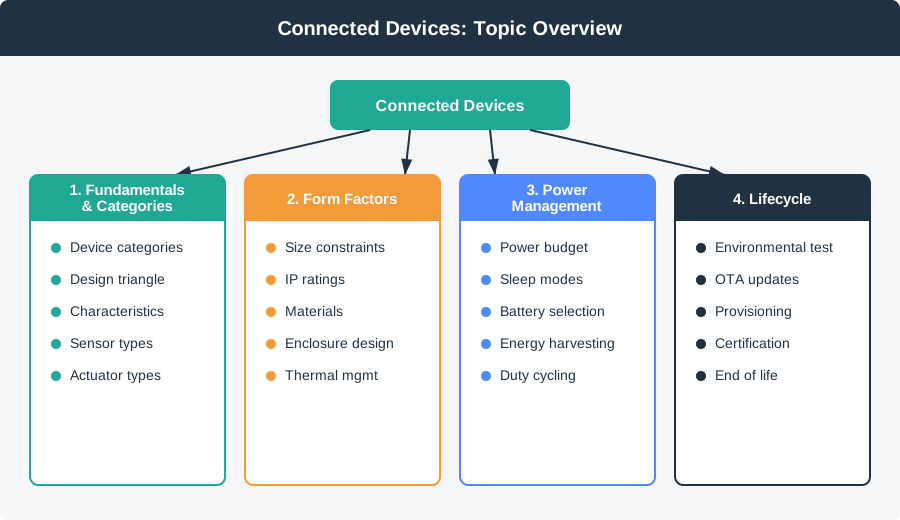
This topic is covered across four focused chapters:

Topic overview showing four connected devices chapters: Fundamentals (device categories, design triangle, characteristics), Form Factors (size constraints, IP ratings, materials), Power Management (power budget, sleep modes, battery selection), and Lifecycle (environmental testing, OTA updates, provisioning)
Figure 31.1: Connected Devices topic structure: Four focused chapters covering fundamentals, form factors, power management, and lifecycle

31.3 Chapter Guide

31.3.1 1. Fundamentals and Categories

What you’ll learn:

  • The four main IoT device categories: wearables, consumer, industrial, and infrastructure
  • The device design triangle: balancing features, cost, and power
  • Key device characteristics and selection criteria
  • Real-world trade-off examples (Apple Watch vs Fitbit vs pedometer)

Best for: Starting your connected devices journey, understanding device types and design principles.


31.3.2 2. Form Factors and Enclosures

What you’ll learn:

  • Size constraints from components, batteries, antennas, and heat dissipation
  • Enclosure material selection (ABS, polycarbonate, aluminum, silicone)
  • IP ratings and environmental protection requirements
  • Mounting methods and user interaction design
  • LED status indicator best practices

Best for: Physical design decisions, environmental protection, user interface elements.


31.3.3 3. Power Management

What you’ll learn:

  • Power budget analysis and battery life calculations
  • Sleep mode implementation (active, sleep, deep sleep)
  • Radio protocol power comparison (Wi-Fi vs BLE vs LoRa vs cellular)
  • Battery chemistry selection for different environments
  • Cold weather considerations for lithium batteries

Best for: Battery-powered device design, maximizing operational lifetime.


31.3.4 4. Lifecycle Management

What you’ll learn:

  • Environmental testing requirements (temperature, humidity, mechanical, EMC)
  • Over-the-air (OTA) update architecture with dual-bank safety
  • Device provisioning workflows (SoftAP, BLE, SmartConfig)
  • Biocompatibility requirements for skin-contact devices
  • Inclusive design for diverse user populations

Best for: Production readiness, long-term device management, regulatory compliance.


31.4 Learning Path

Recommended Reading Order
  1. Start with Fundamentals to understand device categories and the design triangle
  2. Then read Form Factors to learn physical design considerations
  3. Continue to Power Management for battery life optimization
  4. Finish with Lifecycle for production and maintenance

Each chapter builds on concepts from previous chapters, but can also be read independently if you need specific information.

31.5 Key Concepts Preview

Concept Chapter Quick Definition
Design Triangle Fundamentals Balance features, cost, and power - optimize for two
IP Rating Form Factors Ingress protection against dust and water
Deep Sleep Power Ultra-low power mode (~10-100µA) with RTC wake
Dual Banking Lifecycle Safe OTA with automatic rollback on failure
Provisioning Lifecycle Connecting device to network and user account

31.6 Knowledge Check

Scenario: A precision agriculture startup needs a soil moisture sensor deployed across 1,000 acres (400 hectares) with 1 sensor per acre. Sensors must survive outdoors for 5 years without battery replacement.

Requirements:

  • 5-year battery life (60 months)
  • IP67 rating (dust-tight, waterproof to 1m depth)
  • -20°C to +60°C operating temperature (farm climate extremes)
  • Transmit reading every 4 hours (6 readings/day)
  • Range: 500m to gateway (LoRa)
  • Cost target: <$50 per sensor ($50,000 total for 1,000 sensors)

Power Budget Analysis:

Interactive Power Budget Calculator

Adjust the power parameters to see how different components and duty cycles affect overall power consumption. The radio TX is typically the largest power drain!

Component Power Mode Current Draw Duty Cycle Energy per Day
Soil sensor Active (10s per reading) 15 mA 6 × 10s = 60s/day 15 mA × (60/3600) h = 0.25 mAh/day
LoRa radio TX (2s per reading) 120 mA 6 × 2s = 12s/day 120 mA × (12/3600) h = 0.40 mAh/day
Microcontroller Active (15s per reading) 8 mA 6 × 15s = 90s/day 8 mA × (90/3600) h = 0.20 mAh/day
Microcontroller Sleep (rest of day) 10 µA = 0.01 mA 86,310s/day 0.01 mA × (86,310/3600) h = 0.24 mAh/day
TOTAL 1.09 mAh/day

Battery Selection:

Target battery capacity for 5-year life: - 5 years = 1,825 days - Energy needed = 1.09 mAh/day × 1,825 days = 1,989 mAh - Add 30% safety margin for cold weather derating: 1,989 × 1.3 = 2,586 mAh

Battery Options:

Type Capacity Voltage Temp Range Cost Suitable?
CR2032 coin cell 220 mAh 3V -30°C to +60°C $1 ❌ No (insufficient capacity)
AA lithium 3,000 mAh 1.5V -40°C to +60°C $3 ✅ Yes (meets requirement with margin)
LiPo rechargeable 500 mAh 3.7V -20°C to +60°C $8 + solar ❌ No (insufficient capacity, expensive)

Selected: 2× AA lithium in series (3,000 mAh, 3V) = 2,750 days battery life (7.5 years, exceeds 5-year requirement with safety margin).

Enclosure Design:

IP67 Requirements (dust-tight, waterproof to 1m for 30 min): - Sealed enclosure with gasket - Cable glands for sensor probe entry - No unsealed openings

Material Selection:

Material Cost UV Resistance Impact Strength Temp Range Selected?
ABS plastic $2/unit Poor (yellows in 2 years) Good -40°C to +80°C ❌ No (UV degradation)
Polycarbonate $4/unit Good Excellent -40°C to +130°C ✅ Yes
Aluminum $12/unit Excellent Excellent -270°C to +660°C ❌ No (too expensive)

Selected: UV-stabilized polycarbonate with IP67 gasket seal. Cost: $4/unit.

Form Factor Constraints:

Size Drivers:

  1. Battery compartment: 2× AA lithium (14.5mm diameter × 50.5mm length) = 20mm × 55mm space
  2. PCB: 40mm × 30mm × 1.6mm (allows LoRa antenna trace)
  3. Cable gland: 12mm diameter for sensor probe cable
  4. Antenna: LoRa needs 1/4 wavelength = 8.6cm wire antenna (868 MHz EU band)

Final Enclosure Dimensions:

  • 80mm (L) × 50mm (W) × 60mm (H)
  • Volume: 240 cm³
  • Weight: 120g with batteries

Mounting Method:

  • Stake mount: 20cm plastic stake driven into soil
  • Enclosure clips onto stake top (above ground level)
  • Sensor probe extends 10cm into soil below enclosure

Environmental Testing:

Test Standard Duration Result
Temperature cycling IEC 60068-2-14 -20°C to +60°C, 100 cycles ✅ Pass (no cracks, 0.2% drift)
IP67 water immersion IEC 60529 1m depth, 30 min ✅ Pass (no water ingress)
UV exposure ASTM G154 1,000 hours ✅ Pass (5% color change, no cracks)
Drop test 1m drop onto concrete 5 drops ✅ Pass (enclosure intact, sensor functional)

Cost Breakdown (per sensor):

Component Cost
Soil moisture sensor $8
LoRa radio module $12
Microcontroller (STM32L0) $3
PCB (4-layer, 40×30mm) $2
Polycarbonate enclosure $5
IP67 gasket + cable gland $3
2× AA lithium batteries $6
Antenna wire + connector $1
Plastic stake mount $2
Assembly labor $8
TOTAL $49

Result: Meets $50 cost target with $1 margin.

Deployment Results (6-month pilot with 100 sensors): - 98% uptime (2 failures due to physical damage from farm equipment) - Battery voltage: 98% of nominal after 6 months (on track for 7.5-year life) - LoRa packet delivery: 99.2% (500m range maintained) - Sensor drift: <2% over 6 months (within accuracy spec) - No water ingress failures (IP67 seal effective)

Key Insight: The design triangle (features, cost, power) required ruthless optimization. Initial design used Wi-Fi (5× power consumption) and LiPo battery with solar (3× cost). Switching to LoRa (low power) and primary batteries (cheap, simple) achieved 7.5-year life at $49/unit. The trade-off: LoRa has lower data rate than Wi-Fi, but 6 readings/day is sufficient for soil moisture monitoring. Over-engineering (1-hour update rate with Wi-Fi) would have required expensive solar panels and shortened battery life to 1 year.

Every IoT device faces the design triangle constraint: You can optimize for two of three factors (features, cost, power), but the third will be compromised.

The Design Triangle:

        FEATURES
          /\
         /  \
        /    \
       /      \
      /________\
   COST        POWER
Interactive Design Triangle Trade-Off Explorer

Select different design priorities to see how the trade-offs manifest in real IoT products. Notice that you can optimize for TWO factors, but the third will always be compromised!

Design triangle optimization: A smartwatch design targeting \(P_{avg} = 50 \text{ mA}\) average power with a \(C_{battery} = 300 \text{ mAh}\) LiPo achieves battery life \(T = \frac{C_{battery}}{P_{avg}} = \frac{300}{50} = 6 \text{ hours}\) active use (approximately 1 day with standby periods). Adding GPS (\(P_{GPS} = 80 \text{ mA}\)) increases total power to \(P_{total} = 50 + 80 = 130 \text{ mA}\), reducing active use life to \(\frac{300}{130} \approx 2.3 \text{ hours}\). To maintain 6-hour active use with GPS, battery must be \(C_{needed} = 130 \times 6 = 780 \text{ mAh}\) — requiring 2.6× larger battery (+15g weight, +$12 cost).

Cost vs. feature tradeoff: BLE radio costs \(\$3\) with \(P_{TX} = 10 \text{ mA}\). Wi-Fi costs \(\$6\) with \(P_{TX} = 200 \text{ mA}\). For a device transmitting 10 seconds per hour, average current = \(\frac{10}{3600} \times P_{TX}\). BLE: \(\frac{10}{3600} \times 10 \approx 0.028 \text{ mA}\). Wi-Fi: \(\frac{10}{3600} \times 200 \approx 0.556 \text{ mA}\)20× higher power for 2× cost. With a \(220 \text{ mAh}\) CR2032, BLE achieves 22,000 hours (2.5 years), Wi-Fi achieves 395 hours (16 days).

Cold weather battery derating: At \(T = -20°C\), lithium primary batteries retain \(\eta_{cold} = 0.4\) (40%) of rated capacity due to increased internal resistance. A \(3{,}000 \text{ mAh}\) battery becomes \(C_{effective} = 3{,}000 \times 0.4 = 1{,}200 \text{ mAh}\). For a device drawing \(0.5 \text{ mA}\) average, room-temp life = \(\frac{3000}{0.5} = 6{,}000 \text{ hours}\) (250 days). Cold-weather life = \(\frac{1200}{0.5} = 2{,}400 \text{ hours}\) (100 days) — 60% reduction. Switching to lithium thionyl chloride (\(\eta_{cold} = 0.8\)) with \(19{,}000 \text{ mAh}\) capacity achieves \(C_{effective} = 19{,}000 \times 0.8 = 15{,}200 \text{ mAh}\) effective at -20°C, yielding \(\frac{15{,}200}{0.5} = 30{,}400 \text{ hours}\) (1,267 days = 3.5 years) for +$5/unit cost.

IP rating impact: Achieving IP67 (dust-tight, 1m water immersion) requires gasket seals and cable glands. A basic ABS enclosure costs \(\$2\). Adding IP67 gasket (+$1.50), cable glands (+$1.50), and polycarbonate material (+$2) totals $7 — a 3.5× cost increase. For 10,000-unit deployment, this is \(\$50{,}000\) additional upfront cost, but prevents \(62\%\) failure rate in outdoor environments (avoiding \(6{,}200 \times \$50 = \$310{,}000\) in replacement costs).

Form factor antenna constraint: A LoRa antenna at 868 MHz has wavelength \(\lambda = \frac{c}{f} = \frac{3 \times 10^8}{868 \times 10^6} \approx 0.346 \text{ m}\). A 1/4-wave antenna requires \(L = \frac{\lambda}{4} \approx 8.6 \text{ cm}\). For an enclosure <10 cm, the antenna fits. For compact designs <5 cm, you need a chip antenna (less efficient: -5 dBi gain vs. +2 dBi for wire) or meander antenna (reduced range by ~30%).

Use this framework to make informed trade-offs:

31.6.1 Trade-Off Matrix

Priority Optimize For Compromise On Example Device Characteristics
Features + Low Cost Rich functionality, affordable Power (short battery life) Smartwatch (1-2 day battery) Feature-rich, charge frequently
Features + Low Power Rich functionality, long battery Cost (expensive) Medical implant (10-year battery) Advanced sensors, surgical-grade materials
Low Cost + Low Power Affordable, long battery Features (minimal functionality) BLE beacon (5-year battery, <$5) Simple broadcast-only, no display

31.6.2 Decision Tree for IoT Device Design

Step 1: What’s your deployment model?

A. Consumer Product (smartphones, wearables, smart home) → Optimize: Features + Cost → Compromise: Power (users accept daily/weekly charging) → Example: Smartwatch with 1-day battery, rich features, <$300 price

B. Enterprise/Industrial (asset tracking, industrial monitoring) → Optimize: Power + Features → Compromise: Cost (ROI justifies expense) → Example: Industrial gateway with 5-year battery, cellular connectivity, $500 price

C. Disposable/Single-Use (shipping trackers, event wristbands) → Optimize: Cost + Power → Compromise: Features (minimal functionality) → Example: Bluetooth tracker with 3-month battery, broadcast-only, <$2 price

Step 2: Apply constraints:

Constraint Implication Design Decision
Battery replacement impossible (sealed device, inaccessible location) Must optimize Power Use ultra-low-power radio (LoRa, NB-IoT), deep sleep, primary batteries
Cost target <$20 Must optimize Cost Use commodity components, minimal sensors, BLE instead of Wi-Fi
Must work 5+ years Must optimize Power Sacrifice update rate, use event-driven wake-up, optimize radio protocol
Rich functionality required Must optimize Features Accept shorter battery life OR higher cost for larger battery

Step 3: Calculate power budget:

Formula: Battery Life (days) = Battery Capacity (mAh) / Average Current (mA)

Interactive Battery Life Calculator

Try adjusting the battery capacity, average current, and operating temperature to see how they affect battery life. Notice how cold weather dramatically reduces battery life!

Example Calculations:

Device A: Smart Home Sensor (Optimize Cost + Power)

  • Battery: CR2032 coin cell (220 mAh, $1)
  • Current: 10 µA = 0.01 mA sleep + 15 mA active × 10s/hour
  • Average current: 0.01 mA + (15 mA × 10s/3600s) = 0.01 + 0.042 = 0.052 mA
  • Life: 220 mAh / 0.052 mA = 4,231 hours = 176 days = ~6 months
  • Trade-off: Can’t add display (would drain battery in weeks)

Device B: Smartwatch (Optimize Features + Cost)

  • Battery: 300 mAh LiPo rechargeable ($5)
  • Current: OLED display + GPS + BLE + sensors = 50 mA average
  • Life: 300 mAh / 50 mA = 6 hours active use = 1 day with charging
  • Trade-off: Users must charge daily (acceptable for wearable)

Device C: Industrial Gateway (Optimize Features + Power)

  • Battery: 3× D-cell lithium (19,000 mAh, $20)
  • Current: Cellular modem + sensors = 5 mA average
  • Life: 19,000 mAh / 5 mA = 3,800 hours = 5 months per battery set
  • Trade-off: High battery cost but meets 5-year life with periodic replacement

31.6.3 Component Trade-Off Table

When choosing between components, use this trade-off guide:

Component Low Power Option High Performance Option Trade-Off
Radio BLE (10-30 mA TX) Wi-Fi (200-400 mA TX) BLE: 10× longer battery, but 100× lower data rate
Display E-ink (0.1 mA) OLED (50-200 mA) E-ink: slow refresh, grayscale; OLED: fast, color, drains battery
Processor ARM Cortex-M0+ (5 mA active, 1 µA sleep) ARM Cortex-A53 (500 mA active) M0+: simple tasks, low power; A53: video processing, 100× more power
Sensor DHT22 temp/humidity (1.5 mA, $2) BME680 air quality (12 mA, $10) DHT22: basic, cheap, low power; BME680: detailed, expensive, higher power

31.6.4 Real-World Example: Tile vs. AirTag

Tile Tracker (Optimize Cost + Power): - Goal: Affordable, 1-year battery - Radio: BLE only (10 mA TX, 1s/hour = 0.003 mA average) - Battery: CR2032 (220 mAh) - Features: Broadcast ID only, no display, no GPS - Life: 1 year - Cost: $25 - Trade-off: No precise location, relies on crowd-sourced Tile network

Apple AirTag (Optimize Features + Power): - Goal: Precise location, long battery, seamless Apple integration - Radio: BLE + UWB (UWB for cm-precision) - Battery: CR2032 (220 mAh) but optimized duty cycle - Features: UWB precision finding, speaker, AR integration - Life: 1 year (same as Tile despite more features) - Cost: $29 - Trade-off: Requires iPhone for full features, slightly more expensive

Key Insight: Tile optimized for Cost + Power (minimal features). AirTag optimized for Features + Power (added UWB, kept battery life, slightly higher cost). Both compromised on different axes based on target market.

31.6.5 Decision Checklist

Before finalizing design, verify:

Key Insight: The design triangle is unavoidable. Trying to optimize all three (features, cost, power) simultaneously leads to failure—either over-budget, under-powered, or feature-poor. Explicitly choose which two to optimize, accept the third as constrained, and design within those limits.

Common Mistake: Underestimating Cold Weather Impact on Battery Life

The Mistake: Testing battery-powered IoT devices at room temperature (20°C) and assuming the same battery life will hold in real-world cold weather deployments (-10°C to -20°C).

Why It Fails:

Lithium batteries (primary and rechargeable) lose 50-80% of capacity in freezing temperatures due to increased internal resistance and slower chemical reactions.

Real-World Example: Smart Parking Sensor

Lab Testing (20°C):

  • Battery: 2× AA lithium primary (3,000 mAh)
  • Average current: 0.5 mA
  • Calculated life: 3,000 mAh / 0.5 mA = 6,000 hours = 250 days (8 months)
  • Test result at 20°C: 240 days (matches calculation)

Field Deployment (Winter, -15°C avg):

  • Actual life: 90 days (3 months)
  • Failure mode: Battery voltage drops below 2.4V (MCU brownout threshold)
  • Result: 62% of deployed sensors failed in first winter, required battery replacement

Why Cold Reduces Battery Life:

Temperature Effective Capacity Internal Resistance Impact
+20°C (lab) 100% (baseline) 0.1Ω Normal operation
0°C 85% capacity 0.15Ω (1.5× increase) 15% life reduction
-10°C 65% capacity 0.25Ω (2.5× increase) 35% life reduction
-20°C 45% capacity 0.40Ω (4× increase) 55% life reduction
-30°C 30% capacity 0.60Ω (6× increase) 70% life reduction

Key Problem: At -20°C, a 3,000 mAh battery behaves like a 1,350 mAh battery. Your calculated 8-month life becomes 3.6 months.

How to Fix It:

1. Cold Temperature Testing:

Test battery life at minimum expected operating temperature, not room temperature.

Testing Protocol:

  • Place device in climate chamber at -20°C for 24 hours
  • Measure battery voltage under load every hour
  • Run full duty cycle (TX burst, sensor read, sleep) at -20°C
  • Compare to +20°C baseline

2. Battery Chemistry Selection:

Battery Type Cold Performance Cost Best For
Alkaline Poor (<30% at -20°C) Cheap ($1) Indoor only
Lithium Primary (AA) Good (60-70% at -20°C) Moderate ($3) Outdoor, -20°C to +60°C
Lithium Thionyl Chloride Excellent (80-90% at -20°C) Expensive ($8) Extreme cold, -40°C to +85°C
LiPo Rechargeable Poor (<40% at -10°C) Moderate ($5) Indoor or warm climates only

3. Derating Factor in Calculations:

Multiply calculated battery life by cold weather derating factor:

Min Operating Temp Derating Factor Example: 250-day life at 20°C becomes
+10°C 0.9× 225 days
0°C 0.75× 188 days
-10°C 0.6× 150 days
-20°C 0.4× 100 days
-30°C 0.3× 75 days

Corrected Parking Sensor Design:

Original (Failed):

  • Battery: 2× AA lithium (3,000 mAh)
  • Temp: -20°C min
  • Derating: 0.4× (60% capacity loss)
  • Effective capacity: 3,000 × 0.4 = 1,200 mAh
  • Life: 1,200 mAh / 0.5 mA = 2,400 hours = 100 days ✓ (matches field result)

Corrected Design:

  • Battery: 3× D-cell lithium thionyl chloride (19,000 mAh)
  • Temp: -20°C min
  • Derating: 0.8× (thionyl chloride cold-resistant)
  • Effective capacity: 19,000 × 0.8 = 15,200 mAh
  • Life: 15,200 mAh / 0.5 mA = 30,400 hours = 1,267 days (3.5 years) ✓

4. Voltage Cutoff Adjustment:

Cold increases battery internal resistance, causing voltage sag under load.

Problem: MCU brownout at 2.4V. At -20°C, battery voltage drops to 2.3V during TX burst (even with 60% charge remaining).

Solution:

  • Use buck-boost converter (maintains 3.3V output even with 2.0V input)
  • Set MCU brownout to 1.9V (allows using battery to 20% capacity instead of 40%)
  • Cost: +$2/unit, but extends battery life by 25%

5. Battery Warming Techniques (Extreme Cold Only):

For devices that MUST work at -40°C (Arctic, high altitude): - Self-heating: Pulse high current through resistor before TX burst (warms battery for 5 seconds) - Insulation: Foam-insulated battery compartment (slows heat loss) - External heating: Solar panel charges small heating element - Trade-off: Adds cost, complexity, and power consumption

Cost of Ignoring Cold Weather:

Example: 10,000-unit smart parking sensor deployment

  • Winter failures: 6,200 units (62%)
  • Truck roll to replace batteries: $50/visit
  • Total cost: 6,200 × $50 = $310,000 in Year 1
  • Reputational damage: City cancels contract due to unreliability

If cold-weather testing done upfront:

  • Use lithium thionyl chloride batteries (+$5/unit)
  • Additional cost: 10,000 × $5 = $50,000
  • Result: 95% uptime, no mid-winter failures
  • Savings: $260,000 in avoided truck rolls

Key Insight: Cold weather isn’t an edge case—it’s a common case for outdoor IoT deployments. Lithium batteries lose 50-80% of capacity below freezing. Always test at minimum operating temperature, apply derating factors to battery life calculations, and select cold-tolerant chemistry (lithium primary or thionyl chloride). Ignoring cold weather costs 5-10× more in field failures than designing for it upfront.
31.7 Concept Relationships

Connected devices are the physical foundation of IoT systems:

In 60 Seconds

This chapter covers the things - connected devices, explaining the core concepts, practical design decisions, and common pitfalls that IoT practitioners need to build effective, reliable connected systems.

31.8 See Also

Device Design Chapters:

Related Technical Topics:

Design and UX:

Common Pitfalls

Commissioning industrial design or tooling before the PCB layout is frozen means the enclosure must be redesigned when components move or heatsinks are added, costing 4-12 weeks of delay. Run electrical and mechanical design in parallel and freeze PCB dimensions before starting the production enclosure design.

Placing metallic enclosure elements or battery inside the antenna keep-out zone degrades RF performance by 3-10 dB, causing range reduction and regulatory test failures. Follow the antenna manufacturer’s reference design keep-out dimensions precisely and verify with return-loss measurement on the first prototype.

Components selected without thermal analysis may run outside their rated temperature range in closed enclosures, causing intermittent failures or shortened lifespan. Perform a simplified thermal resistance calculation early in design and prototype with a thermocouple to validate before finalising the enclosure.

31.9 What’s Next

Next Chapter
Start Series Fundamentals and Categories – Device types, design triangle, and selection criteria
Recommended Next Connecting Together – How IoT devices discover, pair, and communicate
Related User Experience Design – Designing interfaces for IoT devices