12 IoT Architecture Model Selection
IoT architecture model selection, IoT layer boundaries, three layer IoT architecture, five layer IoT architecture, IoT architecture fit summary, architecture review evidence
12.1 Start Simple
An architecture model becomes a UX tool when it tells the team who owns the user-visible promise. Start with the state, command, data, permission, and support boundaries that affect people, then choose the model that makes those responsibilities clear enough to test and change.
12.2 In 60 Seconds
Architecture models help a team decide where device sensing, connectivity, data processing, application behavior, business policy, operations, security, and support responsibilities belong.
The UX review question is not “which architecture diagram looks most complete?” The useful question is whether the chosen model helps the team make user-facing behavior, failure recovery, data responsibility, ownership, and support evidence clearer without adding unnecessary coordination overhead.
12.3 Learning Objectives
By the end of this chapter, you will be able to:
- compare simple layered, expanded layered, and multi-view architecture models for IoT design work
- review whether architecture complexity matches user outcomes, system scope, team boundaries, and operational needs
- define layer responsibilities without hiding ownership, failure, privacy, or support evidence
- identify when cross-cutting concerns require explicit review across layers and views
- write an architecture fit summary with accepted limits, owners, and change conditions
12.4 Minimum Viable Understanding
An IoT architecture model is reviewable only when it names the user outcome, system boundary, participants, layer responsibilities, decision owners, data paths, local/cloud boundaries, operational evidence, security and privacy responsibilities, accepted tradeoffs, and change conditions.
Avoid accepting a model because it is common, formal, simple, or detailed. A model is useful when it improves decisions. It is harmful when it creates vague boxes that no team owns or when it hides important behavior behind a generic layer name.
12.5 Prerequisites
This chapter builds on:
- Design Model Introduction, which introduces why design models matter before implementation.
- Connected Device Fundamentals, which defines device roles and boundaries.
- Layered Network Models, which explains protocol layers behind IoT communication paths.
- IoT Reference Models, which provides broader reference-model vocabulary.
12.6 Architecture Models as Risk Filters
An IoT architecture model should expose the risks that matter for a product decision. A three-layer view may be enough for a small sensor-gateway-app system. A multi-view model is justified when one diagram cannot explain data meaning, deployment placement, identity, operations, and support responsibility at the same time.
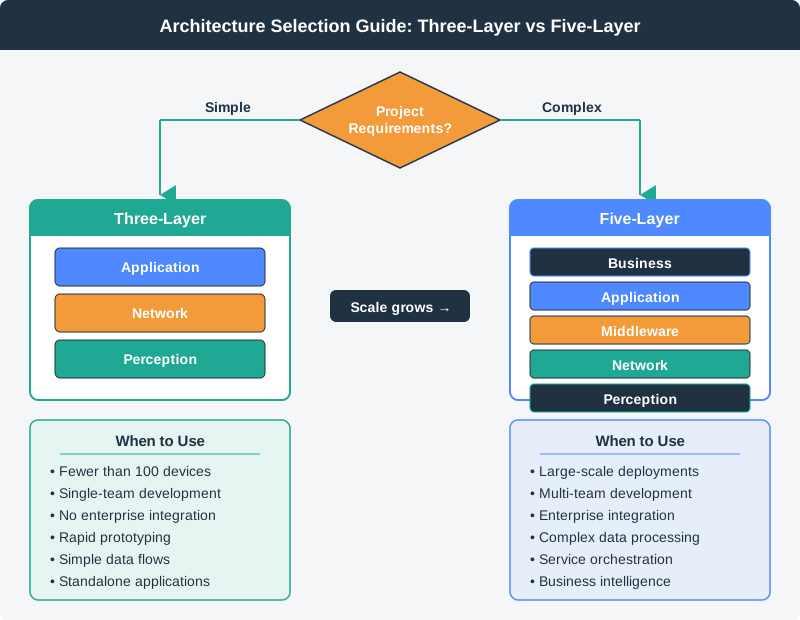
The model choice shapes the user experience. If alert rules move from a gateway to the cloud, latency, outage behavior, privacy boundary, support logs, and update ownership all change. If device health is hidden inside an application layer, users may see a stale “online” state while support cannot tell whether the fault is power, radio, gateway, broker, cloud, account, or policy.
Choose the lightest model that can answer the review question. A classroom weather station may only need device, gateway, and application layers. A managed building system may need separate views for edge analytics, tenant identity, role-based access, cloud ingestion, data retention, service desk diagnostics, and facilities handover. A richer model is justified by decisions it makes clearer, not by the number of boxes it contains.
The architecture review should also name what the model intentionally leaves out. A three-layer model can be accepted when it records that firmware updates are manual, alerts are advisory, cloud outage leaves local display working, and support can inspect gateway logs. The same model becomes weak when it hides OTA rollout, audit history, remote command safety, or privacy review behind a generic application layer.
- Simple model: use device, communication/gateway, and application layers when responsibilities are clear and the product has few roles.
- Expanded model: add device management, processing, business policy, analytics, integration, or operations layers only when they own real decisions.
- Multi-view model: use functional, information, deployment, operational, and risk views when teams need different evidence from the same system.
- Fit summary: record the chosen model, rejected alternatives, accepted limits, owner, open issue, and trigger for review after scope changes.
12.7 Match Artifacts to Decisions
Use concrete architecture artifacts when they answer a review question. A C4 context or container view can show people, devices, gateways, apps, brokers, cloud services, and external platforms. A UML sequence diagram can test commissioning, command acknowledgement, and rollback timing. A UML or SysML state machine can expose offline, stale, denied, overridden, pending, and recovered states.
Start from the product decision rather than the artifact library. If the question is where alert rules should run, compare gateway rules, AWS IoT Core rules, Azure IoT Hub routing plus Azure Functions, a Kubernetes service, and a mobile-only rule against latency, local fallback, auditability, and ownership. If the question is device management, compare LwM2M objects, Matter clusters, vendor device shadows, OTA rollout tooling, and support-console evidence.
- Pick the decision. Example: Should room alert rules run on the gateway, in AWS IoT Core rules, in Azure IoT Hub routing plus a function, or in the mobile app?
- Pick the artifact. Use AsyncAPI for MQTT topics, OpenAPI for service APIs, JSON Schema for payloads, a deployment diagram for edge/cloud placement, or a responsibility matrix for layer ownership.
- Pick the acceptance check. Test latency, local fallback, data quality, privacy boundary, update path, support diagnosis, and who owns changes after launch.
Real systems often need mixed views. A Matter device may need a cluster/capability view, a fabric and controller ownership view, and a support view. An industrial gateway may need OPC UA information modeling, MQTT topic contracts, network segmentation, and maintenance workflow evidence.
Document the exact evidence that would change the model. A fleet that adds cellular backhaul may need a deployment and cost view. A product that adds tenants may need an identity and authorization view. A healthcare or safety workflow may need audit, consent, fail-safe command, and incident-response views. A useful architecture record gives each future reviewer a clear reason to keep, simplify, or expand the model. ## Layers Change State Authority {.depth-l2}
Layer boundaries are design decisions because they decide where truth lives. Sensor firmware may hold measured state, a gateway may cache state, an MQTT broker may retain the last message, a digital twin may store desired and reported properties, and an app may display a local cache. The architecture model must say which state is authoritative for each user promise.
Protocol and platform choices often force hidden architecture work. MQTT topics need ownership and quality-of-service rules. CoAP resources need response-code handling. LwM2M objects define device management and firmware-update semantics. OPC UA nodes carry industrial information-model meaning. Matter clusters define commands, attributes, and events. Time-series stores need retention, units, and quality flags.
Architecture boundaries also decide where errors are translated. A gateway may convert a Modbus timeout into an MQTT error topic, a cloud function may convert a malformed payload into an API response, and a mobile app may convert an authorization denial into a disabled control. If the model does not preserve cause, timestamp, source, and retry state across those translations, support teams cannot distinguish a bad sensor, a stale retained message, a policy denial, or a delayed cloud write.
State authority should be recorded per promise, not once for the whole product. The authoritative source for a live temperature, an alert threshold, a command acknowledgement, a firmware version, a billing event, and a user role may be different systems. The record should name freshness windows, conflict rules, replay behavior, rollback path, and which logs prove that an edge, broker, cloud, or app layer acted correctly.
- Data path: distinguish raw measurement, calibrated value, derived alert, displayed status, and retained history.
- Control path: distinguish command intent, authorization, routing, acknowledgement, physical effect, and rollback.
- Operations path: connect firmware updates, configuration changes, incident logs, replacement, ownership transfer, and decommissioning to the layers that own them.
- Evidence path: carry correlation ids, device ids, gateway ids, topic names, API responses, timestamps, and actor identity far enough for review and support.
12.8 Architecture Selection Map
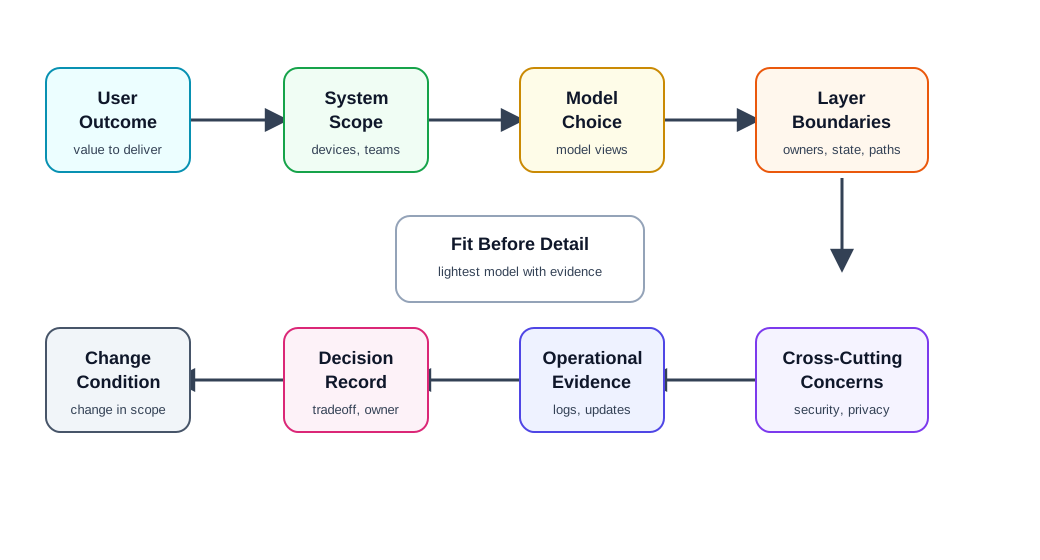
Use Figure 12.2 to keep model selection grounded:
- User outcome: what the architecture must help deliver, protect, explain, or recover.
- System scope: devices, gateways, apps, sites, services, users, teams, and external systems.
- Model choice: simple layered model, expanded layered model, multi-view reference model, or a documented hybrid.
- Layer boundaries: what each layer owns, passes through, stores, transforms, and exposes.
- Cross-cutting concerns: security, privacy, identity, safety, reliability, accessibility, compliance, and support.
- Operational evidence: monitoring, logs, update path, replacement path, ownership transfer, and incident workflow.
- Record and change conditions: accepted limits, owners, open issues, and conditions after system or organization change.
12.9 Start With Architecture Work To Be Done
Architecture is not a decoration for a document. It is a tool for coordinating decisions.
Review:
- what decisions the model is supposed to support
- which teams, roles, or stakeholders need the model
- what user-facing behavior depends on architectural boundaries
- whether the model separates real responsibilities or invents artificial handoffs
- whether the model can explain failure, support, update, replacement, and decommissioning behavior
- whether the model is short enough to stay current as the system changes
If a diagram cannot help a team answer “who owns this behavior?” or “what happens when this boundary fails?”, it is not yet useful enough for acceptance.
12.10 Simple Layered Model
A simple layered model is often enough when the system has a clear physical-device layer, a clear communication or gateway layer, and a clear application layer.
Review:
- what belongs in the physical device boundary: sensing, actuation, firmware, power state, local control, and physical safety
- what belongs in the communication boundary: local links, gateway behavior, buffering, translation, routing, and connectivity state
- what belongs in the application boundary: user interface, rules, dashboards, reports, account policy, and data presentation
- what crosses each boundary and in which format
- which behavior continues locally if the application or cloud path is unavailable
- whether support can separate device, gateway, network, account, and application causes
A simple model is not a weak model. It is strong when the responsibility boundaries match the actual product and are easy for developers, users, installers, and support teams to understand.
12.11 Expanded Layered Model
An expanded layered model adds explicit responsibilities such as middleware, device management, business policy, analytics, integration, or operations when those responsibilities are large enough to need separate ownership.
Review:
- why the extra layer exists and which decisions it owns
- whether the layer performs work or only repeats another layer’s responsibility
- whether device management, identity, data processing, rules, analytics, reporting, and business policy have clear owners
- how errors move between layers without losing cause
- how update, rollback, provisioning, and replacement workflows cross layers
- whether adding the layer improves maintainability more than it increases coordination burden
Extra layers should be earned by real complexity: multiple teams, multiple user roles, multi-site operation, heterogeneous device fleets, regulated records, enterprise integration, or operational workflows that would otherwise be mixed into one unclear application layer.
12.12 Multi-View Reference Thinking
Some systems cannot be reviewed well from one stack diagram. They need several views of the same system.
Useful views include:
- Functional view: services, commands, workflows, rules, user actions, and operator actions.
- Information view: data model, units, timestamps, quality, retention, lineage, and meaning.
- Deployment view: devices, gateways, networks, regions, sites, redundancy, and physical constraints.
- Operational view: monitoring, incident response, update workflow, support workflow, replacement, and decommissioning.
- Risk view: security, privacy, safety, accessibility, compliance, and misuse boundaries.
Multi-view thinking is useful when one team talks about services, another about data meaning, another about hardware placement, and another about operations. It is excessive when the views repeat the same information without improving a decision.
12.13 Layer Boundary Review
Layer names are only useful when the boundary is testable.
Review each boundary with these questions:
- What enters this boundary?
- What leaves this boundary?
- What state is stored here?
- What decision is made here?
- What is intentionally not owned here?
- What evidence proves the boundary behaved correctly?
- What failure message or support signal appears when it does not?
- What change requires reviewing this boundary again?
Ambiguous boundaries create duplicated logic, inconsistent state, and confusing support paths. A clear boundary should make implementation and support simpler, not only the diagram cleaner.
12.14 Cross-Cutting Concerns
Security, privacy, identity, safety, accessibility, reliability, observability, and lifecycle management do not fit neatly into one layer. They must be reviewed across the model.
Review:
- where identity is created, checked, stored, rotated, and revoked
- where privacy notice, consent, retention, sharing, and deletion are enforced
- where safety or critical local behavior remains available during outages
- where accessibility requirements affect device setup, app feedback, physical controls, and alerts
- where monitoring, logs, and support evidence are generated and correlated
- where firmware, configuration, model, or policy updates are staged and rolled back
A model that places “security” or “privacy” in one box is usually incomplete. Cross-cutting concerns need owners at every boundary they cross.
12.15 Architecture Fit Checks
Use fit checks to avoid both under-engineering and over-engineering.
A simple model may be too thin when:
- device provisioning, updates, support, and replacement have no owner
- many users, sites, teams, or external systems need different views of the same data
- data quality, lineage, retention, or compliance rules are unclear
- application code is absorbing device management, business policy, and operations all at once
- support cannot tell which layer caused a user-visible issue
An expanded or multi-view model may be too heavy when:
- extra layers have no unique decisions
- every change requires several teams to coordinate without a user-facing benefit
- documents describe ideal layers but implementation bypasses them
- teams debate box ownership more than tested behavior
- the model cannot be updated after real design changes
The right model is the lightest one that still assigns responsibility, preserves evidence, and supports recovery.
12.16 Architecture Fit Summary
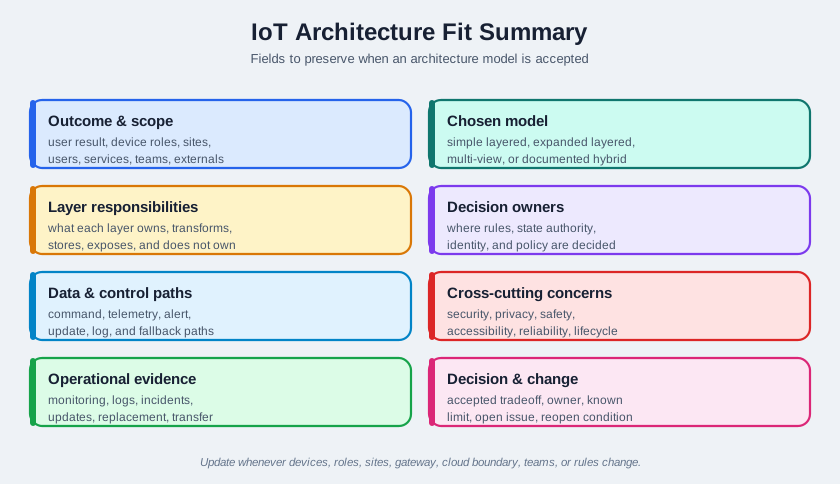
Figure 12.3 shows the fields to preserve:
- Outcome and scope: user result, device roles, sites, users, services, teams, and external systems.
- Chosen model: simple layered, expanded layered, multi-view, or documented hybrid.
- Layer responsibilities: what each layer owns, transforms, stores, exposes, and explicitly does not own.
- Decision owners: where rules, state authority, identity, policy, and support decisions are made.
- Data and control paths: command, telemetry, alert, update, log, and fallback paths.
- Cross-cutting concerns: security, privacy, identity, safety, accessibility, reliability, and lifecycle ownership.
- Operational evidence: monitoring, logs, incidents, updates, replacement, transfer, and decommissioning evidence.
- Decision and change condition: accepted tradeoff, owner, known limit, open issue, and condition that reopens review.
The record should be concise enough to update whenever the device mix, user role, deployment site, gateway behavior, cloud boundary, team ownership, support workflow, or regulatory expectation changes.
12.17 Architecture Responsibility Record
Use reference architectures as explanation tools, not templates to copy:
- Three-layer view: device, network, and application layers are enough when the review question is basic responsibility split.
- Five-layer view: perception, transport, processing, application, and business layers help when analytics, operations, and governance are part of the decision.
- Multi-view model: user journey, data flow, trust boundary, operations, and support views expose different failures in the same system.
- Cross-cutting concerns: security, privacy, accessibility, reliability, observability, and lifecycle ownership should appear across layers, not in one isolated box.
The architecture summary should name which view answered the question, which view was intentionally skipped, and what evidence would require a richer architecture model.
12.18 Worked Review: Room Monitoring Product
A small product monitors conditions in rooms and shows status in a mobile app. It has sensors, a gateway, a cloud service, and one user-facing app.
Architecture evidence to request
- the user outcome and the minimum device, gateway, and app behavior needed to support it
- what runs on the sensor, what runs on the gateway, and what runs in the application
- what happens if the gateway is offline, the app is unavailable, or the cloud path is delayed
- where state age, device health, alert rules, and user permissions are owned
- how support separates sensor power, local link, gateway, internet, cloud, and account issues
- how sensor replacement preserves room meaning and alert history
Likely review action
Approve a simple layered model if the sensor, gateway, and application responsibilities are explicit and the gateway/app outage behavior is visible. Hold the decision if alert rules or support evidence are hidden behind the generic word “cloud.”
Change condition
Rerun the review when alert rules move between gateway and cloud, device roles change, room assignment changes, user roles expand, or support evidence changes.
12.20 Common Findings
- The model is chosen because it is familiar, not because it fits the decisions the team must make.
- Layer names are clear, but ownership, state authority, and failure behavior are not.
- Device management is hidden inside the application layer without operational evidence.
- Business reporting depends on data whose meaning, quality, or retention is not owned.
- Security and privacy appear as one box instead of responsibilities across every boundary.
- The diagram shows data flow but not command, update, alert, log, or fallback paths.
- Support cannot distinguish device, gateway, cloud, account, policy, and application causes.
- Extra layers create handoffs without reducing implementation or support complexity.
- The architecture record lacks an owner, known limit, open issue, or change condition.
12.21 Review Checklist
Before accepting an architecture model, confirm that the record includes:
- user outcome, system scope, device roles, user roles, team roles, and external systems
- selected model and why simpler or richer alternatives were rejected
- layer responsibilities, non-responsibilities, state ownership, and decision ownership
- command, telemetry, alert, update, log, local, cloud, and fallback paths
- cross-cutting responsibilities for security, privacy, identity, safety, accessibility, reliability, observability, and lifecycle
- operational evidence for monitoring, support, incidents, updates, replacement, transfer, and decommissioning
- user-facing failure and recovery behavior at each important boundary
- accepted tradeoff, owner, known limit, open issue, and change condition
12.22 Knowledge Check
12.23 Matching Quiz
12.24 Ordering Quiz
12.25 Summary
IoT architecture models help teams assign responsibility for devices, gateways, applications, data, policy, operations, security, privacy, support, and lifecycle behavior. The right model is not the most detailed one. It is the lightest model that still makes important decisions explicit and reviewable.
Strong architecture records show why a model fits the current system, what each layer or view owns, how commands and data cross boundaries, what works locally, how failures are diagnosed, and what change requires another review.
12.26 Key Takeaway
Architecture choices should connect users, devices, services, data flows, failure modes, and support responsibilities in one reviewed model.
12.27 Concept Relationships
- Design Model Introduction explains why design models should guide decisions before implementation.
- Reference Architecture Responsibility Record expands reusable architecture views and templates after model selection is clear.
- 8 Facets of IoT Design reviews user-visible and platform-visible design dimensions that span architecture layers.
- Design Thinking for IoT validates whether architecture decisions support real user needs.
- IoT Design Patterns and Components applies implementation patterns inside the chosen architecture.
- Edge, Fog, and Cloud Computing explains deployment options that often shape architecture boundaries.
12.28 What’s Next
Continue to Reference Architecture Responsibility Record to review reusable architecture templates and reference views in more detail.