3 IoT Value: Qualification Tests
More
Depth: Practitioner
Progress saves as you read. Mark sections complete as you go; your progress appears in the sidebar.
- Podcast audio coming soon
- Character narration audio coming soon
3.1 Test the Product and Its Purpose
A manager proposes adding an app and a radio to an ordinary product and calling it IoT. The team needs a quick test that a student, engineer, and business owner can all use. They must show what is sensed, what travels, and what useful decision or action closes the loop. A radio alone does not establish a working connection to a remote service, and connectivity alone does not explain the product’s value.
This chapter builds on What IoT Delivers: Closed-Loop Value. The problem is to assess the manager’s proposal without confusing a connected feature with a useful outcome. First, apply the three-ingredients test to the device. Then estimate payback from stated costs and savings. Finally, use five human activities to explain what the system is for and what evidence supports the claim.
KEY CONCEPTS
- Three ingredients
A physical thing, computation, and an internet path establish the device test.
- Simple payback
Cost divided by monthly savings gives the recovery time.
- Five human purposes
SUSTAIN, MOVE, HEAL, FEED, and MAKE explain the outcome.
3.2 Part Objectives
- Test three ingredients test with a concrete scenario and pass criteria.
- Validate why this framework matters with a concrete scenario and pass criteria.
3.3 Establish the Three Ingredients
The three-ingredients test asks whether a proposal has a physical thing, computation, and internet connectivity. The thing is the physical object. Computation comes from a processor or microcontroller. Connectivity is a working internet path, either direct or through a gateway that relays data between networks.
Without a physical thing, the proposal is software or a cloud service. A physical object with no processing is passive. With computation but no internet path, it is an embedded device. All three ingredients are required for the IoT-device classification used here. Adding a microcontroller supplies computation; adding Wi-Fi, cellular, or a gateway connection must also establish the onward internet path.
| Device | Thing | Computation | Connectivity | Result |
|---|---|---|---|---|
| Basic microwave | ✓ | ✓ | ✗ | Embedded device |
| Smart thermostat | ✓ | ✓ | ✓ | IoT device |
| Fitness tracker | ✓ | ✓ | ✓ (via phone) | IoT device |
| Traditional thermometer | ✓ | ✗ | ✗ | Passive object |
| Cloud dashboard | ✗ | ✓ | ✓ | Software service |
The microwave’s digital timer, display, heating element, and microprocessor establish local control, not internet connectivity. A connected version that sends cook-state telemetry through Wi-Fi to a remote service and receives app commands has the missing path. The fitness tracker takes a different route: it measures steps and heart rate, then sends them over Bluetooth to a smartphone. The phone uploads over Wi-Fi or cellular. Bluetooth is the local link; the phone is the internet gateway. A tracker with its own LTE modem instead reaches the cloud directly.
For the manager’s product, trace that complete path before accepting the label. The separate tool lets you change each ingredient and compare the resulting classification.
3.4 Connect a Reading to a Useful Decision
Passing the device test establishes what the product is. The next question is what it changes. Connected sensing and control can improve efficiency in specific workflows, but the useful comparison is between the previous decision and the decision supported by the new information.
| Impact area | Without IoT | With IoT | Potential result |
|---|---|---|---|
| Home energy | Manual thermostat adjustments | Learns schedules and optimizes settings | Lower heating and cooling energy use |
| Factory maintenance | Machines break unexpectedly | Sensors flag developing faults | Less unplanned downtime |
| Healthcare | Vitals checked at doctor visits | Continuous monitoring at home | Earlier detection can save lives |
| Agriculture | Water entire field equally | Sensors guide irrigation in dry areas | Less water applied where it is not needed |
| Transportation | Fixed traffic-light timing | Timing responds to real-time traffic | Less delay on evaluated corridors |
The scale explains the interest: IoT Analytics forecast 21.1 billion connected IoT devices worldwide by the end of 2025. IoT Analytics A $1.5 trillion market estimate creating millions of jobs has no dated citation here; treat it as context requiring verification rather than evidence for a purchase.
Figure 1 follows one measurement into several decisions. Ultrasonic and pressure sensors measure the reservoir against a marked reference level. The reading is combined with weather data and inflow predictions before it leaves the site, so the information sent onward is closer to a forecast than an isolated number.
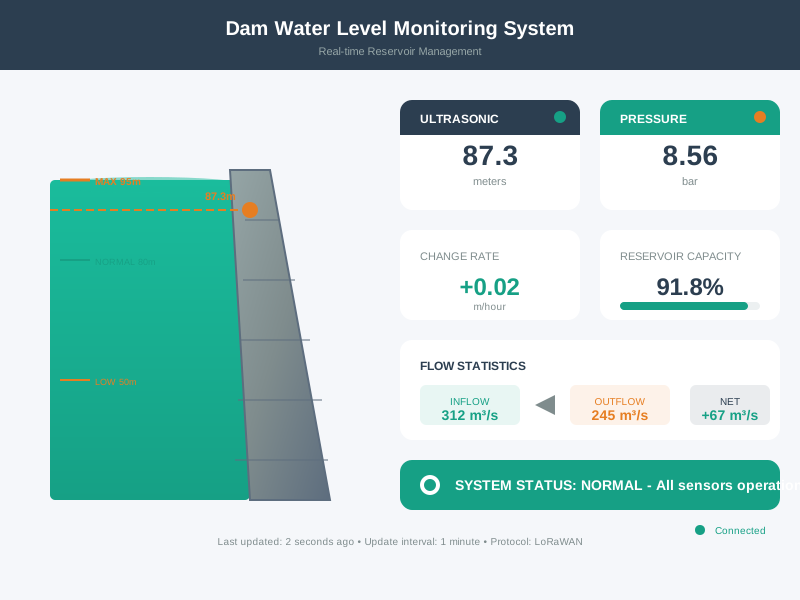
Water management agencies use that real-time visibility for flood control, power generation optimization, and downstream release planning. One measurement therefore serves public safety, an economic decision, and a neighbour’s water supply. The marked level is a schematic reference, not a live reading. This is why water infrastructure monitoring can support proactive flood management and hydroelectric generation: people receive information they can act on.
The manager’s team should make the same connection explicit. For example, factory vibration sensing supports planned bearing repairs and more reliable production. It does not eliminate scheduled maintenance or guarantee that bearings will never fail.
3.5 Calculate Payback From Stated Assumptions
Once the team can name a useful outcome, it can ask whether the benefit justifies the cost. Simple payback is the time needed for savings to recover the initial purchase cost. Keep the saving and time unit consistent: divide cost by monthly savings to obtain months.
For this exercise, assume a $250 smart thermostat reduces a home’s $3,900 annual heating and cooling bill by 30%, with no other costs. Annual savings are $3,900 × 0.30 = $1,170. Dividing by 12 gives average monthly savings of $97.50. Payback is $250 ÷ $97.50 = approximately 2.6 months, or about 3 months when rounded to a whole month. The first-year saving exceeds the purchase price under these assumptions; payback need not wait for a full annual billing cycle.
The 30% is an assumed reduction, not a measured promise and not a number of months. Actual savings need field evidence. Consumer and industrial payback varies with purchase price, tariffs, maintenance, scale, and measured savings. An industrial deployment can remain attractive with a longer payback when absolute savings and risk reduction are larger.
The calculator varies device cost from $50 to $5,000 in $50 steps, annual operating spending from $500 to $10,000 in $100 steps, and efficiency improvement from 5% to 50% in 5-point steps. It starts with this chapter’s $250, $3,900, and 30% example. It reports annual and monthly savings, payback in months and years, and five-year net savings calculated as five times annual savings minus device cost. Those outputs inherit the stated savings and cost assumptions.
3.6 Explain the Human Purpose With Five Verbs
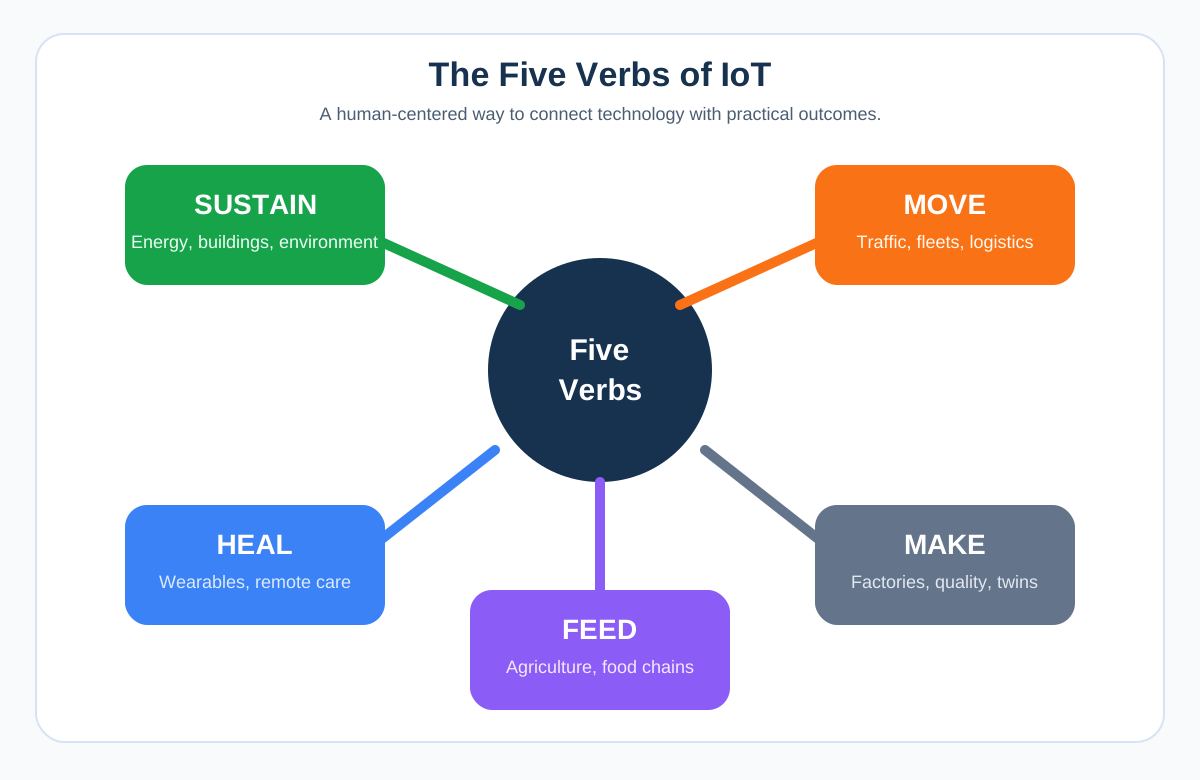
With qualification and payback established, return to the manager’s reason for connecting the product. The five verbs organize applications around fundamental human activities: SUSTAIN, MOVE, HEAL, FEED, and MAKE. This framework gives students, designers, and business leaders a memorable way to categorize thousands of applications, from smart cities and connected healthcare to precision agriculture.
Figure 2 pairs each human purpose with a physical input and a connected action. Compare waste-bin sensing with traffic signals: the pattern is similar, while the purpose differs. Some applications serve two activities at once; that overlap helps explain their value.
3.6.1 SUSTAIN: conserve resources and protect the environment
SUSTAIN covers reducing waste, conserving energy, monitoring ecosystems, and enabling sustainable living. Smart grids use two-way utility–consumer communication to balance electricity supply and demand. PG&E SmartMeter provides usage history and enables time-of-use rate choices; peak-demand effects need a cited tariff and evaluation.
Environmental networks track air quality, water pollution, deforestation, and wildlife. Air-quality readings can inform traffic policy, but city names, sensor counts, and emissions changes need municipal evidence. Fill-level sensors in waste bins can guide collection trucks to bins needing service; cost and route savings likewise need a named, measured case.
For buildings, DOE/PNNL modeled about 29% potential commercial-building energy savings from properly tuned HVAC, lighting, and occupancy controls. Realized savings require the building’s baseline. The DOE/PNNL building-controls report provides the context for that modeled potential. DOE/PNNL The Edge developer reports that its Amsterdam building consumes 70% less electricity than typical offices. These examples connect resource use to control decisions; Smart Cities and Energy-Aware Design develop those decisions further.
3.6.2 MOVE: transport people and goods
MOVE aims for faster, safer, cheaper transport with less environmental impact. Fleet telematics combines GPS, fuel sensing, and driver-behaviour monitoring. UPS’s ORION route optimization is described as saving 10M+ gallons of fuel annually. Connected vehicles use vehicle-to-vehicle (V2V) and vehicle-to-infrastructure (V2I) communication. Waymo’s self-driving taxis have completed 1M+ autonomous miles using LiDAR, cameras, radar, and onboard computation; the driving task does not require a cellular signal.
Adaptive traffic signals respond to real-time flow. Carnegie Mellon reports that Surtrac cut average travel time by 25%; USDOT reports a Pittsburgh pilot cut emissions by 20%. Supply-chain trackers monitor location, temperature, shock, and humidity. Maersk’s Remote Container Management sends reefer-container data for remote monitoring. Maersk These applications can reduce congestion and improve logistics; Transportation and Logistics and Mobile Devices as Sensors explain the transport setting and sensing inputs.
3.6.3 HEAL: support care and healthy lifespans
HEAL uses monitoring and remote care to support earlier diagnosis and healthier lives. Remote patient monitoring uses wearable and implantable sensors to track vital signs 24/7 at home. Chronic-heart-failure monitoring can reduce readmissions in some studies; any percentage needs its trial, comparator, and follow-up. Earlier detection and fewer readmissions depend on a working care pathway.
Connected infusion pumps, ventilators, and monitors integrate with electronic health records. Philips reports that patients at hospitals with an eICU program were discharged from the ICU 20% faster; its VA case describes a network serving 1,800 ICU beds nationwide. Philips eICU brochure Philips VA case
Connected pill bottles and digital pills support medication-adherence monitoring. Ingestible sensors can record medication-taking events for a care team; an adherence gain needs a named study. Motion sensors, fall detection, and activity monitoring support aging in place. CarePredict reports 69% fewer resident falls at Paradise Pointe Senior Living in its case study. Healthcare IoT follows care workflows, while Wearable Sensors explains the sensing foundations.
3.6.4 FEED: produce food and protect its journey
FEED covers crop yields, water and fertilizer use, livestock health, and food safety from farm to table. Precision agriculture combines soil moisture, drone imagery, and weather stations to guide variable-rate irrigation and fertilization. John Deere reported average herbicide savings of 59% across US corn, soybean, and cotton fields using See & Spray in 2024.
Livestock collars track location, activity, temperature, and rumination. A Cowlar customer testimonial reports milk yield 15% higher than the prior year; that comparison does not establish that disease detection three days earlier caused the change. Smart irrigation combines soil sensing and weather forecasts. A California Energy Commission field project across several crops, including almonds, reported 9% better water-use efficiency from smart-meter-informed irrigation optimization.
Cold-chain temperature and humidity sensing supports safe food transport. Walmart used blockchain traceability for leafy greens to speed identification during food-safety incidents; a waste-reduction figure needs a measured study. Yield, water-use, and spoilage benefits depend on the crop and deployment. Agriculture and Farming develops the irrigation workflow, and Wireless Sensor Networks explains how distributed readings travel.
3.6.5 MAKE: improve manufacturing and production
MAKE aims to build products faster, cheaper, with higher quality and less waste through Industry 4.0. Predictive maintenance uses vibration, temperature, and acoustic sensors to detect developing equipment faults. Lufthansa Technik offers engine condition monitoring to detect and rectify faults before failures occur. As with the manager’s proposal, distinguish support for maintenance decisions from a guarantee of uninterrupted production.
Computer vision, quality cameras, and sensor fusion can inspect items at production speed. For a specified line, measure inspection coverage, downtime, defect rates, false-negative rates, accuracy, throughput, sample size, and defect prevalence. A general capability does not establish performance for that installation.
A digital twin is a virtual replica used to simulate changes before implementation. GE said its proposed digital wind farm could boost energy production by as much as 20%; this was projected potential, not an achieved gain. Radio-frequency identification (RFID) tags and sensors track components through production. The chapter’s Boeing example describes tracking 10M+ parts across 787 Dreamliner assembly and reducing build time from 30 to 12 days. Industrial IoT connects these examples to trusted operations and the evolution toward Industry 4.0.
3.7 Use the Framework Without Overclaiming
The five verbs make the proposal understandable. Students can ask which verb a new application serves, start designs with a human need, and explore careers in sustainability engineering, transportation technology, health technology, ag-tech, or industrial automation. Practitioners can compare markets and transfer ideas across them: fleet-tracking algorithms from MOVE can inform ambulance routing in HEAL.
The same vocabulary helps business storytelling. “We help manufacturers MAKE better products” names the outcome more directly than “We provide predictive maintenance IoT solutions.” GE, Siemens, and Cisco illustrate the industrial strategies associated with this framework. For the manager’s team, its practical use is to connect the physical input, the connected action, and the human purpose in one explanation.
Market comparisons need a separate evidence check. The $3.3T total market estimate has no dated segmentation study supporting it here. A market comparison would need 2024 market size, 2030 projected size, compound annual growth rate (CAGR), drivers, and leading companies; those numerical inputs are not supplied here. For SUSTAIN, MOVE, HEAL, FEED, and MAKE, use a dated cited segmentation study or explicitly label each input as an illustrative market-model assumption. Label TOTAL as the sum of those illustrative inputs, document the calculation and rounded CAGR, and avoid presenting it as a measured global IoT market. Distinct application segments can have different maturity and growth; their labels alone do not establish where investment flows fastest.
The team can now give a reviewable answer: identify the three ingredients, calculate payback under explicit assumptions, choose the human purpose, and attach evidence to the claimed outcome. That makes the proposal useful to an engineer and a business owner alike.
Summary
The three-ingredients test distinguishes passive objects, embedded devices, software services, and IoT devices. A gateway can supply the internet path, as the phone does for the fitness tracker. Qualification establishes connectivity; a useful proposal also explains which decision improves.
Simple payback follows from stated cost and savings: the thermostat exercise gives $1,170 annually, $97.50 monthly, and about 2.6 months to recover $250. The five verbs organize applications around human purposes while keeping measured results, vendor reports, projections, and illustrative market assumptions distinct.
Show the physical thing, computation, and internet path, then explain the human outcome and the evidence that makes its value credible.
Carry this evidence into IoT Value: Delivery Frameworks, which begins with the Five Verbs Market Growth Tool.