19 IoT Perspectives: Shared Definitions and Decisions
19.1 Start With the Story
A thermostat review has five confident answers: security wants stronger protection, hardware wants longer battery life, data wants more samples, UX wants fewer prompts, and operations wants simple recovery. The team needs a shared definition of the system and a decision record that keeps every real constraint visible.
19.2 Overview
This route exposes single-perspective failure, builds a layered IoT definition, and resolves security, battery, data, UX, and operating trade-offs across a project team.
This is part 2 of 2. Review IoT Perspectives: Role Lenses when you need the first route.
19.3 Learning Objectives
By the end of this chapter, you will be able to:
- recognize the failure caused by a single role perspective
- build a practical layered definition for an IoT system
- resolve cross-functional trade-offs with testable evidence
19.4 Chapter Roadmap
Follow the original sections below in order. They begin at the reviewed split boundary and keep every worked example, figure, check, and supporting banner with the section that owns it.
19.5 Single-Perspective Pitfall
The most common IoT project failure mode is when one perspective dominates to the exclusion of others:
- Security-dominated projects become unusable (too many passwords, too slow)
- Hardware-dominated projects lack data security (cheap but vulnerable)
- Data-dominated projects drain batteries and consume bandwidth
- UX-dominated projects sacrifice safety for convenience
- Architecture-dominated projects become over-engineered
Prevention: Assign a “perspective advocate” for each viewpoint during design reviews. Require that every architectural decision explicitly addresses at least three perspectives.
 Checkpoint: Six Perspectives
You now know:
- The chapter names six recurring perspectives: security, maker, hardware, architecture, data analytics, and user experience.
- Each perspective has a primary question and a success metric, so disagreement often means the team has not aligned its evidence yet.
- A balanced design review asks at least three perspectives to sign off on each architectural decision.
Knowledge Check: IoT Perspectives
19.6 IoT Perspective Tradeoff Tool
Use this calculator to explore how different stakeholder priorities affect design decisions. Adjust the weights to see how total scores change.
Interactive element unavailable — chart cell
Plot: Observable Plot (charting library) is not bundled
Show source
// Visualization
Plot.plot({
marginLeft: 250,
marginRight: 50,
height: 200,
x: {
domain: [0, 10],
label: "Weighted Score →"
},
y: {
label: null
},
marks: [
Plot.barX(sortedOptions, {
y: "name",
x: "weightedScore",
fill: (d, i) => i === 0 ? colors.teal : (i === 1 ? colors.orange : colors.gray),
tip: true
}),
Plot.text(sortedOptions, {
y: "name",
x: "weightedScore",
text: d => d.weightedScore,
dx: 20,
fill: colors.navy
})
]
})
19.7 IoT System Components Taxonomy
The following taxonomy provides a complete overview of the IoT ecosystem across all layers:
Figure 19.1 gives the five layers a whole IoT system has to cover, and it is worth checking a project against.
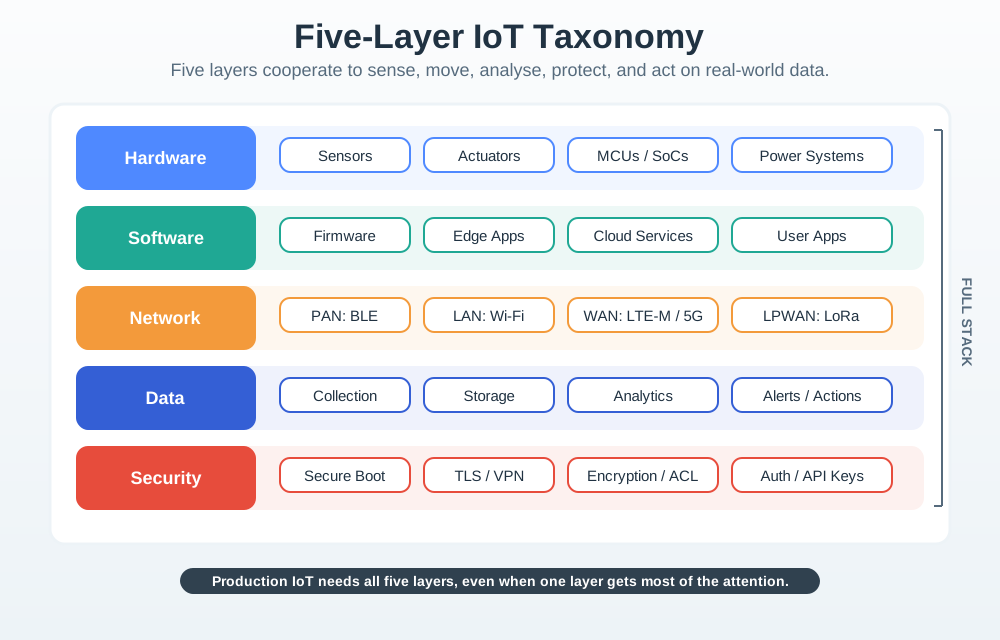
Read the five columns as a checklist rather than a ranking. The first three are the ones teams naturally staff: hardware to sense and act, software from firmware up to the user’s app, and a network layer that already offers four different ranges to choose between. The fourth column is where value appears, because data only matters once collection turns into an alert or an action. The fifth is the one that gets postponed. Security is drawn as a full layer rather than a feature inside another, since secure boot, transport encryption, and access control each belong to a different part of the stack. The line at the foot of Figure 19.1 is the test: production systems need all five.
The table below provides specific technologies and examples for each layer and category:
- Hardware: sensors such as temperature, motion, pressure, light, GPS, and humidity devices; actuators such as motors, relays, valves, LEDs, speakers, and displays; microcontrollers such as Arduino, ESP32, Raspberry Pi, and ARM Cortex; and power systems such as battery, solar, mains, and energy harvesting.
- Software: firmware such as RTOS, Embedded C, and MicroPython; edge applications such as gateway logic, local analytics, and protocol bridges; cloud services such as data storage, ML/AI, APIs, and dashboards; and user applications such as mobile apps, web portals, and voice control.
- Network: PAN technologies such as Bluetooth, Zigbee, Z-Wave, and Thread; LAN technologies such as Wi-Fi and Ethernet; WAN technologies such as 4G/5G, NB-IoT, and LTE-M; and LPWAN technologies such as LoRaWAN, Sigfox, and RPMA.
- Data: collection through sampling, streaming, and event-driven messages; storage through time-series databases, NoSQL, or data lakes; analytics through real-time, batch, ML/AI, and predictive workflows; and action through alerts, automation, visualization, and reporting.
- Security: device protections such as secure boot, attestation, and TPMs; network protections such as TLS/SSL, VPNs, and firewalls; data protections such as encryption, access control, and privacy controls; and application protections such as authentication, authorization, and API security.
19.8 Defining Internet of Things (IoT)
Now that the roles are clear, define the object they are arguing about. IoT definitions are tools: choose the one that fits the decision you need to make.
The Internet of Things (IoT) represents a paradigm where physical objects are endowed with digital identities, enabling them to operate in interconnected smart environments. IoT leverages intelligent interfaces to facilitate communication within social, environmental, and user contexts. Below are two foundational perspectives on IoT definitions:
19.9 Academic Definitions
Figure 19.2 sets the three definitions beside each other so you can pick by the decision you face.
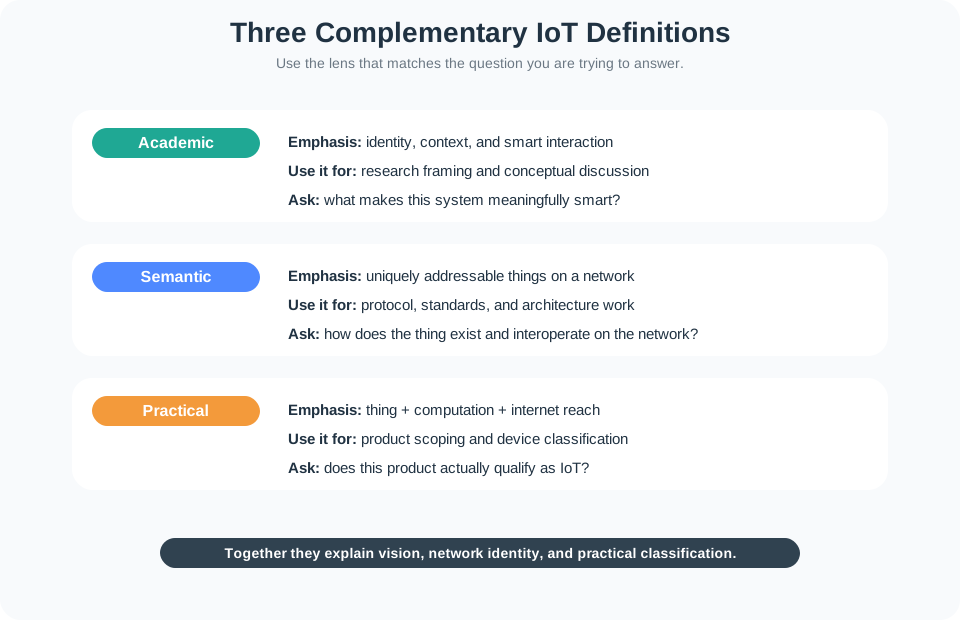
Each column carries three lines, and the third is the one to use. The academic column asks what makes a system meaningfully smart, which is the right question when framing research or arguing about scope. The semantic column asks how a thing exists and works with others on a network, which is what a standards or architecture decision turns on. The practical column asks whether a product qualifies at all, which is what a product manager needs before writing a spec. Figure 19.2 makes the point without ranking anyone. The definitions do not compete, they answer different questions, and choosing the wrong one produces a long argument about the wrong thing.
First, Identity and Contextual Interaction:. Next, “Things have identities and virtual personalities operating in smart spaces using intelligent interfaces to connect and communicate within social, environmental, and user contexts.”. Then, Key concepts: Identities, Virtual personalities, Social, environment, user contexts. After that, Strength: Captures the intelligence and context-awareness that distinguishes IoT from simple networking.
- Conceptual Breakdown:
- “The semantic origin of the expression is composed by two words and concepts: Internet and Thing, where Internet can be defined as the world-wide network of interconnected computer networks, based on a standard communication protocol, the Internet suite (TCP/IP), while Thing is an object not precisely identifiable. Therefore, semantically, Internet of Things means a world-wide network of interconnected objects uniquely addressable, based on standard communication protocols.”
- Key concepts: Identifiable unique Things, Network connectivity
- Strength: Grounds the concept in established networking principles and unique addressability
19.10 Connected Things Diversity
Figure 19.3 is worth reading for its final band rather than its inventory of objects.
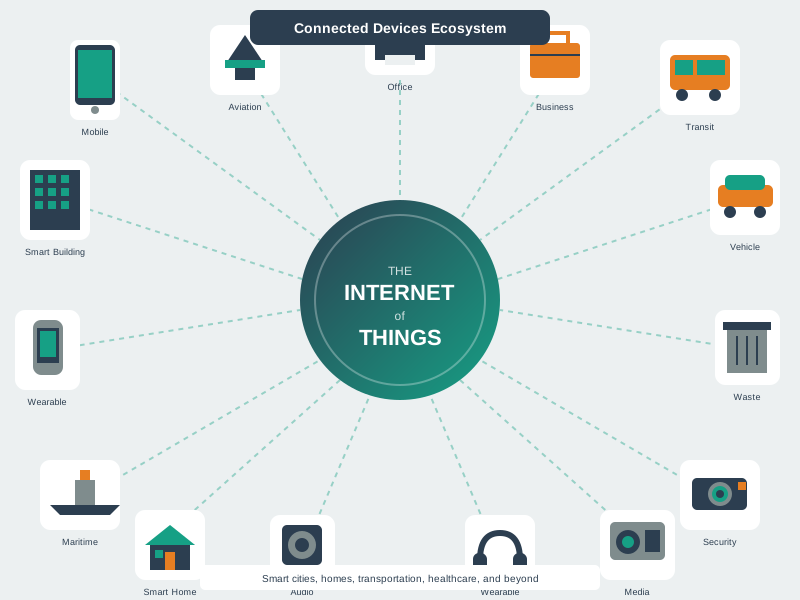
The illustration groups everyday objects into five families, from vehicles and buildings down to bins and street lights, and arranges them around the phrase at the centre. That layout makes the breadth obvious, and it is the easy half of the message. The band along the foot carries the harder half. It says value comes from devices sharing data and coordinating actions, which is a claim about what happens between the icons rather than about how many there are. Take that away from Figure 19.3 when the list below starts to look like a catalogue. A thousand connected objects that never exchange anything are just a thousand separate products.
This academic visualization captures a key insight: virtually any physical object can become an IoT device. The diversity shown here includes:
- Transportation: Aircraft, buses, ships, cars
- Buildings: Smart homes, offices, factories
- Appliances: Refrigerators, washing machines, beds
- Personal devices: Phones, cameras, headphones, speakers
- Infrastructure: Trash bins, street lights, utility meters
The connecting lines illustrate that IoT value emerges not from individual smart devices, but from the network effects when thousands of diverse devices share data and coordinate actions.
Source: University of Edinburgh - Principles and Design of IoT Systems
19.11 Practical Definition Framework
For practitioners, the most operationally useful definition provides clear, verifiable criteria:
Minimum Requirements Definition: Thing + Computation + Internet
This framework enables:
- Product classification (is this smart toaster IoT?)
- Requirements validation (missing internet connectivity = not IoT)
- Evolution tracking (embedded -> connected -> IoT progression)
19.12 Definitions Are Lenses, Not One Checklist
The source material offers two broader lenses alongside this operational test. One frames IoT as people and things being connected anytime, anyplace, with anything and anyone, over any suitable path or service. Another describes interrelated devices, machines, objects, animals, or people that carry unique identifiers and transfer data across a network without requiring a person to move every message. These definitions describe reach, identity, and machine-to-machine exchange; they do not replace the engineering boundary below.
The same source also presents a four-part minimum: an everyday thing, computation, internet connectivity, and computational intelligence. In this course, the first three remain the quick classification test because they are directly observable. Intelligence is then reviewed as a separate capability question: does the system merely report or relay state, or does it use computation to interpret context and support a decision? Keeping the two questions separate prevents a connected object from being called intelligent by default while preserving the source’s reminder that useful IoT systems usually do more than move raw readings.
19.13 IoT Classification Test
Use this three-question test to determine if any device qualifies as IoT:
Use this quick classification test:
- Is it a physical object, or “thing”? If not, it is not IoT.
- Does it have computation capability, such as a processor or firmware? If not, it is only a sensor or passive object.
- Can it communicate over the internet, directly or through a gateway? If yes, it meets the practical IoT definition; if not, it is an embedded or local system.
Try it yourself: Is a Bluetooth-only fitness band that syncs to your phone (which then uploads to the cloud) an IoT device? Yes — under the gateway model used in this course, the phone provides the device’s internet path, so the three criteria are satisfied. The trade-off is that remote reach disappears when the gateway phone is absent.
- Academic, identity, and context definitions capture intelligence and context well, but can be operationally vague. They fit research papers and vision documents.
- Semantic, network, and unique-ID definitions emphasize networking foundations, but can miss the intelligence aspect. They fit standards bodies and protocol design.
- Practical Thing plus Compute plus Internet definitions are clear and verifiable, but can oversimplify. They fit product development and project scoping.
Best Practice: Use the practical definition for product development and the academic definitions for conceptual understanding and research.
Checkpoint: IoT Definitions
You now know:
- Academic definitions emphasize identity, virtual personality, and context awareness.
- Semantic definitions emphasize uniquely addressable things on standard communication protocols.
- The practical test asks whether the system has a physical thing, computation, and internet connectivity, including a gateway path when that is how the product works.
19.14 Why Multiple Definitions Matter
19.15 The Multidisciplinary Imperative
Definitions classify the system; multidisciplinary review decides whether the system is worth shipping. The same device can satisfy the IoT definition and still fail if one perspective quietly dominates.
Understanding diverse IoT perspectives is not merely academic — it is essential for project success:
Cross-Functional Challenges:
- Security engineer vs Hardware engineer: Security demands encryption overhead; hardware wants minimal power consumption
- Data scientist vs Network engineer: Analytics wants high-frequency data; network wants minimal bandwidth
- UX designer vs System architect: Users want seamless experience; architecture requires complexity
Resolution Strategy:
- Acknowledge that each perspective is valid and necessary
- Identify conflicts early in design phase
- Make explicit trade-offs with stakeholder buy-in
- Document decisions for future reference
Example: In this simplified medical-wearable comparison, assume ChaCha20-Poly1305 uses half the encryption energy overhead of AES-256-GCM. Measure power and verify that the chosen authenticated-encryption implementation meets the deployment’s security requirements.
19.16 Security-Battery Tradeoff
Given: Medical wearable, AES-256-GCM vs ChaCha20-Poly1305 authenticated encryption
- AES-256-GCM is assumed to add about 15% battery drain and about $3 to the bill of materials.
- ChaCha20-Poly1305 is assumed to add about 7.5% battery drain and about $1.50 to the bill of materials, half the encryption energy overhead in this simplified comparison.
Impact on 7-day battery (180 mAh):
- With AES-256-GCM, a 180 mAh battery at 85% effective capacity gives about 153 mAh, or 5.95 days in this example.
- With ChaCha20-Poly1305, the same battery at 92.5% effective capacity gives about 166.5 mAh, or 6.48 days.
Key insight: Under the example’s assumed costs and loads, ChaCha20-Poly1305 extends battery life by about 8.8% and saves $1.50 BOM per unit; assess security suitability independently. At 100,000 units, that is $150,000 in assumed hardware savings.
19.17 Battery vs Security Explorer
Use this battery vs security explorer section as a guided decision record, not as a list to memorise. First identify the stated input, assumption, or scenario; then compare each option on the same units and time boundary. Next check which value changes the outcome and which evidence would reveal an invalid assumption. For battery vs security explorer, the useful result is the reasoning chain: observed condition, governing constraint, calculation or classification, and operational consequence. Record that chain before choosing an answer or carrying a value into the next section. Where the panel supplies several choices, reject each distractor against the chapter’s named mechanism instead of relying on wording cues. Where it supplies a table or timeline, compare rows at like-for-like scale and preserve the difference between an early indication, an actionable threshold, and a final outcome. This turns battery vs security explorer into evidence that can be reviewed, recalculated, and connected to the running design narrative.
Explore the real-world impact of encryption choices on battery life for IoT devices.
Checkpoint: Security-Battery Evidence
You now know:
- The simplified example compares assumed encryption overhead and BOM costs for two authenticated-encryption choices.
- In that model, ChaCha20-Poly1305 has half the encryption energy overhead of AES-256-GCM; neither option’s security can be expressed as a percentage of the other.
- The design method is not to pick the weakest control, but to document the trade-off and compensate elsewhere when security is non-negotiable.
Knowledge Check: Definitions
19.18 Build an IoT Project Team
To solidify the connection between perspectives and practice, consider how you would assemble a team for a smart building energy management system:
Inspect Figure 19.4 to see how six specialist views meet at product choices that no single role can settle alone.
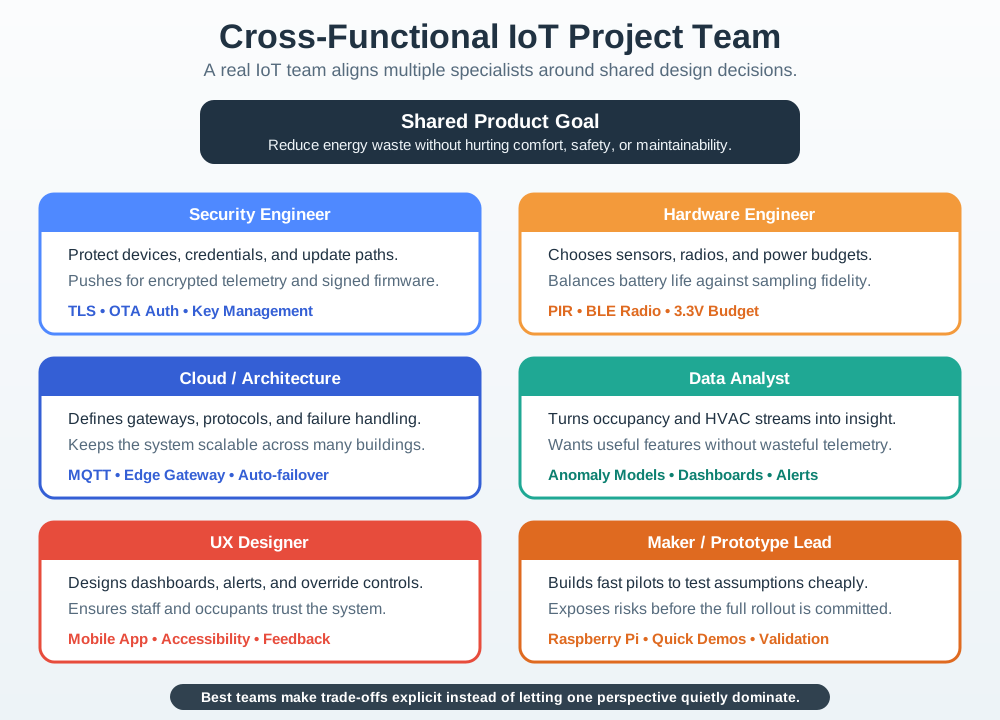
Start Figure 19.4 at the shared product goal, then move outward to security, maker, hardware, architecture, data, and user experience. The examples show why coordination must happen at decisions. One-second sampling improves detail but consumes network capacity, so a 15-second average plus event bursts balances data and architecture needs. MFA can protect critical controls while a PIN keeps routine dashboard access usable. Detailed retention can be limited to one year while five-year aggregates support trends. These are explicit compromises with owners and evidence, not hand-offs between isolated teams.
Key design decisions and their perspective trade-offs:
- Sensor sampling rate: Data wants one-second readings while architecture worries about network capacity. A balanced resolution is a 15-second average with event-driven bursts.
- User authentication: Security wants MFA while UX wants one-tap access. A balanced resolution is biometric confirmation for critical controls and a PIN for dashboards.
- Data retention: Data teams want five years while security and privacy want minimal retention. A balanced resolution is one year of detailed records, five years of aggregated records, and documented deletion behavior.
- Edge versus cloud processing: Hardware has limited edge compute while data teams want complex models. A balanced resolution is edge anomaly detection plus cloud predictive modeling.
19.19 Interactive Quiz: Match Concepts
19.20 Interactive Quiz: Sequence the Steps
Common Pitfalls
19.21 Initial Prototype Over-Engineering
Adding too many features before validating core user needs wastes weeks of effort on a direction that user testing reveals is wrong. IoT projects frequently discover that users want simpler interactions than engineers assumed. Define and test a minimum viable version first, then add complexity only in response to validated user requirements.
19.22 Development Security Neglect
Treating security as a phase-2 concern results in architectures (hardcoded credentials, unencrypted channels, no firmware signing) that are expensive to remediate after deployment. Include security requirements in the initial design review, even for prototypes, because prototype patterns become production patterns.
19.23 Failure and Recovery
Designing only for the happy path leaves a system that cannot recover gracefully from sensor failures, connectivity outages, or cloud unavailability. Explicitly design and test the behaviour for each failure mode and ensure devices fall back to a safe, locally functional state during outages.
19.24 Label the Diagram
19.25 Code Challenge
19.26 Summary
In this chapter, you learned:
- Six stakeholder perspectives shape IoT understanding: Security, DIY/Maker, Hardware, Architecture, Data Analytics, and User Experience — each with distinct priorities, questions, and metrics
- IoT is inherently multidisciplinary — no single perspective captures the complete picture, and every design decision creates trade-offs across disciplines
- Three complementary definitions serve different purposes: Academic (identity + context) for research, Semantic (network + unique ID) for standards, and Practical (Thing + Compute + Internet) for product development
- The IoT taxonomy spans five interconnected layers: Hardware, Software, Network, Data, and Security
- Cross-functional collaboration with explicit trade-off documentation is the most reliable path to IoT project success
- Real-world examples (Nest thermostat, medical wearables, pet trackers) show that successful products result from deliberate compromises between competing perspectives
19.27 Knowledge Check
19.28 Quiz: IoT Perspectives
19.29 Resolve IoT Perspective Conflicts
The final section turns the chapter into a repeatable meeting procedure. Use it when a role conflict is real enough to affect cost, risk, service life, compliance, or usability.
When different perspectives clash during IoT product development, use this structured resolution framework:
19.29.1 Step 1: Identify the Conflict Type
- Security versus usability: Security engineers ask for stronger authentication while UX designers protect low-friction access.
- Performance versus battery: Hardware engineers protect service life while data scientists ask for real-time inference.
- Cost versus features: Product teams push bill-of-materials limits while engineers price radios, sensors, memory, and certification realistically.
- Privacy versus monetization: Legal and privacy teams constrain data use while business teams may see value in location, behavior, or occupancy data.
- Speed versus reliability: Software teams want fast rollout while architecture teams protect device variants, rollback paths, and field reliability.
19.29.2 Step 2: Apply the Resolution Matrix
For each conflict, score both perspectives on two dimensions:
Score the conflict on two dimensions:
- Regulatory risk, 1 to 5: Does this violate GDPR, safety standards, FCC regulations, or another binding rule?
- User impact, 1 to 5: Does this make the product unusable, unsafe, misleading, or worthless for customers?
Resolution Rule:
- Regulatory Risk ≥ 4: Security/Privacy perspective MUST win (non-negotiable)
- User Impact ≥ 4: UX/Product perspective should win (unless Regulatory ≥ 4)
- Both <4: Find the middle-ground compromise (neither perspective dominates)
19.29.3 Step 3: Find the Third Option
Most IoT conflicts are false dichotomies. Look for the synthesis solution:
Example 1: Security vs. UX (Smart Door Lock)
- Security demand: Biometric authentication required (fingerprint or facial recognition)
- UX demand: One-tap unlock for daily use
- False choice: “Secure but slow” vs. “Fast but insecure”
- Third option: Tiered authentication by context
- At home Wi-Fi: One-tap unlock (phone presence = implicit auth)
- Away from home: Biometric required
- 3 failed attempts: Escalate to 2FA
- Result: 95% of unlocks are one-tap (home use), 5% require biometric (away/suspicious)
Example 2: AI Model vs. Battery Life (Wearable)
- Data scientist demand: Run ML model every 10 seconds for activity tracking
- Hardware demand: Model runs drain battery in 8 hours; need 48+ hour life
- False choice: “Accurate tracking” vs. “Usable battery life”
- Third option: Adaptive sampling + edge/cloud hybrid
- Accelerometer samples at 50Hz (low power)
- Edge classifier detects “activity vs. rest” (runs on MCU, <1mW)
- Only invoke ML model (150mW) when activity detected
- 90% of time in “rest mode” extends battery to 52 hours
- Result: 97% model accuracy with 6.5x battery improvement
Example 3: Cost vs. Features (Agricultural Sensor)
- Product demand: Add GPS to track sensor location ($12 module)
- Business demand: Keep BOM under $50 ($62 with GPS exceeds target)
- False choice: “Traceable sensors” vs. “Affordable price”
- Third option: Hybrid location strategy
- GPS module: $12 (rejected)
- Alternative 1: Bluetooth beacon ($2) + phone app for setup mapping
- Alternative 2: QR code ($0.05) + GPS from installer’s phone during deployment
- Alternative 3: LoRaWAN geolocation (free, uses time-of-arrival from 3+ gateways, ±50m accuracy)
- Result: Option 3 (LoRaWAN geolocation) achieves location tracking at zero BOM cost, maintaining $50 target
19.29.4 In 60 Seconds
Use the framework to turn a role conflict into evidence: name the competing perspectives, score the regulatory and user impact, look for a third option, and document the decision so the team does not relitigate it later.
19.29.5 Step 4: Document the Trade-off
Every decision should be explicitly documented with:
- Perspectives involved: Who advocated for what?
- Scores: Regulatory Risk and User Impact ratings
- Decision made: Which approach was selected
- Rationale: Why this balances the competing needs
- Review trigger: Under what conditions should this be revisited?
Template:
**Decision**: [Short description]
**Date**: YYYY-MM-DD
**Perspectives**: Security (John), UX (Sarah), Product (Maria)
**Conflict**: Security wants mandatory 2FA; UX wants one-tap; Product prioritizes adoption
**Scores**: Regulatory Risk = 3, User Impact = 4
**Resolution**: Context-based tiered authentication (home = one-tap, away = biometric)
**Rationale**: Regulatory risk moderate (healthcare data); User impact severe if every unlock is slow. Tier by location context achieves both.
**Review Trigger**: If breach occurs or HIPAA auditor flags concern
Why Documentation Matters: Six months later, someone will propose the rejected approach again. Documentation prevents relitigating resolved decisions.
19.29.6 Decision Framework Summary
- Identify: Name the conflict pattern, such as security versus usability.
- Score: Rate regulatory risk and user impact from 1 to 5.
- Find a third option: Look for a synthesis, such as context-based tiered authentication.
- Document: Record the decision, rationale, evidence, and review trigger in a design log.
Key Principle: The best IoT products result from deliberate compromises that honor multiple perspectives, not from one perspective dominating all others.
19.30 Cross-Functional IoT Design
The big picture: Every IoT product reflects dozens of compromises between six stakeholder perspectives (Security, Hardware, Data, Architecture, UX, Maker), with no single perspective dominating.
Step-by-step breakdown:
- Identify stakeholders: List all perspectives touched by your product (Security wants encryption, Hardware wants low power, Data wants high-frequency samples, UX wants seamless experience) — Real example: A medical wearable has 6 active stakeholders across engineering, legal, and product teams
- Prioritize characteristics: Assign weights based on domain (Medical: Secure 20% + Fast 15% + Low Maintenance 20% = 55% of decision criteria) — Real example: Healthcare regulations mandate security and reliability, making them non-negotiable at combined 40% weight
- Score trade-offs: In the worked medical-device example, Device A scores Secure 7/10 and Low Maintenance 4/10; Device B scores Secure 9/10 and Low Maintenance 10/10. Device B’s seven-day battery also beats Device A’s two-day battery.
- Document decisions: Record the rationale for each compromise with review triggers (e.g., “Assumed ChaCha20-Poly1305 has half the encryption energy overhead of AES-256-GCM; measure both on the target hardware and check FIPS requirements before selection.”) — Real example: Design decisions documented in 6-month reviews prevent re-litigating resolved debates
Why this matters: Understanding multiple perspectives prevents single-perspective thinking that kills 60% of IoT projects. A security engineer who insists on AES-256 without considering battery life (Hardware perspective) creates an unusable product. A UX designer who wants one-tap unlock without security review (Security perspective) creates a vulnerability. The maturity to recognize “my perspective is valid AND insufficient” separates successful IoT teams from failed pilots.
19.31 Concept Relationships
- Six perspectives connect to IoT Requirements: each perspective prioritizes different characteristics from the eleven ideals.
- The trade-off framework connects to design methodology: it gives teams a systematic way to resolve competing requirements.
- The security perspective connects to Security Threats: encryption, authentication, and threat models are the deep technical version of that lens.
- The IoT taxonomy connects to Reference Architectures: the five layers expand into system design patterns.
- Academic definitions connect to IoT History: formal definitions evolved as connected things moved from vision to deployment.
19.32 See Also
Related Fundamentals:
- IoT Introduction - The Three Ingredients Test and Five Verbs provide context for perspective differences
- Device Evolution - How Embedded → Connected → IoT progression affects each stakeholder’s concerns
Architecture and Design:
- Design Principles - Systematic frameworks for multi-stakeholder design
- Testing and Validation - How each perspective defines “success” differently
Security Deep Dives:
- Security Threats - The Security perspective’s technical requirements
- Privacy and Compliance - Balancing Data and Privacy perspectives
19.33 What’s Next
- Next: IoT Requirements and Characteristics - minimum requirements and ideal characteristics after the perspective view.
- Previous: Systems Evolution to IoT - how computing economics and chip trends made large-scale IoT practical.
- Related: Security Threats - deep dive into the security perspective.
- Related: Reference Architectures - five IoT layers expanded into system design patterns.
- Hub: Quiz Navigator - test your understanding across chapters.
19.34 Key Takeaway
Every IoT project is a negotiation between technical feasibility, user value, business viability, operational support, and risk. Strong designs make those perspectives explicit early instead of resolving conflicts after deployment.