35 IoT Pricing: Revenue Models
35.1 Start With the Decision
“We need to figure out how to let kids use our playground,” said Sammy. “But building it cost us a lot of allowance money!”
35.2 Route Overview
This is part 2 of 2. Review IoT Pricing: Value Metrics for the preceding evidence.
35.3 Learning Objectives
- Trace pricing strategies and revenue models across its components and failure boundaries.
- Validate tiered pricing roi with a concrete scenario and pass criteria.
35.4 Chapter Roadmap
- For Kids: Meet the Sensor Squad!
- Pricing Strategies and Revenue Models
- Tiered Pricing Framework
- Pricing Strategy Design Principles
- Dynamic Pricing and Market Moats
- Future Monetization Research Directions
- Checkpoint: Tier Shape
- Real-World Tiered Pricing Examples
- Tiered Pricing ROI
- Continue to Part 2
35.5 For Kids: Meet the Sensor Squad!
Pricing is like deciding how much to charge for rides on the coolest playground slide ever built!
The Sensor Squad — Temperature Terry, the LED, the microcontroller, and the battery — had built an amazing smart playground with a slide that changes colors, a swing that plays music, and a climbing wall that keeps score!
35.5.1 Smart Playground Pricing Problem
“We need to figure out how to let kids use our playground,” said Sammy. “But building it cost us a lot of allowance money!”
Lila had an idea: “What if we have THREE ticket types?”
| Ticket | Price | What You Get |
|---|---|---|
| Green Ticket | Free! | Use the regular slide and swings |
| Orange Ticket | 1 coin/day | Color-changing slide + musical swings |
| Gold Ticket | 3 coins/day | Everything + climbing wall scoreboard + choose the music |
“But why give anything away for free?” asked Bella.
Max explained: “Because once kids try the regular slide, they’ll see how cool the color-changing one is and WANT to upgrade! It’s like when you try a free sample of ice cream and then buy a whole scoop!”
Sure enough, 20 kids came to try the free slide. 5 of them (25%) upgraded to Orange tickets, and 2 of those (40%) got Gold tickets!
“We made way more money than if we just charged everyone 2 coins!” cheered Sammy. “Some kids couldn’t afford 2 coins but could pay 1, and the Gold ticket kids actually paid MORE than 2!”
35.5.2 Key Words for Kids
| Word | What It Means |
|---|---|
| Tiers | Different levels of a product, like Small/Medium/Large drinks |
| Free Tier | The basic version that costs nothing, to get people interested |
| Upgrade | Moving to a better (and more expensive) version |
| Conversion | When someone changes from free to paid — like upgrading your ticket |
35.5.3 Try This at Home!
The Pricing Experiment:
First, Pretend you are selling access to your favorite game or toy. Next, Create THREE tiers on paper: Free, Basic ($1), and Premium ($3). Then, Ask 5 friends: “Which would you choose?”. After that, Count up: How much total money would you make? Finally, Now try with just ONE price ($2): Would you make more or less?
35.6 Pricing Strategies and Revenue Models
IoT pricing strategies must balance customer value perception with business sustainability. Companies employ tiered pricing models that segment customers by needs and willingness to pay.
Figure 35.1 reads across rather than down: each tier names a customer before it names a price.
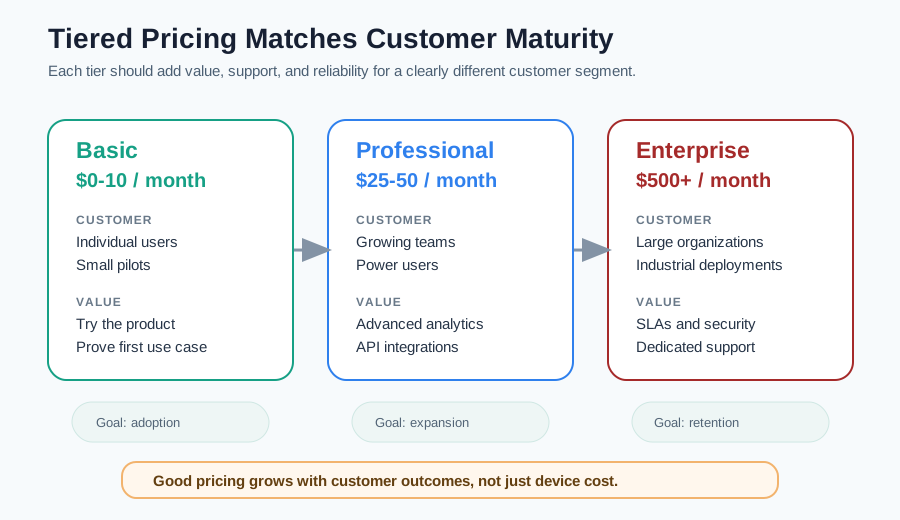
Take Figure 35.1 one column at a time. The basic tier is priced for an individual or a small pilot, and its job is to let someone prove a first use case. The professional tier is aimed at growing teams, and what it adds is analytics and integration rather than more devices. The enterprise tier is priced for large organisations, and what it sells is service-level commitments, security and dedicated support. The goal line under each column is the part to remember: adoption, then expansion, then retention. Read that way the price gaps are not arbitrary. Each marks a change in who is buying and what they need proved.
35.6.1 Subscription Tier Funnel
This diagram shows how a free tier can demonstrate value while reserving longer retention, alerts, and analytics for paid tiers. The conversion path is useful because it makes the upgrade reason visible instead of hiding the paid value behind a vague “premium” label.
Figure 35.2 makes each upgrade reason explicit, which is the test this section sets for a tier ladder.
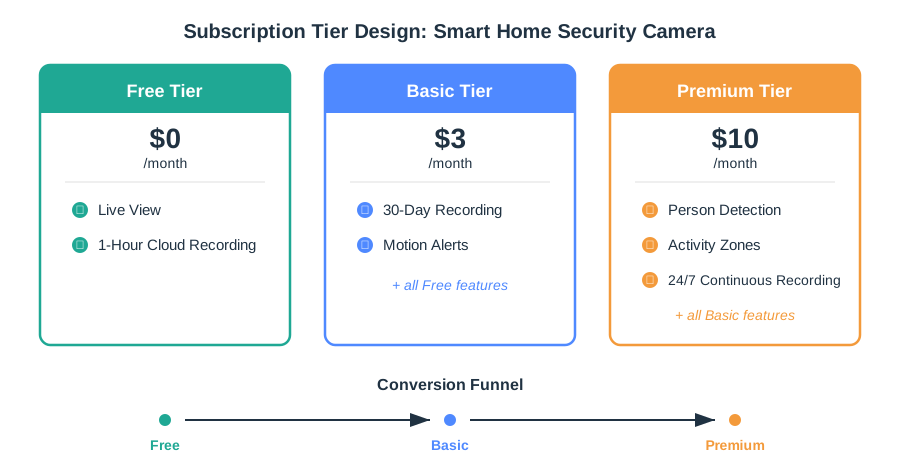
Read the three columns of Figure 35.2, then read the line at the foot of each one. The free tier gives live view and an hour of history, which is enough to prove that the camera and the app work. Its upgrade line states the trigger plainly: the owner will want older footage and to be told when something happens. The basic tier answers that with thirty days of recording and motion alerts, and its own upgrade line points at the next irritation, which is noisy notifications. The premium tier sells person detection and activity zones to fix exactly that. Each step names the problem it solves.
35.7 Tiered Pricing Framework
Tiered Pricing Framework Comparison:
Basic ($0-10/month) Target segment: Individuals and small businesses Key features: Core device functions, basic analytics, mobile app Support level: Email support Conversion goal: Acquire users and demonstrate value
Professional ($25-50/month) Target segment: Growing businesses and power users Key features: Advanced analytics, API access, custom integrations Support level: Priority support plus live chat Conversion goal: Convert from free and retain active users
Enterprise ($500+/month) Target segment: Large organizations and industrial customers Key features: Dedicated infrastructure, SLA guarantees, custom development Support level: 24/7 phone support plus an account manager Conversion goal: High-margin revenue and long-term contracts
35.8 Pricing Strategy Design Principles
Pricing Strategy Design Principles:
First, Value-Based Pricing: Align price with customer outcomes (energy savings, downtime reduction, productivity gains). Next, Psychological Anchoring: Enterprise tier makes Professional tier seem reasonably priced. Then, Clear Feature Differentiation: Each tier has distinct value propositions preventing confusion. After that, Upgrade Path Clarity: Natural progression as customer needs grow creates revenue expansion. Finally, Free/Basic Tier Strategy: Reduces adoption friction, builds user base for network effects.
35.9 Dynamic Pricing and Market Moats
IoT pricing can move beyond fixed monthly plans when device data exposes real-time demand, capacity, location, or service priority:
- Dynamic pricing works when customers can shift behavior, such as EV charging away from peak grid hours or industrial equipment use away from a capacity bottleneck. It fails when customers cannot predict, understand, or respond to the price signal.
- Network effects can justify lower early hardware margins because a larger installed base attracts integrations, developers, partners, and data advantages. Price cuts are strategic only when the later ecosystem revenue is credible.
- Commoditization defense means charging for hard-to-copy service and insight layers — device management, analytics, workflow integration, trained models, and support — rather than relying on sensor hardware margin.
Pricing implication: keep commodity device and connectivity costs transparent, then capture recurring value where the customer sees continuing operational benefit.
Inspect Figure 35.3 to see when a changing tariff alters demand and when it merely changes the bill.
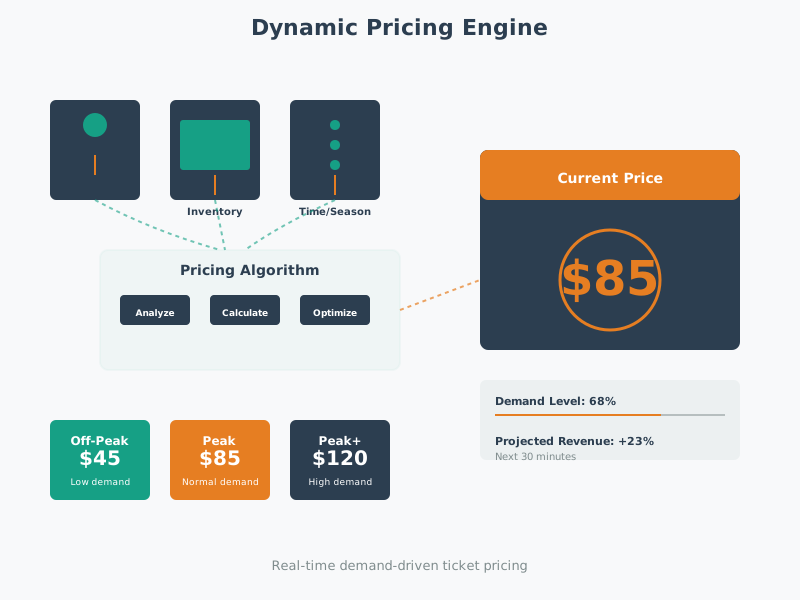
Start with the demand, capacity, and time inputs in Figure 35.3. They produce an off-peak or peak-plus price signal, but that signal has value only if customers can predict, understand, and respond to it. Follow the yes branch to the baseline-versus-treatment test: measure peak load, total usage, and service completion, not revenue alone. The final guardrail checks whether apparent peak relief caused unfair exclusion or shifted demand into a new rebound peak. Dynamic pricing is a behavior intervention before it is a moat.
35.9.1 Smart Data Pricing: Who Pays, for What, and When
Network pricing is a policy mechanism as well as a revenue model. A service can vary the charge by usage, time, location, or congestion; make the customer prepay or pay later; apply a contract or a flexible plan; and decide whether the user, an enterprise, a content provider, or another sponsor pays. It can also price the transaction, the connectivity service, the cloud work, or the IoT outcome. These dimensions must be reviewed together because a tariff that improves capacity use can still make access less predictable or favor one service over a competitor.
That is where network-neutrality questions enter the product record. Blocking, throttling, paid prioritisation, zero-rating, and sponsored data change which traffic is reachable, fast, or visible in the user’s bill. They can fund access or protect a constrained service, but they can also distort competition and make identical packets receive different treatment because of commercial ownership. A historical regulatory proposal is useful for exposing these tensions, not as a statement of current law. For a real deployment, record the current jurisdiction, operator terms, affected traffic classes, user disclosure, appeal path, and the owner who will recheck the policy when regulation or commercial arrangements change.
35.9.2 Prove That a Time-Dependent Price Shifts Demand
A time-dependent tariff succeeds only if it changes the right behavior. Compare a baseline period with a treatment period and separate at least three outcomes: peak load, total usage, and service completion. A lower peak may mean customers moved flexible work to a quieter interval, but it may also mean they abandoned useful work or could not afford the peak price. Total usage can rise while the peak falls when an off-peak discount behaves like a sale, so neither metric is a substitute for the other.
For example, an EV-charging service can offer a lower overnight price and then examine the distribution of charging starts, the maximum simultaneous load, energy delivered, unfinished sessions, and differences between customers who could and could not defer. Keep the price schedule, eligible population, capacity conditions, confounding events, and uncertainty with the result. The product decision is defensible when the experiment shows that demand moved away from the bottleneck without hiding lost service, unfair exclusion, or a rebound peak elsewhere.
35.10 Future Monetization Research Directions
Some IoT monetization ideas are still better treated as research directions than default product patterns. Machine-to-machine micropayments, for example, imagine devices paying each other for bandwidth, energy, data, storage, or local compute. The hard question is not only whether a blockchain or payment rail can clear tiny transactions. It is whether the design can prove identity, prevent fraud, cap spending, handle failed connectivity, reverse mistakes, and keep transaction cost below the value exchanged.
Privacy-preserving monetization is another active design frontier. A data product may use aggregation, differential privacy, federated learning, secure enclaves, or homomorphic encryption to sell useful insight without exposing individual people, homes, farms, vehicles, or factories. These techniques can protect trust, but they also change the product economics: stronger privacy may reduce precision, increase compute cost, limit buyer queries, or require stricter release audits.
Three other directions keep appearing in advanced IoT strategy work:
- AI-driven pricing: machine learning can tune prices from demand, capacity, customer segment, and willingness-to-pay signals, but the product still needs explainable guardrails so pricing does not become discriminatory, unstable, or impossible for customers to predict.
- Circular economy models: product-as-a-service, refurbishment, equipment reuse, battery recovery, and sustainability reporting can turn lifecycle stewardship into revenue, but only if the provider tracks asset condition, residual value, logistics cost, and verified environmental benefit.
- Edge computing economics: moving processing closer to the device can reduce bandwidth, latency, storage, and privacy exposure; the business case should compare edge hardware and maintenance cost against cloud savings and new local insight revenue.
Cross-sector data marketplaces sit across all of these directions. They need provenance, consent, quality scoring, entitlement checks, buyer logs, deletion paths, and clear standards for secure exchange. Without those controls, a marketplace can create more liability than revenue.
35.10.1 Try It: Write a Pricing Gate
Before choosing Basic, Professional, and Enterprise prices, write one gate record for the value metric you plan to charge against:
| Gate field | Evidence to write |
|---|---|
| Customer outcome | The operational result the customer pays for, such as less downtime, lower energy cost, fewer false alerts, or faster compliance evidence |
| Value metric | The unit that grows with customer value, such as devices managed, messages processed, sites monitored, alerts investigated, or reports generated |
| Cost floor | The recurring cost that must be covered for that unit, including cloud storage, connectivity, support, data processing, and warranty risk |
| Upgrade trigger | The observable moment when a customer should move to the next tier, such as more devices, stricter SLA needs, API access, or audit requirements |
| Perverse incentive check | The behavior the price might accidentally discourage, such as sending safety pings, reporting faults, or keeping sensors online |
Accept the pricing gate only when the value metric scales with customer benefit, covers recurring cost, and does not punish the behavior that makes the IoT service valuable.
 Checkpoint: Tier Shape
You now know:
- Basic should prove value without hiding the upgrade path.
- Professional should turn active use into recurring revenue through limits, integrations, analytics, or support.
- Enterprise should charge for SLA, SSO, data residency, custom retention, procurement, and security review.
35.11 Real-World Tiered Pricing Examples
Real-World Tiered Pricing Examples:
First, Google Home Premium (formerly Nest Aware; US prices as of October 2026): Eligible cameras have limited free event history; Standard is $10/month for 30 days of event video history; Advanced is $20/month for 60 days of event history plus up to 10 days of continuous history on eligible wired cameras. Key differentiator: history type and duration. Next, Ring Protect (US prices as of October 2026): Free live view does not include recorded history; Ring Solo covers one device at $4.99/month; Ring Multi covers all devices at one location at $9.99/month; Ring Pro adds advanced features at $19.99/month. Key differentiator: device coverage and features. Then, Fitbit: Basic tier is free tracking; Pro tier is $10/month for Premium; no enterprise tier because it focuses on B2C customers. Key differentiator: advanced health insights and coaching. After that, AWS IoT Core (US East example; as of October 2026): Eligible use has a free tier; paid MQTT/HTTP messaging starts at $1 per million metered messages, while $0.08 per million is the connection-minute rate. AWS Support is priced separately. Key differentiator: usage-based component billing.
Tiered pricing creates revenue scalability while addressing diverse customer segments from individual consumers to enterprise organizations.
35.12 Tiered Pricing ROI
Experiment with different pricing tier structures to see how they impact your revenue metrics. Adjust the sliders to model your IoT product’s potential pricing strategy.
35.12.1 Try This
Experiment with the pricing calculator above:
First, Ring-style pricing: Set Free users to 500K, Basic to 75K at $3, Premium to 25K at $10 (20% conversion, 33% premium adoption). Next, Fitbit-style pricing: Set Free users to 10M, Basic to 0, Premium to 1.2M at $10 (12% direct conversion, no middle tier). Then, Your product: Model your own IoT product’s potential tiers and see what conversion rates you need for viability.
35.13 Continue to Part 2
Continue with IoT Pricing: Revenue Models and Selection.
35.14 Continue Your Route
This final part closes the route from For Kids: Meet the Sensor Squad! through Continue to Part 2. Return to IoT Pricing: Value Metrics or continue from the applications module index.