4 IoT Value: Delivery Frameworks
More
Depth: Practitioner
Progress saves as you read. Mark sections complete as you go; your progress appears in the sidebar.
- Podcast audio coming soon
- Character narration audio coming soon
4.1 Start With the Human Outcome
An IoT proposal needs two explanations: what makes the system IoT, and why anyone benefits from connecting it. This second part of the value chapter builds on IoT Value: Qualification Tests. You will use the Five Verbs framework to describe useful outcomes, test a market-growth model, and follow sensor evidence through to a decision.
Consider the connected ambulance from this chapter’s examples. It transports a patient and transmits vital signs to the hospital en route. Transport serves MOVE; the measurements that help the emergency room prepare care serve HEAL. Calling the ambulance “connected” says little about either benefit. Calling it “smart” says little about the evidence behind its decisions.
The problem is to connect a technical capability to a human activity without overstating what the system does. Start by testing its ingredients, then classify its value, compare assumptions, and trace the action that delivers that value. The same approach will help us assess the chapter’s microwave, thermostat, agricultural and factory examples.
KEY CONCEPTS
- Three ingredients
Find the thing, computation and internet path.
- Value verbs
Name the human activity and each supported benefit.
- Growth assumptions
Compare compounding rates and sizes on the same horizon.
- Accountable action
Trace sensing through to an observed result.
4.2 Learning Objectives
- Test five verbs market growth tool with a concrete scenario and pass criteria.
- Evaluate sensor to smart decision with range, error, power, and interface evidence.
4.3 Test the Ingredients Before the Label
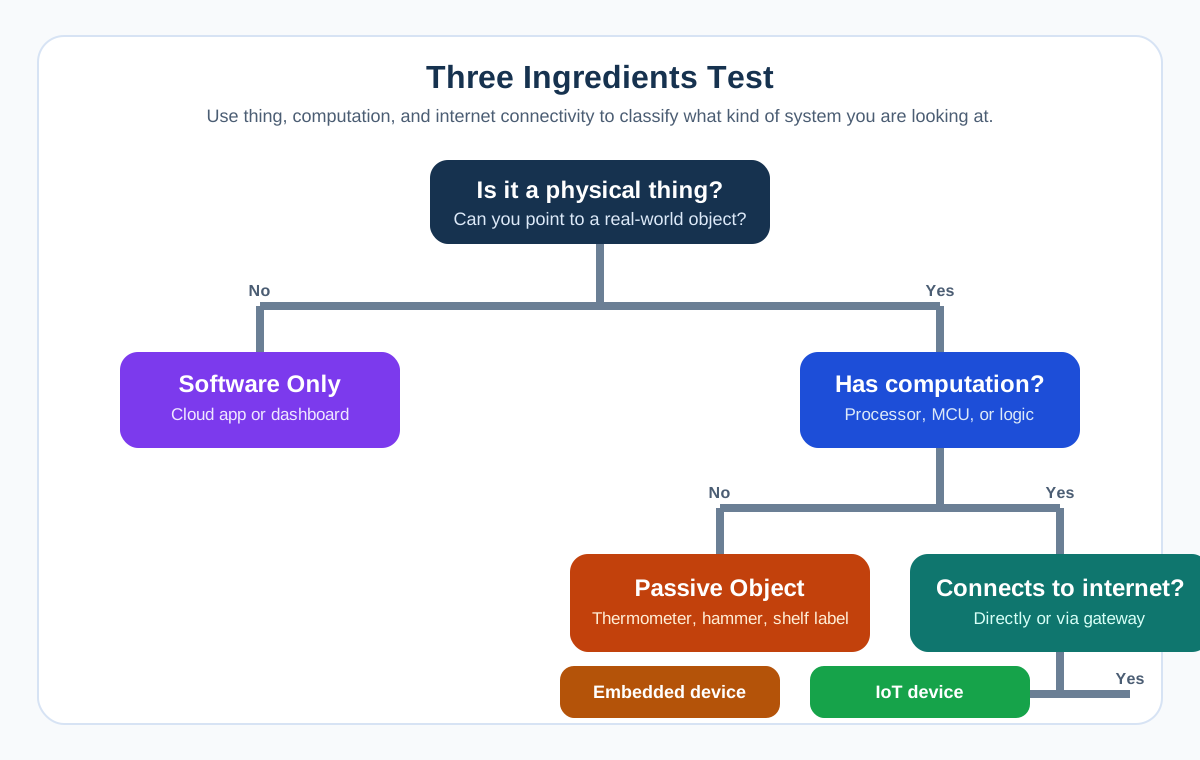
The Three Ingredients Test asks for a physical thing, computation and internet connectivity. A microprocessor and display alone do not establish IoT. A basic digital thermostat can sense and control locally while remaining an embedded device. Conversely, internet connectivity need not mean a direct connection from every sensor: a smartphone can bridge a Bluetooth Low Energy (BLE) device to the internet.
In the chapter’s fictional Smart Microwave scenario, a company markets a $299 appliance as “IoT-enabled.” It has a digital touchscreen, 20 preset cooking programs in memory, a moisture sensor that adjusts power, and voice notifications when cooking finishes. These are useful embedded capabilities. The physical microwave supplies the thing, and its microprocessor supplies computation. It has no Wi-Fi or cloud connection, so the third ingredient is missing.
Customers expected smartphone remote control and cloud recipe suggestions. In this teaching scenario, assume returns reach 18% against an assumed 4% comparison rate. These figures, and all prices, costs and review scores in this scenario, are assumptions rather than a documented product history. The distinction matters: the complaint is a mismatch between the promised connection and the delivered appliance, not a failure of moisture sensing.
Without an internet path, the microwave cannot receive recipe updates over the internet, learn from usage across thousands of customers, integrate with internet-based smart-home services, or provide internet remote control and notifications. Device Evolution develops the Embedded → Connected → IoT progression in more depth.
The test is an introductory classification aid. Thing plus computation without internet describes an embedded device; computation plus internet without a physical thing describes a cloud service. Thing plus internet without computation describes a conceptual networked device, but a working network camera also performs computation. Do not use “dumb webcam” as proof that computation is absent. Nor does remote control alone disqualify an otherwise complete IoT system: autonomy and connectivity answer different questions.
4.4 Use the Five Verbs to Describe Value
Once the ingredients are clear, ask which human activity the system improves. The Five Verbs framework groups applications by purpose: SUSTAIN concerns energy, environmental protection and resource sustainability; MOVE concerns transportation and logistics; HEAL concerns health and care; FEED concerns food and agriculture; MAKE concerns production.
A smart thermostat serves SUSTAIN by optimizing energy use and reducing its associated carbon footprint. Greenhouse automation serves FEED by managing plant-growth conditions. A factory robot with sensors and connectivity serves MAKE, while a wearable fitness tracker serves HEAL by monitoring health metrics. These categories turn an abstract technology discussion into a discussion of needs.
Return to the ambulance. HEAL follows from its vital-sign transmission, and MOVE follows from transporting the patient. No GPS-routing optimization was stated or is needed for that classification. SUSTAIN does not mean “sustaining life” in this framework; its meaning is environmental and resource sustainability.
Overlap is useful when each benefit is explicit. A connected delivery truck can MOVE goods efficiently through route optimization and FEED people through food delivery and cold-chain monitoring. Medical-supply logistics can combine MOVE and HEAL. A smart hospital can SUSTAIN energy while supporting HEAL. In the chapter’s John Deere “See and Spray” teaching example, take the stated 80% herbicide reduction as the case premise: targeted weed control primarily serves FEED, while reduced chemical use, runoff and soil degradation provide a secondary SUSTAIN benefit. Tractor movement alone does not make the service a transportation application.
For a design discussion, identify the primary verb, ask whether additional verbs have a supported benefit, and quantify the impact for each: efficiency, cost savings or lives saved. This avoids forcing one category onto a business case with several stakeholders. IoT Perspectives examines how six stakeholder types can see the same system differently.
The chapter’s historical comparison places MAKE first, through industrial machine-to-machine (M2M) communication in factories, with a 10–15 year head start over consumer IoT. Treat that as the chapter’s broad historical comparison rather than a universal adoption date. Industry 4.0 develops the industrial sensing and manufacturing setting; Application Domains connects the verbs to industry verticals and use cases.
The original illustrative timeline spans 2005–2030 and marks MAKE from 2006+ (industrial M2M, predictive maintenance and digital twins), SUSTAIN from 2009+ (grids, buildings and sensing), MOVE from 2013+ (fleets, V2X and routing), HEAL from 2016+ (monitoring and wearables), and FEED from 2018+ (farming and cold chain). Treat these as the chapter’s illustrative historical markers, not verified universal adoption dates.

4.5 Compare Growth Assumptions Without Making a Forecast
Classifying a benefit does not establish the size of its market. The Five Verbs Market Growth Tool uses an illustrative 2024 base and fixed annual rates. Its slider covers 1–10 years from 2024, with six years selected initially to reach 2030. These are exercise inputs, not observed market outcomes or career advice.
| Verb | Assumed 2024 size, USD billions | Assumed annual growth |
|---|---|---|
| SUSTAIN | 520 | 13.2% |
| MOVE | 380 | 16.5% |
| HEAL | 290 | 14.3% |
| FEED | 180 | 15.1% |
| MAKE | 410 | 13.3% |
Compound annual growth rate (CAGR) describes an equivalent annual compounding rate. The tool computes future value as present value × (1 + rate) raised to the number of years. It sorts categories by future size, compares each with the largest bar, calculates each share of the total, and displays the combined total in trillions.
Under these assumptions, SUSTAIN remains largest at about $1.1T in 2030. MOVE has the highest rate, 16.5%; FEED starts smallest and grows at 15.1%, below MOVE. MAKE reaches about $867B, or roughly $870B, and HEAL about $647B. The assumed total rises from $1.78T to about $3.98T, rounded to $4.0T, over six years. That comparison does not demonstrate that the market doubles every five years or that millions of jobs will result.
The source connects SUSTAIN with climate and regulatory demand for energy optimization in buildings, factories and cities; FEED with water scarcity, climate pressure and agricultural modernization; and HEAL and MAKE with conservative purchasing and long sales cycles. These are reasons to investigate a market, not proof of guaranteed stability or decades of recurring revenue. Consumer gadgets such as speakers and fitness trackers are only part of IoT; the model is a reason to examine industrial opportunities too, without using its assumptions to rank real careers.
4.6 Follow Sensing Through to an Accountable Action
The verbs explain why the ambulance matters; the delivery path explains how its measurements become useful. A Sense–Connect–Process–Act loop follows a measurement through communication and computation to an action, then repeats. The thermostat provides a concrete way to examine the stages.
Use these as illustrative device-loop inputs, not measured Nest performance: the room is at 65°F, the desired temperature is 72°F, and the sensor takes 10 readings per minute. In the hypothetical connection stage, a 100-byte payload travels over home Wi-Fi to a cloud service in under 50 milliseconds. Processing compares the reading with the target and an assumed schedule under an assumed device load.
For the action stage, suppose the thermostat receives a command, activates the furnace relay and sends a phone alert. Assume the furnace ignites within 2 seconds and the room reaches 72°F in 18 minutes. These separate observations describe transmission, actuation and heating; one does not establish the others. Local thermostat control can also perform sensing, processing and action. The internet path adds remote services without making cloud processing a requirement for every control decision.
For the ambulance, apply the same evidence discipline to the vital signs. A physical measurement needs its unit, time, location and quality state. Local computation validates, filters and packages it; a gateway bridges constrained links. Forwarding alone does not prove delivery. The internet service receives qualified evidence, records the outcome and supports a bounded action or notification with an owner and safe fallback.
The chapter’s ordering activity follows sensor capture, edge filtering, gateway transmission, cloud analysis including machine-learning models, and application action or notification. Its labeling activity distinguishes physical sensing, local computation and gateway, and internet service with accountable action. The separate checks retain those exercises alongside a healthcare moving-average code challenge: a five-reading window selects the latest values from [72, 75, 71, 73, 76, 74, 72] to smooth sensor noise.
4.7 Make the Promise and the Business Case Agree
An observable action still needs to justify its cost. Return to the fictional microwave: assume $2.1M for embedded software, $850K for marketing, and 60,000 units sold at $299. At an assumed 18% return rate with full-price refunds, returns and refunds total about USD 3.23M. Assume a 2.3-star review average compared with 4.1 for the company’s traditional microwaves. These values illustrate the cost of a misleading promise, without claiming an observed industry case.
There are two coherent responses. Adding an assumed $8 Wi-Fi module and $15K of firmware development could enable smartphone control, recipe downloads and usage analytics, supporting an IoT product proposition at the assumed $299 price against a $199 traditional model. Alternatively, market the existing product as a “Digital Microwave with Smart Sensors,” emphasize moisture sensing and convenient cooking, and use the assumed $229 price. Its value is embedded convenience; the description should avoid unsupported “IoT” or “app-enabled” claims.
For a thermostat, payback depends on purchase price, energy tariff, the previous thermostat and household use. Google reports average Nest savings of 10–12% on heating and 15% on cooling, and says a Nest thermostat can pay for itself in under two years on average. Those attributed averages are not a guarantee for a household, and the savings cannot all be assigned to cloud processing. Quantify return on investment (ROI) for the intended setting before building; Worked Examples develops deployment calculations.
Security belongs in that calculation. Every internet-connected device presents a potential attack path. A functioning prototype without authentication, encryption or a firmware-update mechanism has not resolved deployment security. Budget according to the threat model, device lifecycle and deployment requirements, and justify the allocation. A successful demonstration alone establishes neither a viable product nor a safe service.
4.8 Ground the Comparison in Dated Evidence
The last step is to separate teaching examples from reusable evidence. IoT Analytics estimated 21.1 billion active IoT connections by end-2025. That is a dated connection estimate, not a revenue measure. Its State of enterprise IoT in 2025 briefing provides enterprise adoption context and research scope. Check date, definition and scope before reusing any market number.
Use the domain chapters to investigate the benefits you classified: Smart Cities covers SUSTAIN through energy and environmental monitoring; Agriculture covers FEED through precision farming and livestock tracking. Transportation IoT develops fleet management, connected vehicles and vehicle-to-everything (V2X) communication. Healthcare applications extend HEAL through remote patient monitoring, wearable sensors and telemedicine.
The following standalone resources offer visual explanations at the point where definitions and examples need comparison. The TED-Ed lesson uses an IBM Think Academy video for definitions and data flow. The other talks examine practical outcomes and domain implications.
Foundational Understanding (Start Here):
| Resource | Format | Key Topics |
|---|---|---|
| What is the Internet of Things? | TED-Ed lesson using an IBM Think Academy video | Definition, data flow, and examples |
| How the Internet of Things is helping solve real problems | TED talk | Air quality, food production, and practical outcomes |
| State of enterprise IoT in 2025 | IoT Analytics briefing | Time-stamped enterprise adoption evidence and research scope |
Deep Dives by Verb Category:
| Category | Recommended Video | Why Watch |
|---|---|---|
| SUSTAIN / FEED | How the Internet of Things is helping solve real problems | Environmental sensing and resource-efficient food production |
| MOVE | From Potholes to Rogue One: An IoT Story | Mobile sensing for road infrastructure |
| HEAL | Get Ready for the Internet of Bodies | Connected health devices and their implications |
| MAKE | Welcome to the age of the industrial internet | Industrial sensing, maintenance, and efficiency |
For further practice, the Quiz Navigator organizes fundamentals checks, the Simulation Playground offers protocol experiments, and the Video Gallery collects visual explanations. The applications module index places these cases in the wider course.
Summary
The Three Ingredients Test identifies the physical thing, computation and internet path. The Five Verbs framework explains the human benefit, including overlapping outcomes such as the ambulance’s MOVE and HEAL roles. A growth calculation compares assumptions; it does not turn them into market evidence.
Follow measurements through delivery, processing and action, then assess cost, security and payback. The microwave shows why the promise must match the ingredients. The thermostat shows why transmission time, physical response and energy savings need distinct evidence.
Start with the human need, identify the system’s ingredients, and require evidence for the outcome it promises.
Next, IoT Requirements and Characteristics expands the three ingredients into minimum requirements and eleven ideal characteristics.