7 IoT History: Paradigm Evidence
More
Depth: Practitioner
Progress saves as you read. Mark sections complete as you go; your progress appears in the sidebar.
- Podcast audio coming soon
- Character narration audio coming soon
7.1 Review the Product Team’s Objection
IoT history is more than a list of dates: each shift must connect a technical ability to the decision or service it changed. This chapter follows changes in sensing, networking and control so you can evaluate a historical claim from dated evidence.
A product team has a useful connected idea, but an expert rejects it because today’s habits make the idea look unnecessary. The team must decide whether that warning exposes a real limit or repeats an old pattern of judging a new system by the system it may replace. Paradigm blindness means missing new possibilities because the evaluation assumes the existing system’s uses and habits will persist.
The problem is deciding what the comparison actually proves. A new device may perform an old task poorly yet enable a different service; it may also fail because its infrastructure cannot support that service. The earlier forecasts and lessons provide the preceding examples. Here we will follow the approaches: examine the changed interaction, trace the operating system around it, then separate a useful analogy from evidence for the team’s proposal. Adoption and cost comparisons and the SHIFT framework belong to the continuing route.
KEY CONCEPTS
- Paradigm blindness
Old measures can miss a change in user behavior.
- New interactions
A useful signal becomes valuable through a dependable service.
- Shared infrastructure
Capacity, governance and investment shape what can scale.
- Dated evidence
A forecast needs a source, a measure and a boundary.
7.2 Part Objectives
- Connect major IoT eras to changes in sensing, networking, and control.
- Evaluate a historical paradigm claim from dated technical evidence.
7.3 Ask What Interaction Becomes Possible
The product team’s first task is to examine what the expert is comparing. The messenger-boy remark attributed to Sir William Preece in 1878 captures the problem:
“The Americans have need of the telephone, but we do not. We have plenty of messenger boys.”
The chapter’s source supplies no contemporaneous record for this attribution, so treat it as an illustration of an evaluation error rather than established historical evidence. Preece’s expertise was in telegraphy. The comparison judges the telephone by telegraph delivery, where Britain excelled, instead of asking how instant voice communication could change social and business patterns.
One useful way to frame that error is to look one step earlier than the telephone. Spoken language made coordination immediate but local. Gutenberg’s movable type made knowledge durable, cheap to copy, and able to travel without the speaker. Telephony then made conversation remote and synchronous. Each transition changed both the medium and the behavior around it. For IoT, the same discipline matters: do not judge a connected object only by the old manual interaction. Ask what changes when status can be sensed, copied, routed, and acted on without waiting for a person to be physically present.
The birth of the telephone is also a systems lesson, not only an inventor story. Alexander Graham Bell’s early instrument turned voice pressure into a changing electrical signal; practical service then needed a transmitter, receiver, battery, local loop, switching, and eventually long-distance operating rules. A tin-can telephone can show the intuition that a medium carries a varying signal, but the Bell System became valuable when that signal path was reliable enough for households and firms to organize around it. The same pattern continued as printed media moved into digital readers: the object still looked like “a book” at first, but storage, search, synchronization, and network delivery changed the surrounding service.
The service changed again when communication reached many receivers at once.
Broadcast networks changed the shape again. A switched telephone call connected selected endpoints; broadcast radio sent one transmission to every receiver in range. That required both invention and industry. De Forest’s Audion made weak radio signals more usable, Edwin Armstrong’s feedback and regenerative receiver work sharpened amplification and tuning, and later FM showed that moving information by frequency variation could improve noise behavior compared with amplitude-only thinking. David Sarnoff and RCA turned that technical base into a mass-market receiver, programming, and spectrum business where the network’s value depended on useful content, reliable reception, and operating scale. The IoT lesson is not that sensor networks are broadcast businesses. It is that shared radio systems need the same layered discipline: physical signal quality, channel planning, receiver behavior, gateway capacity, message priority, and application value all have to line up before a fleet can feel like infrastructure rather than a clever demo.
Television made that network-and-content dependency visible at national scale. RCA, NBC, CBS, ABC, PBS, and their affiliates were not valuable because a transmitter existed in isolation; they were valuable because receivers, studio cameras, live events, programming schedules, rights, advertisers, and long-haul distribution could be aligned. A 1950 television network map compared with later national coverage shows the same adoption curve as many connected systems: first the technical reach is sparse, then the service becomes durable when the content and operating model justify more infrastructure. For IoT, “content” may be telemetry, alarms, state estimates, or control actions, but the rule is similar: a network that moves data without a valuable use case remains a transport demo.
For the team, the question is concrete: what useful interaction becomes possible when someone no longer has to be physically present? That identifies a service to investigate. It does not yet establish that the proposed network can deliver it.
7.4 Trace the Infrastructure Behind the Service
Once the interaction is clear, follow the path that must support it. Telephone service needed both a way to select a connection and a way to carry the conversation. The distinction remains useful when reviewing an IoT fleet.
The control plane coordinates connections. Its scaling problem appears when the network has more than two people. If every caller needed a direct line to every other caller, the number of pairs would grow as N * (N - 1) / 2; a neighborhood of 1,000 people would need 499,500 pair connections. Telephone exchanges changed the shape of the problem. A switchboard or central office let each subscriber attach to a smaller shared switching system, where an operator, a Strowger step-by-step switch, a crossbar switch, and later stored-program control selected the path for the call. That is the old telephony version of separating coordination from payload: control logic decides who should be connected, while the established circuit carries the conversation. Modern IoT systems repeat the pattern whenever identity, routing, authorization, and fleet policy must scale without giving every device a permanent private path to every other device.
The data plane carries the conversation after coordination establishes a path. Metallic-circuit route maps, interurban trunks, transcontinental lines, and transatlantic cable landing points reveal the hidden work behind talking at a distance: wires, repeaters, amplifiers, rights-of-way, power, landing stations, repair practice, and operational monitoring. Lee de Forest’s Audion mattered because amplification changed how far a weak signal could travel before conversation became unusable. The IoT analogy is practical: gateways, links, brokers, queues, storage, and backhaul must carry telemetry and commands reliably at the scale adoption creates.
AT&T and Bell Labs show the next layer of the same history. Sampling, quantisation and encoding turned continuous speech and sensor signals into digital records; speech coding made voice small enough for constrained links; Claude Shannon’s information theory gave engineers a language for capacity, noise, and uncertainty; the transistor made electronic switching and amplification compact; and C plus Unix made portable systems software practical. The Bell Labs transistor story, from Bardeen, Brattain, and Shockley to practical switching circuits, is also the bridge from room-scale electronic equipment to minicomputers, microcontrollers, phones, cameras, radios, and other endpoint devices. Those topics now live in separate technical chapters, but historically they belonged to one infrastructure problem: how to turn physical signals into reliable, computable, networked services.
Bell Labs’ research impact also came from hard infrastructure constraints, not from research being detached from operations. Materials science, solid-state electronics, microwave and optical communication, Unix and C, CCD imaging, laser cooling, quantum-effect work, broadband copper and optical access, cellular systems, heterogeneous networks, and cloud-network ideas all answered problems created by real communication scale. The practical lesson is that a strong IoT research program should be tied to concrete “10x” system challenges: cheaper deployment, lower power, better capacity, safer attachment, stronger interoperability, or more reliable operation under messy field conditions.
The product team can now distinguish a promising signal or prototype from a dependable service. Capacity, power and field operation are part of the proposal, and the institutions supporting those capabilities need the same scrutiny.
7.5 Examine Who Sustains the Platform
A service’s operating boundaries include ownership and access as well as wires and software. Telephone history shows why funding, governance and attachment rules belong in an architecture review.
Theodore Vail’s regulated-monopoly Bell System argued that a telephone network became more useful when service was universal, reliable, and centrally coordinated; the same logic gave AT&T stable revenue and obligations that could support long-horizon Bell Labs research. The later breakup of AT&T changed that industrial structure, but not the lesson for IoT infrastructure: network value, regulatory constraints, operating scale, and research investment are coupled. A fleet platform can fail if it treats connectivity as only a technical feature while ignoring who funds the shared infrastructure, who governs access, and how the network keeps improving.
The breakup was not a single switch flipped overnight. The 1913 Kingsbury Agreement connected AT&T long-distance service to independent exchanges, the 1921 Willis-Graham Act allowed more local consolidation under regulated-service logic, and the Justice Department’s 1949 Western Electric case eventually kept AT&T out of the general computer business while protecting its telephone-equipment role. Carterfone in 1968 changed the attachment boundary by allowing non-AT&T devices on the network, and the 1974 antitrust case led to the 1984 divestiture. Later recombinations among Bell Atlantic, NYNEX, GTE, MCI, US West, Qwest, Ameritech, Southwestern Bell, Pacific Telesis, BellSouth, Verizon, SBC, and the new AT&T show that network markets keep reorganizing even after a formal breakup. For IoT, that history is a warning: ownership boundaries, device-attachment rules, platform access, and regulatory bargains can shape architecture as much as a radio or protocol choice.
Those institutional boundaries shaped the platform on which later developers worked.
C and Unix are part of that same platform history. Ken Thompson and Dennis Ritchie built Unix at Bell Labs, Ritchie created C, and Brian Kernighan and Ritchie’s The C Programming Language helped make systems programming portable enough to travel across machines. AT&T Unix System V, BSD Unix, Linux, Android, macOS, and iOS are not one identical operating system, but they show how a small set of abstractions — files, processes, permissions, pipes, sockets, and portable C interfaces — became the software substrate for servers, gateways, phones, and development boards. A Qualcomm DragonBoard 410c or similar embedded Linux board is therefore not just “a board with chips”; it is the transistor, operating-system, compiler, and network stack story condensed into a bench-top IoT endpoint or gateway prototype.
That history also explains why IoT has had several names before the current shorthand settled. Mark Weiser’s ubiquitous-computing work at Xerox PARC framed the goal as computing embedded into everyday environments until it feels natural. Neil Gershenfeld’s MIT Media Lab work and Kevin Ashton’s Auto-ID framing shifted attention from people browsing the Web to physical things using networked identifiers and data. The ITU’s 2005 Internet report then described networked objects such as appliances, vehicles, radio-frequency identification (RFID) tags, and sensors as part of a new communication era. The European Commission’s 2009 action plan emphasized objects with identifiers, IP reachability, sensors, and actuators inside larger systems. Cisco’s later “Internet of Everything” language widened the lens again to people, process, data, and things. For engineering review, these labels are less important than the boundary they keep repeating: small devices, low power, sensing or actuation, communication, internet reachability, programmability, and local or system-level autonomy can work together in a dependable product.
For the team, this turns a broad promise of connectivity into questions about a product’s boundaries. Who funds the shared infrastructure? Who can attach a device? Which portable software interfaces make development practical? Which combination of sensing, communication and autonomy makes the service dependable? These questions connect the historical examples to the review without assuming the same market outcome will recur.
7.6 Compare Forecasts With Evidence
With the service and its support system in view, return to the expert’s forecast. The source’s examples suggest a recurring mismatch between incumbent measures and emerging uses. They are starting points for investigation, and their wording and outcomes need dated sources before they can carry a historical argument.
| Year | Attributed speaker | Quotation reproduced in the source | Outcome used in the comparison |
|---|---|---|---|
| 1876 | Western Union memo | “The telephone has too many shortcomings to be seriously considered as a means of communication” | Telephones became the backbone of global communication. |
| 1995 | Robert Metcalfe, Ethernet inventor | “The Internet will soon go spectacularly supernova and catastrophically collapse in 1996” | The Internet became a foundation of the modern economy. |
| 2007 | Steve Ballmer, Microsoft CEO | “There’s no chance that the iPhone is going to get any significant market share” | The source links Apple’s rise to the iPhone and describes it as the world’s most valuable company; that ranking needs a date. |
No contemporaneous records accompany these quotations here. The unsupported “five computers” quotation attributed to IBM or Watson in 1943 is excluded from the evidence set. A memorable dismissal can reveal an assumption, but it cannot establish how common that assumption was or quantify the forecast error.
Figure 1 presents the four-stage argument: a new idea appears, experts judge it against an old job, new uses emerge, and the market reorganizes. Read that sequence as a hypothesis to test against each technology.
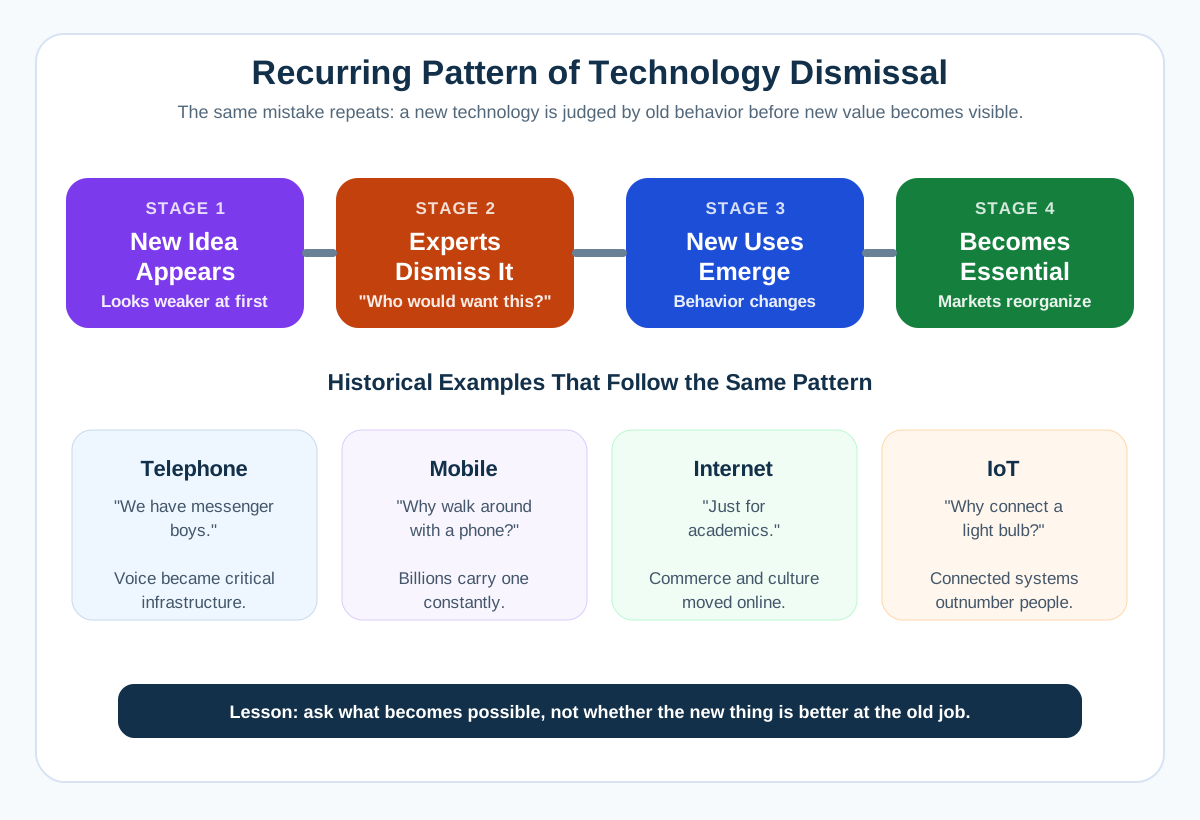
The figure’s telephone series needs particular care at 1890. A line count without a defined country and measure cannot establish adoption growth, even when its curve looks persuasive. The same rule applies to the source’s broader comparisons below: distinguish an illustrative question from a documented quotation and a dated adoption measure.
| Era | Illustrative dismissive question | Change or claim to examine |
|---|---|---|
| Telephone (1876) | “We have messenger boys.” | Instant voice communication became essential infrastructure. |
| Mobile (1983) | “Why walk with a phone?” | The source says 5+ billion people carry phones; the count needs a date and population definition. |
| Internet (1995) | “It’s just for academics.” | Global commerce, communication and culture changed. |
| Smartphones (2007) | “Who needs email on a phone?” | Smartphones became primary computing devices for billions. |
| IoT (2015+) | “Why connect a light bulb?” | The source’s 10-to-1 connected-device-to-person claim lacks a dated device definition and supporting count. |
The transferable lesson is to ask what becomes possible beyond the old job. It is not a rule that every dismissed technology becomes essential. In the team’s review, an expert may correctly identify cost or quality gaps while assuming users will keep behaving as they do now. A changed workflow challenges that assumption; evidence must still establish whether the workflow works.
Figure 2 places the attributed qualitative judgment beside adoption counts. It cannot measure a numeric forecast error because the quoted judgment supplies no numeric prediction.
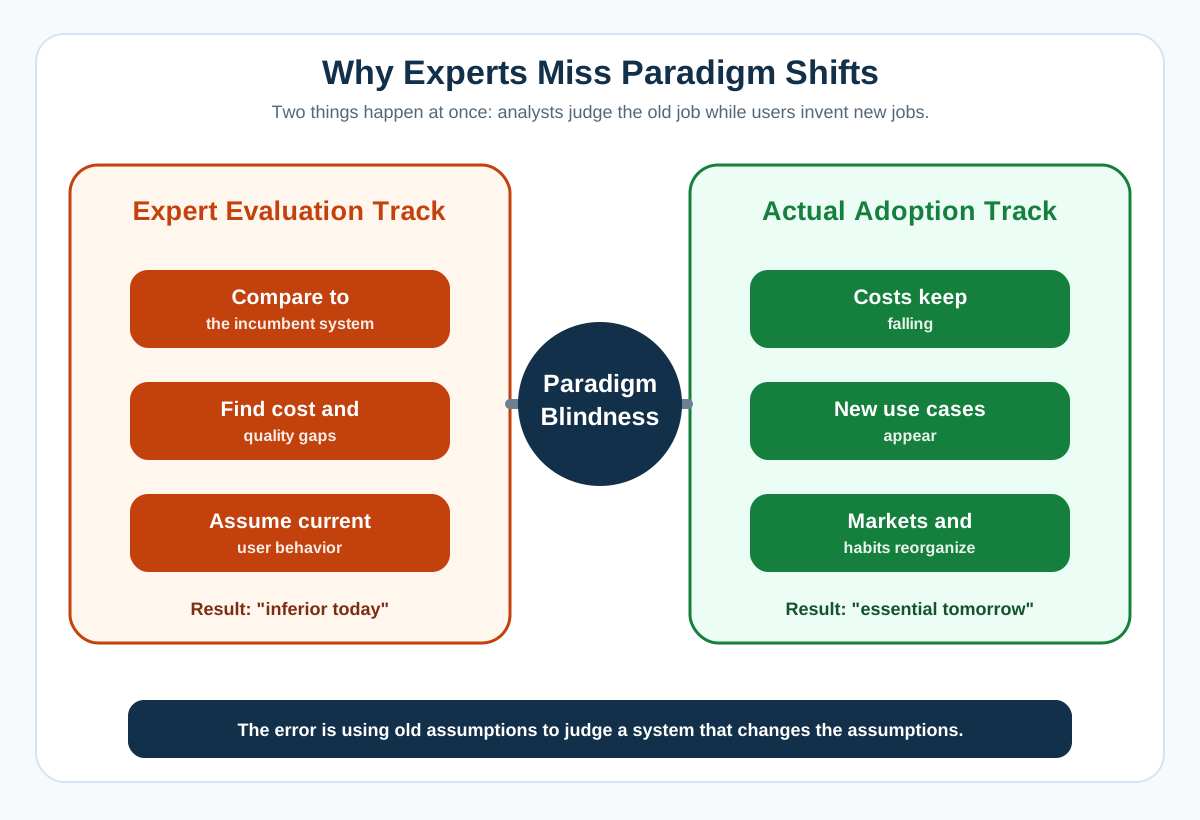
Conceptually, two readings start from the same technology. One uses existing metrics, finds cost and quality gaps, and calls it inferior. The other examines falling costs, emerging uses and reorganized habits, and may eventually call it essential. Paradigm blindness is the gap created when only the first reading informs the forecast. Neither a new workflow nor a historical success story settles the team’s decision: trace the changed behavior, the infrastructure it requires, and the evidence for each claim.
7.7 Summary
Communication history links new abilities to changed services. Telephony made conversation remote and synchronous; switching coordinated connections; transmission infrastructure carried them. Broadcasting, television, Bell Labs research and portable software show how physical signals, shared systems and useful applications developed together. Ownership and access rules helped determine what those systems could support.
The product team can use this history to examine an expert’s assumptions. A sound review asks what interaction changes, what makes it reliable, and what dated evidence supports the claim. An analogy suggests questions; it does not guarantee adoption or success.
Judge a connected proposal by the service it enables and the infrastructure it needs, then test the forecast against evidence with a defined date and measure.
Carry that review into IoT History: Adoption and Cost, beginning with The Anatomy of Paradigm Blindness.