34 IoT Pricing: Value Metrics
More
Depth: Practitioner
Progress saves as you read. Mark sections complete as you go; your progress appears in the sidebar.
- Podcast audio coming soon
- Character narration audio coming soon
34.1 Price the Ongoing Promise
IoT pricing connects a customer outcome to a measurable payment unit, then turns recurring cost, willingness to pay, and service limits into defensible tiers. The decision matters after the hardware ships: a sale that cannot fund years of service can fail both the customer and the provider.
Picture a farmer considering a connected water monitor. The hardware price looks fair, but the service also needs support, message delivery, repairs, and useful alerts for years. Start with the farmer’s decision: what result matters, how often is it delivered, and what happens when the service is late or unavailable? Then list the seller’s continuing costs and the risks each side carries.
The problem is choosing a payment measure the customer understands and the team can verify. A cheap first sale is insufficient evidence that the ongoing promise is affordable. Test the offer with a light user, a heavy user, a quiet month, a device failure, and a support call. The same plan should remain clear and able to fund safe service across those cases.
The approaches below connect price to service costs, choose a fair metric, and build an upgrade path. A camera example then makes conversion and customer value concrete before we examine metering. You will compare subscription, usage-based, transaction-fee, and freemium choices, and use revenue, margin, and retention evidence to evaluate them. Costs, behaviour, and competition change, so the first model needs review rather than false precision.
This chapter builds on IoT Business Model Fundamentals. It assumes percentages, basic financial ratios, revenue, margin, and pricing fundamentals.
KEY CONCEPTS
- Value metric
Payment follows a unit of customer benefit.
- Tiered pricing
Each buyer segment sees a reason to upgrade.
- Revenue and retention
Compare conversion, ARPU, cost, and lifetime value.
- Metering and entitlements
Measured usage must match the purchased service.
34.2 Part Objectives
- Test mvu: minimum viable understanding with a concrete scenario and pass criteria.
- Validate iot pricing basics with a concrete scenario and pass criteria.
34.3 Connect the Price to Continuing Service
For the farmer, buying the monitor begins a service relationship. Connectivity, cloud ingestion, storage, alerts, video retention where applicable, API calls, firmware updates, security support, warranty risk, and customer support can continue for years. A cost floor is the recurring cost the price must cover, including cloud, connectivity, support, warranty, billing, and compliance work.
The distinction is easier to see beside a regular toaster: its price covers making it plus a profit. A smart thermostat can learn habits, save energy each month, and improve through software updates. The price must account for continuing delivery of that value. For the farmer’s monitor, the same question applies to useful alerts and continuing support.
A good structure connects what the customer values to what the provider keeps running. A smart camera may charge for recording days and AI event detection. A fleet platform may charge by vehicle, driver, site, API usage, or compliance module. Industrial monitoring may charge by asset, line, plant, service-level agreement (SLA), or avoided downtime. An SLA states the service commitments being purchased.
These choices lead to different ways of collecting revenue. A subscription charges monthly for ongoing features; pay-per-use charges for measured consumption; freemium provides basic access free and charges for premium features. Transaction fees offer another revenue pattern to compare. The source examples below illustrate the distinction; their prices have no date or scope here and should not be treated as current quotations.
| Approach | Payment basis | Source example |
|---|---|---|
| Subscription | Monthly ongoing features | Ring Protect: $3/month for video recording |
| Pay-per-use | Units consumed | AWS IoT: $0.08 per million messages |
| Freemium | Free basic access, paid premium features | Fitbit: free tracking, $10/month for coaching |
A free tier is a commercial strategy: let people experience value, then show a paid benefit when their needs grow. Recognisable services such as Netflix and Spotify are prompts to compare offers, not evidence that all services share the same free-to-paid model. A convincing upgrade depends on the product’s actual benefits and service costs.
34.4 Choose a Metric That Preserves Useful Behaviour
With continuing costs visible, choose the value metric: the unit of payment that grows with customer benefit. Devices, homes, vehicles, sites, monitored assets, retained video days, API calls, active users, seats, messages, storage days, and work orders are possible units. The safest metric is understandable, hard to manipulate, and aligned with the outcome.
Charging by device can work when each device creates clear value and cost. Usage-based pricing charges per consumed unit, such as messages sent, devices connected, or API calls, allowing revenue to grow with customer usage. Message charging can suit developer platforms, but it can discourage health pings, safety telemetry, fault reporting, or diagnostic messages when customers fear surprise bills. For the farmer, reducing useful monitoring to avoid charges would undermine the service being bought.
Charging by site, SLA, or workflow module may fit enterprise buyers better than raw telemetry units. Unlimited video retention creates the opposite tension: storage cost can grow faster than revenue. A pricing gate should catch both hidden unlimited costs and incentives to suppress data that protects reliability.
Begin the review with customer segments. A home camera user may buy video history; a small retailer may buy incident review across stores. A multi-site franchise has different needs again. An enterprise security team may buy single sign-on (SSO), retention policy, audit export, support response time, and integration with ServiceNow, Splunk, or a security operations workflow. Similar devices do not imply identical outcomes or willingness to pay.
For each segment, name the paid result: fewer truck rolls, lower energy cost, faster compliance reporting, reduced downtime, or better occupancy planning. Map messages, storage, video minutes, API calls, firmware downloads, support contacts, and connectivity to cost. This gives a concrete basis for choosing limits rather than assuming an average customer represents everyone.
34.5 Make Tiers Explain the Upgrade
Once a metric matches the outcome, tiered pricing offers multiple price points, such as Basic, Pro, and Enterprise, for different customer segments and willingness to pay. The range can run from hobbyists exploring free access to enterprises purchasing SLAs and dedicated infrastructure. A single price may leave value uncaptured or exclude customers before they experience the service.
A practical ladder separates entry, growth, and enterprise use. Entry pricing proves the product and makes the upgrade path visible. Growth pricing scales with normal expansion while keeping gross margin positive. Enterprise pricing covers procurement, SSO, support response, uptime commitments, data residency, security review, and custom retention. These promises connect pricing to product architecture as well as sales.
The pricing ladder in Figure 1 connects each tier to customer maturity and the support it must fund.
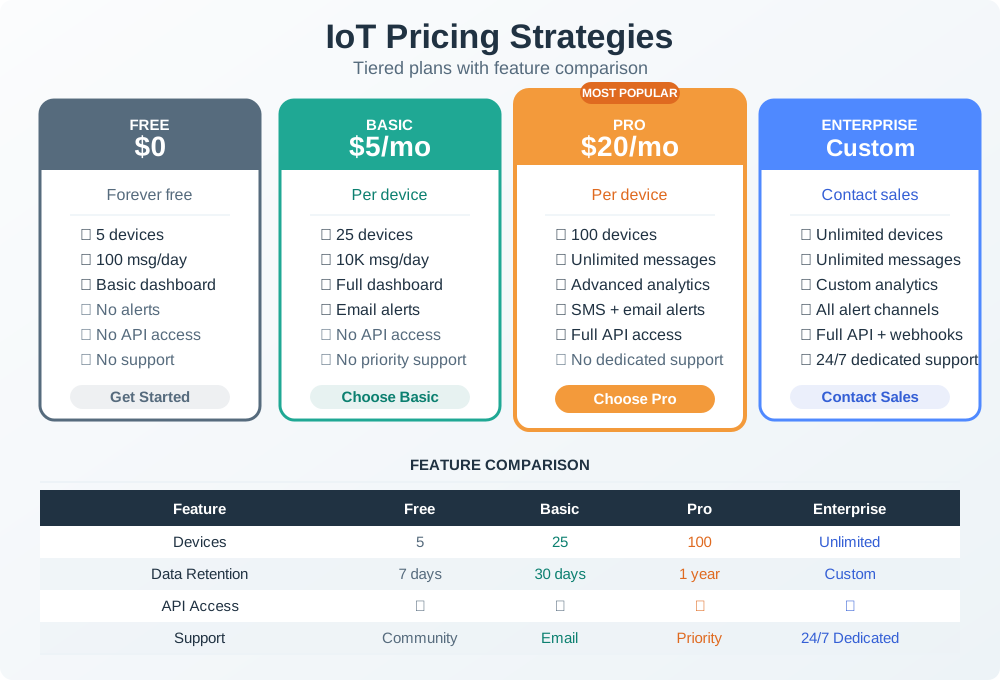
Read the ladder by customer maturity: an individual or small business, then a growing business, then a large organisation. Features and support must both follow those needs because support contributes to the cost floor. The source ladder places Basic at $0–10/month and Professional at $25–50/month, with tailored Enterprise commitments. These are illustrative bands, not a recommendation for every product.
| Tier | Buyer need | Example entitlement |
|---|---|---|
| Free/Basic | Beginners trying the service | Live camera feed without recordings |
| Pro | Growing businesses | Video history and smart alerts |
| Enterprise | Large companies | Custom features and 24/7 support |
An expansion path is the reason a customer upgrades as deployments grow, risk increases, or integrations become more valuable. Set fair limits for devices, users, sites, retention, API rate, SLA, and integrations so the reason is visible. If few Basic users upgrade, test a paid benefit tied to their needs and measure actual upgrades. Tier names or a higher bill alone do not establish added value.
Compare tiered and single-price offers using the same product cohort, conversion, average revenue, and margin. Any claimed uplift needs a named study. A plan should describe the customer’s journey and the service being funded, rather than merely increasing a feature count.
34.6 Put Revenue Beside Cost and Retention
The ladder now needs numbers. Average revenue per user (ARPU) is total revenue divided by the number of users in the stated population and period. Conversion rate is the percentage of free or lower-tier users who become paid or higher-tier users. Specify the population before comparing offers; free accounts are not recurring paid revenue.
Consider the security-camera company’s freemium example: 500K free users, 75K Basic users at $3/month, and 25K Premium users at $10/month. A first-pass revenue estimate of customer lifetime value (LTV) multiplies monthly revenue by lifetime in months. Over 24 months, Basic yields $3 × 24 = $72 per customer; Premium yields $10 × 24 = $240. These are lifetime revenue estimates before service costs.
Monthly recurring revenue (MRR) is (75K × $3) + (25K × $10) = $225K + $250K = $475K/month. Multiplying by 12 gives $5.7M in annual recurring revenue (ARR). Conversion across all users is 100K paid / 600K total (500K free + 100K paid) = 16.7%. Premium adoption is a different measure: 25K / 100K paid = 25%.
The source’s “typical 2–10%” freemium range has no dated benchmark scope, so it cannot establish that 16.7% is excellent. Conversion varies by product, acquisition channel, and definition of “paid.” Likewise, a 25% Premium share shows adoption, but does not by itself measure price elasticity, which requires evidence about response to price changes.
Before publishing tiers, estimate bill of materials support, cellular or low-power wide-area network (LPWAN) connectivity, cloud ingestion, database storage, event processing, notification delivery, customer support, payment fees, warranty reserve, and security maintenance. Compare gross margin, ARPU, churn, LTV, customer acquisition cost (CAC), CAC payback, and net revenue retention. Churn measures customer departures; revenue alone cannot show how profitably or how long a tier serves them.
For a contribution comparison, subtract monthly service cost from ARPU, then divide that monthly contribution by the churn fraction for a simple contribution LTV. Keep that cost-adjusted measure distinct from the camera example’s lifetime revenue. A higher subscription price alone cannot establish which tier contributes more over the customer’s lifetime.
34.7 Make the Invoice Match the Service
Revenue estimates depend on accurate measurement. Metering records billable usage; entitlements specify the features and limits a customer has purchased. Recurring IoT revenue depends on enforcing both consistently. Instrument billing with reliable measurements, invoice explanations, usage alerts, and dispute handling through Stripe Billing, Chargebee, Zuora, or an internal billing service.
Tier design shapes architecture. A free tier may limit retention, alert types, integrations, and API access. A professional tier may add webhook delivery, export jobs, SSO, or advanced analytics. Enterprise may add private networking, dedicated support, an uptime SLA, SAML/OIDC, SCIM provisioning, data residency, and contract-specific retention rules. Those identity and provisioning mechanisms become part of the purchased service.
The system needs durable customer, device, site, and plan identifiers, feature flags, quota counters, billing periods, usage events, and entitlement checks. Device management, the API gateway, message broker, storage pipeline, and billing service must agree on what the customer bought.
Design metering like a production data pipeline. Amazon Web Services (AWS) IoT Core, Azure IoT Hub, EMQX, Eclipse Mosquitto, Kafka, Kinesis, BigQuery, Snowflake, or Postgres can appear in different products; the billing event still needs stable meaning. Record customer id, device/site id, feature, unit, timestamp, source, and a deduplication key. State who owns the event, which plan applies, whether it is a retry or duplicate, and whether to bill it, ignore it, cap it, or show it only as operational telemetry.
Apply entitlement gates consistently across the app, API, broker, analytics jobs, and support tools. The app may display a Premium feature while the gateway enforces a quota, the broker allows a device to publish, analytics stores retained events, and billing invoices at month end. Different plan caches or customer identifiers produce entitlement bugs and invoice disputes.
Treat billing, identity, observability, and support tooling as one contract. Usage dashboards, threshold alerts, plan-change history, exportable invoices, and clear overage rules make that contract reviewable.
34.8 Test the Offer Against Failure Cases
Return to the farmer’s monitor with the metric, tiers, and metering contract in view. Review a light user, a heavy user, a quiet month, a failed device, and a support call. Record why a tier, recurring fee, usage charge, or one-time price fits the promised result. The test is whether customers understand the offer and the provider can continue delivering it safely.
Apply three gates to the draft. First, a heavy but legitimate customer should not become unprofitable because Free or Basic includes hidden unlimited costs. Second, a growing customer should see a reason to upgrade before a painful limit. Third, a support or security incident should not expose disagreement between billing, entitlement, and device records.
Surprise overage bills reduce trust; underpriced retention undermines margin. Charging for every diagnostic message can encourage customers to disable useful telemetry. Make costs visible while preserving the behaviours that keep the service healthy. The price must fund cloud, connectivity, support, warranty, billing, and compliance without rewarding less reliable monitoring.
These gates turn a pricing proposal into evidence that can be reviewed. They also connect cost-plus reasoning to customer value: calculate what continuing service costs, then test whether the benefit, limits, and upgrade path justify the offer to each segment.
Summary
A fair value metric connects payment to customer benefit and continuing service cost. Entry, growth, and enterprise tiers should explain who buys each promise, what limits apply, and why expansion warrants an upgrade. Conversion, ARPU, recurring revenue, margin, and retention provide different evidence; name the population and cost basis before comparing them.
The promise reaches the invoice through metering and consistent entitlements. Test heavy usage, growth, failures, and support incidents so the offer funds service and preserves useful monitoring.
Choose a payment unit customers can understand and the team can verify, then test whether every tier funds the ongoing promise.
Carry this evidence into IoT Pricing: Revenue Models, the next part on revenue models and selection.