18 IoT Perspectives: Role Lenses
More
Depth: Practitioner
Progress saves as you read. Mark sections complete as you go; your progress appears in the sidebar.
- Podcast audio coming soon
- Character narration audio coming soon
18.1 One Heating Service, Several Responsibilities
A connected heating service in a block of flats gives us one system to examine from several sides. A resident wants comfort, simple control, fair cost, and help after a fault. A building manager wants fewer faults. A supplier wants a service it can support. A security reviewer sees possible harm, while a regulator asks whether people are treated fairly. Each has a different responsibility, so each needs different evidence before calling the service successful.
A perspective is a view of a system shaped by a person’s needs, responsibilities, and risks. This chapter uses those views to find failure modes and turn disagreements into testable design questions. It assumes the basic sensor and connectivity concepts in IoT Introduction, including the Five Verbs; no programming or hardware experience is required. If the product boundary is unclear, Device Evolution distinguishes embedded, connected, and IoT products before you compare their stakeholders.
Keep that boundary fixed as you walk around the heating service. Include the device, local controls, online service, support team, and data use. Mark who pays, who can act, and who carries harm when something fails. A benefit for one group may create work or risk for another. Lower service cost, for example, cannot erase the owner’s duties to residents. Different descriptions of the service must still refer to the same physical and organizational system.
The resident may care who sees home data as much as whether the controls are easy. The operator needs clear state, fault notification, safe remote action, repair history, and a way to handle lost links. The owner wants fewer wasted visits, lower energy use, and known service costs. The maker must build and support the product, with stable parts, update paths, useful fault records, and an honest end-of-life plan. These needs overlap, but none is interchangeable with another.
Security review asks who can enter, who can act, what a stolen account can do, how access ends, and how recovery avoids more harm. Public-rule review asks about fairness, access, data purpose, retention, and complaint routes. A legal minimum may still leave poor service. Include residents with low vision, people without smart phones, repair staff, nearby people affected by the system, and those who cannot choose to leave. Each group also contains people who disagree; a role label does not give everyone equal power or one shared voice.
The problem is that a local success can conceal a system failure. “Easy control” for the resident needs clear state and recovery for the operator. “Useful data” for a sponsor needs permission and purpose for the people described by it. One group’s easy action may raise another group’s risk. Record disagreement rather than hiding it: list each view, link every claim to evidence, mark each conflict, name its owner, and set a review date. Keep affected people visible and change the design when harm outweighs value.
Now we can compare approaches: identify the failure each role notices, translate the concern into a measurable trade-off, and connect the evidence across layers. Keep one fault time, one device identity, and one action owner in the shared record. Different words must not create different truths.
KEY CONCEPTS
- Role lenses
Each role notices a different risk in the same system.
- Shared boundary
Keep devices, controls, services, support, and data use in view.
- Testable trade-offs
Name the protected risk, technical constraint, and acceptance condition.
- Decision evidence
Record the choice, rejected alternatives, owner, and follow-up evidence.
18.2 Learning Objectives
By the end of this chapter, you will be able to:
- Distinguish diverse IoT perspectives: Compare how different stakeholders — from security teams to makers to data scientists — prioritize different aspects of IoT systems
- Apply formal definitions: Use academic and industry definitions to classify whether a system qualifies as IoT
- Map the IoT ecosystem: Categorize IoT components across Hardware, Software, Network, Data, and Security layers
- Justify cross-functional collaboration: Explain why no single perspective is sufficient and apply structured conflict-resolution strategies to resolve design trade-offs
- Evaluate trade-offs: Assess the tensions between competing stakeholder priorities and propose balanced solutions
18.3 Each Role Sees a Different Failure Mode
Start with the people. IoT design becomes easier once each role is treated as a trained risk detector rather than as a competing opinion.
IoT perspective work is not about making every stakeholder happy. It is about finding the failure mode each role is trained to notice before a device reaches real users, installers, operators, or maintainers. A single connected product crosses physical sensing, embedded firmware, radio behavior, cloud services, data interpretation, security controls, support tooling, and human routines. Each role sees a different part of that system because each role is accountable for a different kind of damage.
A smart lock may look successful to a mobile-app team when setup is short, but a security engineer will ask about credential storage, ownership transfer, lockout recovery, and firmware update trust. A hardware engineer will ask whether BLE advertising, motor current, and cold-weather batteries still meet the service interval. A UX designer will ask whether a family member, landlord, guest, or technician can understand permission state without guessing. A support lead will ask what the user sees when the door, phone, bridge, and cloud disagree.
The same pattern appears in agriculture, healthcare, logistics, manufacturing, and smart homes. Dense telemetry can improve a model while draining a battery or exceeding LoRaWAN airtime. A cloud-only automation may be easy to analyze while failing a safety or local-operations requirement. A privacy-preserving design may protect users while reducing the data a business team hoped to monetize. The chapter’s central skill is therefore translation: turn “my perspective is right” into “which risk are we protecting, which layer creates the constraint, and what test proves the compromise is acceptable?”
- Security lens: identity, provisioning, encryption, update trust, access revocation, and abuse cases.
- Hardware lens: sensors, actuators, enclosure, antenna path, battery, thermal limits, and manufacturing tolerances.
- UX lens: setup, status clarity, accessibility, shared ownership, stale state, and recovery from partial failure.
The stakeholders in Figure 1 ask different questions of the same IoT system and use different measures of success.
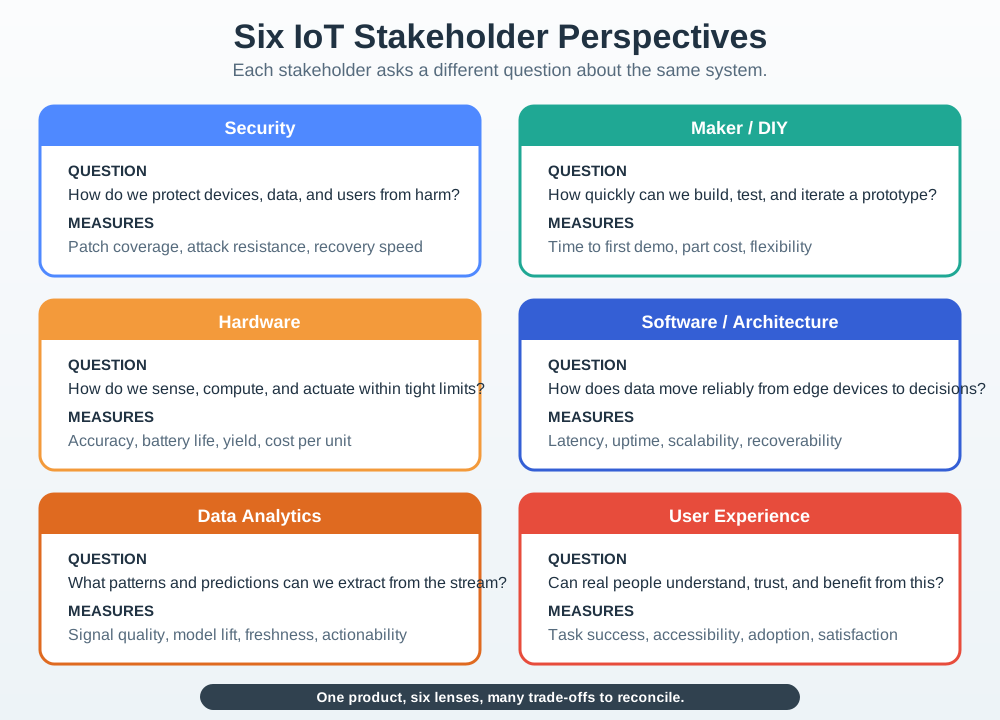
Read Figure 1 around the shared system. Security asks how people and assets are protected, using patching and detection evidence. The maker asks how quickly a working prototype can be built, while hardware focuses on physical accuracy, power, reliability, and unit cost. Architecture tests data flow at scale; analytics asks whether fresh data produces useful predictions; user experience measures whether people can complete the real task. None of those questions can stand in for another, so a product decision needs aligned evidence rather than one team’s local success metric.
The six lenses provide a practical vocabulary for that discussion. Security sees IoT through data protection and privacy: safeguarding connected devices and networks from unauthorized access, breaches, and cyber threats. Secure device authentication, encryption, and robust security protocols answer its question, “How do we protect this system and its users?” Its measures include vulnerabilities patched, encryption strength, and time to detect breaches. The Privacy and Security chapters examine these responsibilities in more depth.
The do-it-yourself (DIY), or maker, lens asks, “How quickly can I build something that works?” Affordable components and open-source platforms enable creativity and customization, from home automation to wearables. Time to first prototype, component cost, and community support are useful measures here. A working prototype demonstrates feasibility, while other roles still have their own questions to answer about the product.
Hardware engineers focus on physical sensors, actuators, and circuits that gather data and perform tasks. Their question is, “How do we sense, process, and actuate in the physical world?” Accuracy, power consumption, reliability, and unit cost measure this foundation. The enclosure, antenna path, thermal limits, and manufacturing tolerances belong in the review alongside the sensor and battery; software teams cannot treat them as invisible implementation details.
Architecture asks, “How does data flow from sensors to decisions at scale?” Scalable, efficient infrastructure connects devices, cloud systems, and users through protocols, middleware, and data management strategies. Latency, throughput, uptime, and scalability test whether those parts fit together. The IoT Architectures chapters develop the detailed architecture patterns behind that lens.
Data analytics asks, “What insights and predictions can we extract from the data?” Data streams support insight, prediction, and decisions through machine learning, AI, and visualization tools. Prediction accuracy, data freshness, and actionable insight rate measure the result. Those measures explain why a data scientist might request more samples, but they do not establish that the power, network, or privacy cost is acceptable.
User experience (UX) concerns the touch-points where people interact with connected systems across devices and modalities. Its question is, “How do real people actually use and benefit from this system?” Seamless, intuitive, accessible interaction needs evidence from task completion rate, user satisfaction, and accessibility compliance. Setup speed alone cannot show whether someone understands permission changes, stale state, shared ownership, or recovery from a partial failure.
The worked example below keeps one connected heating service fixed and asks two roles for different evidence. Security asks who can enter and act, what a stolen account can do, and how access and recovery are handled. UX asks whether a resident can complete simple control and whether status and recovery remain understandable.
Inspect Figure 2 from top to bottom. The system boundary stays the same: device, local controls, online service, support team, and data use. The same trace then branches into two review artifacts instead of two different versions of the system.
On the Security side, the audit log and security contract make identity, access, recovery, and update trust reviewable. The chapter’s Security metrics—vulnerabilities patched, encryption strength, and time to detect breaches—remain separate from the UX evidence. On the UX side, the resident’s simple-control task is checked with task completion rate, while user satisfaction and accessibility compliance provide additional UX evidence. The bottom strip is the translation rule from earlier in the chapter: the same fault should have one time, the same device one identity, and the same action one owner. Different roles can ask different questions without creating different truths.
Before accepting either review, compare the team figure in Part 2. Security protects identity and update trust; hardware constrains sensing, power, and radio behaviour; UX exposes state and recovery; operations sustains the result. The shared decision needs evidence from each responsibility, even when one role first identifies the problem.
18.4 Treehouse Roles Analogy
The treehouse analogy makes the division of responsibility easier to remember. A safety lead reduces risk, protects trust, and checks resilience, much like security. A builder balances materials, parts, power, cost, and feasibility, like hardware and makers. A planner makes the subsystems fit together, like architecture. An analyst measures performance and turns observations into useful insight, like data analytics. An experience designer makes the result usable and accessible, like UX.
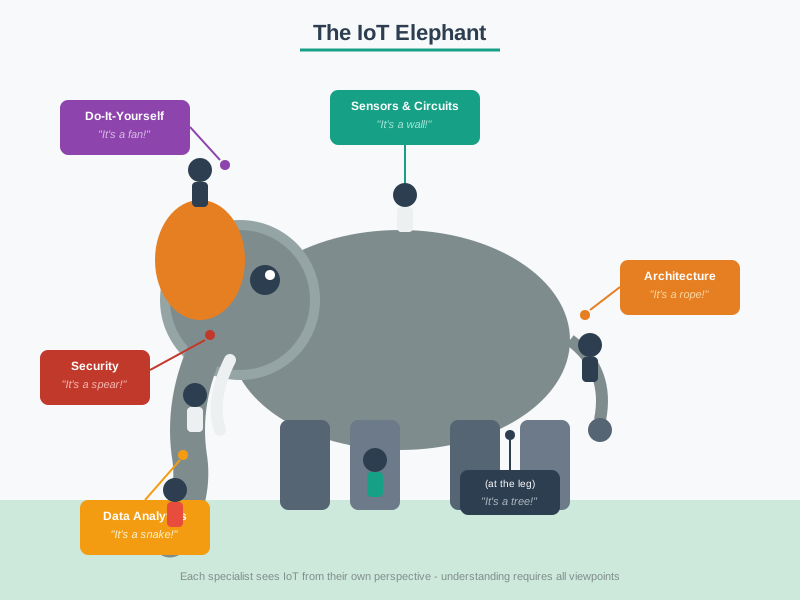
The analogy has a practical limit: each role must inform the others early. A highly secure system that people cannot use is still a bad design. A sleek interface with weak authentication is also a bad design. Like the story of blind people describing different parts of an elephant, each description captures part of the same whole. Successful IoT products require deliberate cross-functional collaboration because each design decision creates trade-offs across disciplines.
18.5 Make the Trade-Off Testable
The next move is to convert role tension into evidence. A team can argue about priorities forever, but it can test latency, battery life, retention, gateway capacity, recovery state, and ownership transfer.
A trade-off is a choice that balances competing requirements. A practical IoT team makes that choice testable. Instead of saying “security versus battery,” name the concrete path: TLS 1.3 or DTLS handshake cost, X.509 certificate storage, secure element use, wake interval, radio airtime, retry policy, and expected service life. Instead of saying “UX versus safety,” name the exact state where the user could misunderstand an unlocked, jammed, offline, shared, or remotely overridden device. Instead of saying “data wants more samples,” name the model feature, sampling interval, edge aggregation rule, network duty cycle, storage cost, and action threshold.
Transport Layer Security (TLS) and Datagram TLS (DTLS) protect communication paths; their handshake is the exchange that establishes a protected connection. An X.509 certificate records identity information used in authentication. A secure element protects sensitive keys in hardware. Over-the-air (OTA) updates deliver new firmware remotely. These names point to different pieces of the security path: measuring encryption alone does not measure wake time, radio use, or retries. Keep the full path in the service-life budget.
The same habit appears in the 2006 ubiquitous-computing research agenda: no one approach could carry the whole design problem. A theoretical perspective asks for models that describe system behaviour at several abstraction levels. An engineering perspective asks how large, heterogeneous, dynamic networks can be built and kept reliable. An experience perspective asks which interaction principles make the system socially acceptable and usable. Treat those as three review lenses, not as competing slogans.
Use the same discipline for data and architecture. A data scientist may want ten-second soil-moisture readings, but LoRaWAN airtime, gateway capacity, battery budget, ADR behavior, and regional duty-cycle regulations may push the design toward event-based reporting or edge aggregation. An industrial architect may reject a cloud-only alert path if supervisory control and data acquisition (SCADA), OPC UA, MQTT Sparkplug B, or a local HMI must remain usable during WAN loss. A privacy reviewer may accept occupancy analytics only if the design aggregates counts on-device, removes persistent identifiers, and documents retention and deletion behavior.
A decision record connects a design choice to its reasons and evidence. It should let another role understand both the selected option and its operating limits. Record the role concern, the design option selected, the rejected alternatives, the measurable acceptance condition, and the owner of follow-up evidence. For a smart lock, that might mean “use a secure element for private keys; require signed OTA updates; prove unlock latency remains under the product threshold; document account-transfer recovery; and run a usability test for shared-household permission changes.” For an agriculture node, it might mean “sample locally every minute, transmit hourly summaries plus threshold crossings, and prove the model still detects irrigation stress within the agronomic window.”
- Name the role concern. Identify which stakeholder risk is being protected: safety, battery life, model accuracy, usability, maintainability, or cost.
- Name the technical boundary. Point to the component, protocol, service, firmware state, or operating condition where the trade-off appears.
- Name the acceptance condition. Define what measurement, walkthrough, or field observation would make the compromise acceptable.
This is where IoT Requirements and Characteristics becomes useful: minimum requirements and ideal characteristics give the review something concrete to classify. Lessons from IoT History and Paradigm Shifts also help a team question its assumptions instead of treating an established role’s habits as proof. The goal is a compromise whose operating consequences can be checked by everyone affected.
The wearable example used by the Math Bridge lesson has a 180 mAh, 3.7 V battery: 0.666 Wh by nameplate. Its stated AES-256 overhead leaves 153 mAh and 5.95 days; ChaCha20 leaves 166.5 mAh and 6.48 days. These are the example’s allowances, not fixed costs of either algorithm. A 120 mA burst drops only 18–54 mV through the example cell. Three shelf months at 2.5% monthly self-discharge lose 7.31%, almost the whole ChaCha20 line item. Comparing those costs on the same pack makes the security–battery discussion concrete.
18.6 Connect the Evidence Across Layers
Most IoT disagreements are cross-layer problems. A “simple” user-facing command may touch a mobile app, BLE pairing, gateway translation, MQTT topic policy, cloud authorization, device firmware, actuator timing, local safety interlock, and support tooling. If one layer hides its assumptions, another role pays for the mistake later. For example, a mobile app may show “locked” because the cloud accepted a command, while the device is still retrying, the motor has stalled, the door sensor is inconsistent, or the local credential has expired. That is not merely a UI bug; it is a state-model disagreement across layers.
For the heating service, the shared record must connect what was requested, what the device reported, what the resident saw, and who owns the response. The same principle applies to the smart lock: acceptance by an online service cannot settle whether the physical mechanism acted. Review state, meaning, and operating support together before choosing the artifacts that will carry the evidence.
- State: Track command, device, network, and user-visible states separately so the interface does not claim certainty the system does not have.
- Semantics: Define units, timestamps, quality flags, ownership, and permission meaning before analytics or automation depend on them.
- Operations: Include logs, health checks, OTA status, support diagnostics, and manual fallback in the same discussion as product features.
Good perspective analysis therefore keeps the artifacts connected. A C4 context view can show system ownership. A sequence diagram can expose command timing and failure responses. A state machine can show pending, applied, rejected, expired, overridden, and rolled-back states. AsyncAPI, OpenAPI, Matter cluster definitions, OPC UA information models, or MQTT topic schemas can make integration assumptions explicit enough for several roles to review. Data contracts should define units, timestamps, identity, quality flags, retention, consent status, and authority for changing a field. Security contracts should define provisioning, key storage, authorization, audit logs, recovery, and OTA trust.
Under-the-hood evidence should make each perspective visible in the same trace. A command trace can show whether authorization, broker policy, device acknowledgement, actuator feedback, and user-visible state agree. A telemetry trace can show whether sampling, compression, timestamping, analytics, and alert ownership preserve meaning. A failure drill can show whether offline operation, stale data, credential revocation, and support diagnostics are understandable. When teams review the same trace, perspective conflict becomes engineering evidence instead of role preference.
18.7 Find a Compromise the Team Can Verify
Real IoT projects constantly navigate tensions between perspectives. The following diagram maps the most common conflicts:
Figure 3 names five conflicts that surface in almost every project, and pairs each one with a way out.
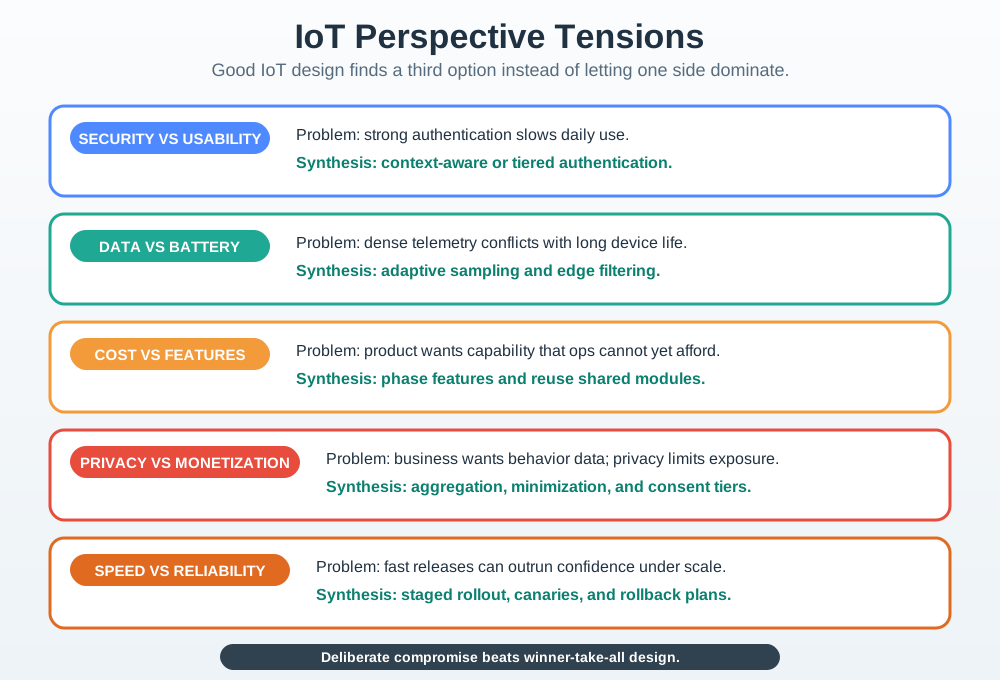
Every card carries the same two lines, and the second is the useful one. The first states a real conflict, such as dense telemetry against long battery life, or behaviour data against privacy limits. The second does not pick a winner. It names a technique that changes the shape of the problem instead: sampling that adapts to conditions, features released in phases, consent offered in tiers, releases staged behind a rollback. Read Figure 3 as a design habit rather than a table of answers. When two perspectives deadlock, the productive move is usually to look for the third option, not to decide which role outranks the other.
18.7.1 Read a Thermostat Through All Six Lenses
The source uses the Nest thermostat to illustrate these design tensions. Treat the following as a design example rather than a specification for every Nest model:
- Security: End-to-end TLS protects cloud communication, but adds firmware overhead.
- Hardware: A low-power ARM Cortex-M processor and motion sensor fit the enclosure and battery budget, but limit on-device machine learning.
- Data: Schedule learning and occupancy patterns improve automation, but raise privacy concerns.
- Architecture: Cloud-based learning with local fallback supports fleet improvement, but adds Wi-Fi and cloud dependency.
- UX: Minimal manual setup lowers friction, but some users may feel less in control.
- Maker ecosystem: OpenThread support illustrates how interoperability can increase compatibility testing; support depends on the thermostat model.
The example presents the final product as the result of hundreds of deliberate compromises between these perspectives. Return to the heating service with the same questions: which compromise protects the resident, which creates work for the operator, and what evidence lets the supplier support it? A single favorable metric cannot answer all three.
Use the Simulation Playground to explore interactive tools when testing a design assumption, or the Video Gallery for another visual explanation of the system. When reviewing the vocabulary, the Quiz Navigator provides a route to further practice. Keep the purpose of each resource tied to the decision: it should help explain a boundary, test a cost, or interpret evidence.
18.8 Summary
The heating service stays one system even when its residents, operators, owner, maker, security reviewer, and regulator describe it differently. Each view reveals needs and risks that another role may miss. Keep the device, local controls, online service, support team, and data use inside the same boundary, and include affected people who have little power to influence the design.
Turn each disagreement into a decision record: name the protected concern, the technical boundary, the selected option, rejected alternatives, measurable acceptance condition, evidence owner, and review date. Connect command state, physical feedback, data meaning, permissions, and support evidence so that one team’s successful test does not stand in for the whole system. Security, hardware, architecture, data, maker, and UX metrics each remain useful when the team understands what they actually measure.
Keep one system boundary and ask each role what could fail. Agree on the evidence that makes a compromise acceptable, then name who will obtain and review it.