24 IoT Project Failure: Promise and Context Risks
More
Depth: Practitioner
Progress saves as you read. Mark sections complete as you go; your progress appears in the sidebar.
- Podcast audio coming soon
- Character narration audio coming soon
24.1 Review the Pilot From Its Worst Monday
IoT project failure often begins with a mismatch between a product’s promise and the conditions in which people must use and support it. This chapter turns that mismatch into review questions before hardware and contracts make change expensive. Buying the device is like buying a car for a road trip: fuel, insurance, maintenance, and a backup plan for a closed road still matter. Ongoing costs, security, and changes to internal processes need the same attention.
A building pilot works during a guided tour. On Monday, two units are offline, a supplier has changed its terms, the installer has left, and a resident cannot remove old account data. None of those failures appears in the demo chart. The product owner must review the system as a service with people, costs, duties, and recovery.
Trace one useful outcome from the physical event to the person who acts. Record what depends on an outside company, a building link, a battery, a support worker, or a paid service. Put upkeep, replacement, data removal, and exit work beside the purchase price. Ask who can still act during an outage.
The problem is that a successful demonstration leaves these dependencies untested. The approaches below are to identify the mismatch, make its failure observable, and test the boundaries between layers. Together they establish a minimum viable understanding (MVU): enough understanding to name a concrete failure, its owner, and the evidence needed to accept the design.
KEY CONCEPTS
- Vendor lock-in
Dependence on one vendor's proprietary platform, protocol, or API makes switching expensive.
- Security neglect
Missing authentication, encryption, or firmware signing creates entry points for attackers.
- Alert fatigue
Excessive notifications desensitise users, who may ignore critical alerts or disable them all.
- Cloud dependency
Core functions stop during internet outages when there is no local processing fallback.
- Integration failure
Failure to connect to enterprise software causes duplicate data entry and disrupts workflows.
- Privacy overreach
Unnecessary personal data collection violates user trust and can breach regulatory requirements.
- Scalability gap
A pilot architecture fails at production load when backend infrastructure is under-designed.
24.2 Part Objectives
- Test minimum viable understanding (mvu) with a concrete scenario and pass criteria.
- Validate pitfalls hide at boundaries with a concrete scenario and pass criteria.
24.3 Identify the Mismatch
Return to the building’s Monday failures: each exposes an assumption about ownership, operating conditions, or support. That gives the review a more useful starting point than the demo’s device-uptime chart.
An IoT project usually fails when the product promise, the operating environment, and the support model do not match. A prototype may prove that a sensor can publish data, but the deployed system also needs commissioning, device identity, network recovery, firmware updates, user consent, data retention, alert handling, observability, service ownership, and end-of-life replacement. The mismatch appears when the surrounding system assumes deployment conditions will stay as tidy as the lab bench.
Figure 1 groups the recurring failures so you can see that they are all the same kind of mistake.
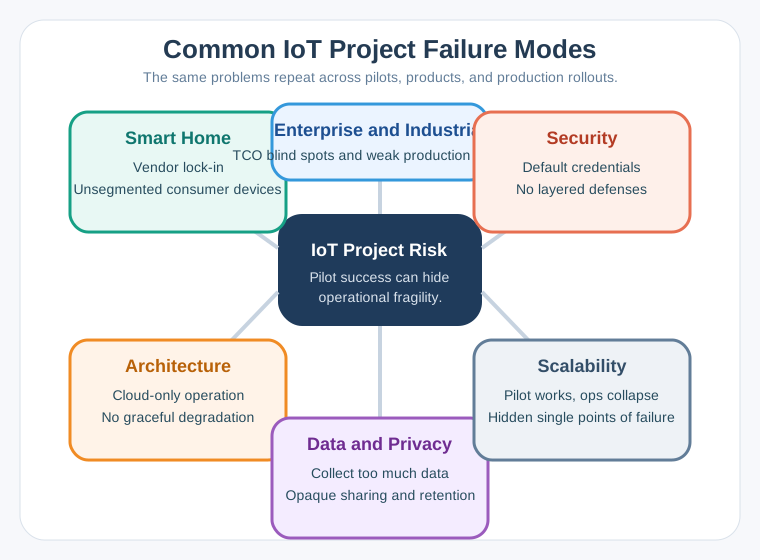
The hub of Figure 1 carries the line the rest of this chapter argues from: pilot success can hide operational fragility. Around it sit six categories, and each names a pair of symptoms rather than a technology. Smart home covers vendor lock-in and devices left on the main network. Enterprise and industrial covers blind spots in total cost and thin production planning. Security, architecture, data and scale follow the same shape. Each category points to an assumption that survived the pilot because it was small, watched and short. That is what makes this a map of mismatches.
Treat each pitfall as a mismatch between what the team assumed and what the system must survive. A smart-home device that depends on one vendor cloud has an ownership and interoperability risk. A factory sensor that cannot buffer data during WAN loss has an operations risk. A health or location product that collects more data than it needs has a privacy and trust risk. A city, retail, or logistics deployment that works only while a dashboard is open has an operational continuity risk, because the physical service still runs when the analytics view, broker, or API is unavailable.
- Lifecycle mismatch: The device ships without a funded plan for batteries, SIM contracts, certificates, patches for known vulnerabilities (CVEs), over-the-air (OTA) firmware rollback, spare parts, support scripts, or replacement.
- Environment mismatch: The design assumes clean Wi-Fi, stable power, dry enclosures, predictable radio coverage, or constant cloud reachability when the installation site does not provide them.
- Responsibility mismatch: Product, IT, security, operations, procurement, legal, and support teams do not agree who owns failures after installation.
- Evidence mismatch: The pilot measures device uptime but not false alerts, truck rolls, privacy exceptions, data-quality gaps, firmware rollback success, or operator recovery time.
A useful pitfall review therefore asks one question again and again: what assumption would make this system look successful during a demo but expensive, unsafe, or unusable in production? The answer might be a single-vendor API, a cellular plan that was never priced past month three, a shared device credential, an app workflow that hides queued commands, or a model that treats missing data as normal.
Ask who owns each part after launch. Who fits the device? Who keeps it current? Who answers a false warning? Who replaces a dead unit? Who pays the outside service? Who removes a former user? Who can export the useful record? Who can act when the supplier is gone? A blank owner is a design fault, not a future task.
Ask what the pilot did not face. Was the room warm and dry? Was the link strong? Did every user speak the test language? Did the team reset failed units by hand? Did the supplier watch the run? Was data removed only from the screen? Were costs paid from a trial budget? Name each gap before using the result elsewhere.
Before choosing a mitigation, keep three essentials in view. If you have only 10 minutes, these provide the minimum review. In the modeled 5-year example, hardware is about 25% of Total Cost of Ownership (TCO); connectivity, cloud, and maintenance dominate. The TCO table gives the calculation. Every IoT device is also a potential network entry point: segment devices onto a separate virtual local area network (VLAN), change default credentials, and keep firmware updated. Finally, connectivity will be lost, sensors will fail, and batteries will die. Graceful degradation means preserving the supported useful functions when part of the system fails.
For the building, prevent lock-in by checking interoperable devices and open standards alongside a documented export and working replacement path. A working phone app proves present operation; it does not establish portability after the supplier changes its service. For a factory sensor with a lost link, expose the fault, buffer records within capacity, and preserve supported local monitoring using fresh readings. Mark or block stale readings where they could drive an unsafe action.
24.4 Make Pitfalls Observable
Once the mismatch has a name, turn it into a condition the team can reproduce. The building review cannot predict every failure or five years of cost from one pilot; it can expose assumptions that need owners and tests.
A practical pitfall review turns vague risk into something the team can test. Do not write “security risk” or “connectivity risk” as standalone concerns. Name the mechanism: default credentials, missing certificate rotation, permissive MQTT topic access control lists (ACLs), cloud-only command paths, BLE commissioning failures, LoRaWAN airtime limits, NB-IoT coverage gaps, local storage exhaustion, unsigned firmware, or a device-management platform that cannot report update status. If the mechanism is not named, nobody can build a test, assign an owner, or budget the mitigation.
Run the review at three moments: before purchasing hardware, before pilot installation, and before production scale-up. At each point, require a small proof that the design survives the condition it claims to handle. For a smart-building deployment, prove that locks, thermostats, and occupancy sensors still follow the intended local policy during a WAN outage. For a factory gateway, prove that OPC UA or Modbus data keeps units, timestamps, quality flags, and asset ids intact when it is republished to MQTT or a historian. For a wearable, prove that the consent flow, deletion flow, and offline behavior are visible to support staff before the device leaves the pilot group.
- Trace the dependency. Follow one user or operator action across device firmware, gateway, broker, cloud service, database, dashboard, and support workflow.
- Break the weakest assumption. Test expired certificates, lost Wi-Fi, full local storage, low battery, broker outage, malformed sensor values, and failed OTA update download.
- Define the acceptable degraded state. Specify what stays local, what queues for later, what is blocked, what alert is raised, and what the user or operator is told.
The output should be an evidence table, not a general risk paragraph. Each row should name the pitfall, the trigger, the owner, the test command or field procedure, the expected telemetry, and the release decision. Example rows include “certificate expires on gateway,” “Matter bridge loses internet but local automations continue,” “battery voltage drops below the calibration range,” “field technician replaces a sensor and transfers ownership,” and “cloud ingestion is delayed for one hour.” This makes pitfall prevention reviewable in the same way as functional acceptance testing.
Then rehearse the awkward cases. Disconnect the outside service. Replace a failed unit. Remove a user. Change a supplier. Grow from ten sites to one hundred. Restore from a saved record. Check whether the team can recover, explain cost, preserve consent, and move essential data without inventing a new process during the incident.
Run a full outage day. Let local safe work continue. Make missing remote state visible. Queue only work that is still useful later. Restore in a controlled order. Check for old commands, repeat alerts, wrong time, and a rush of stored work. Make support solve the issue from the normal record, without a developer whispering the answer.
Run a change day too. Replace one unit with a new model. Move one user to a new role. Change a paid service. Rotate a secret. Correct a past record. Remove consent. Check every copy and hand-off. The system should show what changed, who approved it, and which old state is no longer trusted.
Price the work people tend to omit. Include fitting, training, service calls, power, data plans, damaged parts, returns, security review, removal, and exit. Use measured trial rates where they exist. Keep ranges where they do not. Show which assumption drives the result. A neat total is weak if no one can change the inputs.
End with a release claim small enough to defend. State the sites, users, dates, load, failures, and outside services tested. State the gaps. Set a trigger for another review. A pilot becomes useful when it reveals what must be owned next, not when its best day is treated as the future.
This is the first of two parts: the evidence prepared here supports the next part’s vendor, cost, scaling, and resilience decisions. The wider route includes a 5-year TCO framework, watchdog timers, plausibility checks, and an 18-point checklist with quizzes and an audit exercise. Defense-in-depth means using protection across layers; the security and redesign route connects it to privacy, power, connectivity, user-interface choices, and the IoT Redesign Framework for adding connectivity to everyday objects.
24.5 Test Where Layers Meet
An observable fault still needs an explanation of which hand-off failed. Follow the building’s record across identity, data, and control before accepting a reassuring screen.
The hardest IoT failures appear where layers meet. A device may use TLS correctly but still be unsafe if every unit shares one certificate. A gateway may translate Modbus or OPC UA data into MQTT, but analytics can still fail if timestamps, units, quality flags, and retained-message behavior are inconsistent. A mobile app may show a friendly success screen even though the device command is only queued and has not reached the actuator. A fleet dashboard may report “online” because the broker connection is alive while the sensor is stuck, uncalibrated, or publishing stale retained values.
Good architecture makes those boundary assumptions explicit. Use per-device identity, least-privilege broker topics, signed firmware, rollback states, health telemetry, idempotent cloud APIs (safe to repeat without duplicate effects), time-series retention policies, and clear data-classification rules. For industrial systems, separate safety interlocks from cloud automation so a dashboard outage cannot create an unsafe physical state. For consumer and workplace systems, keep local control and privacy state visible so a product does not become unusable when the vendor API, mobile app, or subscription path changes.
- Identity boundary: Provision unique credentials, rotate or revoke them, and record ownership transfer without exposing shared secrets.
- Data boundary: Preserve units, timestamps, calibration status, and quality codes before data enters dashboards or machine-learning pipelines.
- Control boundary: Keep command acknowledgement, actuator completion, manual override, and rollback as separate states.
Implementation details matter because many pitfalls are created by “almost right” integrations. MQTT retained messages need a freshness policy. OPC UA nodes need stable namespace ownership. Time-series tables need a schema for nulls, late data, and corrected samples. OTA systems need signed artifacts, staged rollout cohorts, rollback markers, and a way to prove which firmware is actually running. Privacy controls need data minimization, role-based access, deletion workflows, audit logs, and retention limits that match the product promise. These are not polish items; they are the controls that stop small mismatches from becoming support failures, compliance incidents, or unsafe automation.
An ACL restricts permitted actions; restricting broker topics puts least privilege at the message boundary. These controls give the reviewer evidence about identity, data, and control rather than a single undifferentiated “online” state.
The same distinction matters outside the building. A clinic app that stores identifiable patient records in a vendor cloud needs a privacy, retention, and consent review across that cloud path even when its device already buffers safely during a WAN outage. Fixing continuity does not settle the data responsibilities.
Summary
IoT projects fail when the product promise, operating environment, and support model do not match. The building’s worst Monday reveals dependencies a guided tour can hide: offline units, changing supplier terms, missing support ownership, and incomplete data removal.
A review makes those risks testable by naming the mechanism, trigger, owner, procedure, expected telemetry, and release decision. Repeat it before hardware purchase, pilot installation, and production scale-up. Keep identity, data quality, command acknowledgement, actuator completion, and rollback separate enough to check. The result is a release claim grounded in the conditions actually tested.
Trace the promised outcome to the person who acts, break the weakest assumption, and require evidence that the agreed fallback works.
Carry this evidence into IoT Project Failure: Cost and Resilience Risks to price the dependencies and plan for production failures.