25 IoT Project Failure: Cost and Resilience Risks
More
Depth: Practitioner
Progress saves as you read. Mark sections complete as you go; your progress appears in the sidebar.
- Podcast audio coming soon
- Character narration audio coming soon
25.1 Review Ownership Before Deployment
A working IoT device is only the start of a working service. This chapter examines costs and resilience risks: the dependencies, recurring bills, and failure responses that decide whether a deployment remains useful after launch. It continues IoT Project Failure: Promise and Context Risks, moving from the initial promise to the obligations of ownership.
Start with the smart home already in view. Lights, locks, and cameras may each work through their own app, yet the homeowner cannot combine them into one automation. A thermostat may depend on a vendor cloud that later disappears. Connecting these devices beside laptops and phones with sensitive data adds another risk: a compromised device has a route toward the rest of the home network.
The same problem grows in a factory’s 1,000-sensor deployment. Buying and installing sensors does not pay for five years of connectivity, cloud services, maintenance, or replacement. A successful lab demonstration also leaves unanswered what happens when a link fails or thousands of devices transmit together. Many projects stall between prototype, pilot, and production because these obligations were never tested or funded.
The problem is to prove continued operation, rather than just initial functionality. Now consider the approaches: preserve an exit from the vendor, isolate devices, calculate lifetime costs, plan failure responses, and validate scale. The IoT Introduction explains the starting value proposition; IoT Requirements and Characteristics helps turn it into minimum requirements. Application Domains supplies examples for applying the same review elsewhere.
KEY CONCEPTS
- Vendor independence
Preserve local control and a path to another platform.
- Network isolation
Limit access from compromised devices.
- Lifetime cost
Fund acquisition, operations, and replacement.
- Failure response
Keep core functions safe and notify operators.
- Production scale
Test concurrency before expanding the fleet.
25.2 Learning Objectives
- Define related chapters and resources with explicit inputs, errors, and change rules.
- Validate iot total cost of ownership with a concrete scenario and pass criteria.
25.3 Preserve an Exit From the Vendor
Vendor lock-in is dependence on one supplier that makes switching difficult or expensive. In a smart home, choosing features without checking interoperability can leave devices unable to communicate across brands. Warning signs include automations that cannot accept another manufacturer’s device, migration costs exceeding the original investment, and duplicate hubs and apps: one for lights, another for locks, another for cameras. The whole home may stop working when a vendor discontinues its cloud service or goes out of business.
This dependency has understandable causes. Vendors benefit from recurring subscriptions and accessory sales, while early adopters prioritized features over standards. Proprietary approaches, including early Zigbee implementations and vendor-specific Wi-Fi integrations, created incompatible ecosystems. A device’s attractive feature list says little about how it will work after a platform change.
Prioritize open standards such as Matter and Thread, and documented local application programming interfaces (APIs), which let software access a device locally. Choose platforms with strong third-party integrations, such as Home Assistant, Apple HomeKit, or Google Home with Matter. Verify local control and operation without the vendor cloud rather than assuming that a familiar brand or voice assistant supplies them.
Before purchasing, check Matter support or documented local APIs. Prefer locally stored automations over rules that require cloud connectivity. Maintain an inventory of device protocols and check each new purchase against the existing infrastructure. These checks make the exit cost visible while there is still a choice.
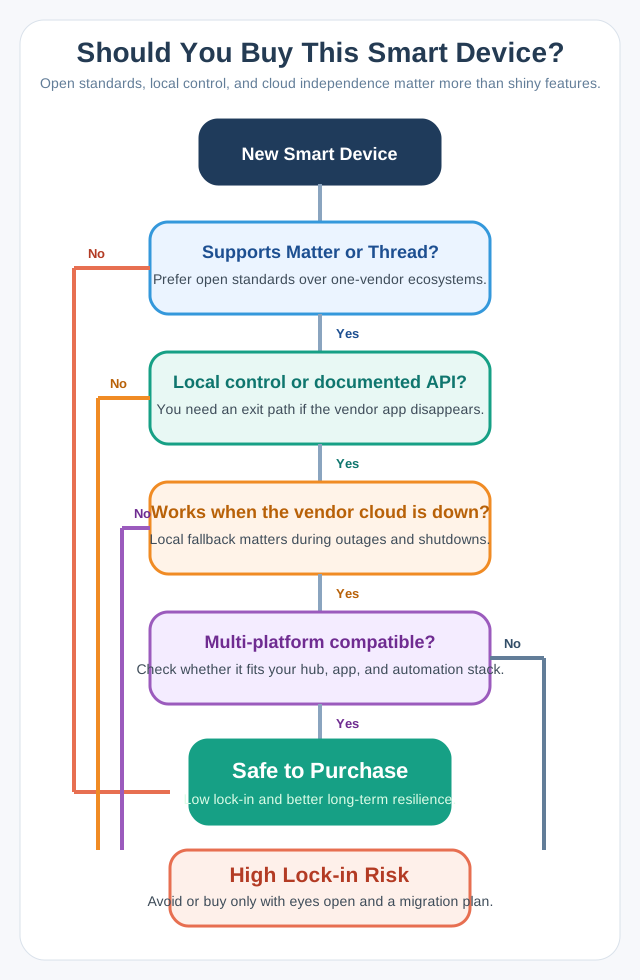
Work through Figure 1 as an exit review. Open-standard support asks whether the device can join another ecosystem. A local interface asks what remains available if the vendor app is withdrawn. Cloud independence asks what survives an outage. The final check asks whether the device fits the hub and automations already running. A failed check calls for a migration plan; it does not automatically forbid purchase. The thermostat example clears all four checks before being marked safe to purchase.
25.4 Isolate Devices and Maintain Their Defenses
Vendor independence does not protect the rest of the home network. Connecting dozens of devices without segmentation, leaving default passwords in place, and neglecting firmware creates multiple entry points for attackers. Look for factory credentials such as admin/admin, devices sharing a network segment with sensitive computers, unknown outbound servers, and firmware years out of date with known vulnerabilities.
Convenience often wins during setup. Many devices lack automatic updates, and home routers may not support segmentation by default. The assumption that “it is just a light bulb” overlooks the device’s network access. In 2016, the Mirai botnet compromised over 600,000 IoT devices, primarily cameras and routers with default passwords. It launched a distributed denial-of-service (DDoS) attack that disrupted major websites including Twitter, Netflix, and Reddit. Factory credentials on neglected devices made that attack possible.
Create a separate virtual local area network (VLAN) or an isolated guest network for IoT devices. Change default passwords immediately after setup. Enable automatic firmware updates where available and schedule monthly manual checks otherwise. A router or firewall with traffic monitoring can expose anomalous communication. Network isolation limits movement from a compromised device toward private laptops and phones; updates still matter within that boundary.
Research security before purchase: does the device support HTTPS, does the vendor have a security disclosure policy, and how long will updates continue? Block device-initiated internet connections unless core functionality requires them. Consider a dedicated IoT security gateway to monitor botnet activity and unauthorized communication. Security Threats develops the threat categories, while Network Topologies explains structure and isolation trade-offs.
Smart-home failures make ownership concrete. In enterprise systems, the same review must also expose recurring costs and the behavior of a much larger fleet.
25.5 Fund Five Years of Operation
Total cost of ownership (TCO) combines acquisition with the costs of operating and eventually replacing a system. Budgeting only for devices ignores connectivity, maintenance, security updates, cloud services, and replacement. Projects then run out of money before deployment finishes, lack monitoring funds, discover vulnerabilities without a patch budget, or reach device end-of-life without a replacement plan.
Hardware is visible and easy to quote. Software, connectivity, and maintenance are less visible, and vendors may quote devices without ecosystem costs. A deployment-focused budget therefore needs a five-year operating view. Capital expenditure (CapEx) covers devices, installation, integration, and platform setup. Operating expenditure (OpEx) covers connectivity, cloud services, maintenance, security updates, and staff. Replacement planning covers end-of-life, typically at 5–7 years for IoT devices in this planning framework.
25.6 IoT Total Cost of Ownership
For the 1,000-sensor example, keep the first year separate from the four later years. This prevents recurring costs from disappearing behind a single deployment total.
| Cost | Year 1 | Years 2–5 combined | Five-year total |
|---|---|---|---|
| Devices | $50,000 | $0 | $50,000 |
| Installation | $25,000 | $0 | $25,000 |
| Connectivity | $12,000 | $48,000 | $60,000 |
| Cloud services | $8,000 | $32,000 | $40,000 |
| Maintenance | $5,000 | $20,000 | $25,000 |
| Total | $100,000 | $100,000 | $200,000 |
Annual operations are $12,000 + $8,000 + $5,000 = $25,000. Five-year TCO is therefore $100,000 in Year 1 plus four years at $25,000, giving $200,000. Devices account for $50,000 / $200,000 = 25%. The $100,000 of Years 2–5 OpEx exceeds the initial $75,000 capital spend.
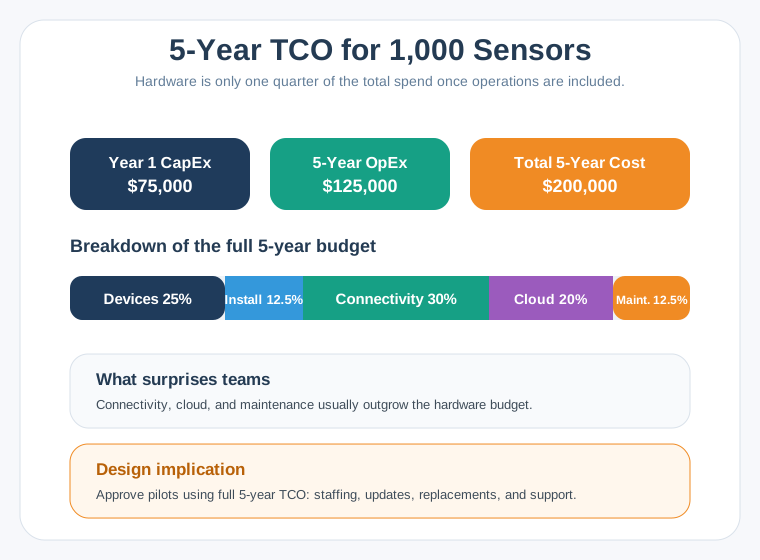
Figure 2 separates the shares: connectivity is 30%, devices 25%, cloud services 20%, and installation and maintenance 12.5% each. Devices and installation form $75,000 of CapEx. Five-year OpEx is $125,000, or 62.5% of TCO, including $25,000 in the first year. The non-hardware $150,000 (75%) includes installation and all five years of operations. It is not all spending deferred until Years 2–5.
Calculate five-year TCO before approval. The chapter’s planning allowances are $10–30 per device per year for connectivity and 15–20% annually for maintenance, with replacement at years 5–7. Keep those allowances distinct from the worked example’s explicit inputs. A hardware-only budget leaves no funding for ongoing service and can fail by Year 2. The 25% hardware share describes this example; use a cost breakdown rather than treating it as a universal rule.
25.7 Interactive TCO Calculator
25.8 Decide What Happens When Something Fails
Funding operation is useful only if the system can survive ordinary disruptions. Ideal-condition testing misses network outages, sensor failures, extreme weather, and adversarial inputs. Symptoms include silent failure when connectivity disappears, no alert for impossible readings, actuators left in dangerous states after partial failure, and security breaches through unexpected input handling.
These gaps arise because development networks are reliable, schedules are rushed, and supposedly rare cases are deferred. Security testing also needs skills that a development team may lack. Make failure responses explicit before deployment. Graceful degradation means continuing core functions when the cloud is unreachable. Watchdog timers detect missing heartbeats and trigger a reset into a safe state. Plausibility checks reject values outside physical limits, such as an indoor sensor reporting a temperature above 200 °C. Secure defaults deny access on failure rather than allowing it; the actuator’s safe physical state still needs an explicit decision.
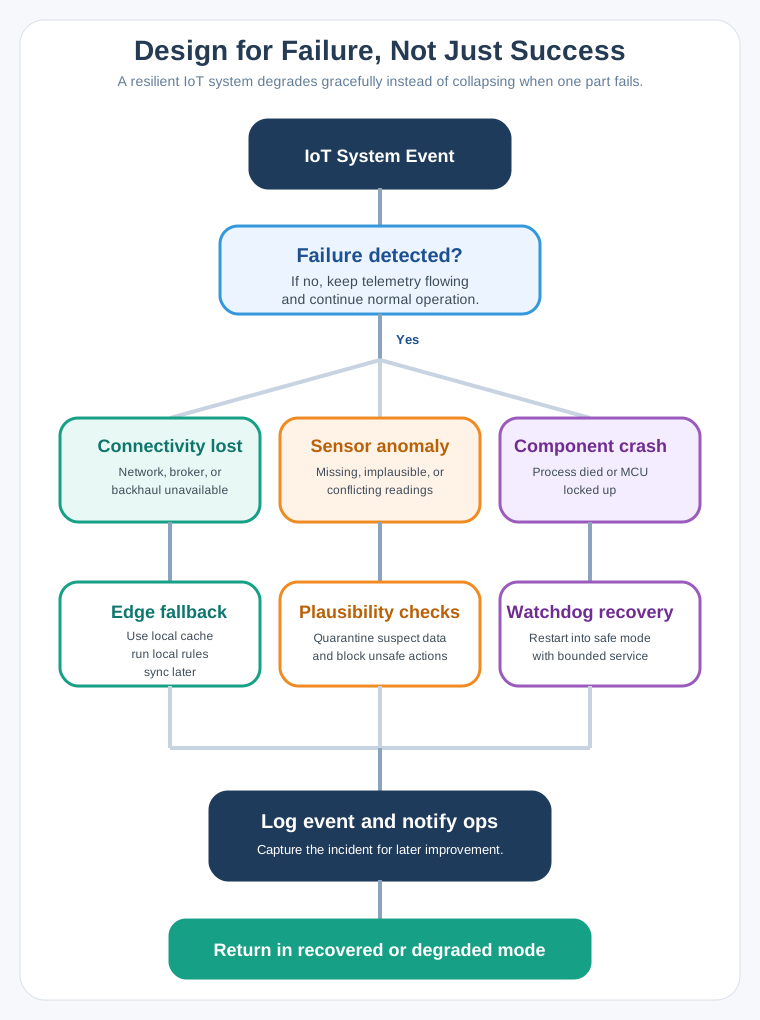
Follow Figure 3 from detection to response. If no failure is detected, normal telemetry continues. A lost link calls for edge processing, local cache, and local rules. Implausible data calls for plausibility checks, quarantine, and blocked actions. A crashed component calls for a watchdog restart into a bounded safe mode. Each path converges on event logging and operator notification before service returns recovered or degraded. Failure detection must be cheap enough to run in the telemetry hot path.
Create a failure mode and effects analysis (FMEA) for every IoT component, reviewing its failure modes and their consequences. Test network failures explicitly, include security testing in every sprint, and conduct chaos engineering exercises in staging by randomly stopping components. Use Threat Modeling for structured failure and attack analysis. The point of these exercises is to observe whether the planned response actually occurs.
25.9 Prove the Fleet Can Run at Production Scale
A safe response on one device still needs to work across the fleet. A bench prototype with 5 devices does not prove readiness for 5,000. Connectivity contention, certificate management, data pipeline throughput, and operational monitoring change with scale. Production symptoms include intermittent failures, Wi-Fi channel saturation, cloud ingestion overload, and no remote way to diagnose or update deployed devices.
Prototypes demonstrate functionality on lightly loaded networks. Sequential lab tests miss devices transmitting concurrently. Manual provisioning that works for 5 devices can become a bottleneck for 5,000; plan programmatic onboarding, as the AWS IoT Lens preparation guidance describes. Provisioning, monitoring, and update infrastructure belong in the production plan from the start.
Calculate messages per second at full deployment and stress-test the pipeline at 2x expected load. Automate onboarding with zero-touch provisioning and certificate-based authentication. Design for observability, the ability to diagnose operation from reported evidence: every device should report battery, signal strength, uptime, and error counts. Roll out in waves of 10%, 30%, 60%, and 100%, validating each stage before expanding.
Make scalability testing a project gate, budget for a device management platform from day one, and use load-testing tools that simulate thousands of concurrent MQTT/HTTP connections. Together, capacity tests and staged rollout expose shared limits before the whole fleet depends on them.
Summary
A sustainable deployment needs an exit from vendor dependencies, isolated networks, funded operations, planned failure responses, and evidence of production capacity. For the 1,000-sensor example, $100,000 in Year 1 plus $100,000 in Years 2–5 gives $200,000 TCO. Hardware represents 25%; connectivity, cloud services, installation, and maintenance account for the rest.
Local control, firmware maintenance, plausibility checks, watchdogs, and staged rollout turn ownership risks into decisions that can be tested. Use the applications module index to apply these questions to another deployment.
Approve the cost and behavior of the service over its lifetime: what keeps working, who pays for operation, and what evidence shows it can recover and scale.