22 IoT Requirements: Connectivity Costs and Trade-Offs
More
Depth: Practitioner
Progress saves as you read. Mark sections complete as you go; your progress appears in the sidebar.
- Podcast audio coming soon
- Character narration audio coming soon
22.1 Choose for the Whole Service Life
Two radios can meet the same connectivity requirement while creating very different ownership costs. This chapter compares five-year costs, turns a battery-life claim into a current budget, and uses eleven design characteristics to make priorities explicit without hiding mandatory requirements.
A warehouse team has narrowed its choices to cellular and LoRaWAN. Purchase price makes one look cheaper, but the team must also count subscriptions, gateways, installation, maintenance and battery replacement. Its pharmaceutical-storage sensors need to report often enough to warn of temperature drift. The problem is deciding what “meets the requirement” means over the deployment’s life, rather than at purchase.
Start with the boundary established in IoT Requirements: Classification and Connectivity: a locally connected product needs an internet path, directly or through a gateway, to form an IoT system. Then compare the full costs, test the power assumptions, and decide which characteristics deserve the most engineering effort. The same reasoning will later help compare two commercial thermostat products.
KEY CONCEPTS
- Lifetime cost
Compare hardware, installation and operations over the same horizon.
- Battery budget
Turn years of service into an allowable average current.
- Design priorities
Choose the characteristics that serve the application.
- Enabling qualities
Check which capability must exist before another can work.
22.2 Part Objectives
- Calculate five-year TCO for cellular and LoRaWAN sensor fleets.
- Score ideal IoT characteristics without hiding mandatory requirements.
22.3 Compare Costs at the Same Scale
Total cost of ownership (TCO) adds hardware, installation and operations over the same service life. For the warehouse’s 50-sensor deployment, use a five-year horizon. Comparing only radio prices or monthly subscriptions would leave part of the decision out.
| Five-year cost | Cellular, 50 sensors | LoRaWAN, 50 sensors | Cellular, 1,000 sensors | LoRaWAN, 1,000 sensors |
|---|---|---|---|---|
| Hardware | $18K | $16K | $360K | $320K |
| Installation | $12K | $3K | $240K | $20K |
| Operations | $25K | $15K | $500K | $300K |
| Total | $55K | $34K | $1.1M | $640K |
For 50 sensors, the saving is ($55K − $34K) / $55K = 38%, rounded. At 1,000 sensors, the gap widens to about 42% savings. The larger deployment has its own installation estimates; do not multiply every 50-sensor row by twenty and assume that reproduces the larger case.
In this example, lower operational costs, ten-year batteries and no SIM management support LoRaWAN’s return on investment despite the initial gateway investment. Treat ten-year battery life and $15K avoided power infrastructure as assumptions for the 50-sensor example. Validate radio load, temperature and installation costs before treating the savings as evidence for procurement.
The reporting interval belongs in that validation. Pharmaceutical-storage temperatures can change over hours rather than seconds, and refrigeration systems have thermal mass, so temperature drift can be slow. The example assumes a 10-minute interval gives ample warning and refers to an hourly regulatory check. That hourly claim is not tied to a named regulation in the source; establish the applicable requirement before relying on it. The stated reporting comparison is 1,051,200 readings/year versus 52,560, illustrating the extra data produced by more frequent reporting.
The warehouse case also assumes one LoRaWAN gateway covers the whole warehouse, good signal penetration through metal racking, and a dedicated IoT network isolated from business Wi-Fi. It contrasts this with a dense deployment of Wi-Fi access points. These are conditions to validate at the site, alongside power and installation costs. They explain why this warehouse might prefer LoRaWAN; a radio label alone does not establish coverage or lifetime.
22.4 Turn Battery Life into a Testable Budget
The warehouse’s cost advantage depends partly on avoiding maintenance visits. A “10-year battery” claim therefore needs a current budget and measurements, rather than acceptance from the cell’s nameplate capacity.
Phoebe’s field note gives the scale of that budget. A 2400 mAh cell retaining 99% per year, with a 15% reserve, leaves about 1850 mAh after ten years. Spread across that lifetime, it allows only 21.1 microamps of average current. A 300 ms, 45 mA uplink every ten minutes, plus 1.5 microamps of sleep current, already averages 24.0 microamps. The pulse also loses 0.675 V through 15 ohms. Average consumption and pulse behaviour both matter to the battery requirement.
These numbers make the decision concrete: the example’s communication schedule already exceeds its average-current allowance. A ten-year target is a measurement contract covering retention, reserve, duty cycle and pulse sag. It cannot be justified by nominal capacity alone. Use the separate Math Bridge to work through Bex’s conversion from years to current before accepting the maintenance assumption in the TCO comparison.
With cost and power assumptions visible, check the connectivity boundary as well as the arithmetic. Bluetooth-only communication can connect a tracker to a phone without giving the combined system an internet path; forwarding through that phone changes the system boundary.
22.5 Give the Eleven Characteristics a Purpose
Cost and battery life do not settle whether a system is good enough for its domain. The eleven characteristics describe design goals for engineers, designers and product managers. Read them in four families: three concern user experience, three concern intelligence and adaptation, two concern trust and performance, and three concern operating the fleet after launch. That grouping exposes an imbalance when a project discusses user experience but never says who replaces the batteries.
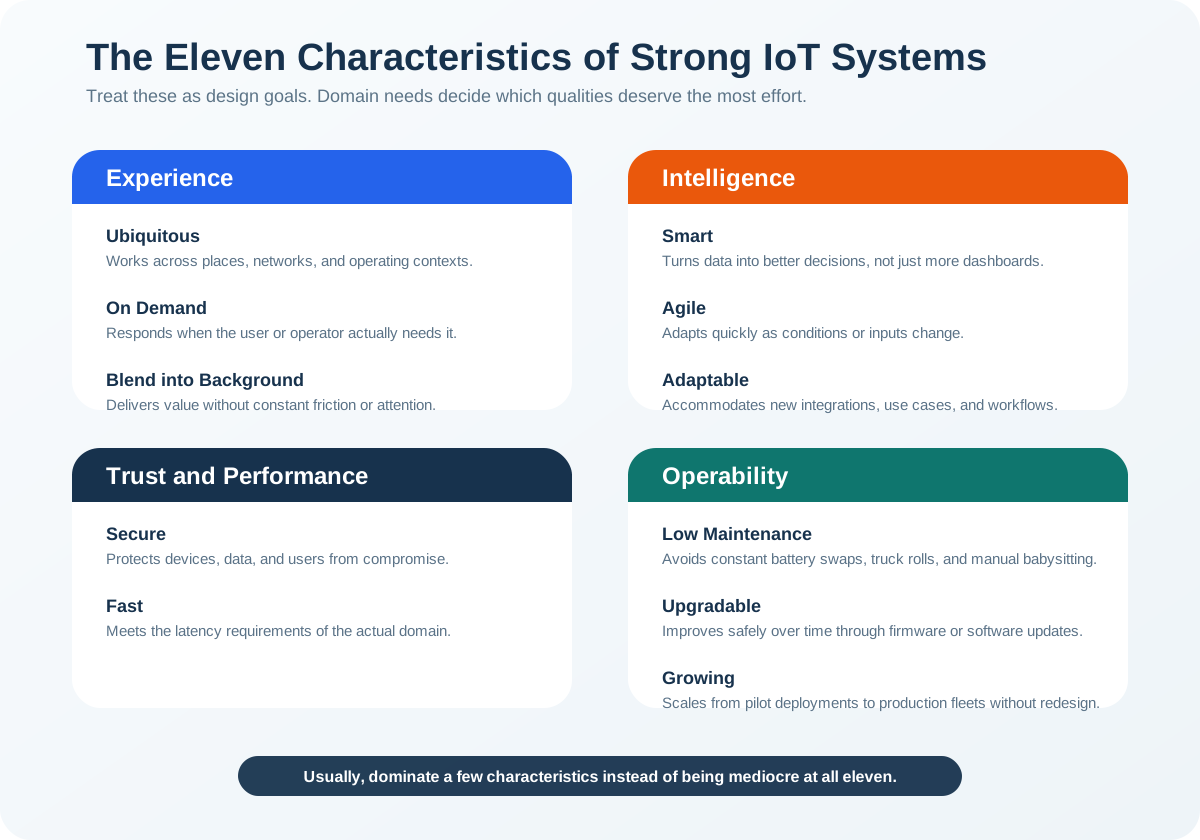
For user experience, Ubiquitous means available across environments, like lighting that works consistently at home, office and hotel. On Demand means responding when requested, like a voice assistant reacting within milliseconds. Blend into Background means unobtrusive operation, like environmental sensors working silently.
For intelligence and adaptation, Smart means making decisions from data and context, like a thermostat learning a schedule and pre-heating before arrival. Agile means adapting quickly to changing conditions, like factory sensors detecting anomalies and adjusting process parameters. Adaptable means supporting new use cases, protocols and integrations as requirements change.
For trust and performance, Secure means resisting cyber threats through encryption, secure boot and regular updates. Fast means low-latency response, like industrial control loops responding in less than 10 ms. These are different goals: rapid delivery does not itself establish protection.
For fleet operation, Low Maintenance means self-monitoring and reduced human intervention through health reports and automatic updates. Upgradable means evolving through over-the-air (OTA) updates, which deliver software without hardware replacement; vehicles gaining software features illustrate it. Growing means scaling from pilot to production fleet without redesign.
No system perfectly achieves all eleven goals. Choose 3–4 characteristics that are critical to the service and make them exceptional. For the warehouse, battery maintenance and coverage already have consequences in the cost model. Giving every characteristic equal weight would hide those consequences instead of explaining the choice.
22.6 Set Priorities Without Hiding Requirements
Priorities change across application domains. The comparison below preserves the source’s 1–10 importance scores; a higher score means greater priority for that example, rather than a measured product capability.
| Characteristic | Smart Home | Industrial IoT | Medical Wearable | Smart Agriculture | Commercial Building |
|---|---|---|---|---|---|
| Ubiquitous | 7 | 5 | 6 | 4 | 6 |
| Smart | 8 | 9 | 7 | 6 | 7 |
| Agile | 6 | 9 | 5 | 5 | 6 |
| On Demand | 9 | 7 | 6 | 3 | 7 |
| Blend into Background | 8 | 5 | 7 | 8 | 6 |
| Secure | 8 | 10 | 10 | 6 | 9 |
| Low Maintenance | 7 | 8 | 9 | 10 | 8 |
| Fast | 7 | 10 | 9 | 3 | 6 |
| Upgradable | 9 | 8 | 8 | 7 | 9 |
| Growing | 4 | 9 | 5 | 10 | 9 |
| Adaptable | 9 | 7 | 5 | 8 | 8 |
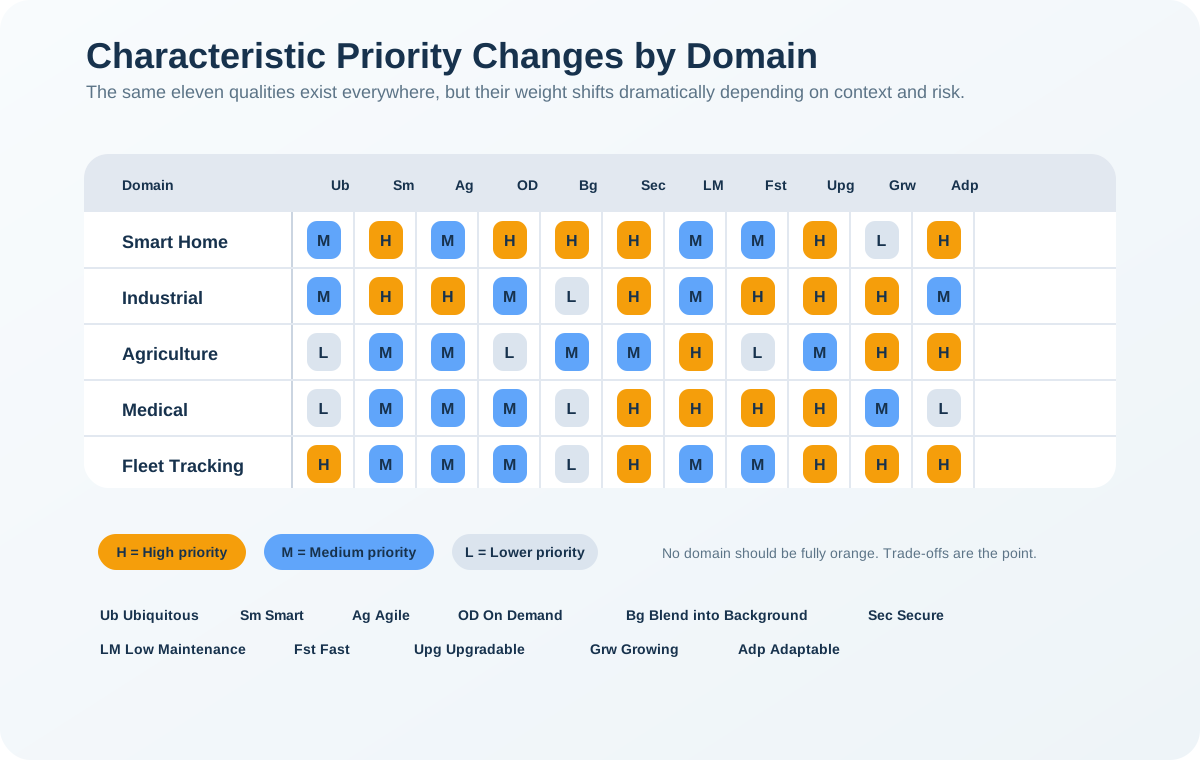
Read the columns from Smart Home through Industrial IoT, Medical Wearable, Smart Agriculture and Commercial Building. Each column ranks the listed characteristics from 1 for lower importance to 10 for higher importance. Compare columns instead of searching for one ideal score. Industrial IoT rates Fast 10/10 because control can be time-critical. Smart Agriculture rates Fast 3/10 and Growing 10/10. Soil moisture changes over hours, while a fleet may expand across many sensors. Hourly agricultural updates can therefore be sufficient. Low Maintenance, Growing and Adaptable become strong priorities for that use.
A medical wearable instead emphasizes Secure, Fast and Low Maintenance; supported-region limits may make reduced ubiquity acceptable. Industrial control emphasizes Fast, Secure and Agile, while visible equipment can be preferable to blending into the background. A consumer smart-home hub emphasizes On Demand, Upgradable and Adaptable so it responds promptly and supports changing device protocols. Appearance matters, but a home’s fixed practical size usually makes fleet-scale growth less central.
The priority scorer lets you choose a preset or Custom, adjust the importance sliders, review the top three characteristics and accept trade-offs on lower-ranked goals. Use the ranking to direct effort, while keeping mandatory requirements visible. A low relative score cannot waive a baseline security obligation.
22.7 Follow Dependencies into a Product Decision
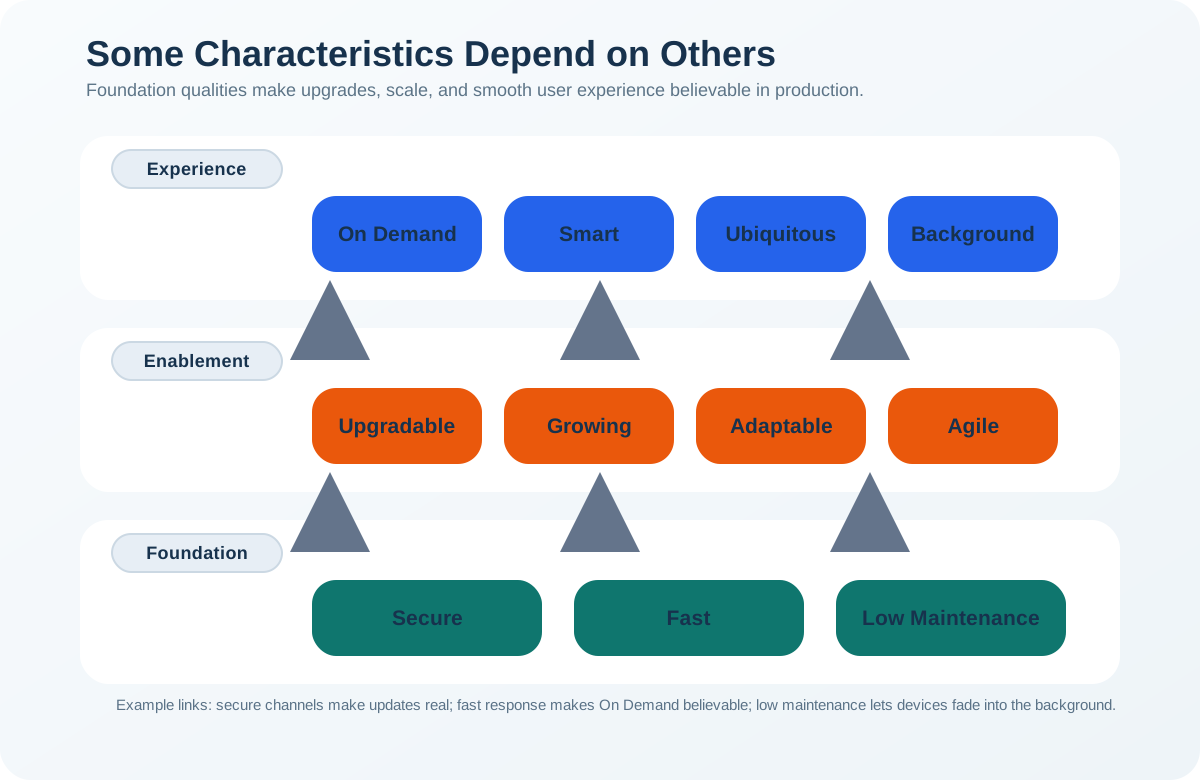
A ranking also needs an investment order. Some characteristics enable others. In the commercial smart-thermostat example, authenticated and encrypted channels provide the secure foundation for automatic OTA upgrades. Those upgrades support operation across 500 units on 50 floors. Secure enables Upgradable here; the relationship is one worked dependency, rather than a complete map of all eleven characteristics. Assess other links separately: fast response, for example, helps deliver an On Demand experience.
22.8 Evaluate IoT Products
Now compare the two products for that deployment:
| Product | Response and interface | Updates and scale | Integration |
|---|---|---|---|
| A | 2-second latency, excellent mobile app | Manual firmware updates via USB; single-building deployment limit | Proprietary protocol |
| B | 8-second latency, basic web interface | Automatic OTA updates; advertised unlimited scalability | Multiple protocols: Wi-Fi, Zigbee, BACnet |
Product B better fits this commercial deployment’s priorities. Growing supports future expansion, whereas A’s single-building limit prevents expansion beyond that boundary. Low Maintenance and Upgradable avoid 500 manual visits for USB updates and let security patches reach the fleet. Adaptable supports integration with existing BACnet building-management systems.
The speed trade-off is acceptable in this example because heating, ventilation and air conditioning (HVAC) systems have thermal mass: rooms do not heat or cool in seconds. An 8-second response is adequate for the stated temperature-control task, so A’s 2-second response adds little practical value. The difference between those responses is six seconds. A’s excellent mobile app also adds little for commercial operators using centralized building-management dashboards rather than individual phone apps.
“Unlimited scalability” remains Product B’s claim to test, not a capacity guarantee. Likewise, A’s single-building limit is disqualifying only when expansion beyond one building is required. These boundaries keep the comparison tied to the service promise. For the warehouse, apply the same discipline to its single-gateway coverage and battery-life claims before carrying them into the ownership total.
22.9 Check the Traps Before Selecting Technology
Five recurring traps can undo an otherwise clear comparison. First, distinguish a connected product from an IoT system. Bluetooth-only marketing labels do not establish internet reachability. A fitness tracker that syncs locally to a phone becomes part of an IoT system when the phone uploads its data to the cloud. If the phone is absent, that cloud path breaks. Record the gateway dependency and what happens when it is unavailable.
Second, avoid treating all eleven characteristics as equally important. Optimizing a farm sensor for millisecond response wastes effort when soil moisture changes over hours. Third, understand range, power, data rate and environment before selecting a technology. Familiar Wi-Fi can drain batteries in days, require power infrastructure at every sensor node and struggle with industrial signal penetration under unsuitable deployment conditions. The warehouse comparison starts with its constraints so that those costs are visible.
Fourth, keep the gateway distinction explicit even when a device’s interface looks complete. Internet reach can be direct through Wi-Fi or cellular, or indirect through a gateway; a mobile app does not establish that path by itself. Fifth, evaluate Growing during prototyping. A 10-sensor prototype does not prove operation at 10,000 sensors. Polling frequency, database schema and message-broker capacity can become constraints at scale.
These traps share a practical lesson: labels, features and small prototypes need evidence before they become requirements decisions. The separate check carries that reasoning into agriculture, medical, automotive and smart-home examples, including OTA upgrades and the difference between a differentiating feature and a baseline obligation.
Summary
For the warehouse, five-year TCO includes hardware, installation and operations: $55K cellular versus $34K LoRaWAN for 50 sensors, with about 38% savings under the example’s assumptions. Battery life, reporting interval, coverage and gateway availability need validation because they support that cost comparison.
The eleven characteristics make design priorities explicit. Choose the few that matter most, preserve mandatory requirements, and check their dependencies. The commercial thermostat example shows why OTA maintenance and integration across 500 units can matter more than a faster response or a polished phone app.
Choose connectivity and products against the whole service promise: lifetime cost, measurable power and coverage assumptions, and the characteristics the application needs most.
Carry this evidence into IoT Requirements: Five-Layer and Seven-Layer Models, whose Visual Bridge moves from five teaching layers to seven reference layers, separating storage, abstraction, applications and business processes before practice in matching, ordering, labeling and code.