14 Applied: Device Evolution Operating Limits
More
Depth: Practitioner
Progress saves as you read. Mark sections complete as you go; your progress appears in the sidebar.
- Podcast audio coming soon
- Character narration audio coming soon
14.1 Name the Responsibility Before the Feature
Device evolution changes who must keep a product working after installation. This chapter turns the comparison in Device Evolution into an operating contract: a record of who owns sensing, control, connectivity, data, updates, support, incident response, and measurable outcome value. Use it when a roadmap, launch plan, or pricing decision promises an IoT service but the evidence only shows app control, cloud dashboards, or connected status messages.
Imagine a thermostat that first controls one room by itself. Later it gains phone access, remote updates, shared data, and an outside support service. Each step moves work and trust beyond the original box. The team must decide whether the device acts locally, waits for a gateway, or depends on cloud confirmation. A gateway is a device or service that passes data between unlike parts of a system; it may also filter, store, or translate data. Its job and owner must be named.
The problem appears when a remote promise has no clear limit. An internet outage, wrong remote command, unfinished update, or final removal from service can cross several owners’ boundaries. Calling the product “connected” or “IoT” does not establish that the added service is safe or supported. Keep local heat control when the phone service is down, and name who restores the remote service.
For each stage, draw a box around the product and add an arrow when a new outside party can read or change state. Name who senses, decides, acts, stores data, and repairs failure; write the owner and proof of a successful handoff on each arrow. Ask what still works offline, what new data leaves the box, who may send a change, and who restores service after failure. Add a stop rule for an unacceptable answer.
We will first classify the product’s claims and test them against an operating scenario. Then we will follow state across firmware, gateways, brokers, cloud services, apps, and business workflows, and specify the command, identity, observability, and lifecycle evidence needed to support a fleet. This makes the engineering and support burden visible before a category becomes a launch promise.
KEY CONCEPTS
- Local function
Keep the control loop within local limits.
- Responsibility
Name the owner at each handoff.
- Command state
Distinguish a request from an applied change.
- Fleet lifecycle
Maintain identity, updates, and retirement.
14.2 Learning Objectives
After this page, you should be able to:
- Explain why device evolution shifts operating responsibility instead of merely adding features.
- Classify a product as embedded, connected, or IoT using its operating claims and evidence.
- Identify the engineering and support work implied by each product category.
- Describe how IoT systems split state across firmware, gateways, brokers, cloud services, apps, and business workflows.
- Specify command-state, identity, observability, and lifecycle contracts that keep a fleet supportable after launch.
14.3 Classify the Claim and Its Operating Burden
The thermostat does not need cloud intelligence simply to belong to a later category. Start with its local job and identify what the connection adds. An embedded device owns a local function: read an input, run firmware, drive an output, and stay within cost, timing, and power limits. Its local control loop has fixed behavior and limited external dependency. A connected device adds remote visibility or remote control through Wi-Fi, BLE, cellular, Ethernet, LoRaWAN, Zigbee, Thread, or a gateway. In this chapter’s operating-model lens, an IoT service adds a wider responsibility: sensing, data flow, decisions, integration, security updates, fleet management, and evidence that the product keeps improving after installation.
That distinction matters because users do not buy “IoT” as a label. They pay for a thermostat that reduces waste without confusion, a machine sensor that prevents downtime, a medication dispenser that records adherence safely, or a logistics tag that makes exceptions visible before cargo is spoiled. The technical category should match the value the product can actually deliver. If a device only moves a button from the wall to a phone app, the value is convenience. If it detects occupancy, learns a schedule, reacts to tariff changes, coordinates with other devices, and documents what it did, the value becomes outcome improvement.
The evolution also changes who must be involved. Embedded products can often be shipped as stable hardware plus firmware. Connected products may need mobile app, cloud API, identity, and support teams, depending on their design. IoT products need operations, analytics, privacy, security, incident response, customer success, and lifecycle planning. A weak classification creates real product risk: teams price a connected product like an intelligent service, promise automation they cannot operate, or ignore the long-term work of device retirement, credential rotation, data retention, and over-the-air (OTA) updates.
A practical way to read the evolution is to ask where responsibility moves. Embedded systems keep responsibility mostly inside the product. Connected systems split responsibility between the product and its connected counterparts, which may include an app or cloud service. IoT systems distribute responsibility across device firmware, edge gateway, network, data platform, rule engine, user workflow, and business process. The label is less important than that boundary map.
14.4 Classify Products by Claims
With that responsibility map in view, classification starts with the claim the product makes and the evidence behind that claim. If a device only exposes a relay through Wi-Fi, BLE, Zigbee, Thread, Matter, or a cellular module, describe the demonstrated capability as connected even if the packaging says smart. If it adjusts behavior from occupancy, weather, energy price, equipment state, route condition, patient adherence, or learned usage patterns, then inspect whether the decision path is real and maintainable. A rule hidden in a cloud dashboard is not the same as a validated control policy with fallback behavior, audit logs, and a support process.
Use the category to choose engineering work. The component-level checklist below makes that work explicit.
Embedded work may focus on ADC accuracy, PWM timing, GPIO safety, I2C or SPI sensor buses, watchdogs, interrupt timing, and real-time firmware on platforms such as STM32, ESP32, RP2040, or Nordic nRF52. Connected work adds commissioning, local network behavior, MQTT or HTTP message design, TLS credentials, cloud outage handling, and mobile-app state. IoT work adds device identity, secure boot, OTA updates, telemetry quality, privacy rules, analytics pipelines, model drift, fleet diagnostics, and clear ownership for alerts that fire at 2 a.m.
14.5 Test the Category Against a Workflow
Test the responsibility map against a complete workflow. The thermostat’s remote button establishes convenience; a freezer monitor makes the distinction between reporting and coordinated action especially clear. Suppose a freezer monitor reports temperature to an app. That demonstrates connected reporting. If it identifies compressor short-cycling, compares current draw to historical baselines, opens a maintenance ticket, suppresses duplicate alarms during defrost, and records the recommended action in a computerized maintenance management system (CMMS) such as ServiceNow or SAP, it demonstrates the wider IoT operating model used here. The extra value comes from coordination between sensing, interpretation, workflow, and accountability, not from the radio alone.
- Name the user outcome. Identify the measurable value: convenience, safety, uptime, energy reduction, compliance, or personalization.
- Name the decision authority. Decide whether the human, firmware, edge gateway, cloud rule, or machine-learning model acts first.
- Name the operating burden. Include provisioning, monitoring, updates, support access, data retention, and retirement before choosing the category.
When a team disagrees about the category, write a one-page classification record. Include the device hardware, radio path, protocol, data fields, command path, user workflow, fallback mode, update channel, and owner for production incidents. Then mark which promises are present today, which are roadmap items, and which are marketing language. This keeps the architecture, launch price, support staffing, and privacy review aligned with what the product can actually sustain.
14.6 Trace Where State Lives
The classification record now needs a map of the state that supports each promise. An operating boundary identifies which parts of the product and service carry that responsibility. For the thermostat, local control, phone status, and a cloud decision may each describe a different part of what happened.
Embedded systems concentrate state inside the product. A Cortex-M, ESP32, nRF52, RP2040, or similar microcontroller may read sensors, run a control loop, sleep aggressively, and drive actuators without the internet. The important engineering questions are local: boot time, clock source, ADC resolution, interrupt latency, electrically erasable programmable read-only memory (EEPROM) or flash wear, watchdog recovery, radio sleep current, and whether the device fails safe. Connected products move some state into a phone, hub, broker, or cloud API, so stale status, retry behavior, authentication, pairing, and rate limits become part of the design.
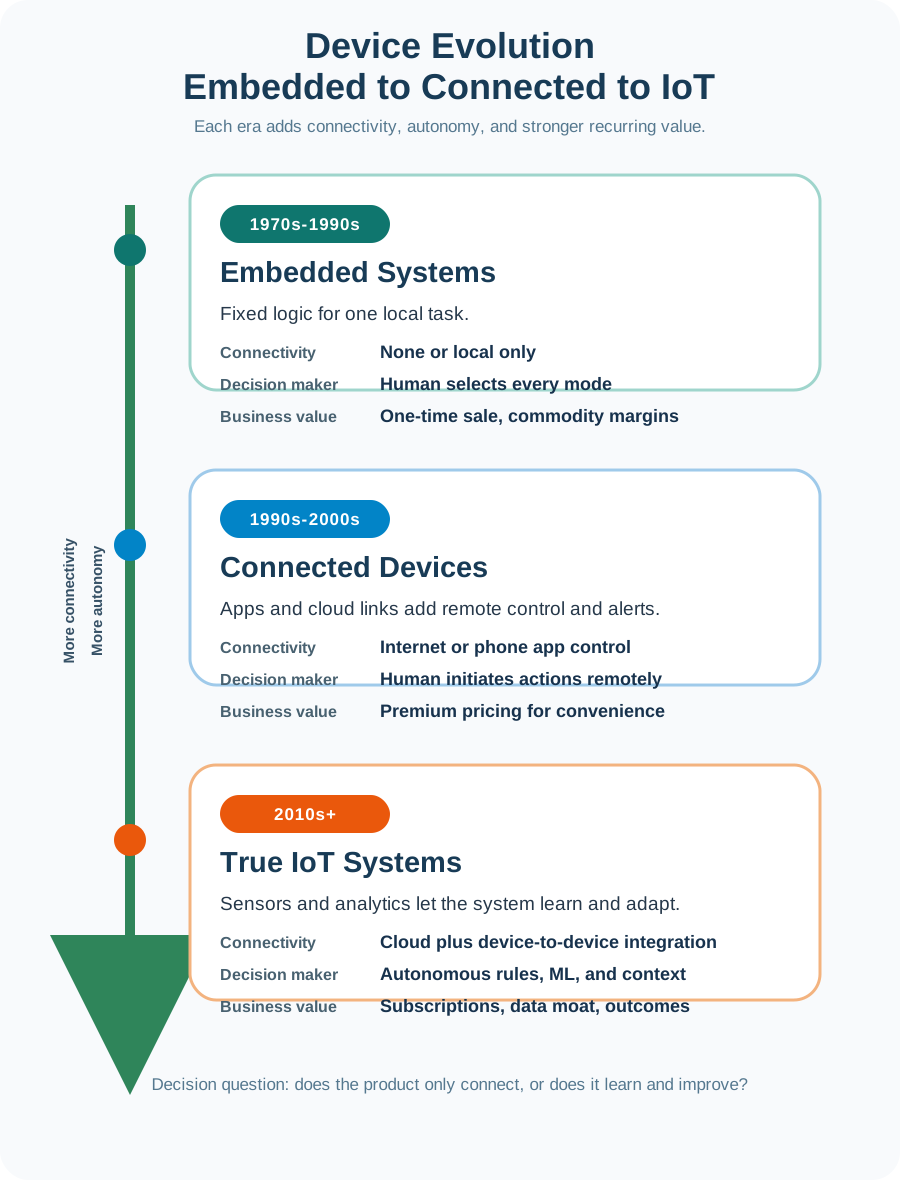
Read Figure 1 as a map of where state lives, rather than a requirement to adopt each later stage. Follow connectivity across the three stages: first, local control keeps the relevant state inside the product; next, a phone or cloud service holds a copy that can be stale, bringing pairing, retries, and authentication into the design; finally, several components hold partial truths at once. The decision comparison widens the review: when rules and analytics can act without a person, record what was requested, applied, or refused. Value depends on being able to sustain those decisions.
14.7 Make Command Outcomes Observable
Once several components hold state, define what each record proves. For the thermostat, a phone request and the resulting device state are separate evidence. A command state records where a requested change stands in its lifecycle, so a queued request cannot silently become a claim that the device acted.
IoT moves the boundary again. Device twins, MQTT retained messages, CoAP resources, LwM2M objects, time-series stores, rules engines, edge inference, and cloud dashboards can all hold partial truths about the same physical object. The system needs unique device identity, signed firmware, rollback-capable OTA, least-privilege topics or APIs, timestamp and unit discipline, schema versioning, and clear command states such as requested, queued, applied, rejected, overridden, and expired. Without those semantics, users see “on” in one interface and “off” at the device, and support teams cannot tell whether the problem is firmware, network, cloud, or expectation.
Requested, queued, applied, rejected, overridden, and expired describe different outcomes along that path. Keep them visible across the app, cloud, gateway, and device. A cloud acceptance can establish that work was queued; it does not establish the physical result. A local control loop can continue independently, and command records do not replace device identity, signed firmware, or OTA rollback. They give users and support staff a shared way to distinguish network delay, cloud processing, rejection, stale work, and device behavior.
14.8 Diagnose Failure and Close the Lifecycle
Those command records become useful when a failure crosses the operating boundary. Observability means having evidence that lets the team understand the system’s behavior. Embedded failures are often reproducible on a bench with a debugger, logic analyzer, or power profiler. Connected failures may depend on router behavior, captive portals, TLS certificate expiry, app permissions, or a cloud outage. IoT failures may depend on delayed telemetry, duplicate messages, inconsistent units, model drift, missing consent, or an integration endpoint changing shape. Production observability therefore needs device logs, event ids, firmware version, radio signal, battery voltage, broker acknowledgments, cloud trace ids, and user-visible command history.
The failure crosses power, state, and business boundaries together. Radio wake time, sensor sampling, TLS handshakes, and retry storms can dominate the battery budget. The app, cloud, gateway, and device may disagree unless command and telemetry semantics are explicit. Subscription pricing is credible only when the system keeps producing outcome value after installation.
This is why “add connectivity” is not a small final step. It changes the trust model, operating cost, test matrix, and product promise. A well-designed IoT system treats firmware, cloud, data, security, and support as one product surface. A weak system treats them as separate add-ons and discovers the coupling only after the first fleet incident.
Close the thermostat’s lifecycle as deliberately as its command path. Remove the user, end the service account, clear old trust, and retain records still needed for law or support. Name who owns device identity, credential rotation, and retirement. Remote control without that exit path leaves a continuing responsibility unresolved. A command button and an online badge are therefore insufficient release evidence: staff also need command outcomes, health, firmware versions, rollback, and retirement records.
Summary
Device evolution shifts operating responsibility. Embedded products own a local function; connected products share state with apps or cloud services. In the operating-model lens used here, the wider IoT service joins sensing, contextual decisions, integration, fleet operations, governance, and support. The thermostat and freezer monitor show why the demonstrated claim matters more than the label.
A supportable product names the owner at each handoff, separates requested commands from observed outcomes, and supplies evidence for diagnosing failures. Identity, security updates, rollback, data retention, credential rotation, and retirement belong in the launch contract alongside the user outcome. Subscription pricing remains credible only while that service keeps producing value after installation.
Classify a product by the operating responsibility it can sustain, and require evidence that each remote promise remains supportable through failure and retirement.
Carry this boundary map into IoT Evolution: Systems Foundations to examine the computing changes behind these operating choices.