26 Why IoT Projects Fail: Security and Redesign
More
Depth: Practitioner
Progress saves as you read. Mark sections complete as you go; your progress appears in the sidebar.
- Podcast audio coming soon
- Character narration audio coming soon
26.1 A Connected Product Still Has to Earn Its Place
A connected product has cleared its budget review and can survive a lost cloud link. It can still fail if one weak device exposes the home or factory, or if connectivity was added without redesigning the original job. This chapter tests those two remaining questions: where does a compromise stop, and does the connected product serve its user better?
Keep the smart water bottle in view. Measuring drinking, reminding its owner, and syncing health data require decisions about sensing, power, feedback, and privacy together. A radio and an app alone do not improve hydration tracking. The same review applies at larger scales, including the city’s 100,000 streetlights and the factory’s 500 sensors used below.
This is part 2 of 2; Why IoT Projects Fail: Cost and Resilience supplies the earlier budget and outage review. Now the approaches are overlapping security controls, six-dimensional product redesign, a connectivity comparison, and a release audit. By the end, you should be able to apply the controls, test product fit, and turn unresolved risks into an owned plan.
The Three Ingredients Test helps expose “smart” marketing without useful function. Bring the different roles described in IoT Perspectives into this review so that one team’s convenient feature does not become another team’s operating burden.
KEY CONCEPTS
- Layered security
Each boundary contains a different failure.
- Product fit
Six design dimensions serve the original job.
- Connectivity cost
Range, power, and recurring costs belong together.
- Release audit
An unresolved risk needs an owner and mitigation.
26.2 Learning Objectives
By the end of this chapter, you will be able to:
- apply defense-in-depth controls to an IoT architecture
- test whether an everyday product has been redesigned for connection
- run a security and product-fit audit before release
26.3 Contain a Compromise at Each Layer
Defense in depth means overlapping security layers so that a failure in one does not compromise the entire system. Read Figure 1 by asking the same question at each boundary: if an attacker has passed the previous control, what stops them here?

Begin with the network. A virtual LAN (VLAN) separates IoT traffic; a separate subnet with firewall rules limits lateral movement after a breach. Network Topologies explains the isolation trade-offs. Segmentation contains reach, but the traffic and stored data still need protection. The encryption layer uses TLS 1.3 for transport and AES-256 for encrypted storage, with device certificates and strong stored-data keys, to reduce eavesdropping and data theft.
Next establish who may connect and what they may do. Mutual TLS authenticates both ends of a connection. Role-based access control (RBAC) assigns permissions through defined roles. A certificate authority and unique device certificates support identity, while narrow roles prevent one stolen credential from granting fleet-wide access. Shared passwords defeat that separation: change default credentials during provisioning and give each device its own identity.
The device layer then protects the software that enforces those decisions. Secure boot checks approved firmware, and a signed bootloader plus an update server support signed over-the-air (OTA) updates. These controls resist malware installation and allow known vulnerabilities, recorded as CVEs, to be addressed. Finally, reduce what a breach can expose: remove personally identifiable information (PII), anonymize telemetry in the data pipeline, aggregate it, and retain less data for less time. Encryption does not remove privacy risk from an unnecessarily detailed record.
Consider the city deploying 100,000 streetlights for remote monitoring and adaptive brightness. Use a dedicated management network isolated from city IT, TLS for all command-and-control traffic with no plaintext, and a unique certificate for every lamp, with revocation for compromised units. Secure boot and signed OTA updates protect the lamps’ firmware. Presence detection could reveal pedestrian patterns, so aggregate it into 15-minute windows at the edge gateway before it leaves.
All five layers matter here. Public devices face physical tampering, 100,000 lamps create 100,000 potential entry points, and presence data reveals behavior. A certificate does not prevent unnecessary data collection, and aggregation does not authenticate a command. Security Threats connects these layers to threat categories; use its threat-modeling material to examine attack and failure paths. With that boundary established, return to whether the bottle deserves its connected features at all.
26.4 Redesign the Bottle Around Drinking
The common redesign mistake is asking only “what cool things can this do?” A useful review asks how six dimensions support the original job: sensors, connectivity, processing, power, user interface, and security. Figure 2 keeps those decisions together rather than treating the radio as the product.

Start with Sensors: capacitive water-level and temperature sensing work with an inertial measurement unit (IMU). The IMU senses tilt; together, these sensors detect drinking events and help track hydration. Processing uses on-device sip counts and daily-intake calculations to keep firmware simple; richer analytics stay in the app. These choices turn readings into useful drinking information, rather than a stream of unexplained sensor data. User Interface pairs an LED cap ring for quick reminders with detailed smartphone app data. Connectivity uses Bluetooth Low Energy (BLE) to reach the phone, which relays data to the cloud. This keeps power low; under Power, a CR2032 coin cell avoids a daily charging burden. Security uses BLE pairing and encrypted health-data sync; records may count as personally identifiable information (PII).
Bluetooth Low Energy (BLE) connects to the smartphone, which relays data to the cloud. That arrangement protects the coin-cell power budget. A CR2032 with roughly one-year life avoids a daily charging burden. An LED ring on the cap provides glanceable reminders, while the app carries detailed data. BLE pairing and encrypted health-data synchronization address the privacy exposure created by connection; hydration records may be treated as PII.
Those choices work as a group. Wi-Fi that drains the battery in days, daily charging that users abandon, GPS collection that adds unnecessary PII, or a bottle that is useless without its phone all undermine the original job. Keep an offline mode so the local drinking reminder remains useful away from the phone or network. Adding connectivity without reworking sensing, feedback, power, and security burdens the bottle without improving hydration tracking.
The user-interface test also travels to other products. Restaurant staff using a commercial dishwasher may lack usable phones in a wet, shared kitchen, with hygiene and glove constraints. A small physical display or local controls provide immediate status at the machine; an app can still give managers deeper analytics. An app-only interface fails when it ignores that workflow. Application Domains provides industry-specific contexts for testing these choices.
Product fit gives us the requirements for a connectivity comparison. It prevents a cheaper component from winning when it makes the product harder to use.
26.5 Compare Connectivity on the Same Assumptions
For the bottle, treat the following component bill of materials (BOM), battery lifetimes, and recurring costs as illustrative design assumptions. They are not guaranteed prices or measured lifetimes. Document purchase quantities, radio duty cycle, and the battery calculation before using them in a real decision.
| Bottle option | Component BOM | Assumed battery life | Annual recurring cost per device |
|---|---|---|---|
| BLE via phone | $1.50 using an nRF52810 | 12–18 months from a CR2032 | $0 in the comparison |
| Wi-Fi | $2.80 using an ESP32-C3 | 3–5 days from a 500 mAh LiPo | $0.50 cloud cost |
| NB-IoT | $8.00 using a BC66 plus SIM | 6–12 months from AA cells | $12 subscription cost |
BLE is the chosen option for this bottle because the nearby phone provides the relay, pairing avoids SIM activation, and the battery assumption avoids daily charging friction. The Wi-Fi example brings that friction; NB-IoT adds a wide-area subscription the bottle does not need. These conclusions depend on this product’s range, traffic, and phone availability. For a nearby indoor plant pot sending infrequent moisture readings, the same reasoning favors BLE over 4G LTE, LoRaWAN’s long-range sparse messaging, or Wi-Fi (802.11n) with a coin-cell power constraint.
The arithmetic makes the consequence visible. The BOM difference between NB-IoT and BLE is $8.00 − $1.50 = $6.50 per unit, or $650,000 for 100,000 units. At $12 per device-year, subscriptions for all 100,000 units add $1.2 million annually. Connectivity selection can therefore change both the purchase budget and the recurring service budget.
The separate comparison varies production volume from 1,000 to 200,000 units and lifetime from 1 to 10 years, starting at 100,000 units and five years. Its calculation is units × (component BOM + annual recurring cost × years). Read that as the comparison’s limited scope, rather than full ownership cost: it does not price every maintenance or replacement obligation. Business Models connects those costs to pricing and value.
26.6 Turn the Checklist Into a Release Decision
A good component choice still needs a project-level audit. Use the 18-item Pitfall Prevention Checklist before finalizing the plan. Every “No” becomes a named risk with a mitigation, cost, and owner. The six groups make the review repeatable across the bottle, the streetlights, and the factory.
- Lock-in, three checks: Support Matter, Thread, or open APIs; operate without the vendor cloud; export data in standard formats. Device Evolution places these standards in context. A protocol label alone does not guarantee independent operation: test the local path, export route, and replacement plan.
- Security, four checks: Change default credentials at provisioning; separate the IoT network segment; provide firmware updates; encrypt data in transit and at rest. The Mirai botnet illustrates why default credentials can turn devices into entry points at internet scale.
- Cost, three checks: Calculate five-year total cost of ownership (TCO); include connectivity per device-year; budget maintenance from the planned fleet, replacement cycles, and service contract. Treat the scorer’s 15–20% annual maintenance entry as an assumption to replace with project evidence. IoT Requirements connects “Growing” and “Low Maintenance” requirements to five-year cost.
- Resilience, four checks: Degrade gracefully without the cloud; reject implausible sensor values; implement watchdog timers and safe-state defaults; complete failure mode and effects analysis (FMEA) for critical components. Edge Computing explains local processing, and Reference Models supplies resilient design patterns.
- Scale, two checks: Load-test at twice the expected device count and automate zero-touch provisioning. A prototype tested at 10 devices can fail at 10,000; observability and staged rollouts make the transition reviewable. Use Testing and Validation to plan failure tests as carefully as happy paths.
- Privacy, two checks: Remove or anonymize PII in telemetry, and define and enforce a retention policy.
The separate scorer contains 18 checks: 3 + 4 + 3 + 4 + 2 + 2 = 18. It divides by 18, so ticking every check gives 100%. It labels scores of at least 90% “Low Risk,” at least 70% “Medium Risk,” at least 50% “High Risk,” and lower scores “Critical Risk.” Use those labels to organize review; a high aggregate score does not erase an unresolved critical failure. Continue monitoring and updating controls, and close security, resilience, and cost gaps before production.
26.7 Give Each Unresolved Risk an Owner
The audit’s output is a remediation roadmap rather than a pass/fail score. Its familiar examples make the categories concrete. Temperature Terry’s toy robot that needs one brand of batteries illustrates vendor lock-in when the supplier disappears. Light Lucy’s advice to replace the factory key means changing defaults before use. Motion Marley’s $50 sensor that may cost $200 over five years illustrates recurring electricity, internet, and cloud-service expenses. A smart thermostat must retain basic operation when the internet fails: this is graceful degradation.
-
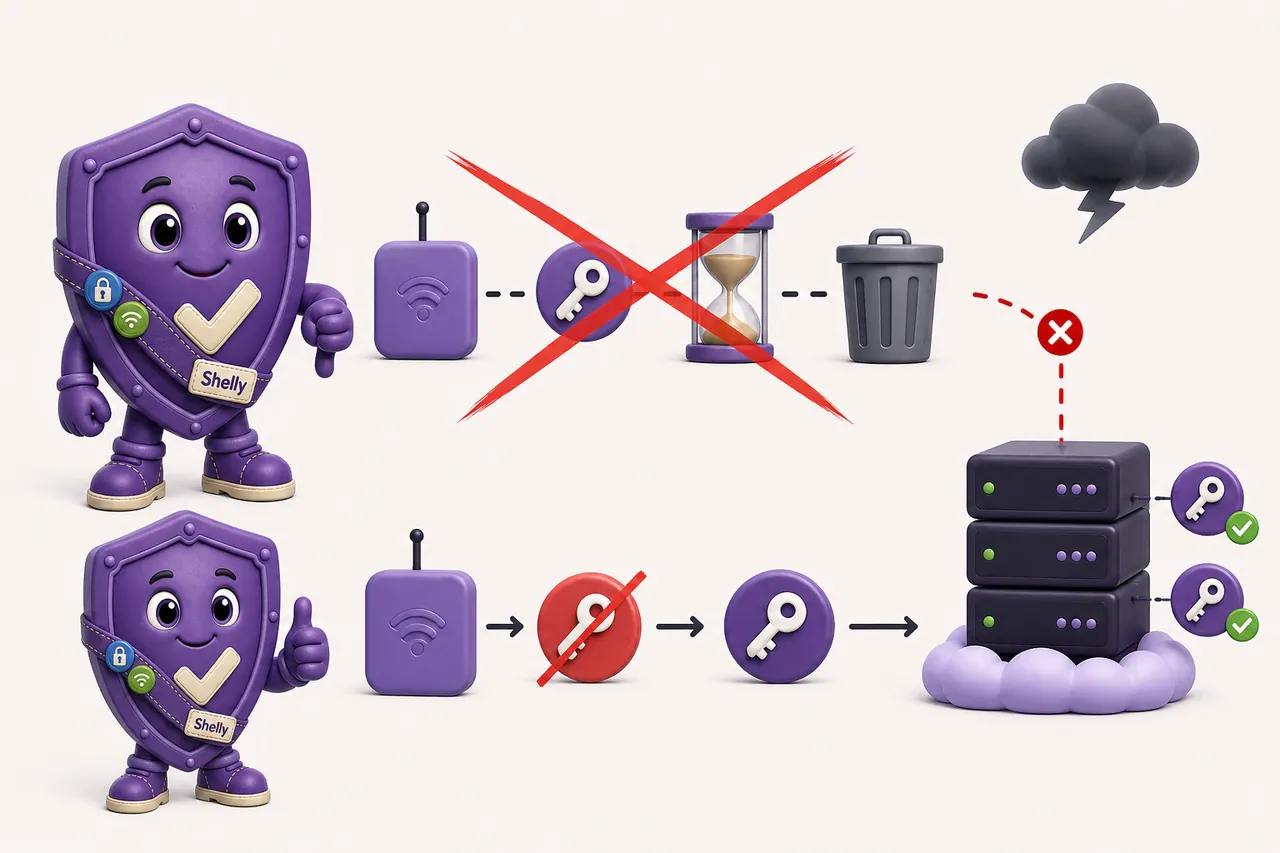
Wrong: Nobody will try the factory password. Replace it with a new, strong password before use.
The same distinction separates shutdown from a temporary outage. A thermostat dependent on a discontinued proprietary cloud needs an exit and local-control plan; a watchdog restart cannot restore that service, and virtual local area network (VLAN) isolation cannot replace it. Consumer lock-in, enterprise TCO underestimation, network neglect, failure-mode neglect, and the prototype-to-production gap require different mitigations.
The factory exercise shows how to record them. Default credentials on 500 sensors create a critical compromise risk, potentially including a Mirai-style botnet and factory shutdown. The proposed mitigation is zero-touch provisioning with unique certificates, with an illustrative $15K for gateway and certificate-authority infrastructure. Missing local operation is a separate medium-severity risk: the exercise assumes two or three 15-minute cloud outages per year, to be checked against a real site log. Its proposed $2K edge gateway keeps a local control loop running for critical machines.
Cost needs the same scrutiny. The exercise’s $60K connectivity, $40K cloud, and $25K maintenance total $125K before hardware, so a $100K budget is insufficient. Its stated $200K five-year total requires a reconciled breakdown; do not infer a hardware share or a Year 2 exhaustion date without the hardware amount and spending schedule. Preparing that model is a $0 planning exercise in the example, followed by multi-year budget approval. Include support, replacement, migration, and shutdown in the lifetime and exit plan.
Summary
Defense in depth contains failures through network segmentation, encryption, authentication, device security, and privacy. The streetlights need all five; the bottle needs the same discipline applied to health data and local operation.
Product redesign connects sensing, connectivity, processing, power, interface, and security to the original job. Compare connectivity with stated assumptions, then use the 18-item audit to name outstanding risks, owners, mitigations, and costs before release.
A connected feature earns its place when it improves the original job and its security, operating costs, and failure behavior have been tested.