13 Device Evolution: Wireless and Classification
More
Depth: Practitioner
Progress saves as you read. Mark sections complete as you go; your progress appears in the sidebar.
- Podcast audio coming soon
- Character narration audio coming soon
13.1 Separate the Radio from the Decision
A phone can switch a lamp on, yet the lamp may make no decision of its own. Wireless access, remote control, and local intelligence describe different capabilities. This chapter explains how changing wireless requirements shape device design, then uses observable capabilities to classify a product and judge its service claims. It completes the four-part route begun in Device Evolution: IoT Products and Enablers.
Consider the chapter’s smart home hub. It connects to Wi-Fi, controls Z-Wave devices through an app, runs on an ARM Cortex-M4, and sends device status to a cloud dashboard. It has no automation rules or learning capability. Calling it “smart” leaves the important questions unanswered: what computation happens locally, what crosses the network, and what changes a decision?
The problem is to distinguish a network path from a capability claim. We will first follow the engineering changes behind wireless systems, then separate baseline IoT membership from adaptation and ecosystem integration. Finally, we will apply those distinctions to the hub’s design and pricing. A radio enables communication; evidence of behaviour establishes what the service can do.
KEY CONCEPTS
- Wireless requirements
Scale changes addressing, security, data and power decisions.
- Baseline IoT
A physical thing, computation and an internet path establish membership.
- Adaptive capability
Connected data changes decisions beyond remote commands.
- Power budget
Compute and radio energy constrain untethered operation.
13.2 Learning Objectives
- Distinguish wireless access from local autonomy and adaptive control.
- Classify smart-home devices from observable capabilities.
13.3 Follow the Changing Wireless Problem
The wireless eras illustrate changes in engineering scale and requirements. They are not a fixed progression in which each generation multiplies the previous population by 1000. The useful comparison is the communication relationship and the problem it makes designers solve.
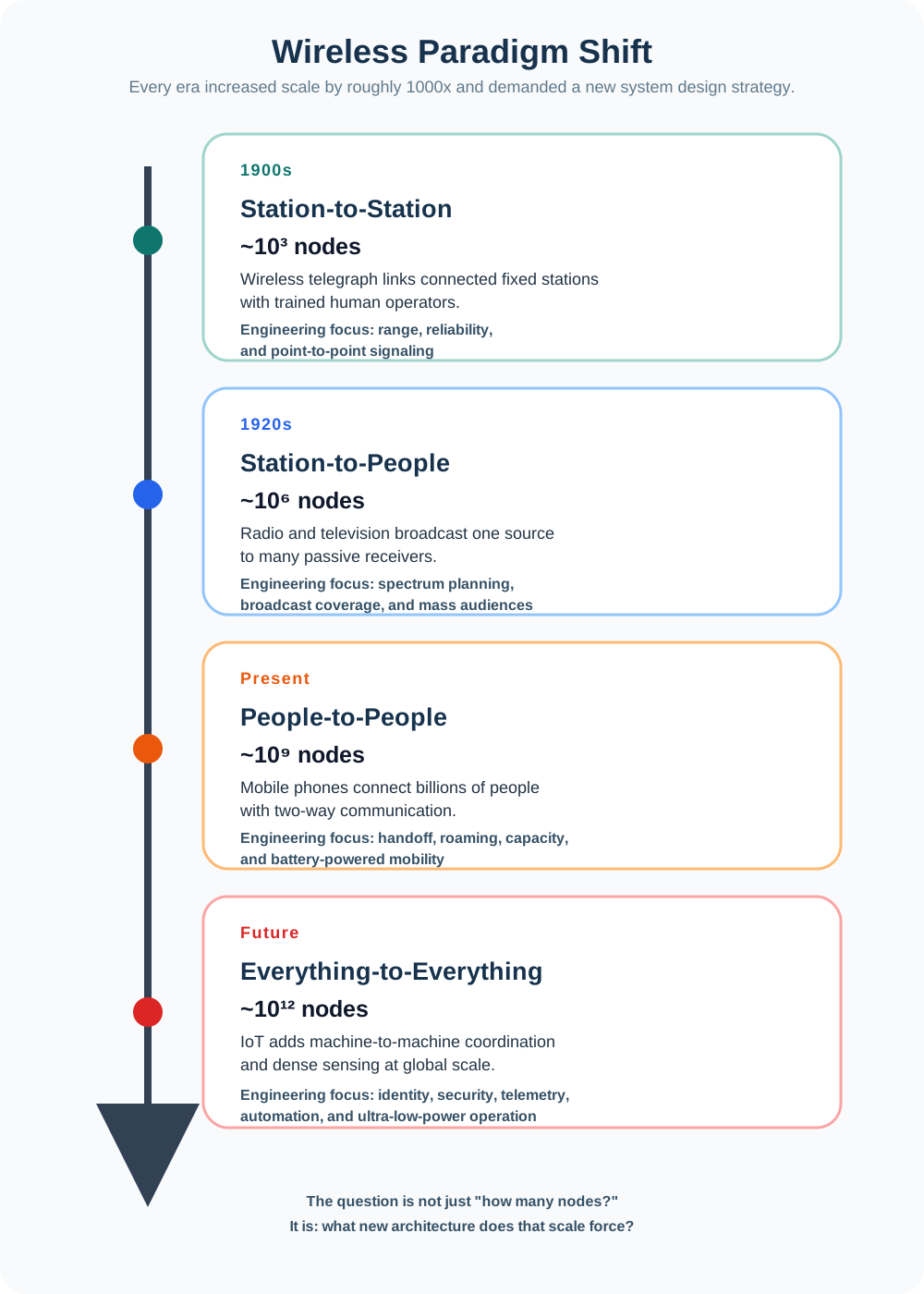
| Era | Communication relationship | Technology | Engineering focus |
|---|---|---|---|
| Around 1900 | Station-to-station | Wireless telegraph | Reach a known station through a point-to-point link. |
| 1920s onward | Station-to-people | Radio broadcasting, followed by AM/FM radio and TV | Plan spectrum for listeners who do not reply. |
| Present mobile era | People-to-people | Mobile phones | Support bidirectional communication, handoff and battery life. |
| IoT | Machines exchanging data with machines and services | Connected sensing and control | Manage identity, security, addressing, data and limited energy. |
Read the table as overlapping engineering problems. A mobile endpoint moves, so maintaining contact requires handoff as well as coverage. A machine may need to operate for years on very little power, while an operator must identify it and protect its data. IoT inherits earlier communication problems and adds constraints associated with large device populations and continuous sensing.
Those changes affect principles, technology, systems and applications together. The history is useful because it explains why simply adding more radios does not settle the architecture. IoT History develops the lessons from paradigm shifts; here, we use those lessons to decide what a device’s network must support.
13.4 Design for Identity, Data and Energy
As the relationship changes, the supporting design changes too. Addressing moves from call signs and phone numbers toward IP addresses, including IPv6 with 128-bit addresses. The enormous address space helps identify devices, but a distinct address does not establish permission to use a service. Security models move from open broadcast toward encrypted channels and zero-trust architectures, where access requires explicit checks.
Data management also changes. Voice-only communication grows into multimedia and continuous sensor streams, which can require processing at the edge, close to the device. Power strategies move from mains-powered stations toward batteries and, where the workload permits, energy harvesting for decade-long operation. These are design possibilities rather than guarantees for every device. Addressing, security and data management must work together at tens-of-billions scale.
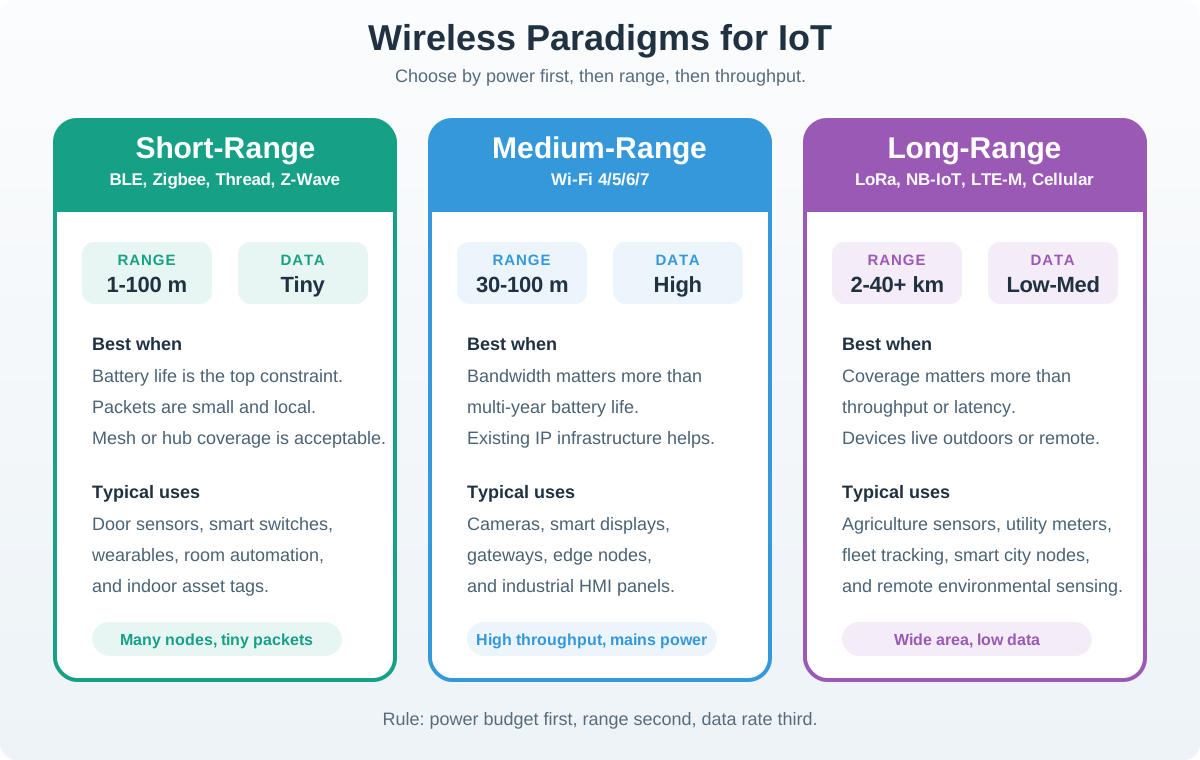
The hub makes these requirements concrete. Its Wi-Fi and cloud path provide remote access, while its Z-Wave side reaches home devices. Neither connection tells us whether it learns. Before choosing a wireless family, classify the sensing, power and communication jobs. Then choose the power budget first, range second, and data rate third.
Short-range links can carry small packets across a room. Long-range links can cross kilometres with tightly constrained data budgets. Wi-Fi can provide substantial bandwidth but consumes energy that makes years of battery operation difficult for many workloads. Range alone does not dictate throughput: compare the actual technology and workload rather than assuming every shorter link carries more data. BLE, LoRa and NB-IoT are examples of low-power wireless approaches to examine against those needs.
Figure 1 groups the source comparison into short-range BLE, Zigbee, Thread and Z-Wave (1–100 m), Wi-Fi 4/5/6/7 (30–100 m), and long-range LoRa, NB-IoT, LTE-M and cellular (2–40+ km). These illustrative groupings are starting points for reviewing a link, not guaranteed coverage or uniform data rates across each family. Door sensors, switches, wearables, room automation and indoor asset tags differ from cameras, displays, gateways, edge nodes and industrial HMI panels; agriculture sensors, meters, fleet nodes and remote sensing add coverage requirements.
Power Optimization connects energy management and power budgeting to multi-year battery design. The practical question is how often computation and communication occur, and what the device consumes between those events. The radio that fits the energy budget can shape the rest of the architecture.
13.5 Establish Membership Before Maturity
An embedded system performs a purpose-built function with limited resources. Microcontroller basics, firmware development and sensor integration form its foundation, governed by the cost–power–performance design triangle. In this chapter’s isolated examples it runs locally without an internet path; embedded computation also remains inside connected products.
The baseline IoT test is a physical thing, computation and an internet path. That path can pass through a gateway rather than a radio built directly into the device. The IoT Introduction explains the Three Ingredients and Five Verbs framework, while IoT Requirements separates minimum requirements from ideal characteristics.
A connected IoT product meets that baseline and provides a networked service, such as app control or a monitoring dashboard. An adaptive IoT product additionally uses learning or context to change decisions. Machine learning is not required for baseline membership. Sensor fusion, prediction and autonomous behaviour describe capabilities to demonstrate, rather than words that every IoT product earns automatically.
Ask the questions in order: does it contain a computer chip, does it have an internet path, does connected data change a decision, and does it integrate with a wider service? A product without computation is outside this computational classification. Local computation without an internet path fits the isolated embedded category. Connectivity establishes connected IoT; adaptation and integration describe additional maturity. Ecosystem coordination can use standards such as Matter, but interoperability and learning remain separate claims.
13.6 Connect Low-Power Hardware to Observable Behaviour
Low-power compute and low-power communication make untethered deployment practical together. The chapter’s enabling examples are ARM Cortex-M, introduced in 2004, and Bluetooth Low Energy, standardized in 2010 and popularized through later phone uses including iBeacon in 2013. Cortex-M provides 32-bit computation with microamp sleep-current possibilities; that is a sleep-state claim, not a promise that active algorithms run at the same current.
The ARM Cortex-M White Papers provide architecture context. Cortex-M is licensed, not an open-source architecture. The processor core does not itself prove that a product includes a wireless radio or all the memory required for logging. Its role in this comparison is efficient local computation; BLE supplies a low-energy communication path. The Bluetooth SIG overview gives the specification context. A coin-cell device sending 30-byte packets over 10–100 metres is an illustrative workload, not a universal BLE payload, range or battery-life limit.
Hardware capability still needs behavioural evidence. A thermostat that learns a schedule, adjusts temperature before occupants arrive and incorporates weather forecasts demonstrates adaptive service behaviour. The Nest Learning Thermostat Case Study is the chapter’s consumer example. Data collection and pattern recognition support machine learning, predictive maintenance and Edge AI, including suitable models running on Cortex-M processors. Time-Series Analysis develops the analysis of readings over time; MQTT addresses a communication mechanism rather than proof of learning. Supervised learning is a related foundation for machine learning in IoT.
A fitness tracker illustrates the same distinction. Counting steps, measuring heart rate and syncing through a smartphone gateway establish connected sensing. Learning that the wearer usually walks 4,000 steps before noon and sending an 11:45 AM reminder when the count is below 3,000 adds adaptive behaviour. If phone sync is disabled, there is no other uplink, and reminders are fixed, the described operating case is local embedded tracking. Battery life affects deployment quality, not the maturity label.
13.8 Turn Classification into a Product Decision
Use convenience, data value and delivered outcomes to choose the service. Remote access may meet the user need without adaptation. Analytics may unlock useful savings when data actually changes an action. This comparison uses illustrative electronics, timeline and premium inputs; validate them for a named category, such as the smart home hub, before budgeting.
| Factor | Basic connected service | Adaptive service |
|---|---|---|
| User need | Convenience and remote access | Optimization of time, money or energy |
| Data value | Status monitoring | Analytics that unlock useful insights |
| Development comparison | $30–80 electronics; 12–18 months | $100–300 electronics; 18–36 months |
| Pricing comparison | 50–100% premium over embedded | 100–300% premium; possible subscription revenue |
| Competitive position | Features may be easily copied | Data and ML may create barriers when the service demonstrates value |
| Source examples to investigate | Smart plug and Wi-Fi bulb | Nest thermostat and Ring doorbell, classified by demonstrated features |
A brand or product family does not establish maturity. A Ring example with motion detection but no learning supports a connected classification, while a Nest example that learns schedules, adjusts automatically and uses weather supports adaptation. Fitness trackers span both tiers. Voice assistants can offer context-aware services across an ecosystem; smart TVs may provide connected service while adaptive interfaces remain a separate claim.
The home-device exercise opens separately. In 30 minutes, beginners identify 10 devices and record connectivity, learning, decisions, adaptation and evidence, aiming to classify at least 8/10 correctly. Its ratio and reflection distinguish basic connected control from added adaptive value. The classification tool separately asks about computation, internet access, learning and ecosystem integration; it returns mechanical, embedded, connected IoT, adaptive IoT or integrated IoT descriptions.
Keep the evidence beside the label. For product designers, promise adaptation only when it can be demonstrated and supported. For engineers, budget compute and radio energy together. For business leaders, tie recurring revenue to an operating service and an outcome. The applications module index places those decisions alongside other application cases.
Summary
Wireless evolution changes engineering requirements for addressing, security, data and energy. Low-power compute and radios support practical battery devices, but neither proves learning. Classify a physical device with computation and an internet path as baseline IoT, then state separately whether it adapts or integrates with a wider service.
The hub meets the connected baseline while lacking adaptive evidence. Use that distinction to guide its feature roadmap, power budget and service promise. Illustrative cost and pricing comparisons become useful decisions only when checked against a named product and customer evidence.
Classify what the product demonstrably does: connectivity establishes a networked service; changed decisions and measured value support stronger capability and pricing claims.
Next, IoT History and Paradigm Shifts examines paradigm blindness, the Innovator’s Dilemma and the SHIFT framework.