12 Device Evolution: IoT Products and Enablers
More
Depth: Practitioner
Progress saves as you read. Mark sections complete as you go; your progress appears in the sidebar.
- Podcast audio coming soon
- Character narration audio coming soon
12.1 What Makes an IoT Product Worth Building?
A smart washer senses its load, checks energy prices, and changes the cycle. Its product claim is credible only when the sensors, computation, radio, and service costs support that behavior. This chapter follows the washer from a useful appliance to an adaptive service, then examines the embedded hardware and wireless technologies that make such products practical. You will trace sensing, edge computation, Bluetooth Low Energy, and cloud services, and test the resulting benefit against battery, privacy, and operating-cost limits.
The washer automatically selects a cycle for water usage, energy efficiency, and load type. In this example, sensors detect fabric types, the device learns usage patterns such as washing jeans on Wednesdays, and it adjusts water temperature using smart-grid energy prices. It may order detergent when supplies run low or start when solar panels generate excess power. Each addition needs an explanation of the useful decision it enables.
Assume this hypothetical washer uses 30% less water and 25% less energy. Those are scenario assumptions: a real claim needs a comparison cycle and load. Higher upfront cost, cloud fees, privacy concerns about usage data, and security vulnerabilities can offset the benefit. The problem is therefore to connect an outcome people value to a design that can deliver it throughout its operating life. We will first distinguish the product capabilities, then examine pricing and the embedded budgets behind them.
This is part 3 of 4; Device Evolution: Boundaries and Connected Products supplies the preceding evidence.
KEY CONCEPTS
- Sensing and adaptation
Context must change a useful product decision.
- Embedded foundation
Dedicated computation fits a cost and power budget.
- Low-power wireless
BLE carries small messages to nearby phones.
- Lifetime evidence
Charge, active time, and battery behavior constrain a claim.
12.2 Learning Objectives
- Trace how sensing, edge compute, BLE, and cloud services enable an IoT product.
- Test a product benefit against battery, privacy, and operating-cost limits.
12.3 Separate Connectivity from Adaptation
The washer illustrates an advanced product stage: embedded technology and connectivity support intelligent decisions. Sensor fusion combines multiple data sources to establish context. Machine learning finds patterns in data, while edge computing processes data locally for timely responses. Together with predefined logic, these capabilities can support autonomous decisions, adaptation to user behavior, and interaction with other devices and cloud services. A product need not demonstrate every advanced capability to meet a baseline IoT definition.
That distinction prevents the “smart” label from doing the work of evidence. A phone-controlled bulb can meet the baseline IoT test, but remote control does not establish adaptive lighting. Apply the maturity test: does it learn, decide, and adapt to changing conditions? A more mature lighting system may learn routines, use ambient-light sensors, and coordinate with other devices.
Likewise, a thermostat with an app is connected IoT; one that learns a schedule and adjusts from occupancy, weather, and energy prices adds adaptive behavior. Selling basic connectivity as autonomous optimization undermines trust. In this chapter’s Embedded → Connected → IoT comparison, the last label denotes this richer adaptive stage; it does not exclude connected products from baseline IoT.
IoT also retains its embedded foundation. Every device must balance cost, power, and performance, including real-time constraints, deterministic behavior, and, where required, sub-1 µA sleep current. Ignoring those requirements can turn a years-long battery target into weeks of operation. Evolution is not an instruction to connect everything: a kitchen timer may do its job without machine learning or cloud analytics. Added connectivity can add cost, complexity, and attack surface without proportional benefit.
For the washer, review the chain one decision at a time. Load and fabric sensing inform the cycle; energy-price context informs water temperature; usage history informs the learned routine. Detergent ordering and coordination with solar generation extend that chain beyond the appliance. The benefit is resource management and convenience, but each service also expands the infrastructure and data-management work required. A working phone interface alone would demonstrate only a small part of this example.
Ecosystem integration is another opportunity to test. A thermostat may coordinate with a home platform, blinds, and occupancy sensors. Such integration can extend value, but its service boundary, failure modes, and customer benefit must be clear before it is built.
12.4 Follow the Infrastructure Behind the Product
The adaptive washer depends on several earlier developments. Figure 1 presents the evolution as a cumulative sequence rather than a replacement of one technology by the next.
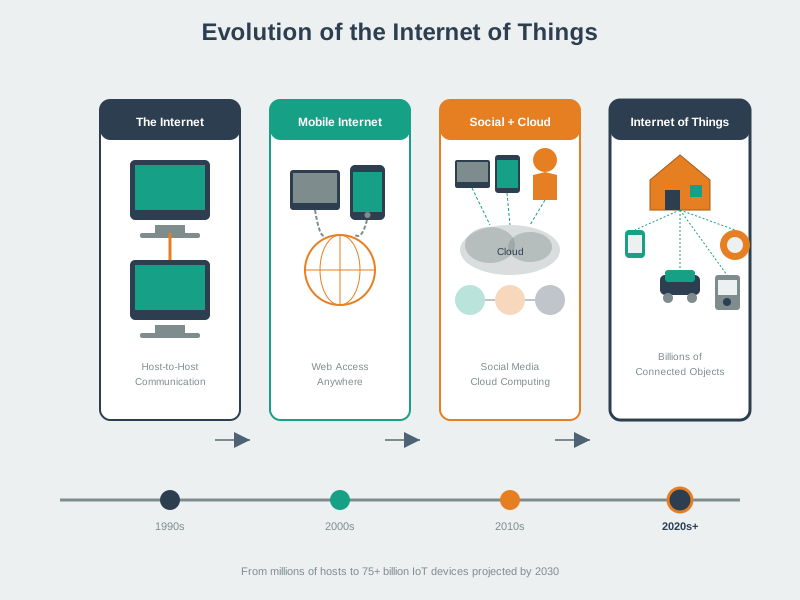
Early networks connect computers for direct communication; the Web connects people to information and services. Mobile access removes the desktop boundary, while social and cloud platforms bring people to shared services and application programming interfaces (APIs). IoT connects things to things and people so systems can sense and act. The historical anchors establish the scale of that progression. Its dependency is equally important: sensing and actuation build on Internet protocols, mobile networks, and cloud platforms.
This progression changes how a product can create value. A one-time sale may become an ongoing service relationship; a feature-based proposition may become an outcome-based one. The washer’s continuing optimization and resource savings could support that relationship, but an ongoing charge still needs ongoing value. Neither a cloud connection nor the provider’s server bill establishes that customers benefit.
Comparisons of typical embedded, connected, and adaptive products need the same care. Treat category cost and development-time ranges as illustrative planning assumptions. Real-world benchmarks need a dated product cohort. In particular, the chapter’s 18–36-month build range is an assumption rather than a category norm. These labels help structure a review; they cannot substitute for product evidence.
12.5 Test the Price Against the Outcome
Consider the existing microwave example. A kitchen appliance manufacturer plans its next 5 years and compares three models. Model A, the $99 budget microwave, has a digital timer, preset power levels, and a mechanical door sensor. It is embedded: its physical appliance and digital controls perform a dedicated local job without an Internet connection.
Model B costs $249 and adds Wi-Fi, smartphone remote start, and recipe downloads to Model A. It is connected: digital controls and the app interface provide convenience, but the scenario supplies no adaptive decision-making. Model C costs $399 and adds weight sensors, humidity monitoring, and machine-learning algorithms that adjust cooking time and power by food type. With Wi-Fi and cloud analytics, it represents the adaptive IoT stage: it learns food types, optimizes cooking, and aims to prevent overcooking.
These are different value propositions, not merely successive feature lists. Remote control can be a nice-to-have benefit, and willingness to pay 2–3× for convenience alone needs validation. Adaptive automation may solve a measurable problem that customers will pay to address. The illustrative connected-convenience premium of 50–100% is another assumption to validate against target-customer prices. The separate $100, $175, and $300 pricing example expresses the same value-gap risk: a price associated with richer IoT behavior needs evidence of that behavior.
The thermostat parallel makes the distinction familiar. A Honeywell programmable thermostat at an illustrative $50 requires a manually set schedule; an ecobee3 lite at $140 adds remote app control. Google reports average Nest savings of 10–12% on heating and 15% on cooling; prices vary by model and date. Keep the savings claim and its context separate from illustrative prices when comparing an actual purchase or launch.
The manufacturer can use this comparison to ask which outcome each premium buys. Model A already supplies independent cooking control. Model B adds access and downloaded recipes. Model C must support its stronger promise with sensor-informed changes to the cooking process. The same question applies to the washer: demonstrate the resource savings and continuing optimization before treating them as a reason for an ongoing customer relationship.
A lifetime comparison should include hardware, subscriptions, and energy savings. Total cost of ownership here combines hardware cost and subscription payments over the customer lifetime. Net value subtracts those costs from cumulative savings; return on investment (ROI) divides net value by total cost and expresses it as a percentage. Basic connected services struggle to justify subscriptions without measurable savings. Adaptive automation may create quantifiable value, but its operating costs still belong in the business case.
12.6 Keep the Embedded Foundation in View
Once the benefit is clear, the design must deliver it within a resource budget. An embedded system combines a processor, memory, and input/output peripherals for a dedicated function within a larger mechanical or electrical system. As Elicia White puts it in Making Embedded Systems (O’Reilly), “An embedded system is a computerized system that is purpose-built for its application.”
Purpose-built design means minimizing cost and maximizing lifetime for an expected workload. Custom software uses as few resources as practical: each byte of code and milliamp of current must justify its use. More RAM or CPU capacity is not a free escape from a constraint. IoT firmware developers often choose C rather than Python because efficiency can reduce cost, extend battery life, and support reliable operation.
A focused function can support low power, small size, and inexpensive control. Household appliances and consumer electronics also operate within tight margins, so designers optimize code and microcontroller resources. A microcontroller (MCU) provides the computation and peripherals for such control. The source’s market-scale examples put those constraints in context:
| Industry | Examples | Annual volume | Typical MCU cost |
|---|---|---|---|
| Consumer electronics | Washing machines, microwaves, coffee makers | Billions | $0.50–$5 |
| Automotive | Engine control, ABS, airbag systems | Hundreds of millions | $2–$20 |
| Medical devices | Blood glucose meters, pacemakers, infusion pumps | Tens of millions | $5–$50 |
| Industrial | PLC controllers, motor drives, process control | Hundreds of millions | $5–$30 |
Figure 2 shows a signal path shared across these applications. A sensor supplies a varying physical measurement; an analog-to-digital converter (ADC) turns an analog signal into numbers. The processor uses its program, memory, and peripherals to perform the dedicated job. A digital-to-analog converter (DAC) can turn a digital output into an analog signal, and an actuator changes something physically. Amplification is application-specific support. This is a template: a product uses the blocks its job needs, and its program, sensors, interfaces, and actuators depend on the application.
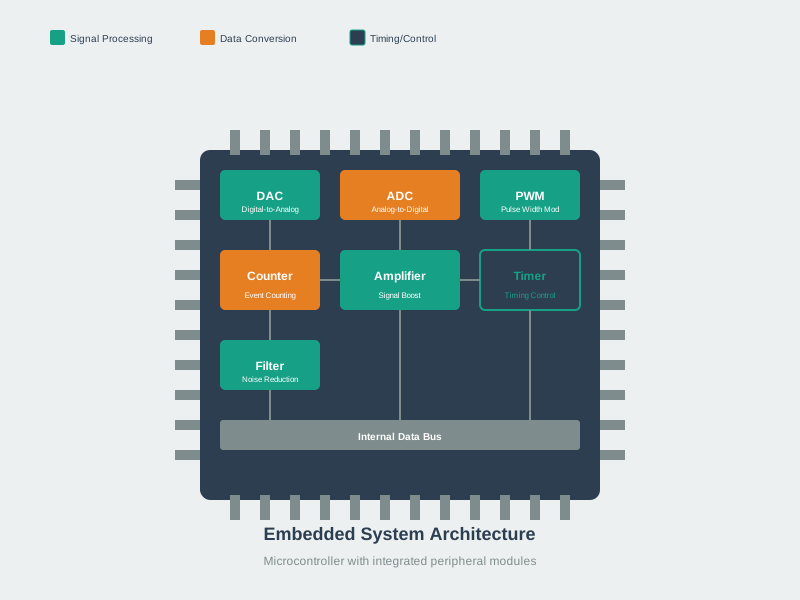
The washer’s resource management and a microwave’s cooking control thus share an embedded design principle without requiring identical hardware. Adding a radio must fit the existing compute, cost, and power envelope.
12.7 Combine Low-Power Compute with Low-Power Wireless
Two technologies addressed different parts of this constraint. ARM Cortex-M processors brought useful 32-bit embedded computation together with low sleep currents. The chapter’s example resource ranges are 8–96 kB RAM and 64–512 kB code flash, with sleep currents below 1 µA in suitable implementations. Earlier design choices often traded the limited capability of low-power 8-bit processors against more power-hungry 32-bit chips. Cortex-M helped close that gap, supporting sensor processing and communication software within a constrained budget.
Bluetooth Low Energy (BLE) supplies an efficient wireless path for small messages and phone communication. The illustrative claim is a 30-byte packet once per second for a year on a coin cell. Treat that as a workload and lifetime target to verify, rather than a guarantee attached to a radio label. Bluetooth 4.0 introduced BLE in 2010; the iPhone 4S supported it in 2011; Apple’s iBeacon highlighted proximity and beacon applications in 2013. BLE became widely available across major smartphones and a common choice for device-to-phone connectivity.
Low-power computation and communication together made battery-powered consumer IoT practical, including fitness trackers, beacons, and smart-home sensors. Without both, a device may connect successfully in a demonstration yet fail as a battery product. The combination can support years of operation without replacement, but active time, sleep current, communication workload, and battery behavior determine whether a particular claim holds.
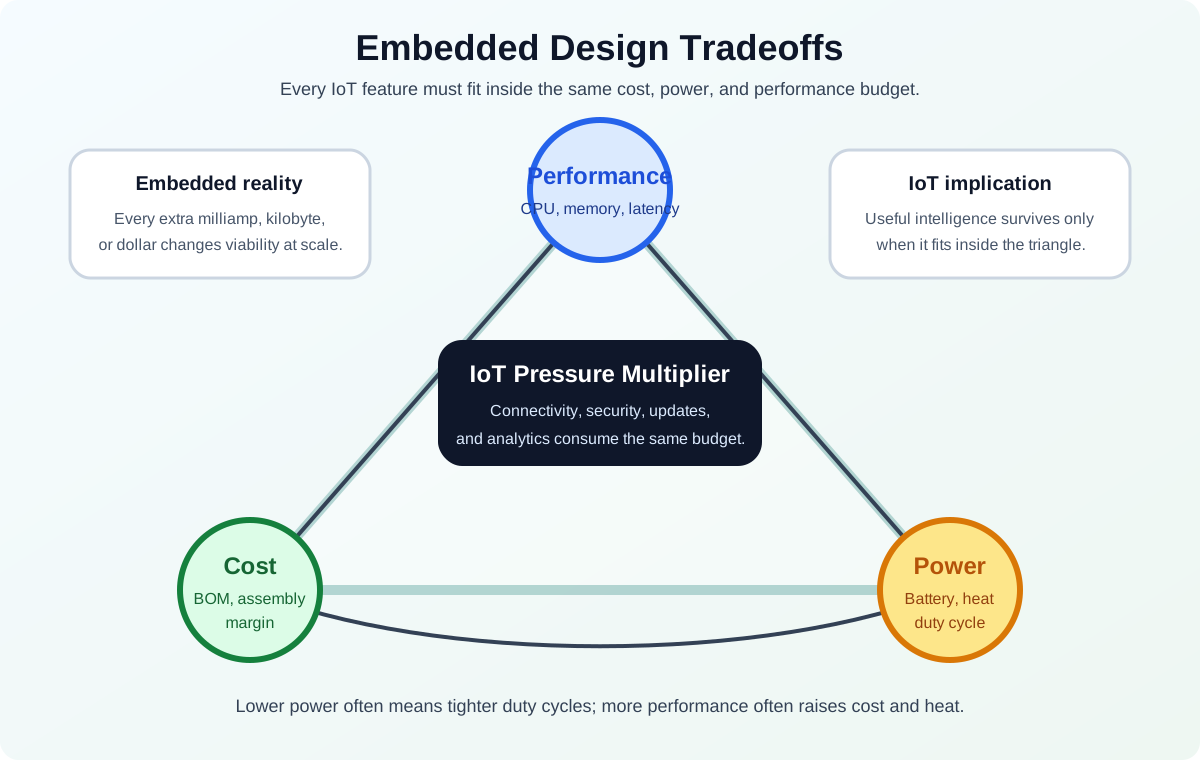
Figure 3 brings those budgets together: 32-bit capability, memory, flash, sub-1 µA sleep, and the consumer MCU cost range of $0.50–$5 sit alongside the BLE workload. Its lower panel is a separate battery calculation, not a derivation of the 30-byte packet claim. That separation matters because a processor specification alone cannot establish a complete device’s average current.
12.8 Check the Battery Claim Through Its Lifetime
The battery comparison holds capacity at 225 mAh and active current at 8 mA, then changes sleep current and active duty cycle. Duty cycle is the fraction of time spent active. Legacy settings of 10 µA sleep and 1% active time average 89.9 µA and estimate 0.29 years. Modern settings of 0.8 µA sleep and 0.1% active time average 8.80 µA and estimate 2.92 years. The difference is measured in years, even before changing battery capacity.
This idealized charge-only model weights active and sleep current by their share of time, then divides capacity by average current. The separate calculator lets you compare those settings and explore capacity, active current, and duty cycle. Its examples include a 225 mAh CR2032 and a 2500 mAh AA alkaline cell, modern sleep currents of 0.5–2 µA, and MCU-plus-BLE transmit currents of 5–15 mA. One second active per 1000 seconds is 0.1% duty cycle. Reducing active time, optimizing sleep, or increasing capacity changes the estimate; real battery effects still need review.
A 225 mAh CR2032 at 3.0 V stores 0.675 Wh by nameplate. Charge capacity and stored energy describe different parts of the budget. During the chapter’s 12 mA BLE burst, 20 ohms of fresh-cell resistance produces a 0.240 V drop and leaves 2.76 V. At 150 ohms near end of life, the same burst produces a 1.80 V drop and leaves only 1.20 V.
One year of 1% self-discharge leaves 222.75 mAh. A charge-only lifetime estimate therefore does not settle whether the radio can still start: energy, pulse sag, and charge retention must be checked together. These battery effects qualify the calculator’s attractive multi-year result.
Summary
The smart washer’s value comes from useful decisions supported by sensing, local computation, connectivity, and services. Remote control establishes a capability; learning and adaptation need further evidence. A stronger product claim or recurring fee needs a measurable customer outcome after hardware and operating costs are counted.
Embedded design remains the foundation. Cortex-M and BLE support computation and communication within tight resource budgets, while duty cycle and battery behavior determine the operating lifetime. A credible product review connects the promised outcome to both the financial case and the physical design.
Trace each claimed benefit to the sensing, decision, service cost, and energy budget that can sustain it.
Carry this evidence into Device Evolution: Wireless and Classification, beginning with the wireless paradigm shift.