19 Applied: Edge Workload Placement
More
Depth: Practitioner
Progress saves as you read. Mark sections complete as you go; your progress appears in the sidebar.
19.1 Start With the Story
This section: Start With the Story — Imagine a freezer that must warn a shop worker before food warms.
Put Each Job Where It Can Be Kept Safe
Imagine a freezer that must warn a shop worker before food warms. A small computer in the shop can act in one second. A distant service can study months of readings, but the internet may fail at the worst time.
The system designer should split the work by job. Keep the urgent warning near the freezer. Send a smaller record for long-term study. For every hand-off, name what goes in, what comes out, how old it may be, and who owns a failure.
Next, test the bad days. Cut the outside link, delay a reading, send an impossible value, and replace the local computer. The warning must still be safe, and the later record must show what happened.
This simple placement rule does not say that nearby work is always best. Some jobs need more power or a wider history. Practitioner compares those costs. Under the Hood follows the exact data changes and proof across each boundary.
Place the freezer warning locally and send a smaller record for wider study, then test both paths during link loss.
19.2 Learning Objectives
This section: Learning Objectives
After this page, you should be able to:
- Place processing stages on device, edge, fog, storage, cloud, or application tiers based on latency, bandwidth, privacy, and compute constraints.
- Distinguish connectivity movement from Level 3 semantic transformation in the IoT reference model.
- Specify evidence records for local alarms, cloud model updates, and tier-crossing data reductions.
- Review what information is lost when raw data becomes features, summaries, events, or work orders.
19.3 Why Placement Follows IoT Tiers
This section: Why Placement Follows IoT Tiers — Edge in the IoT Reference Model maps edge computing onto the seven-layer reference model.
Edge in the IoT Reference Model maps edge computing onto the seven-layer reference model. This page turns that map into an implementation contract: what runs at each tier, which tier owns the consequence, and what evidence must cross boundaries so a later operator can explain the decision.
Use it when a system mixes local gateway decisions, fog aggregation, cloud analytics, model rollout, and application workflows.
19.4 Choose the Right Tier
This section: Choose the Right Tier — The IoT reference model spreads computation across a continuum: the device itself, the edge/fog (a gateway or local server near the data), and the cloud (elastic but distant).
The IoT reference model spreads computation across a continuum: the device itself, the edge/fog (a gateway or local server near the data), and the cloud (elastic but distant). The design skill is not choosing device or cloud, but deciding which tier each piece of processing belongs on.
Four forces drive that placement: latency (how fast must it respond?), bandwidth (how much data would travel?), privacy (must the raw data stay local?), and compute/energy (how heavy is the work?). Read those four for each stage of a pipeline and the right tier usually names itself.
A useful way to apply the model is to follow one measurement upward. Level 1 creates the observation, such as a vibration sample or a temperature reading. Level 2 carries it across a local link. Level 3 decides whether the stream needs immediate action, format repair, feature extraction, or aggregation before it becomes a stored record at Level 4. Levels 5 to 7 then use the accumulated data for analytics, applications, and business coordination. That ordering prevents a common design error: calling every gateway task “connectivity” just because it sits near the network. If the gateway interprets payloads, removes noise, computes a feature, or triggers a local response, it is doing Level 3 edge work.
Intuition: keep the fast, private, bandwidth-heavy work close to the sensor, and send only the distilled, heavy-lifting, big-picture work to the cloud. The edge decides; the cloud learns.
Use the seven-layer diagram in Figure 19.1 to locate the decision before comparing edge, fog, and cloud as placement options.
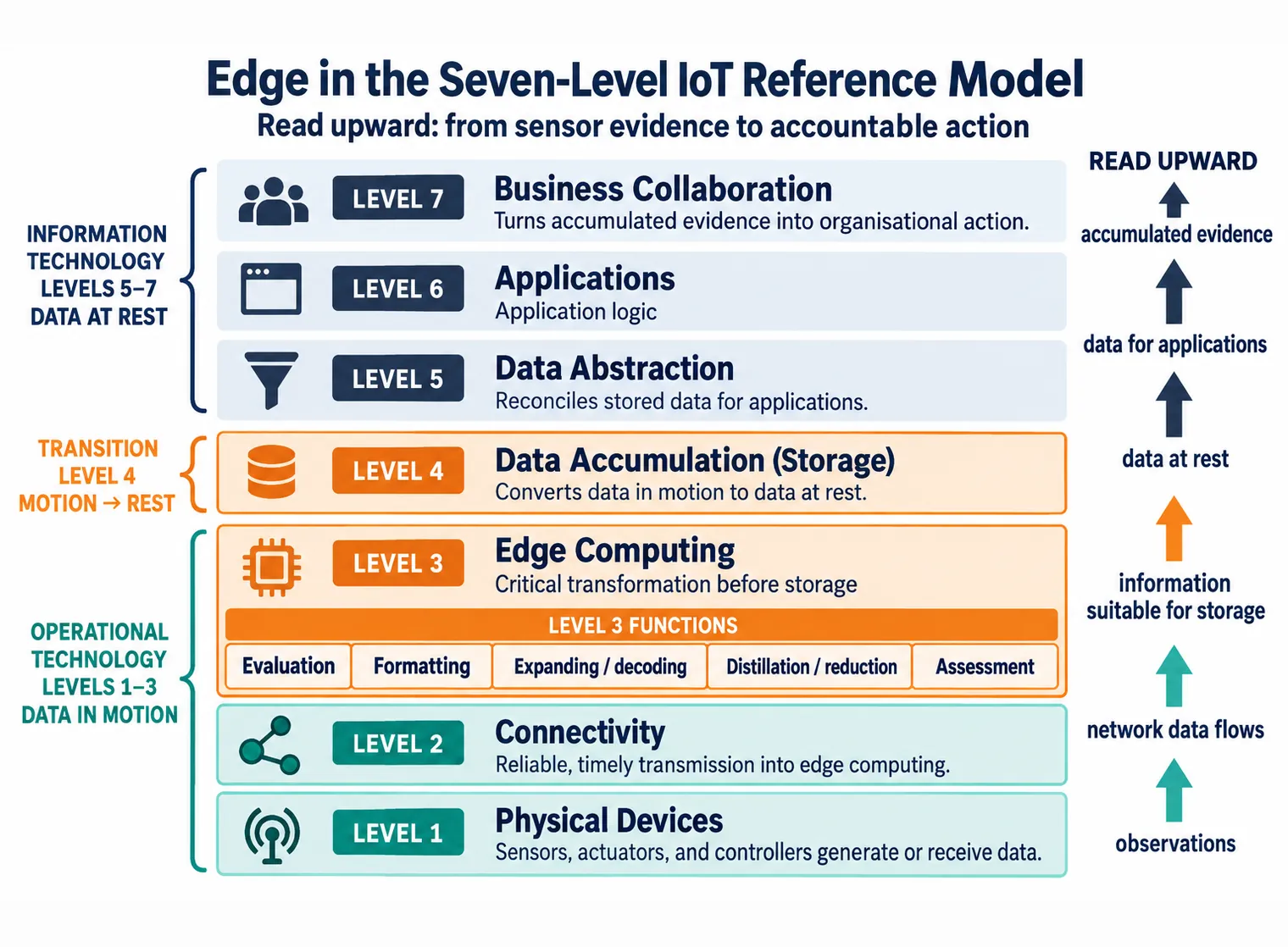
Read Figure 19.1 from physical devices and connectivity into Level 3 edge computing, then upward through accumulation, abstraction, applications, and collaboration. Level 3 is where immediate evaluation or reduction can occur near moving data; higher levels add durable history and broader organisational context. The stack does not require every observation to visit every level before action. It connects to the chapter's running placement rule: choose the lowest tier that can satisfy the decision safely, then send the evidence needed by higher-level learning and governance.
For example, a cold-chain truck may sample temperature at Level 1 and forward readings over BLE or a vehicle bus at Level 2. The gateway at Level 3 rejects impossible values, converts units, checks the 8 C compliance threshold, and sends one-minute summaries unless an excursion occurs. Level 4 stores the summaries and alert events. Fleet dashboards and route-planning applications use those records later, but the compliance-critical decision already happened at the edge.
19.5 Overview Knowledge Check
This section: Overview Knowledge Check
19.6 Practitioner: Placing Each Stage
This section: Practitioner: Placing Each Stage — In practice, tier placement starts as a row-by-row review of the data path.
In practice, tier placement starts as a row-by-row review of the data path. Write down each operation, then mark the deadline, raw input size, privacy boundary, failure mode, and update cadence. Operations with hard deadlines or raw high-rate signals stay close to the gateway. Operations that compare many sites, train models, or join historical records move upward. The reference model is useful because it makes those decisions explicit: “filter vibration peaks at L3, store events at L4, retrain bearings model at L5, show maintenance work order at L6.”
Latency-critical (a safety cutoff)      -> edge (no cloud round trip)
High-volume raw data (kHz sampling)     -> edge reduces it to summaries
Privacy-sensitive (voice, video, health)-> keep raw at the edge
Heavy training / fleet-wide analytics   -> cloud (elastic compute)
Worked example: a vibration monitor for a machine
Raw signal: accelerometer at 10 kHz -> ~10,000 values/sec.

  Stream all raw to cloud?  No -- bandwidth is huge and a
  fault alarm cannot wait for a cloud round trip.

Placement:
  EDGE: compute features + anomaly score locally; raise the
        alarm in milliseconds; transmit only summaries + events
  CLOUD: collect summaries from the whole fleet; retrain the
         model; push the updated model back down to the edge

Result: fast local decisions, small uplink, global learning.
This split — inference at the edge, training in the cloud, models pushed back down — is the backbone pattern of production IoT analytics.
A design review should also record the evidence contract for each tier. The edge alarm should include the sensor ID, feature window, threshold version, local clock, and gateway software version so the cloud can audit why a shutdown happened. The cloud model update should include the training data period, model hash, rollout target, and rollback condition before it is pushed back to gateways. Without those contracts, the architecture may look layered on a diagram but fail in operations because teams cannot explain which tier made a decision or reproduce it later.
Practitioner Knowledge Check
Use a simple rule of thumb: the tier that owns the consequence should hold enough evidence to defend that consequence. A gateway that stops a motor must retain the local readings and threshold that justified the stop. A cloud service that changes a maintenance interval must retain the fleet-level trend and model version that justified the change.
19.7 Practitioner Knowledge Check
This section: Practitioner Knowledge Check
19.8 Edge Continuum, Not Switch
This section: Edge Continuum, Not Switch — Under the hood, the placement decision is about what state changes at each boundary.
Under the hood, the placement decision is about what state changes at each boundary. Level 2 moves packets and frames, so its evidence is delivery status, link quality, retries, and addresses. Level 3 changes the meaning of the payload: raw waveforms become features, device-specific payloads become a common schema, and readings become alerts, summaries, or local control actions. Level 4 changes persistence state by assigning retention, indexes, lineage, and replay rules. Levels 5 to 7 change organizational state by turning stored records into trends, dashboards, maintenance tickets, automation rules, or business decisions.
That separation is useful during outages. If the cloud is unavailable, a well-designed Level 3 gateway can keep applying local safety rules, buffer evidence, and forward a compressed backlog when connectivity returns. If the gateway is unavailable, Level 4 may show stale records but should not pretend that fresh local assessment occurred. If a model changes in the cloud, gateways need a versioned rollout so every local decision can be traced to the model actually running at the time. The reference model is therefore both an architecture diagram and an accountability map.
The other hidden issue is information loss. Edge reduction is valuable only when the discarded data is not needed for the decision being defended. Sending one-minute averages may be correct for billing or environmental trends, but wrong for diagnostics that need spikes, spectra, or phase relationships. Keeping only event clips may protect privacy, but incident review still needs timing, thresholds, confidence, and local clock evidence. Good edge designs document these losses deliberately, with a rule for when the gateway keeps richer evidence temporarily.
Latency by tier
A cloud round trip is typically tens to hundreds of milliseconds; local edge processing is sub-millisecond to a few milliseconds. That gap alone forces real-time control to the edge.
Bandwidth is a cost, not just a limit
Streaming raw high-rate data is often infeasible and always expensive. The edge's core job is data reduction -- filter, aggregate, featurize -- so only valuable, compact data travels.
Fog fills the middle
Between device and cloud sits fog computing on gateways and local servers: more power than a sensor, lower latency than the cloud. Many pipelines place different stages on different tiers.
Privacy is a placement force
Keeping raw voice, video, or health data on the device and sending only derived results is often the simplest privacy control: the data that never leaves cannot leak.
So the reference model is a spectrum of placement choices, not an on/off switch. The same application routinely runs sensing and real-time inference at the edge, aggregation on a fog gateway, and training plus fleet analytics in the cloud — each stage placed where its latency, bandwidth, privacy, and compute needs are best served.
A strong placement contract names the state mutation at each crossing. For a Level 3 edge crossing, write the raw input, the transformation, the output summary, the local rule or model version, and the retained replay evidence. For a Level 4 storage crossing, write the schema, retention class, lineage key, and replay or deletion rule. For a Level 5 to 7 crossing, write the analytics result, application action, owner, and business consequence.
This separation matters for failure handling. Cloud dashboards should label stale records when the gateway is offline; gateways should continue local safety rules when the cloud is offline; and model rollout should leave enough version evidence to explain a local action weeks later.
A useful sanity check is to ask whether a tier crossing loses information needed for a later defense. Sending only averages upstream may be correct for billing or environmental trends, but wrong for diagnostics that need spikes or spectra. Keeping only event clips may protect privacy, but it must still preserve enough timing and threshold evidence for incident review. Good edge designs document those losses deliberately instead of discovering them after the raw data is gone.
Practitioner Knowledge Check
19.9 Under-the-Hood Knowledge Check
This section: Under-the-Hood Knowledge Check
19.10 Release Checklist
This section: Release Checklist
Before shipping a reference-model placement contract, verify these records:
- Each pipeline operation names its owning tier: device, connectivity, edge/fog, storage, analytics, application, or business process.
- Local actions include the source data window, rule or model version, timestamp, gateway software version, and rollback or manual-review path.
- Cloud model updates include training period, model hash, target fleet, rollout gate, fallback version, and gateway acknowledgement record.
- Data-reduction boundaries say what was discarded, what summary evidence remains, and when richer raw evidence is retained temporarily.
- Outage behavior is explicit for each tier, including local operation, buffered replay, stale-data labels, and post-reconnect reconciliation.
19.11 See Also
This section: See Also
- Edge in the IoT Reference Model for the seven-layer placement map.
- Edge Processing Patterns for filter, aggregate, infer, and store-forward implementation choices.
- Edge Stream Window Contracts for window semantics and bounded state behind edge summaries.
- Edge Patterns Placement and Cost Contracts for cost, latency, privacy, and lifecycle review.
19.12 Next
This section: Next — Return to Edge in the IoT Reference Model, then continue to Edge Patterns Practical Guide for worked placement decisions.
Return to Edge in the IoT Reference Model, then continue to Edge Patterns Practical Guide for worked placement decisions.
Find help
3 reviewed answers.
Where should I start in a module?
Open the module page from the sidebar to see its chapters in order. Use the module map to return to a topic you need.
Modules and pathsReviewed
What can I try when a project does not work?
Check the symptom, then work through the diagnostic steps. Keep the error message and the smallest example that reproduces it.
When you are stuckReviewed
How do interactive examples work?
Use the interactive guide to check how examples and simulations work before changing your project.
Interactive examples guideReviewed