45 Sensor Fusion Architectures
More
Depth: Practitioner
Progress saves as you read. Mark sections complete as you go; your progress appears in the sidebar.
45.1 Start With the Story
This section: Start With the Story — Picture three room sensors trying to report one temperature.
Picture three room sensors trying to report one temperature. One is beside a heater. One has an old clock. One misses samples. The system needs a shared estimate that keeps those limits visible.
Latency means the time from new evidence to the result that needs it. Bandwidth means the data capacity available on a link. A fusion design decides where several readings become one estimate. A central service sees the broad set. A local group can cut network use and contain a fault. Peers can share work when no single owner is safe to assume. Each choice must keep source, time, uncertainty, and duplicate handling with the result.
Ask these placement questions:
- Which decision needs the estimate?
- Which sensors can help it?
- Are their clocks aligned?
- Which unit does each source use?
- Where are bad readings stopped?
- Who combines the evidence?
- Can the network carry raw data?
- What happens when one source fails?
- Can the output name its sources?
- Can a reviewer trace the result?
One fused value is not proof that all sources agreed. Practitioner compares central, grouped, and peer designs. Under the Hood covers duplicate evidence, uncertainty, abstraction levels, and degraded modes. Those details can change the chosen owner. They never make hidden disagreement safe to ignore.
Compare where the estimate is made with how each design exposes missing, duplicate, or conflicting source evidence.
45.2 Where Fusion Evidence Combines
This section: Where Fusion Evidence Combines — A sensor-fusion architecture defines where readings become a shared estimate.
A sensor-fusion architecture defines where readings become a shared estimate. In a centralised architecture, sensors send evidence to one fusion process. In a hierarchical architecture, local groups produce intermediate estimates that flow upward. In a distributed architecture, nodes exchange estimates with peers and converge without a single coordinator.
The best architecture depends on latency, bandwidth, failure isolation, time alignment, uncertainty, and review needs. A single central process may give the cleanest global view when the network is reliable. Hierarchical fusion reduces bandwidth and isolates local failures. Distributed fusion is useful when no coordinator can be assumed, but it requires careful handling of duplicated evidence and peer disagreement.
If the architecture cannot explain which sensors contributed, when they were observed, and how uncertainty was combined, the fused estimate is difficult to trust even when the algorithm is sound.
A useful architecture review produces a contract, not only a diagram. It names the fusion owner, input level, clock authority, uncertainty format, duplicate-evidence rule, degraded-mode behavior, and audit record that travels with the output. That contract is what lets a downstream dashboard, controller, or incident review distinguish a fresh global estimate from a local summary or a decision-level vote with hidden disagreement.
The placement decision also controls where bad evidence is stopped. A central service can quarantine raw readings in one place, but it depends on transport and storage capacity. A room gateway can reject stale local sensors before sending a compact state upward, but the building service must still see the rejected-input count and uncertainty. A distributed peer can keep operating during an outage, but it must publish estimate age and conflict state so later convergence is explainable.
Before comparing fusion algorithms, trace Figure 45.1 to locate where sensor observations become a combined claim.
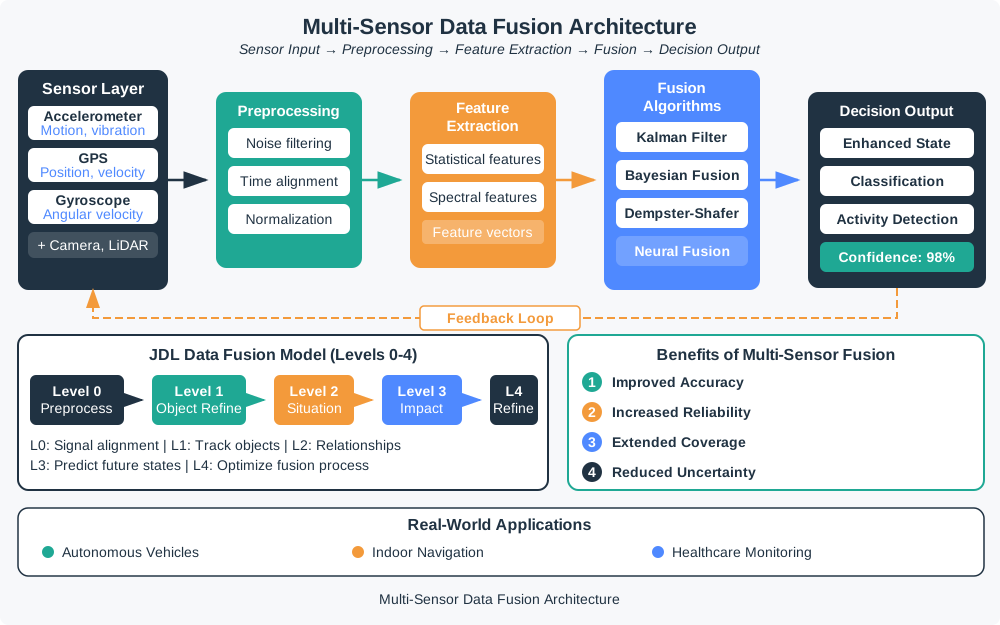
Read Figure 45.1 from sensors through preprocessing and feature extraction into the fusion stage, then continue to the decision and feedback loop. Early stages align units, time, frames, and quality; fusion combines only that prepared evidence; the decision layer applies the result to an operational boundary; feedback tests whether the claim remained useful. The JDL levels describe different abstraction points along the same route. This connects architecture to the running narrative: fusion placement is defensible only when provenance and uncertainty survive every transformation.
Centralised
All raw or lightly processed evidence reaches one fusion service with a global state view.
Hierarchical
Local fusion nodes summarise nearby sensors, then send estimates upward by room, floor, zone, or asset.
Distributed
Peers share estimates or beliefs and update locally without depending on one central service.
Decision-Level
Independent detectors or classifiers vote, arbitrate, or escalate when raw evidence cannot be shared.
The same centralised-versus-decision-level choice shows up inside a single learning task, not just across a building's sensor network. When a mobile-sensing system has readings from several sensors, one design concatenates every sensor's feature vector into a single input and trains one learner on the combined vector; that is centralised, feature-level fusion, and it lets the model learn interactions between sensors directly. The other design trains a separate learner per sensor and combines their individual outputs through an ensemble stage; that is decision-level fusion, and it tolerates one sensor going offline or changing without retraining the whole model, at the cost of discarding cross-sensor interactions the individual learners never see. Neither choice is automatically better: the review should record which pattern was used and why, because it changes what a single failed or drifted sensor does to the fused output.
Overview Knowledge Check
45.3 Match Fusion Pattern to Bottleneck
This section: Match Fusion Pattern to Bottleneck — Start with the bottleneck.
Start with the bottleneck. If the bottleneck is estimator quality and the network is dependable, centralised fusion may be simplest. If the bottleneck is bandwidth or local resilience, use hierarchical fusion and send state estimates upward. If the bottleneck is intermittent connectivity or organisational boundaries, use distributed or decision-level fusion and treat disagreement as explicit evidence.
Practitioner Knowledge Check
Worked example: room-to-building hierarchical fusion
rooms: 50
sensors per room: 4
reading interval: every 10 seconds
raw payload: 32 bytes per sensor reading

centralised raw stream:
50 rooms * 4 sensors * 32 bytes / 10 s = 640 bytes/s

room-level fused state:
one 64-byte room state every 30 seconds
50 rooms * 64 bytes / 30 s = 106.7 bytes/s

building-level summary:
one 128-byte building state every 30 seconds
128 bytes / 30 s = 4.3 bytes/s

hierarchical upstream rate:
106.7 + 4.3 = 111.0 bytes/s

reduction:
1 - (111.0 / 640.0) = 0.827, about 83% less upstream traffic

Design consequence:
The bandwidth saving is useful only if each room state also carries time span,
sensor health, uncertainty, and rejected-input evidence.
The same arithmetic is easier to defend when it is drawn as traffic. Figure 45.2 follows the fifty-room building’s readings up both candidate paths and prices each hop.

Both columns of Figure 45.2 start from the same 50 rooms × 4 sensors source card. The baseline column sends the raw readings at 640 B/s; replay still requires durable, timestamped retention; the tiered column lets each Room gateway compress four readings into a 64 B state every 30 s, adds the Building service roll-up at 4.3 B/s, and lands on 111.0 B/s in total. The amber strip is the clause that keeps the 83% saving honest: every state must still carry its time span, sensor health, uncertainty, and rejected-input counts, because those fields are exactly what the baseline column was implicitly buying with its bandwidth.
Practitioner Knowledge Check
45.4 Fusion Level Sets Audit Trail
This section: Fusion Level Sets Audit Trail — Fusion can happen at several abstraction levels.
Fusion can happen at several abstraction levels. Data-level fusion combines raw or calibrated measurements. Feature-level fusion combines extracted features such as residuals, FFT bands, occupancy counts, or localisation features. State-level fusion combines estimates and uncertainty, such as Kalman filter tracks. Decision-level fusion combines labels, votes, or incident decisions.
Each level loses and gains information. Raw data supports the richest reprocessing but costs bandwidth and storage. Feature and state estimates reduce transport, but they must preserve uncertainty, time span, calibration, and feature version. Decision-level fusion is compact and sometimes necessary across organisational boundaries, but it is the easiest place to hide incompatible labels or weak confidence.
Those levels become easier to audit when each one is written as an input-output signature. The ladder diagram in Figure 45.3 names the five signatures and attaches one concrete transformation to each.

The top rows of Figure 45.3 stay in the data domain: DAI-DAO turns a noisy frame into a cleaner frame with a Gaussian or median filter, and DAI-FEO hands segmentation a raw frame and receives blobs with pixel sizes. Below them, FEI-FEO joins video and audio features for one activity window, FEI-DEO turns a feature vector into a fault label, and DEI-DEO lets two detector verdicts vote. The closing rule condenses the architecture decision into one line — fuse as high on the ladder as the links can afford and only as low as the audit duty permits — because a row once descended cannot be replayed from above.
Worked example: track-to-track covariance check
tracker A position: x = 10.2 m, sigma = 0.4 m
tracker B position: x = 10.4 m, sigma = 0.4 m

If the estimates are independent:
precision for each tracker = 1 / 0.4^2 = 6.25
combined position = (10.2*6.25 + 10.4*6.25) / 12.5 = 10.3 m
combined sigma = sqrt(1 / 12.5) = 0.28 m

If both trackers used the same upstream UWB anchor observation, that 0.28 m
confidence is optimistic because the same evidence was counted twice. The
architecture should mark common sources, correlation assumptions, and any
covariance inflation rule before publishing the fused state.
This is why architecture diagrams should show common sources and summary boundaries, not only arrows. A state-level fusion service needs to know whether two tracks came from independent sensors, from two gateways that shared one anchor, or from two classifiers trained on the same labeled incident set. When independence is unknown, a conservative design keeps the larger uncertainty, flags the common-source path, or routes the fused output for review before it drives actuation.
Data Level
Combines measurements before feature extraction, often after calibration and time alignment.
Feature Level
Combines derived features while preserving feature schema, window, and sensor coverage.
State Level
Combines estimates, tracks, covariance, and confidence from local filters or trackers.
Decision Level
Combines alarms, classes, votes, or abstentions when lower-level evidence is unavailable.
Under-the-Hood Knowledge Check
45.5 Summary
This section: Summary — Sensor-fusion architecture determines where data, features, states, or decisions are combined.
Sensor-fusion architecture determines where data, features, states, or decisions are combined. Centralised fusion gives one service a global view but depends on network and coordinator reliability. Hierarchical fusion reduces upstream traffic and isolates local failures when summaries carry time, uncertainty, and health evidence. Distributed fusion avoids a single coordinator but must handle peer disagreement, clock differences, and duplicated evidence. Decision-level fusion is compact, but it requires explicit label definitions, confidence, abstain rules, and voting policy.
Choose the fusion architecture by the bottleneck: estimator quality, bandwidth, latency, coordinator reliability, privacy, or auditability. Every fused output must preserve timing, uncertainty, contributing evidence, and rejection metadata.
45.6 See Also
This section: See Also
Data Fusion Introduction
Review why multiple sensors are combined and what evidence must travel with the fused value.
Kalman Filters
Use state and covariance when fusing estimates over time.
Complementary IMU Fusion
Place fast and slow sensor corrections in a practical embedded fusion design.
Fusion Best Practices
Keep calibration, time alignment, uncertainty, and fallback behavior reviewable.
Find help
3 reviewed answers.
Where should I start in a module?
Open the module page from the sidebar to see its chapters in order. Use the module map to return to a topic you need.
Modules and pathsReviewed
What can I try when a project does not work?
Check the symptom, then work through the diagnostic steps. Keep the error message and the smallest example that reproduces it.
When you are stuckReviewed
How do interactive examples work?
Use the interactive guide to check how examples and simulations work before changing your project.
Interactive examples guideReviewed