67 Edge Quiz: Comprehensive
Putting Numbers to It
Quiz mastery targets are easiest to plan with threshold math:
\[ C_{\text{target}} = \left\lceil 0.8 \times N_{\text{questions}} \right\rceil \]
Worked example: For a 15-question quiz, target correct answers are \(\lceil 0.8 \times 15 \rceil = 12\). If a learner moves from 8/15 to 12/15, score rises from 53.3% to 80%, crossing mastery with four additional correct answers.
67.1 Learning Objectives
For Beginners: Edge Quiz: Comprehensive
This chapter tests your understanding through questions and exercises. Think of it as a practice session that helps you identify which topics you know well and which ones need more review. Working through these problems builds the confidence you need for real-world IoT data challenges.
By the end of this chapter, you will be able to:
- Synthesize Calculations: Apply multi-step computations across data reduction, power, and cost domains
- Evaluate Trade-offs: Analyze architectural decisions considering multiple factors simultaneously
- Justify Decisions: Provide quantitative support for edge vs cloud architecture choices
- Integrate Concepts: Connect Level 1-4 processing with storage, cost, and business considerations
67.2 Comprehensive Review Quiz
This comprehensive review covers all edge computing concepts from previous chapters with integrative questions requiring synthesis across multiple topics.
67.3 Visual Reference Gallery
Edge Computing Diagrams
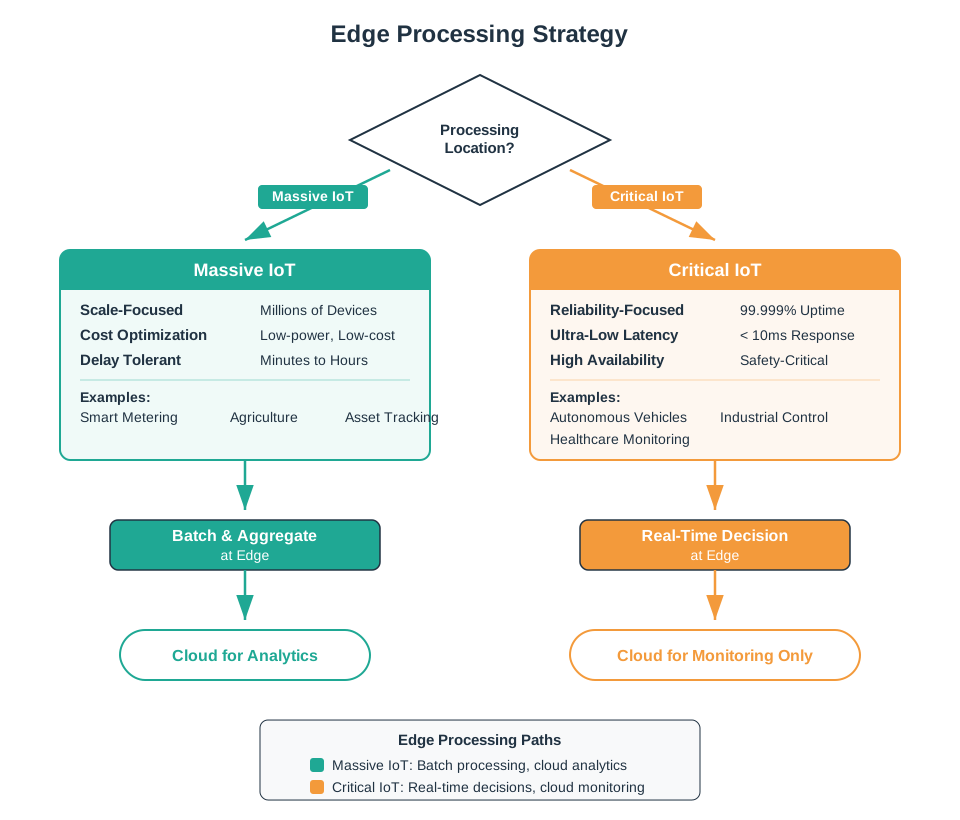
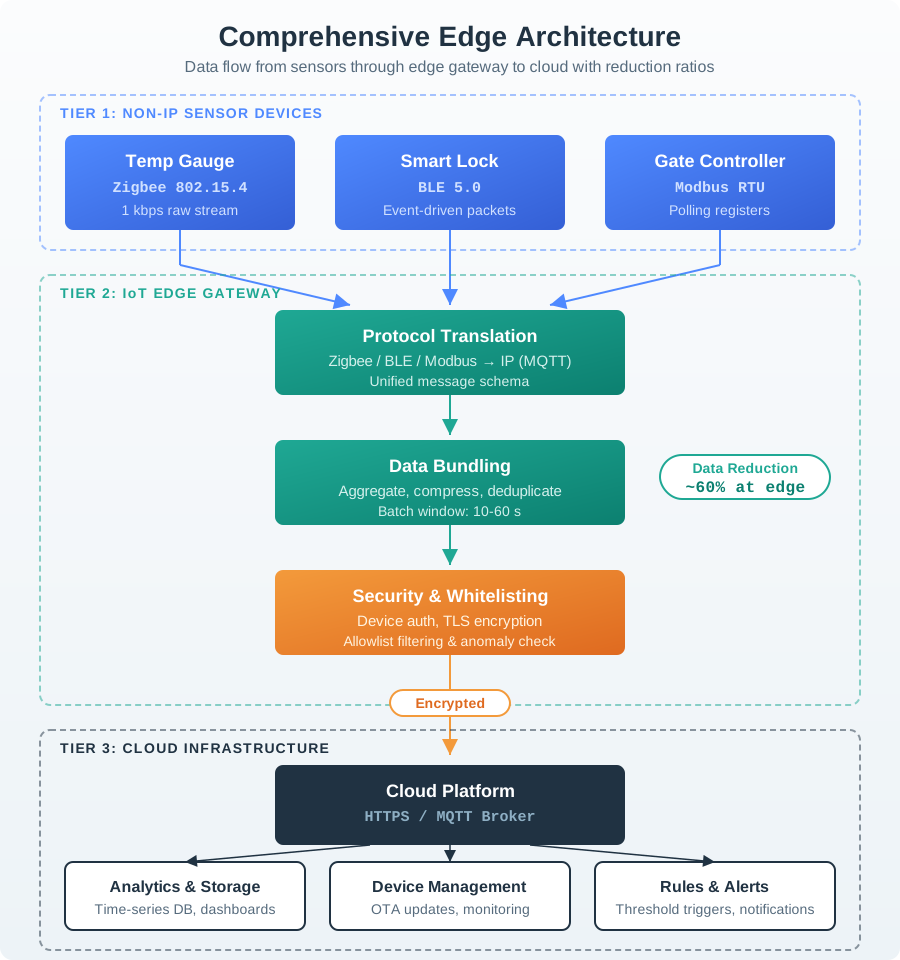
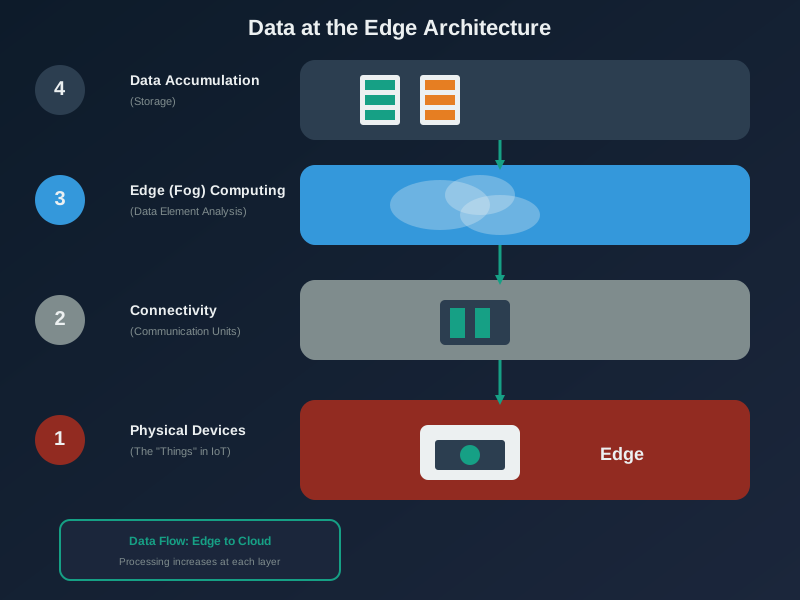
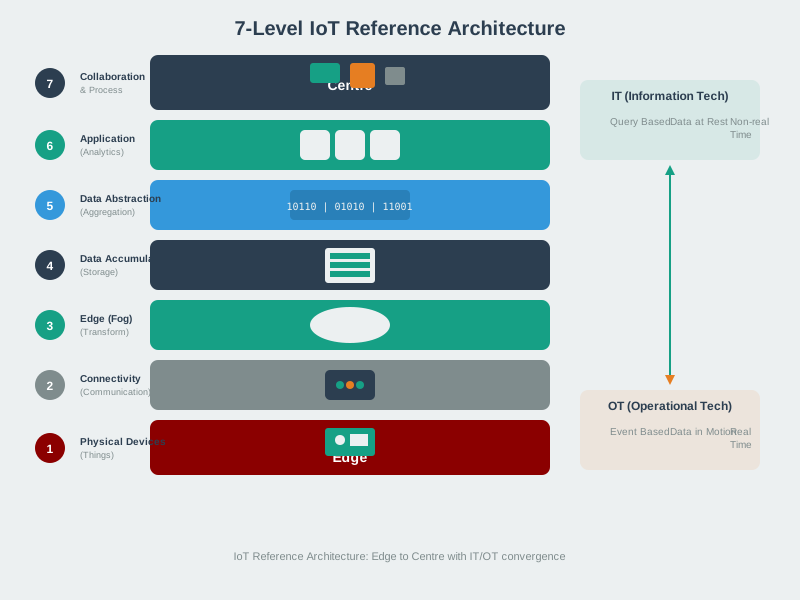
These diagrams provide visual reference for the edge computing concepts tested in this quiz bank.
Worked Example: Multi-Tier Edge Architecture for Fleet Vehicle Monitoring
A logistics company monitors 500 delivery trucks with 15 sensors each (GPS, fuel, tire pressure, door sensors, cabin temperature). Design a complete edge-to-cloud data flow with realistic numbers.
Tier 1 - Device (in-vehicle MCU):
- Sample all sensors at 1 Hz (every second)
- Per vehicle data rate: 15 sensors x 1 Hz x 20 bytes = 300 bytes/second
- Apply local filtering: discard GPS if speed < 5 km/h (stationary), discard door sensor when unchanged
- Estimated filter reduction: 40% (removes redundant stationary readings)
- Post-filter rate: 300 bytes/s x 0.6 = 180 bytes/second per vehicle
Tier 2 - Gateway (in-vehicle edge computer):
- Aggregate 10-second windows: calculate min/max/avg for fuel, temperature, tire pressure
- GPS: keep 1-second resolution (safety requirement)
- Door events: keep all state changes
- Aggregated payload: GPS (1 Hz, 12 bytes) + aggregated metrics (0.1 Hz, 80 bytes) + door events (event-driven, approximately 5 bytes/min avg)
- Per vehicle rate: 12 bytes/s + 8 bytes/s + 0.08 bytes/s = approximately 20 bytes/second
- Reduction from raw: 180 / 20 = 9x reduction at vehicle gateway
Tier 3 - Regional Fog Node (depot server):
- 50 trucks report to each depot
- Aggregate fuel efficiency metrics hourly (not real-time critical)
- GPS trajectories compressed using Douglas-Peucker algorithm (95% point reduction for routes)
- Door anomaly detection: only forward unusual patterns (door opened while moving)
- Per-depot rate: 50 vehicles x 20 bytes/s = 1,000 bytes/s = 1 KB/s before fog processing
- After fog aggregation: approximately 200 bytes/s to cloud (5x further reduction)
Cloud tier: Final data volume
- 10 depots x 200 bytes/s = 2 KB/s = 173 MB/day total fleet
- Original raw: 500 vehicles x 300 bytes/s = 150 KB/s = 13 GB/day
- Overall reduction: 13 GB to 173 MB = 75x reduction
Cost impact:
- Cellular data: 13 GB/day x 30 days x $10/GB = $3,900/month (raw) vs 173 MB/day x 30 x $10/GB = $52/month (processed)
- Annual savings: ($3,900 - $52) x 12 = $46,176/year from tiered architecture
This demonstrates how multi-tier edge processing (device to gateway to fog to cloud) achieves 75x data reduction while preserving safety-critical GPS resolution and door event fidelity.
Decision Framework: Edge vs Cloud Processing for Different IoT Workloads
Workload guide:
- Safety-critical control: Best tier = Device/Gateway (Tier 1-2); latency requirement = <10ms; examples = collision avoidance, emergency braking
- Real-time alerting: Best tier = Gateway/Fog (Tier 2-3); latency requirement = <1 second; examples = equipment failure detection, intrusion alerts
- Operational dashboards: Best tier = Fog/Cloud (Tier 3-4); latency requirement = <10 seconds; examples = live factory floor KPIs, vehicle fleet status
- Trend analysis: Best tier = Cloud (Tier 4); latency requirement = minutes acceptable; examples = daily energy consumption patterns
- Predictive maintenance: Best tier = Cloud (Tier 4); latency requirement = hours/days acceptable; examples = failure prediction models, fleet-wide optimization
- Regulatory reporting: Best tier = Cloud (Tier 4); latency requirement = batch (monthly); examples = OSHA compliance reports, environmental data
Selection criteria:
- Latency < 100ms: Must process at device or gateway (network round-trip too slow)
- Bandwidth cost > $100/month: Implement gateway aggregation to reduce transmission volume
- Multi-site correlation needed: Fog tier aggregates across local region before cloud
- ML model training: Cloud tier (needs historical data from entire fleet)
- Edge fails-safe: Critical control loops at device tier (e.g., airbag deployment, motor shutoff)
Common Mistake: Over-Aggregating and Losing Critical Events
Engineers often downsample aggressively to minimize bandwidth – converting 100 Hz sensor data to 1-minute averages. This saves 6,000x bandwidth but hides brief spikes that indicate failure modes.
What goes wrong: A motor vibration sensor samples at 100 Hz. To save bandwidth, the edge gateway computes 1-minute averages (reducing 6,000 samples to 1 value). A bearing fault causes a 2-second vibration spike to 50 Hz before the motor self-corrects. The 1-minute average shows “normal” because 2 seconds of high vibration averaged with 58 seconds of low vibration appears fine.
Why it fails: Aggregation functions (mean, median) smooth out anomalies. A sensor reading 95 degrees C for 5 seconds within a 60-second window produces an average of approximately 22 degrees C (assuming baseline of 20 degrees C), completely hiding the critical overheat event.
The correct approach:
Always include min/max alongside mean in aggregation windows:
# BAD: Only mean
aggregated = {"temp_avg": 22.5}

# GOOD: Include min/max to catch spikes
aggregated = {
    "temp_avg": 22.5,
    "temp_min": 20.1,
    "temp_max": 95.3,  # Critical spike preserved
    "temp_stddev": 12.8
}
Use event-driven transmission for anomalies: Normal data gets aggregated (e.g., 1-minute averages), but any reading exceeding 3x standard deviation triggers immediate transmission of the raw sample.
Configure percentiles, not just mean: For latency monitoring, p95 and p99 reveal tail behavior that mean obscures. A server with average latency of 50ms but p99 of 5 seconds has a serious problem hidden by the mean.
Real consequence: An oil refinery monitored tank pressure with 10 Hz sensors, aggregating to 5-minute averages to save cellular bandwidth. A pressure relief valve stuck, causing a 30-second pressure spike to 95% of safety limit before releasing. The 5-minute average showed “normal” (only 10% higher than baseline). Six months later, a similar spike lasted 90 seconds and exceeded safety limits, triggering a $2M emergency shutdown. Post-incident analysis revealed the earlier warning sign was lost to aggregation. The fix: transmit 5-minute averages as usual, but include min/max values and configure immediate alert transmission for any instantaneous reading above 80% of limit. Cost: 2 extra bytes per message.
67.4 Concept Relationships
How This Comprehensive Quiz Connects
Integrates All Edge Topics:
- Architecture - IoT Reference Model Levels 1-4, Massive vs Critical IoT
- Data Processing - Filter, Aggregate, Infer, Store-Forward patterns
- Calculations - Data reduction (14,400x), power optimization (98% savings)
- Gateway Design - Protocol translation, buffer management, priority processing
Multi-Domain Questions:
- Data reduction + cost analysis (factory vibration scenario)
- Buffer management + FIFO behavior (gateway overflow)
- Power bundling + agricultural deployment (LoRa transmission)
- Quality scoring + multi-factor assessment (battery/signal/freshness)
- Priority processing + Critical vs Massive IoT (dual-path architecture)
Builds on Previous Quizzes:
- Edge Quiz: Fundamentals - Business case foundation
- Edge Quiz: Data Calculations - Calculation skills
- Edge Quiz: Power Optimization - Battery and TCO
67.5 See Also
Related Resources
Study Materials:
- Edge Compute Patterns - Pattern reference
- Edge Comprehensive Review - Complete content
- Edge Topic Review - Topic-focused review
Architecture Context:
- Edge, Fog, and Cloud - Three-tier model
- IoT Reference Models - Seven-level architecture
Learning Resources:
- Quiz Navigator Hub - All quiz banks
- Knowledge Gaps Hub - Identify weak areas
Common Pitfalls
1. Studying algorithms in isolation without system context
A comprehensive edge quiz tests how algorithms fit into system architectures. Knowing the Kalman filter equations but not understanding when to deploy it at the edge versus fog versus cloud will cause errors on system design questions.
2. Mixing up precision and recall definitions under exam pressure
Precision = TP/(TP+FP) (how many alerts are real), Recall = TP/(TP+FN) (how many real anomalies are caught). Write these definitions before starting any metrics question to prevent mixing them up.
3. Underestimating numerical calculation questions
Comprehensive quizzes often include bandwidth budget or battery life calculations. Practice the standard IoT calculation templates: data volume = devices × sensors × rate × bytes; battery life = capacity / average current.
4. Not reviewing the edge-fog-cloud tier boundaries
Many comprehensive quiz questions test whether you can correctly assign a processing task to the appropriate tier. Review the capability constraints of each tier before any comprehensive assessment.
67.6 Summary
- Edge computing quiz bank validates understanding through calculation-intensive problems covering data volume reduction, aggregation strategies, and power optimization across the IoT Reference Model’s four levels
- Questions require multi-step computations demonstrating downsampling effects (100-1000x reduction), buffer management behaviors (FIFO queues), and bandwidth savings from edge processing versus raw cloud transmission
- Battery life calculations incorporate duty cycling, deep sleep modes, and transmission power consumption to assess deployment viability and cost-effectiveness for long-term IoT sensor networks
- Real-world deployment examples include industrial vibration monitoring, agricultural sensor networks, and smart building systems with specific data rates, reduction factors, and cost analyses
- Architectural trade-offs evaluate gateway buffer sizing, aggregation window timing, quality score thresholds, and cloud synchronization intervals for optimizing edge-to-cloud data flow
- Gateway architecture questions assess protocol translation strategies for non-IP devices, cost-benefit analysis of different connectivity approaches, and the Variety challenge in industrial IoT deployments
- Quiz format combines conceptual understanding with practical problem-solving, requiring learners to apply formulas, interpret system diagrams, and justify architectural decisions with quantitative analysis
Related Chapters and Resources
Study Materials:
- Edge Compute Patterns - Study patterns and implementations
- Edge Data Acquisition - Data collection fundamentals
- Edge Comprehensive Review - Complete review material
Focused Reviews:
- Edge Topic Review - Focused review on key concepts
Architecture Context:
- Edge Fog Computing - System architecture
Learning Resources:
- Quiz Navigator Hub - Find more interactive quizzes
- Knowledge Gaps Hub - Identify and track weak areas
Key Takeaway
Comprehensive edge computing mastery requires synthesizing calculations across data reduction (14,400x achievable), buffer management (FIFO graceful degradation), power optimization (98% savings from bundling), priority processing (dual-path for critical vs. massive IoT), and gateway architecture (10-20 gateways serving 960+ non-IP devices). The ability to perform these multi-step calculations and justify architectural decisions with quantitative evidence is essential for real-world IoT deployments.
For Kids: Meet the Sensor Squad!
“The Ultimate Edge Challenge!”
The Sensor Squad faced their biggest challenge yet: a massive factory with 500 vibration sensors, each buzzing 1,000 times per second!
“That is 8 megabytes of data EVERY SECOND!” Sammy the Sensor gasped. “How do we handle all of this?”
Max the Microcontroller cracked his digital knuckles. “Watch this! Step one: I slow down the readings from 1,000 per second to just 10. That is a 100x reduction right there!”
“But wait, there is more!” Max continued. “Step two: I group 100 sensors together and create a single summary. Instead of 500 individual reports, the Cloud gets just 5 tiny summaries.”
Lila the LED did the math. “So the original 28.8 gigabytes per hour becomes just 2 megabytes? That is 14,400 times less data!”
“And I get to last 60 times longer!” Bella the Battery added. “Instead of sending data every minute, we bundle it and send once an hour. My energy goes from lasting a few months to lasting DECADES!”
“But what about the 960 sensors that do not speak internet language?” Sammy asked about the older factory equipment.
“That is where edge gateways come in,” Max explained. “Instead of replacing 960 expensive machines, we use just 20 gateway translators. It is like having 20 interpreters instead of giving everyone a language lesson!”
What did the Squad learn? Edge computing is like a super-efficient assistant: it shrinks data, saves battery, translates protocols, and makes smart decisions – all before anything needs to travel to the Cloud!
67.7 What’s Next
| Current | Next |
|---|---|
| Edge Quiz: Comprehensive | Data in the Cloud |
Related topics:
| Chapter | Focus |
|---|---|
| Edge Comprehensive Review | Edge computing fundamentals |
| Cloud Computing Fundamentals | Cloud computing architectures |
| Data Storage and Databases | Data storage and databases |