51 Sensor Fusion Best Practices
More
Depth: Practitioner
Progress saves as you read. Mark sections complete as you go; your progress appears in the sidebar.
51.1 Start With the Story
This section: Start With the Story — Picture a greenhouse where two heat sensors disagree.
Picture a greenhouse where two heat sensors disagree. One says the room is safe. The other says it is too hot. Taking the average may hide the bad sensor and start the wrong fan.
Start by keeping both source readings visible. Check their unit, time, place, range, and health. Decide what must be true before the combined result may cause an action. Then remove one source, delay one reading, add a clear fault, and watch the system respond.
Record why a source was trusted, reduced, or rejected. Keep a safe fallback when the sources cannot support the decision. More sensors do not guarantee more truth. A smooth combined value can still be late, biased, or built from two copies of the same error.
Go deeper in two steps. The Practitioner section uses gates before a combined result may act. Under the Hood builds the retreat plan used when source health or agreement breaks.
Make a source card for the first review. Give each sensor a name. Show its value, unit, time, place, range, and health flag. Keep the raw values next to the combined value. Do not hide a rejected source. State the rule that rejected it.
Next, write the action gate in plain words. For example: both room sensors must be fresh, at least one must pass its self-test, and their gap must stay below the agreed limit. If the gate fails, hold the fan in its safe mode and ask for a check. The fallback is part of the design.
Test the rule with a set of named cases. Use two good readings. Use one stuck reading. Use one late reading. Use two readings with the same bias. Use no readings. Record the result for each case. A reviewer should be able to repeat every choice without guessing.
A fusion result must survive stuck, late, biased, and absent-source cases without hiding the original readings.
51.2 Reviewable Fusion Evidence
This section: Reviewable Fusion Evidence — Sensor fusion fails most often when the surrounding evidence contract is weak.
Sensor fusion fails most often when the surrounding evidence contract is weak. A mathematically sound filter can still publish bad output if sensors are miscalibrated, timestamps describe different moments, uncertainty is misreported, or fallback rules keep stale sensors in the estimate. Best practice is to design the validation, calibration, timing, health, and retest rules at the same time as the fusion algorithm.
The practical goal is not to make the fused estimate look smooth. The goal is to publish a state estimate with visible confidence and visible limits. Every fused output should preserve enough metadata for a reviewer to answer which sensors contributed, which inputs were rejected, how fresh the evidence was, what uncertainty was reported, and what degraded mode was active.
If you only need the intuition, this layer is enough: do not trust a fused value just because it is fused. Trust it only when the calibration, time alignment, validation gates, uncertainty, sensor-health checks, and fallback behavior are all recorded and tested.
A useful best-practice checklist follows the evidence from raw register to local decision, not just from algorithm input to algorithm output. Each stage should name its owner and its review record: raw value and unit before cleaning, rejection rule before calibration, calibration formula and version before fusion, and the threshold or fallback rule before a downstream action is allowed. When the record is missing, the system can still look stable while silently mixing incompatible evidence.
For example, a room occupancy service might fuse motion, door, camera, and CO2 evidence. The dashboard should not show only "occupied: yes". It should also expose that the camera is in privacy-masked mode, the CO2 sensor is 11 minutes old, the door sensor was accepted, and the motion channel was rejected for a stuck-high heartbeat. That evidence boundary tells operators whether to trust the fused state, wait for recovery, or route the decision to manual review.
That kind of combination question has more than one accepted mathematical answer, and naming which one a system uses is itself part of the evidence contract. Probability-based methods, including the Kalman-style recursive filters used elsewhere in this fusion module, treat each source as a random variable with a noise model and combine them through Bayesian update rules. AI-based methods let a trained model, such as a neural network, learn the combination rule directly from labeled examples instead of a hand-specified probability model. A third family, evidence theory (Dempster-Shafer belief functions), fits the room-occupancy situation above particularly well: it lets a sensor assign belief across a set of possibilities, including an explicit "unknown" mass when it has no useful opinion, instead of forcing a masked camera or a rejected motion channel into a full probability distribution it cannot honestly support, and it defines a combination rule for reconciling sources that partly disagree. The choice between these families is a design decision like any other: it should be written down, tested against labeled conflict cases, and revisited if the sensor mix or failure pattern changes.
Before any of those method families runs, the design should also say why fusing is worth it here at all — and every classic advantage arrives with an evidence obligation. The numbered flow in Figure 51.1 pairs each claimed benefit with the amber gate that has to pass before the claim ships.

Read Figure 51.1 from top to bottom: each numbered claim carries its own bill. Survive a failed sensor is real only after the errors independent + exclusion rule rehearsed gate runs, and Shrink the error band depends on current calibration with no shared reference offset. The coverage and resolution claims pay in alignment — units, frames, and sample rates for one; synced clocks and mapped placement for the other. The Publish card then pins claim and gate evidence together, which is the reviewable-output rule this chapter keeps returning to: a benefit whose gate never ran is a hope, not a result.
Before setting version and review rules, inspect Figure 51.2 to ask which changes turned a raw sensor value into the fused output.
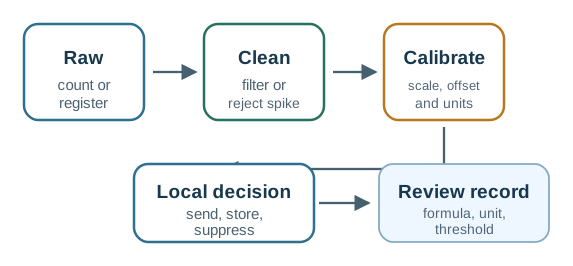
Read Figure 51.2 from the raw sensor value toward the review record. The first handoff preserves the count or register and its unit before a cleaning rule filters or rejects a spike. Calibration then attaches scale, offset, formula, and version, rather than replacing the source without a trace. The local decision records whether the result was sent, stored, or suppressed, together with its threshold or fallback rule. Finally, the review record keeps those facts in one chain. When a fused result changes, that chain lets the team separate a changed signal from cleaning, calibration, or policy drift.
Calibrate
Verify bias, scale, axis alignment, units, and placement before using measurements in a fused state.
Align Time
Fuse measurements by event time, not arrival time, and define how stale or missing readings are handled.
Gate Inputs
Reject measurements that violate range, physics, innovation, freshness, or sensor-health checks.
Retest
Rerun validation after firmware, enclosure, sensor supplier, clock, threshold, or deployment-environment changes.
Overview Knowledge Check
51.3 Practitioner: Use Gates Before Actuation
This section: Practitioner: Use Gates Before Actuation — Validation should happen before a fused estimate drives alerts, control, or actuation.
Validation should happen before a fused estimate drives alerts, control, or actuation. Simple gates catch obvious failures: missing values, stale timestamps, invalid units, impossible ranges, and physical jumps. Statistical gates catch subtler cases by comparing a measurement to the filter's prediction and uncertainty. In Kalman-style filters, this is often done with the innovation and its covariance.
The gate output should be stored as operational evidence, not treated as a private filter detail. An accepted measurement records the innovation, threshold, timestamp, and calibration version that justified the update. A rejected measurement records the same evidence plus the fallback state that was published instead. That record lets an engineer distinguish a real process jump from a clock fault, a bad noise estimate, or a sensor that returned after maintenance with a different offset.
Worked example: scalar innovation gate
predicted temperature: 22.0 deg C
predicted variance P: 0.25
new measurement z: 25.0 deg C
measurement variance R: 0.25

innovation:
y = z - prediction = 25.0 - 22.0 = 3.0

innovation variance:
S = P + R = 0.25 + 0.25 = 0.50

normalized innovation squared:
NIS = y^2 / S = 9.0 / 0.50 = 18.0

decision:
For a one-dimensional 95 percent chi-square gate, the threshold is about 3.84.
18.0 is above that gate, so reject or quarantine this measurement.
Do not feed it into the fused state until the cause is understood.
Practitioner Knowledge Check
51.4 Fusion Needs a Retreat Plan
This section: Fusion Needs a Retreat Plan — A production fusion system needs fault detection and exclusion, not just a best-effort estimate.
A production fusion system needs fault detection and exclusion, not just a best-effort estimate. Fault detection identifies suspect inputs through health, timing, residual, and consistency checks. Exclusion removes or downweights the suspect evidence. The retreat plan defines what the application does next: continue with reduced confidence, switch to a backup source, hold last good state for a bounded time, alert the operator, or stop actuating.
The retreat plan should be numeric enough to test. Suppose a gateway fuses three range sensors for a conveyor diverter. Normal mode requires at least two fresh sensors with residuals inside the gate. Degraded mode allows one fresh sensor for at most 5 s if the diverter remains below 0.5 m/s and an operator alert is active. Stop mode triggers when all sensors are stale, when the only fresh sensor has two consecutive rejected innovations, or when the calibration version no longer matches the approved release. Those thresholds make the fallback behavior reproducible instead of dependent on whoever reads the alarm.
Isolation should also record which state dimension was protected. If range sensors A, B, and C report residuals of 0.08 m, 0.11 m, and 0.72 m while the configured gate is 0.30 m, the system can exclude C from the position update without marking every sensor unhealthy. The published state should then say "two-of-three range evidence, C excluded, position-only confidence widened" rather than simply "healthy". If the excluded sensor later returns with residuals of 0.09 m, 0.07 m, and 0.06 m over three windows, the recovery rule can allow it back in. If it returns once at 0.09 m and then jumps to 0.41 m, it stays quarantined and the maintenance record remains open. This prevents a single lucky sample from hiding a loose mount, bad reference, or intermittent cable.
The same per-dimension discipline appears in one of the most common fusion products, 3-D orientation. The axis-by-axis panel in Figure 51.3 audits roll, pitch, and yaw separately — and the three axes do not come out equal.

Read Figure 51.3 from Roll down to Yaw: the first two axes each pair the drifting gyro rate with gravity as a steady anchor — two independent witnesses, so their innovation gates can stay tight. Yaw gets no help from gravity; its only anchor is the magnetometer, which nearby metal can skew without raising any fault code. The Degraded-mode rule applies this section’s exclusion principle to a single state dimension: when the magnetometer misbehaves, widen yaw alone and keep publishing tight roll and pitch, instead of degrading the whole orientation estimate or pretending nothing changed.
Detect
Use residuals, innovation spikes, heartbeat loss, saturation flags, and cross-sensor disagreement to identify suspect inputs.
Exclude
Remove, downweight, or quarantine invalid evidence. Record the exclusion reason and the affected state dimensions.
Degrade
Publish a lower-confidence mode when fewer sensors remain observable. Do not pretend the full system is still available.
Recover
Require a recovery rule before trusting a sensor again, such as stable residuals over several windows or a calibration check.
Practitioner Knowledge Check
Retreat-plan checklist for a fused output
normal: at least two fresh sensors, residuals inside gate, calibration current
degraded: one fresh sensor, bounded speed/load, alert active, max hold time set
exclude: record sensor id, rejected dimension, residual, threshold, and time
recover: require stable residuals over N windows plus a calibration/version check
stop: no fresh evidence, unsafe actuator state, or unapproved calibration version
Good exclusion is also reversible only through a defined recovery path. A sensor that failed one innovation gate should not rejoin the fused state just because its next sample looks reasonable; it may need several stable windows, a heartbeat check, or a reference comparison. The same rule protects model updates: if a new noise estimate changes which evidence is accepted, the release needs a replay of known normal, degraded, and fault cases before the new gate drives production decisions.
Under-the-Hood Knowledge Check
51.5 Summary
This section: Summary — Sensor fusion best practices make fused estimates auditable under real deployment conditions.
Sensor fusion best practices make fused estimates auditable under real deployment conditions. Calibration, event-time alignment, input sanity checks, physics limits, innovation gates, fault detection, exclusion, degraded modes, and recovery rules protect the fused state from stale or invalid evidence. The algorithm matters, but the operating contract around the algorithm is what keeps the output trustworthy.
A fusion system should never publish only a smooth number. It should publish a bounded estimate with current uncertainty, accepted and rejected evidence, sensor-health state, degraded-mode status, and retest triggers.
51.6 See Also
This section: See Also
Sensor Fusion Foundations
Review sensor roles, timing, uncertainty, and complementary evidence before applying production gates.
Kalman Filter for IoT
Connect innovation gating and uncertainty to state-estimation practice.
Data Quality Validation
Apply input validation and quality checks before data enters fusion logic.
Data Fusion Architectures
Place validation and fallback responsibilities across device, gateway, cloud, and application layers.
Find help
3 reviewed answers.
Where should I start in a module?
Open the module page from the sidebar to see its chapters in order. Use the module map to return to a topic you need.
Modules and pathsReviewed
What can I try when a project does not work?
Check the symptom, then work through the diagnostic steps. Keep the error message and the smallest example that reproduces it.
When you are stuckReviewed
How do interactive examples work?
Use the interactive guide to check how examples and simulations work before changing your project.
Interactive examples guideReviewed