60 Cloud Data: Quality and Security
More
Depth: Practitioner
Progress saves as you read. Mark sections complete as you go; your progress appears in the sidebar.
60.1 Start With the Story
This section: Start With the Story — Picture a cold store that sends a high-temperature alert to a duty manager.
Protect the Meaning as Well as the Record
Picture a cold store that sends a high-temperature alert to a duty manager. The number arrives in a shared data service, but its unit is missing and the device clock is wrong. The data team must decide whether to warn staff, hold the alert, or ask for a fresh reading.
Start with the decision, not the chart. Record the source, event time, unit, quality state, rule version, and person allowed to see or change the record. Keep those fields when data is cleaned, joined, stored, copied, or shown. A neat chart cannot repair lost meaning.
Test a late reading, a repeated row, a changed unit, a revoked user, a failed store, and a restored copy with an old rule. Check that bad data is marked rather than hidden and that each use leaves a clear trail. Also check that old copies leave when their stated purpose ends.
Keep the safe local alarm working when the shared service is late or unavailable. The remote path can compare sites and retain history, but it must not be the sole path for an urgent action.
This opening does not choose storage or prove that every reading is true. Practitioner builds the quality and access record. Under the Hood examines keys, lineage, restore tests, retention, and the controls needed at each step.
A cloud reading is fit for action when its units, lineage, access, and restore state can be checked.
60.2 Trust Needs Quality and Security
This section: Trust Needs Quality and Security — Cloud IoT data is useful only when it is trustworthy enough to act on and protected enough to share responsibly.
Cloud IoT data is useful only when it is trustworthy enough to act on and protected enough to share responsibly. Data quality asks whether readings are accurate, complete, consistent, timely, and traceable. Data security asks whether the data is confidential, intact, available, and accessible only to identities with a legitimate need.
These concerns should be designed into the pipeline, not patched into dashboards after release. A temperature anomaly, machine-risk score, smart-meter bill, or fleet route recommendation should carry evidence: source device, schema version, validation result, quality state, transformation lineage, access policy, retention class, and audit trail. Without that evidence, a system can be fast and polished while still being wrong or unsafe.
The practical contract is simple: do not let data drive decisions unless the pipeline can prove where it came from, how it was changed, whether it passed quality checks, who accessed it, and why it is still retained.
Trust can be lost before storage, during analysis, or after a dataset has outlived its purpose. Figure 60.1 places quality and security checks across the whole lifecycle so the release gate below can test more than encryption at rest.
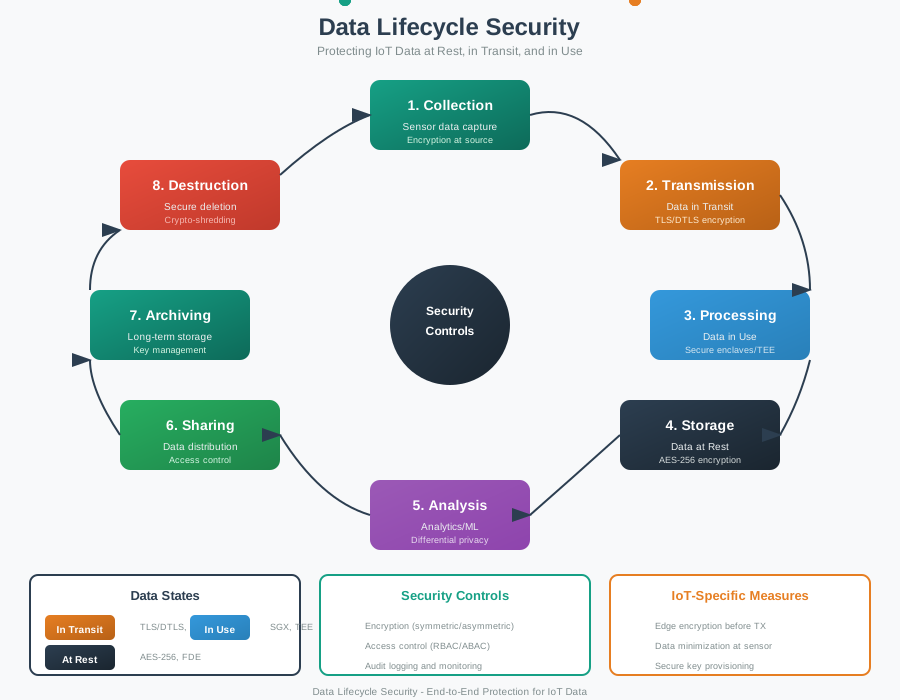
Follow the numbered stages in Figure 60.1 from 1. Collection, where minimisation and encryption at source govern sensor capture, through 2. Transmission under TLS/DTLS and 3. Processing in a secure enclave or TEE. 4. Storage pairs AES-256 with key management, while 5. Analysis and 6. Sharing add privacy and RBAC/ABAC controls. 7. Archiving retains protected evidence and 8. Destruction closes it with secure deletion or crypto-shredding. The lower In Transit, At Rest, and In Use bands show why the release record must attach validation, access, key, retention, and deletion evidence to each data state rather than declare the dataset trustworthy once.
Validate
Check schema, type, range, freshness, duplicates, calibration, and cross-sensor consistency before analytics.
Trace
Record source ids, offsets, table versions, transform versions, quality outcomes, and lineage references.
Protect
Use mTLS or TLS, encryption at rest, KMS or HSM-backed keys, IAM, network segmentation, and least privilege.
Govern
Classify data, define retention, mask sensitive fields, review access, and preserve audit evidence for release.
Overview Knowledge Check
60.3 Build Validation Release Gates
This section: Build Validation Release Gates — A cloud IoT pipeline should treat data quality as a release gate.
A cloud IoT pipeline should treat data quality as a release gate. The first gate is technical correctness: payload decodes, required fields exist, timestamps parse, and types match the schema. The second gate is format consistency: units, clocks, coordinate systems, and category names are canonical. The third gate is statistical and physical validation: values are plausible, rate-of-change is reasonable, and related sensors agree. The fourth gate is completeness and freshness: expected devices and windows have arrived within the decision deadline.
Each failed gate should produce evidence rather than silent deletion. Use a dead-letter queue, quarantine table, validation report, and alert rule. A rejected reading is often the first sign of a firmware problem, calibration drift, network corruption, or attempted data injection.
Worked example: HVAC reading quality score
incoming reading:
sensor_id: hvac-17
payload_temp_f: 85
timestamp: 2026-07-03T07:00:00Z
expected office range: 18 C to 26 C
historical mean: 22 C
historical standard deviation: 2 C

technical correctness:
payload decodes and required fields exist: pass

format consistency:
convert Fahrenheit to Celsius:
(85 - 32) * 5 / 9 = 29.4 C

statistical validation:
range check: 29.4 C is above 26 C
z-score: (29.4 - 22) / 2 = 3.7

quality decision:
mark reading as suspicious, not silently clean
keep original value, canonical value, rule id, and reason
route a copy to quarantine for sensor or HVAC review

release rule:
dashboards may show the value with a warning flag.
model training excludes suspicious values unless the training run explicitly
includes flagged records and documents why.
Clamping a bad value can be appropriate for a display, but the original value and rejection reason must remain available for audit and debugging.
Practitioner Knowledge Check
60.4 Security as Data Control
This section: Security as Data Control — Security controls are strongest when they are tied to the data contract.
Security controls are strongest when they are tied to the data contract. Device-to-cloud telemetry should use authenticated channels such as mTLS or token-based TLS. Stored data should use managed keys with rotation policy. Service accounts should have least privilege for specific topics, tables, and object prefixes. Sensitive fields should be classified, masked, tokenized, aggregated, or withheld according to purpose. Every human and service access should leave a reviewable log.
Retention is part of the same trust model. Holding raw data forever raises cost and privacy risk. Deleting too early breaks audit, replay, billing, and model investigation. A defensible policy names hot, warm, cold, aggregate, and deletion windows, plus who can place legal hold or privacy hold on a dataset.
Worked example: smart-meter minimization
fleet: 3,000,000 smart meters
reporting: one reading every 15 minutes
readings per meter per day: 96

daily readings:
3,000,000 * 96 = 288,000,000 readings/day

privacy-aware data products:
billing view:
meter-level kWh by billing period, restricted to billing roles

grid-balancing view:
postcode or feeder aggregate by hour, no direct customer id

customer portal view:
customer-specific detail only for authenticated customer and approved support role

release evidence:
data classification tag
purpose for collection
retention window
access policy id
key id
aggregation rule
lineage from raw reading to aggregate
audit log of reads and exports

design reading:
Minimization is not the same as deleting all data. The pipeline creates separate
data products for separate purposes, each with the smallest useful detail level
and its own retention and access policy.
Identity
mTLS, device certificates, token scopes, service-account boundaries, user MFA, and regular access review.
Encryption
TLS in transit, managed encryption at rest, KMS/HSM key ownership, rotation policy, and key-use logging.
Segmentation
Separate raw, curated, sensitive, tenant, and partner zones with network, table, and object-level policy.
Recovery
Backups, replay offsets, restore drills, incident roles, RTO/RPO targets, and immutable audit records.
Security and privacy reviews should therefore look at data products, not just infrastructure. A firewall rule cannot tell whether a dashboard is exposing raw location history to the wrong role. A key-management service cannot decide whether a dataset should be retained for 13 months or aggregated after 30 days. Those decisions belong in the data contract and must be verified before release.
Under-the-Hood Knowledge Check
The boundary map in Figure 60.2 tests whether a data-security claim survives from capture to use rather than stopping at cloud storage.

Read Figure 60.2 from Sensor + boot through Gateway, Transport, and Cloud services to Application. The END-TO-END SECURITY RECORD binds device identity, source time, schema, unit, key version, retention deadline, and command result, so encrypting one segment cannot disguise broken provenance or unsafe use.
60.5 Summary
This section: Summary
- Cloud IoT data needs both quality controls and security controls before it can safely support decisions.
- Validation should check schema, type, unit, timestamp, range, freshness, duplicates, calibration, and cross-sensor consistency.
- Provenance should record source, offsets, schema versions, transformation versions, quality outcomes, table versions, and release evidence.
- Security should bind device identity, transport encryption, encryption at rest, IAM, network segmentation, key management, and access logging to the data contract.
- Privacy and retention controls should create purpose-specific data products instead of exposing raw sensitive telemetry everywhere.
60.6 Key Takeaway
This section: Key Takeaway — Quality and security are not separate paperwork tracks.
Quality and security are not separate paperwork tracks. They are the evidence system that makes cloud IoT data safe to use: validate it, trace it, protect it, minimize it, retain it deliberately, and prove those controls before release.
60.7 Common Pitfalls
This section: Common Pitfalls
- Validating only inside dashboards after bad data has already entered storage and model-training tables.
- Deleting suspicious records without preserving the original value, rule id, and rejection reason.
- Treating encryption as sufficient security while ignoring identity, least privilege, access logs, retention, and data classification.
- Calling data anonymous without testing whether location, time, or device patterns can re-identify a person or organization.
- Keeping raw telemetry indefinitely because no one owns lifecycle rules.
60.8 See Also
This section: See Also
| If you want to… | Read this |
|---|---|
| Understand where quality and security fit in Levels 5-7 | Cloud Data IoT Reference Model |
| Choose cloud services that host these controls | Cloud Data Platforms and Services |
| Build validation and cleaning pipelines | Data Quality and Preprocessing |
| Fill short gaps without hiding uncertainty | Data Quality Imputation and Filtering |
| Operate freshness, replay, and retention runbooks | Big Data Operations |
Find help
3 reviewed answers.
Where should I start in a module?
Open the module page from the sidebar to see its chapters in order. Use the module map to return to a topic you need.
Modules and pathsReviewed
What can I try when a project does not work?
Check the symptom, then work through the diagnostic steps. Keep the error message and the smallest example that reproduces it.
When you are stuckReviewed
How do interactive examples work?
Use the interactive guide to check how examples and simulations work before changing your project.
Interactive examples guideReviewed