17 IoT Edge Models: Processing Levels
More
Depth: Practitioner
Progress saves as you read. Mark sections complete as you go; your progress appears in the sidebar.
17.1 Start With the Decision
This section: Start With the Decision — Keep the first design small.
Keep the first design small. Use one sensor, one local check, and one outside service.
17.2 Route Overview
This section: Route Overview — This is part 1 of 2.
This is part 1 of 2. Continue with IoT Edge Models: Cold-Chain Processing.
17.3 Part Objectives
This section: Part Objectives
- Test iot edge reference check with a concrete scenario and pass criteria.
- Validate level 3 processing functions in detail with a concrete scenario and pass criteria.
17.4 Start With the Story
This section: Start With the Story — Imagine a factory camera that notices a blocked walkway.
Imagine a factory camera that notices a blocked walkway. Sending every frame away would be slow and costly. An edge system does some work near the camera before it sends a result. Bandwidth means how much data a link can carry in a given time.
Start with the decision the system must support. Keep the first useful check close to the sensor when delay, privacy, or link cost matters. Send the evidence that another person needs to review the result. Then test a lost connection, a stale model, and a wrong alert. The design should say what continues locally and when a person must step in.
Keep the first design small. Use one sensor, one local check, and one outside service. Write the input and output in plain words. Time the local result. Time the sent result. Turn off the link. Show what the operator sees. Restore the link. Mark any old result. This short trial often reveals where the first useful decision should live.
Use a short placement review. Name the raw input. Name the first useful result. Set the latest safe response time. Mark any private data. Measure the link on a bad day. Decide what the device can do alone. Decide what the site can do offline. Send only what the next step needs. Keep enough detail to explain an alert. Record the model and rule in use. Mark old results as old. Give a person a clear way to pause a wrong action.
The best location is not always the nearest one. It is the place that meets the need and leaves honest evidence. Recheck that choice when data, links, models, or risks change.
This simple path does not decide every placement question. Some work belongs on the device, some at a site, and some in a central service. The Practitioner section maps those jobs to the IoT reference levels. Under the Hood examines timing, trust, and data-flow trade-offs.
Map each job to device, site, or central levels, then test the delay and trust boundary it crosses.
- Start With the Story
- In 60 Seconds
- IoT Edge Reference Check
- Key Concepts
- Edge in the IoT Model Basics
- Prerequisites
- IoT Reference Model Overview
- Level 1 Devices and Controllers
- Level 2 Connectivity
- Level 3 Edge Computing
- Putting Numbers to It
- Edge Bandwidth Savings Calculator
- Level 3 Processing Functions in Detail
- Checkpoint: Level 3 Transformation
This chapter follows data as it climbs the reference model:
- First separate the device, connectivity, edge-computing, and storage responsibilities.
- Then recompute the Level 3 bandwidth bill for vibration data.
- Next test the same functions against cold-chain monitoring and processing-location choices.
- Finally connect the model to application requirements, quizzes, and the placement-contract chapter.
Checkpoints recap the placement decisions. Calculation panels and practice exercises can be collapsed on a first read.
17.5 Learning Objectives
This section: Learning Objectives
By the end of this chapter, you will be able to:
- Explain the Seven-Level IoT Reference Model: Describe how data flows from physical devices through edge processing to cloud analytics
- Distinguish OT vs IT Layers: Classify which levels handle operational technology (data in motion) versus information technology (data at rest)
- Apply Level 3 Processing Functions: Implement evaluation, formatting, decoding, distillation, and assessment at the edge
- Design for Data Accumulation: Determine appropriate storage strategies at Level 4 based on data characteristics
Key Concepts
This section: Key Concepts
- IoT reference model: A standardised multi-tier architecture model (physical → network → middleware → application → business) that provides a common vocabulary and design framework for IoT system architects.
- Device tier: The lowest layer of the IoT reference model containing physical sensors, actuators, and embedded processing — the tier where edge patterns are most directly applied.
- Connectivity tier: The network layer responsible for transporting sensor data from devices to higher processing tiers, using protocols suited to the device’s power, range, and bandwidth constraints.
- Edge analytics tier: An intermediate processing layer (typically gateways or fog nodes) that applies data reduction, event detection, and protocol translation before forwarding to cloud.
- Cross-tier optimisation: Designing computation placement, data formats, and communication frequencies across multiple tiers simultaneously rather than optimising each tier in isolation.
This chapter shows where edge data processing fits in the larger IoT architecture. Think of understanding where the kitchen sits in a restaurant floor plan — knowing the overall layout helps you design each part to work well with the others. The IoT reference model maps out how data flows from sensors through edge devices to the cloud.
17.6 Prerequisites
This section: Prerequisites — Use those prerequisites as orientation: this chapter names the reference-model levels first, then asks which evidence each layer should produce.
Before diving into this chapter, you should be familiar with:
- Edge Compute Patterns Overview: Introduction to edge computing concepts and application types
- Edge, Fog, and Cloud Overview: Understanding the three-tier architecture
Use those prerequisites as orientation: this chapter names the reference-model levels first, then asks which evidence each layer should produce.
17.7 IoT Reference Model Overview
This section: IoT Reference Model Overview — The IoT Reference Model provides a structured framework for understanding where data processing occurs in IoT systems.
The IoT Reference Model provides a structured framework for understanding where data processing occurs in IoT systems. It spans seven levels, from physical devices at the bottom to business collaboration at the top. Start with Figure 17.1 because placement only becomes meaningful once the whole path and the Level 3 transformation boundary are visible.
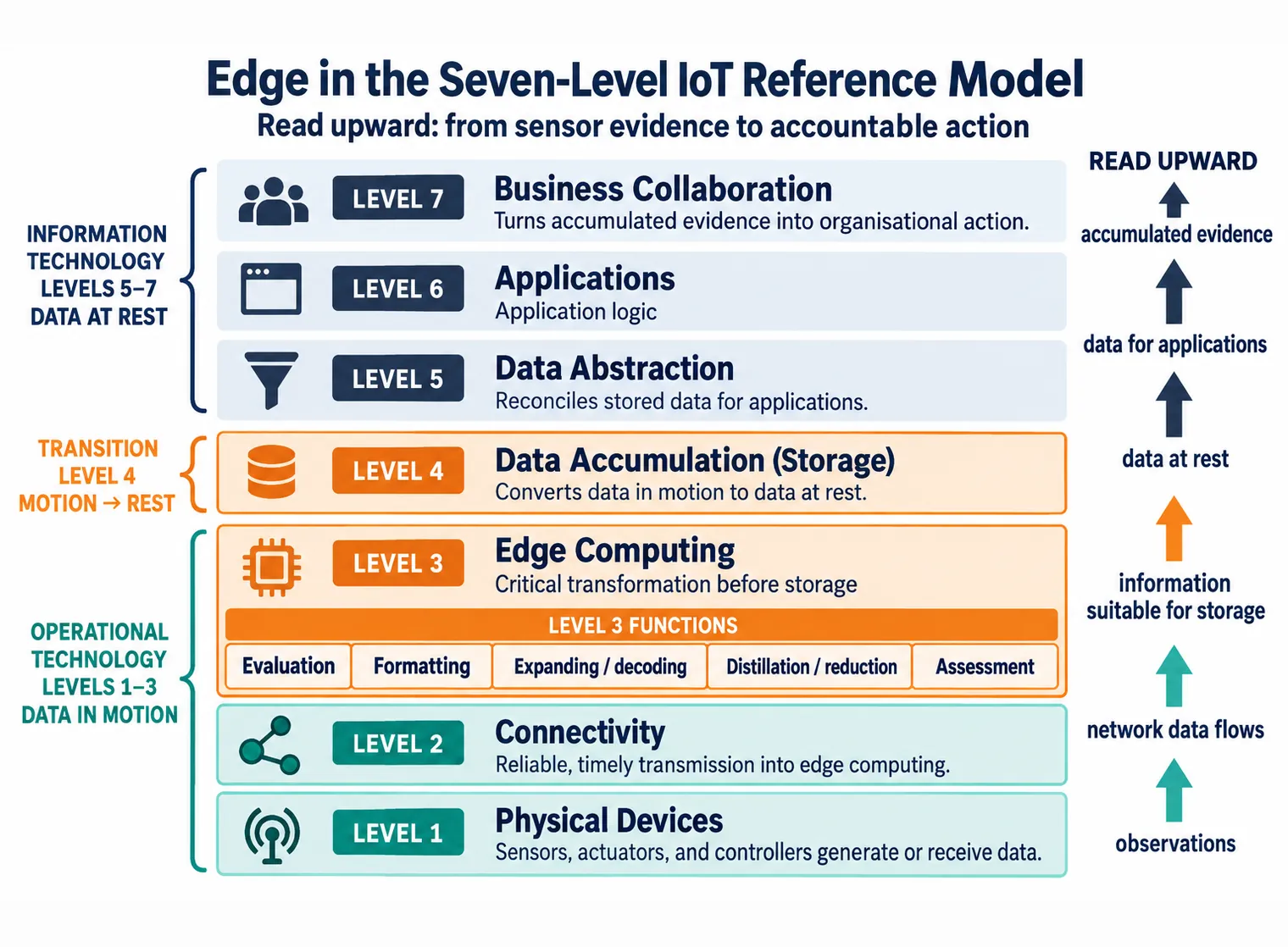
Read Figure 17.1 from Level 1 upward. Devices create observations, connectivity moves them, and Level 3 evaluates, formats, distils, or assesses them before Level 4 makes data durable. Higher levels then analyse, present, and turn accumulated evidence into organisational action. With that path established, the timeline in Figure 17.2 shows what changes when a response stops locally or continues upward.
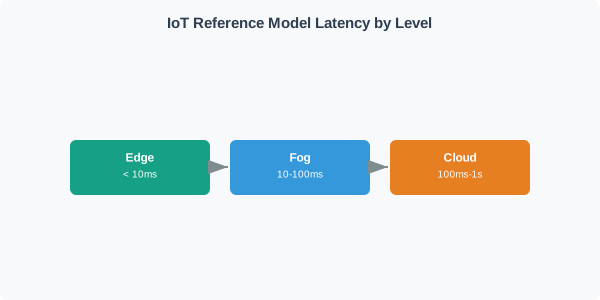
Read Figure 17.2 from the local branch to the cloud branch. The local route stops at Level 3 for a response measured in tens of milliseconds, whereas the cloud route crosses accumulation and higher-level processing and can take seconds or longer. The comparison connects level placement to the chapter’s running constraints—latency, bandwidth, and the amount of context required by the decision. The architecture comparison in Figure 17.3 applies that timing distinction to complete system shapes.
IoT Reference Model Levels 1-7: Seven-layer architecture showing transition from Operational Technology (data in motion, Levels 1-3) to Information Technology (data at rest, Levels 5-7). Level 3 edge computing performs critical functions: evaluation, formatting, reduction, and assessment before data accumulation at Level 4.
The paired architecture diagram in Figure 17.3 asks whether immediate device traffic must reach the central service or can terminate at a governed local node.
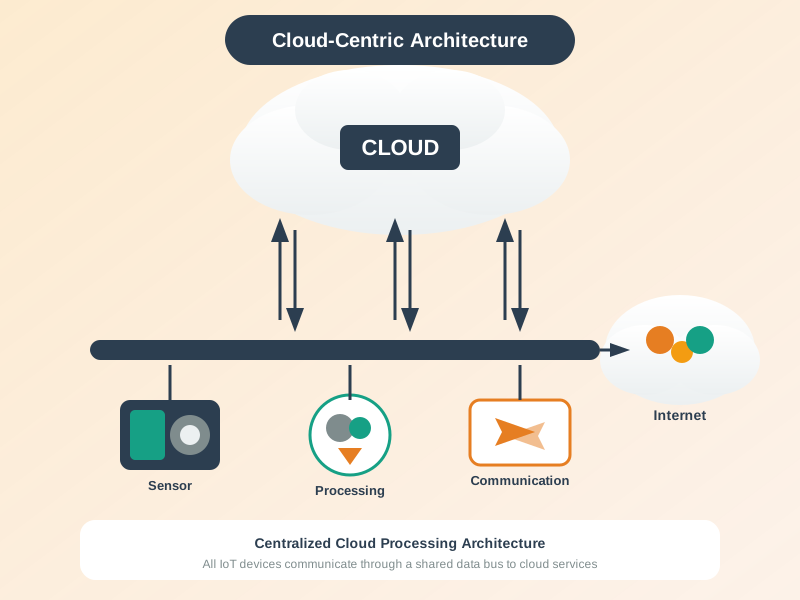
Start with the cloud-centric route in Figure 17.3. Every device crosses the shared bus to reach the central service, so a lost upstream path also removes its immediate decision point. Then compare the edge-centric route. Its governed local node absorbs nearby processing and can keep selected decisions close to the source, even though summaries still join the larger data path. The choice is therefore about dependency, not whether the cloud exists. The layered view that follows places that local node within the wider system.
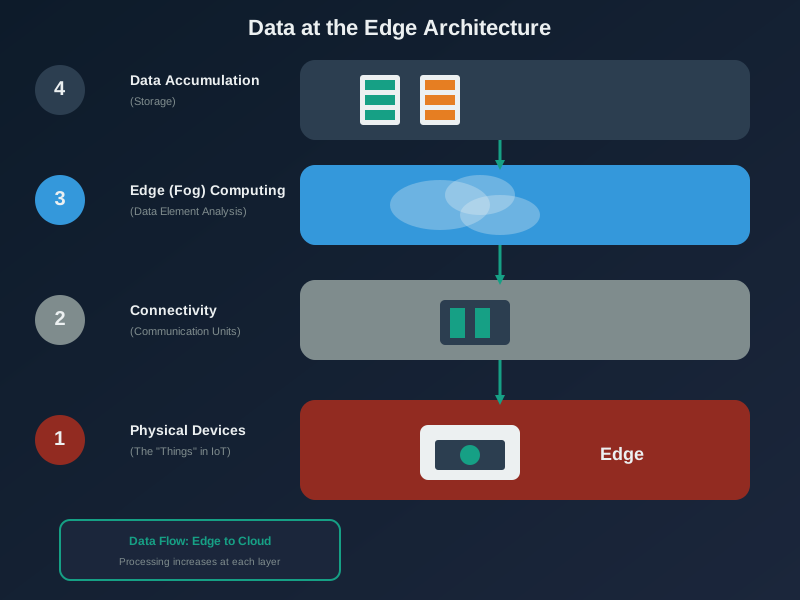
Trace Figure 17.4 from devices through filtering and aggregation at the edge to cloud analytics and storage. That order shows that edge and cloud are complementary tiers, not competing labels: the edge handles bounded, time-sensitive reduction, and the cloud retains the broader history and compute needed for fleet analysis and business collaboration. This completes the running route from reference-model level to latency consequence and then to an implementable tier boundary.
Practitioner Knowledge Check
17.8 Level 1 Devices and Controllers
This section: Level 1 Devices and Controllers — The IoT Reference Model starts with Level 1: Physical devices and controllers that might control multiple devices.
The IoT Reference Model starts with Level 1: Physical devices and controllers that might control multiple devices. These are the ‘Things’ in the IoT, and they include a wide range of endpoint devices that send and receive information. Today, the list of devices is already extensive and it will become almost unlimited as more equipment is added to the IoT over time.
Device Categories at Level 1:
| Category | Examples | Data Generated |
|---|---|---|
| Sensors | Temperature, humidity, pressure, motion | Continuous measurements |
| Actuators | Motors, valves, switches, displays | State changes, commands |
| Controllers | PLCs, MCUs, embedded systems | Processed signals, control loops |
| Gateways | Protocol converters, edge boxes | Aggregated device data |
17.9 Level 2 Connectivity
This section: Level 2 Connectivity — Level 2 contains communications and connectivity — providing reliable, timely information transmission.
Level 2 contains communications and connectivity — providing reliable, timely information transmission. This includes transmissions from devices (Level 1) to the network, across the network, and into the edge computing layer (Level 3).
Before treating Level 2 as a reliable transport layer, inspect Figure 17.5 to see where its promises must be tested. The numbered topology makes the route concrete: devices may use different access links, may hand traffic to a gateway, and may reach the backend through different failure and trust boundaries. That is why connectivity must be reviewed as a set of constrained paths rather than as one abstract link.
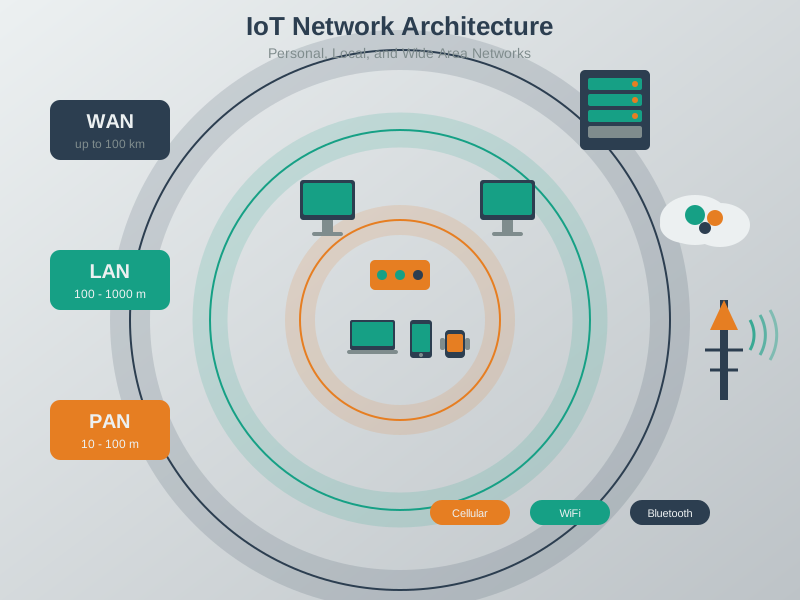
Trace Figure 17.5 from devices through their Wi-Fi, cellular, LoRaWAN, or wired links and any gateway toward the backend. Compare range, power, bandwidth, and failure boundaries before treating the paths as equivalent connectivity. A gateway changes protocol and trust responsibilities, while a direct IP path moves more of those responsibilities onto the device. This advances the reference-model narrative: Level 2 must deliver the identity, time, and payload evidence that Level 3 is expected to evaluate and transform.
Connectivity Considerations:
- Protocol selection: Match protocol to bandwidth, range, and power requirements
- Network topology: Star, mesh, or hybrid depending on reliability needs
- Reliability mechanisms: Acknowledgments, retransmission, error correction
- Security: Encryption, authentication at the transport layer
17.10 Level 3 Edge Computing
This section: Level 3 Edge Computing — Level 3 focuses on high-volume data analysis and transformation.
Level 3 focuses on high-volume data analysis and transformation. It converts network data flows from Level 2 into information suitable for storage and higher-level processing at Level 4 (data accumulation). Level 3 processing can include:
- Evaluation: Applying criteria to determine if data should be processed at a higher level
- Formatting: Reformatting data to improve consistency
- Expanding/decoding: Decrypting data and translating device-specific code
- Distillation/reduction: Distilling data to reduce the amount of network traffic
- Assessment: Determining whether data should trigger a response
17.11 Putting Numbers to It
This section: Putting Numbers to It
Consider a fleet of 100 vibration sensors sampling at 10 kHz (10,000 samples/sec):
Without Level 3 processing (raw transmission to cloud):
With Level 3 edge processing (512-point FFT every 51.2 ms):
- Transmit only top 20 frequency components (40 bytes) at ~19.5 Hz
Result: Level 3 achieves about 96% cost reduction ($777.60 to $30.38/month) while preserving spectral anomaly detection. This is the power of distillation at the edge.
17.12 Edge Bandwidth Savings Calculator
This section: Edge Bandwidth Savings Calculator — Use this interactive calculator to explore how edge processing reduces bandwidth and cost for vibration monitoring fleets.
Use this interactive calculator to explore how edge processing reduces bandwidth and cost for vibration monitoring fleets.
The architecture diagram in Figure 17.6 connects the calculator’s bandwidth result to the physical processing path that produces it.
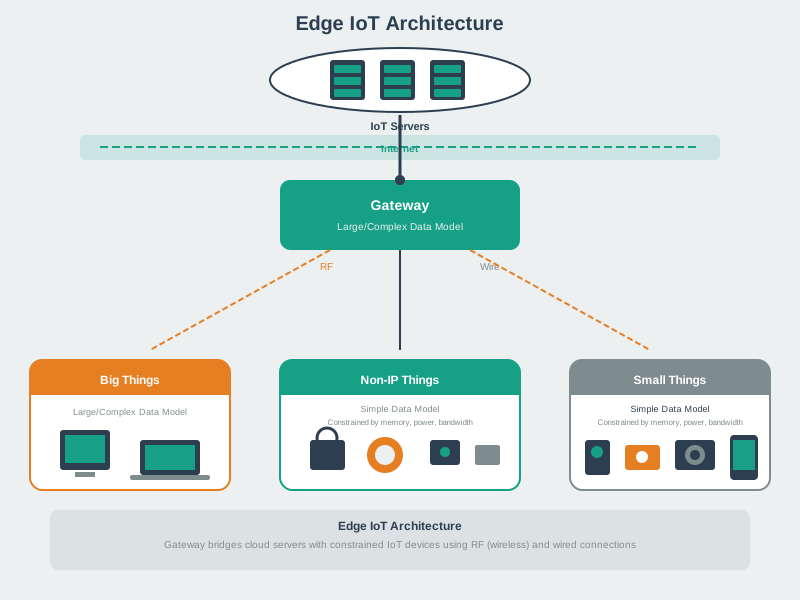
Read Figure 17.6 from the sensors to the edge gateway. The gateway tests, filters, and groups the data before it sends a smaller stream to the cloud. Compare the raw and reduced paths with the result from the calculator. The math gives the size of the saving, while the diagram shows where it is made. That point must also keep the meaning of each event. A lower byte count is useful only if the cloud can still make its decision and the gateway logs what it dropped or grouped.
17.13 Level 3 Processing Functions in Detail
This section: Level 3 Processing Functions in Detail — Read the Level 3 Processing Functions in Detail material as a decision path rather than as isolated entries.
Read the Level 3 Processing Functions in Detail material as a decision path rather than as isolated entries. First identify the operating condition in each entry and keep its units, timing, source, and assumed system state attached to it. Next compare the entries at the point where responsibility changes between device, gateway, network, analytic service, and operator; that hand-off is where apparently similar choices often produce different outcomes. Then follow the failure case: ask what becomes stale, delayed, unavailable, or unsafe, who detects it, and what evidence permits recovery. Finally connect the result to the chapter’s running design record by naming the selected behavior, the rejected alternative, the measurement that justifies the choice, and the condition that forces a recheck. That order turns the examples or comparison into an auditable engineering argument.
Evaluation determines whether data warrants further processing:
Raw reading: temperature = 23.4 C
Evaluation criteria: Alert if > 30 C or < 10 C
Result: Within normal range -> do not escalate
Formatting standardizes data from heterogeneous sources:
Device A reports: {"temp": 23.4, "unit": "C"}
Device B reports: {"temperature_f": 74.12}
Formatted output: {"temperature_celsius": 23.4, "timestamp": "2026-01-19T10:30:00Z"}
Distillation reduces data volume while preserving key information:
Input: 1000 temperature readings over 1 minute
Distillation: min=22.1, max=24.8, avg=23.4, stddev=0.5
Output: 4 values instead of 1000 (99.6% reduction)
Assessment triggers immediate local responses:
Vibration reading: 8.5 g-force (threshold: 5.0)
Assessment: CRITICAL - exceeds safe operating limit
Action: Trigger immediate machine shutdown (local actuator)
This section:
 Checkpoint: Level 3 Transformation
You now know:
- Levels 1-2 collect and move operational data before edge processing changes it.
- Level 3 evaluates, formats, decodes, distills, and assesses data before storage.
- The vibration example drops monthly transfer from 5,184 GB and $777.60 to 202.5 GB and about $30.38.
This section:
17.14 Continue to the Next Part
This section: Continue to the Next Part — Carry this evidence into IoT Edge Models: Cold-Chain Processing, which begins with Cold Chain Edge Processing.
Carry this evidence into IoT Edge Models: Cold-Chain Processing, which begins with Cold Chain Edge Processing.
Find help
3 reviewed answers.
Where should I start in a module?
Open the module page from the sidebar to see its chapters in order. Use the module map to return to a topic you need.
Modules and pathsReviewed
What can I try when a project does not work?
Check the symptom, then work through the diagnostic steps. Keep the error message and the smallest example that reproduces it.
When you are stuckReviewed
How do interactive examples work?
Use the interactive guide to check how examples and simulations work before changing your project.
Interactive examples guideReviewed