31 IoT Machine Learning Fundamentals
More
Depth: Practitioner
Progress saves as you read. Mark sections complete as you go; your progress appears in the sidebar.
31.1 Begin With One Decision
This section: Begin With One Decision — Machine learning means using examples or patterns to make a useful estimate.
Machine learning means using examples or patterns to make a useful estimate. Firmware is the code that runs on a device. Picture a pump that may need a service visit. A model could score its sound, heat, and flow. First state the decision that the score may support. Do not start with a model name.
Name the event to predict and the cost of a wrong answer. Mark where the examples came from. Keep train and test cases apart. Compare the model with a plain rule. Then try a simple field check. Feed it a common case, a rare case, a missing value, and a case from a new site. Record the score, input version, model version, and safe fallback.
A rich model may catch a weak pattern, but it can be hard to explain and costly to run. A small model may fit on the device, but it may miss change. A good test score does not prove safe field use. Use the Practitioner layer to review data, measures, splits, and guardrails. Use the Under the Hood layer to define the input and output contract, device or cloud run point, drift checks, and fallback. The deeper routes bound the claim; they do not turn a score into a fact.
Keep one example from start to end. Show the raw values. Show each clean step. Show the features. Show the expected label. Show the score. Show the limit and final act. A reviewer should be able to find the first point where the wrong act began.
Use a holdout that looks like future work. Do not let copies of the same event sit on both sides. Report misses and false alarms, not just one mean. Read a few wrong cases by hand. They often show a bad label, a missing group, or a weak input.
Set the safe fallback before release. A missing model is a normal fault case. The device or service must know whether to wait, use a plain rule, ask a person, or stop the act.
31.2 Start With the Story
This section: Start With the Story — A model claim starts with the sensor data, target label, and action it is meant to support.
A model claim starts with the sensor data, target label, and action it is meant to support.
-
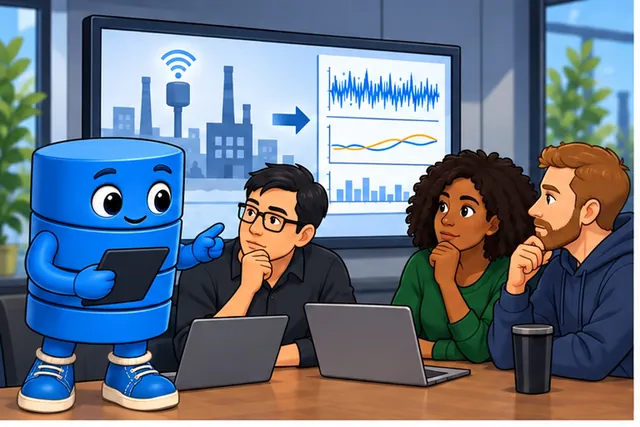
A device record is about to drive a machine-learning alert.
-
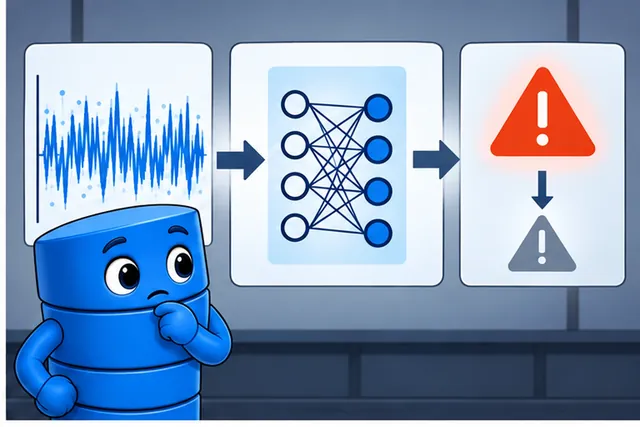
Messy input can turn a sure model result into a bad action.
-

Keep the input, data treatment, model result, and test visible.
-
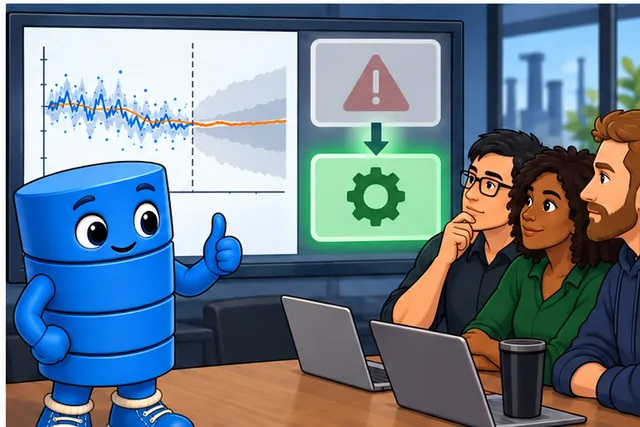
Act only when a reviewer can trace why the result should be trusted.
31.3 Overview: What an IoT ML Claim Means
This section: Overview: What an IoT ML Claim Means — Machine learning in IoT means using data from devices, sensors, gateways, applications, and operations records to make a repeatable prediction or classification.
Machine learning in IoT means using data from devices, sensors, gateways, applications, and operations records to make a repeatable prediction or classification. The useful claim is not “we use AI.” The useful claim is that a named model can turn a defined input stream into a decision that is accurate enough, timely enough, explainable enough, and maintainable enough for a specific deployment.
Traditional firmware and application logic usually encode known cases directly: if a message, reading, or event matches this rule, take this action. A machine-learning workflow keeps the decision explicit, but lets a fitted model learn the boundary from examples. Training data, labels, features, and observed errors change the model parameters; inference then reuses that fitted boundary on future readings. The code path can be reused across problems, but the learned pattern is only as good as the examples and validation record behind it.
That boundary matters because IoT data is rarely a clean spreadsheet. Sensors drift, batteries sag, gateways miss packets, clocks disagree, labels can be delayed, devices move, and normal behavior can change with season, site, user, firmware, or workload. A model that looks strong in a notebook may still fail if the data path, label meaning, feature pipeline, deployment target, and monitoring plan are not reviewed together.
If you only need the intuition, this layer is enough: approve IoT machine learning from a bounded decision and evidence trail, not from an algorithm name. Name the decision, input data, labels, features, model role, deployment point, fallback behavior, owner, and retest trigger.
Worked example: for a pump-vibration classifier, the reviewable claim is not “predict failure.” A tighter claim is “use a 10-second acceleration window from the motor housing to flag likely bearing wear within 2 seconds, send the alert to maintenance, suppress it when the sensor health check fails, and retest after sensor replacement or firmware changes.” That wording exposes what data must exist, which label history is relevant, where inference can run, which operator receives the result, and which operational change invalidates the previous evidence. It also gives reviewers a concrete checklist to test before a model becomes a production dependency.
The lifecycle diagram in Figure 31.1 is the chapter’s first test of an ML claim: it makes the field evidence and the post-release feedback as visible as model training.
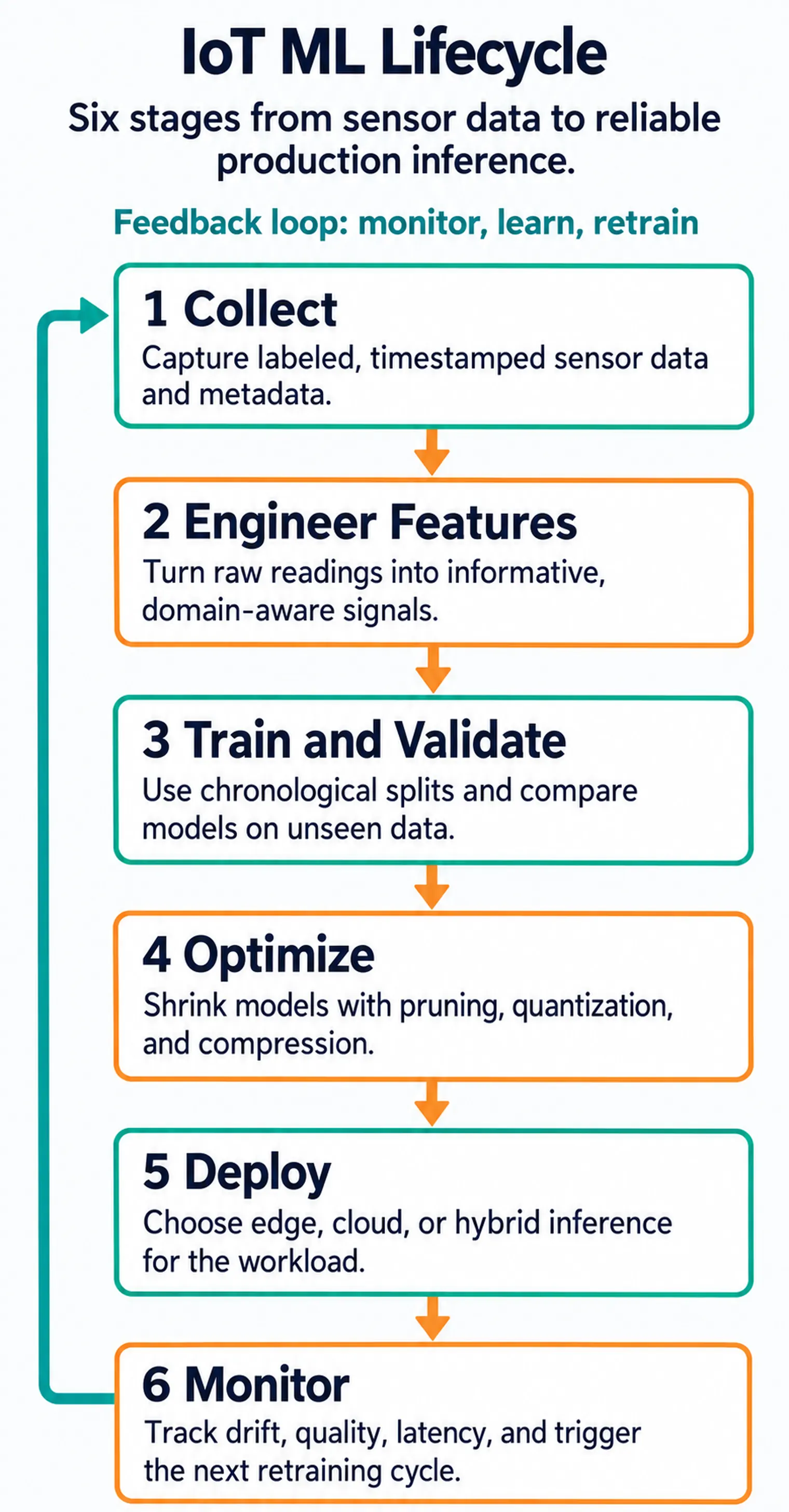
Read Figure 31.1 from collection through feature engineering, training and validation, optimisation, deployment, and monitoring. Each arrow is a contract: labels must match the decision, deployed features must repeat the training recipe, optimisation must preserve accepted behavior, and monitoring must detect changed inputs or outcomes. Finally follow the feedback arrow to collection; it shows that production evidence can narrow or renew the claim. This connects the lifecycle to the running narrative: an IoT ML result is a maintained system claim, not a score frozen in a notebook.
The First Evidence Boundaries
Decision
State what the model is allowed to decide: classify an activity, flag an anomaly, estimate remaining life, choose a control action, or route a review.
Data and labels
Record where examples came from, how labels were assigned, what context was captured, and which examples are out of scope.
Features and model
Show how raw readings become features, which baseline or model is used, and why the evaluation metric fits the operational cost.
Deployment and monitoring
Define where inference runs, what happens on low confidence or missing data, who owns alerts, and when the model must be retested.
Beginner Examples
Read the Beginner Examples material as a decision path rather than as isolated entries. First identify the operating condition in each entry and keep its units, timing, source, and assumed system state attached to it. Next compare the entries at the point where responsibility changes between device, gateway, network, analytic service, and operator; that hand-off is where apparently similar choices often produce different outcomes. Then follow the failure case: ask what becomes stale, delayed, unavailable, or unsafe, who detects it, and what evidence permits recovery. Finally connect the result to the chapter's running design record by naming the selected behavior, the rejected alternative, the measurement that justifies the choice, and the condition that forces a recheck. That order turns the examples or comparison into an auditable engineering argument.
- A vibration model that flags a motor fault needs sensor placement, sample window, maintenance-label meaning, normal operating range, alert handling, and retest evidence.
- An activity-recognition model for a wearable needs user diversity, device orientation, sampling behavior, privacy boundaries, battery impact, and confidence handling.
- A gateway anomaly detector may be useful even when it is simple, if the baseline is reviewed, false alarms are manageable, and stale or missing data is handled explicitly.
- A high validation score does not approve deployment by itself. The score must come from a split that reflects how the model will see future data.
Common Learning Shapes
It is tempting to treat machine learning as a black box: feed examples into a model, accept the output, and celebrate when the answer looks useful. The safer view is to treat the model as one tool in a reviewable toolbox. A black-box output is not enough for an IoT decision unless the examples, labels, features, split, metric, fallback rule, and owner are still visible.
Supervised Learning
Training examples include expected outputs. The team names the categories or numeric target before training and checks whether the fitted model can repeat that mapping on held-out data.
Unsupervised Learning
Examples arrive without expected outputs. The model looks for groups, clusters, or structure, and the team still has to decide whether those discovered groupings are useful and safe for the product decision.
Regression
The output is a continuous value such as price, remaining battery life, temperature, vibration severity, or time to service. Error size and operating units matter.
Classification
The output is a category such as normal, warning, fault, open, closed, occupied, or review. Class balance, false alarms, missed cases, and unsupported inputs matter.
Feature representation is the bridge between raw data and these learning shapes. Each feature acts like a dimension in the model's coordinate system: one feature might encode color, another weight, another recent vibration energy, and another missing-sample count. Choosing features is therefore not only a coding step. It defines what differences the model can see, what it may ignore, and which errors must be caught during validation.
Model families draw different boundaries through that feature space. A nearest-neighbour classifier assigns a new example by looking at nearby labeled examples, so the choice of k and the feature scale can change the answer. Decision trees split on one feature test at a time; random forests combine many such trees so one brittle split does not dominate. Support vector machines look for a separating margin, can extend multi-class work through one-versus-rest classifiers, and can use kernels to make nonlinear separation possible after mapping examples into a richer feature space. These names are useful only when the release record also preserves the feature set, scaling rule, validation split, latency budget, and fallback behavior.
More dimensions can make classes easier to separate, but they can also create false confidence. A model is strongest in the region represented by its training examples; outside that region there are no guarantees unless validation deliberately held out the relevant user, device, site, season, or operating mode. High-dimensional feature sets therefore need the same discipline as simple ones: test the deployment boundary, watch for drift, and route unsupported inputs to review instead of forcing every point into the nearest known class.
Overfitting is the warning sign that the learned boundary has memorized special cases instead of learning a decision that travels. A high-degree curve can pass close to every training point while swinging away from held-out examples; a high-dimensional classifier can draw tiny pockets around examples that look convincing in training but fail in deployment. Prefer the simplest boundary that preserves the required signal, then prove it with held-out users, devices, sites, seasons, or time periods that match the intended generalization claim.
Overview Knowledge Check
31.4 Reviewable ML Workflow
This section: Reviewable ML Workflow — A practical IoT ML workflow starts before model training.
A practical IoT ML workflow starts before model training. It starts by writing the operational decision in plain language, then preserving the chain from physical observation to model output. That chain includes the sensor, placement, timestamp, gateway, storage record, cleaning rule, label source, feature code, model artifact, deployment target, alert rule, and feedback loop.
The safest first model is often a baseline: a threshold, ruleset, statistical profile, or simple classifier that the team can explain. More complex models are useful when they improve the decision under the same evidence boundary. Complexity is not a substitute for a clear train-test split, class-balance check, leakage review, and production monitoring plan.
A Review Sequence
Read the A Review Sequence material as a decision path rather than as isolated entries. First identify the operating condition in each entry and keep its units, timing, source, and assumed system state attached to it. Next compare the entries at the point where responsibility changes between device, gateway, network, analytic service, and operator; that hand-off is where apparently similar choices often produce different outcomes. Then follow the failure case: ask what becomes stale, delayed, unavailable, or unsafe, who detects it, and what evidence permits recovery. Finally connect the result to the chapter's running design record by naming the selected behavior, the rejected alternative, the measurement that justifies the choice, and the condition that forces a recheck. That order turns the examples or comparison into an auditable engineering argument.
- Name the decision. Write the prediction or classification, who uses it, how fast it must arrive, and what a wrong result costs.
- Freeze the data meaning. Record sensor units, sampling interval, placement, device state, clock behavior, missing-data rules, and label source.
- Build features deliberately. Use windows, summaries, frequencies, rates, context, or event counts that match the decision and can be reproduced at inference time.
- Evaluate with the right split. Prefer splits that mimic deployment: future time periods, different devices, different sites, or different users when that is the expected generalization challenge.
- Deploy with guardrails. Define low-confidence behavior, manual review, rollback, versioning, telemetry, drift checks, and retest triggers.
Metric Choice
IoT models often face imbalanced events. Equipment failures, falls, leaks, intrusions, and unsafe states are usually less common than normal operation. In those cases, overall accuracy can be misleading because a model can look strong while missing the event that matters. Review the metric against the decision: precision for alert burden, recall for missed hazards, latency for response time, calibration for confidence use, and error distribution for regression tasks.
For regression outputs, do not stop at "the line looks close." Pearson correlation measures how strongly two normally distributed numeric variables move together, while Spearman correlation measures whether their rank ordering agrees. Both can help summarize predicted versus actual values, but they do not replace error size in the operating unit. A temperature model with a high correlation can still be unacceptable if its readings are consistently offset by 3 degrees C.
For classification outputs, start from the confusion matrix and then choose the metric that matches the action. True positives, false positives, false negatives, and true negatives support accuracy, precision, recall, F1 score, sensitivity, specificity, and false-positive rate. Multi-class matrices add an extra diagnostic layer: off-diagonal cells show which classes are being confused, such as neighbouring gesture, activity, or character labels. Receiver operating characteristic curves show how true-positive and false-positive rates move as a threshold changes; a conservative threshold usually reduces false positives but can miss more real events, while a liberal threshold catches more positives and creates more review burden.
Practitioner Knowledge Check
31.5 ML Inference Contract
This section: ML Inference Contract — Under the hood, an IoT ML system is a chain of contracts.
Under the hood, an IoT ML system is a chain of contracts. The data contract says what each reading means. The feature contract says how a repeatable input vector is built. The label contract says what the model is supposed to learn. The model contract says how predictions are produced. The inference contract says how the deployed system handles timing, missing values, low confidence, and model versions.
The most common deep failure is a mismatch between training and inference. A feature may be calculated with future data during training but only past data during deployment. A label may be available from maintenance logs weeks after the event, while the deployed system needs an immediate warning. A gateway may batch data during training export, while edge inference receives partial windows. These mismatches create optimistic evaluation and fragile field behavior.
A practical contract bundles the model file with the scaler, feature order, units, threshold, supported sensor firmware, and fallback behavior. For example, changing a temperature feature from Celsius to Fahrenheit, dropping a calibration-age field, or moving from complete hourly windows to partial five-minute windows is not a harmless implementation detail. It changes the input distribution and may make the validation result irrelevant. The review should be able to replay a held-out record through the exact production path and explain why the same feature vector, confidence value, and action would be produced. If replay requires a manual spreadsheet step, an undocumented gateway export, or a field that is unavailable during live operation, the inference contract is not yet controlled. That replay evidence is often the fastest way to find hidden train-serve gaps.
Training and Inference Are Different Jobs
Training
Uses historical examples to fit model parameters. It can be slower, can run offline, and can inspect carefully prepared datasets.
Validation
Tests whether the fitted model generalizes to data that reflects the future deployment boundary, not just the training records.
Inference
Runs the frozen model on current inputs. It must use the same feature meaning, handle incomplete data, and meet latency and resource limits.
Monitoring
Checks whether input quality, feature distributions, confidence, alert rates, and outcome feedback still support the approved model claim.
Failure Boundaries to Separate
Read the Failure Boundaries to Separate material as a decision path rather than as isolated entries. First identify the operating condition in each entry and keep its units, timing, source, and assumed system state attached to it. Next compare the entries at the point where responsibility changes between device, gateway, network, analytic service, and operator; that hand-off is where apparently similar choices often produce different outcomes. Then follow the failure case: ask what becomes stale, delayed, unavailable, or unsafe, who detects it, and what evidence permits recovery. Finally connect the result to the chapter's running design record by naming the selected behavior, the rejected alternative, the measurement that justifies the choice, and the condition that forces a recheck. That order turns the examples or comparison into an auditable engineering argument.
- Sensor failure: The physical reading is wrong, missing, delayed, or observed under a condition the model never saw.
- Feature failure: Windows, units, scaling, timestamps, or context fields differ between training and deployed inference.
- Label failure: The recorded outcome is delayed, subjective, inconsistent, or not the decision the deployed system must make.
- Split failure: The evaluation set is too similar to training data, so the reported result does not represent future devices, sites, users, or time periods.
- Operations failure: No one owns alert response, threshold updates, feedback capture, rollback, or model retirement.
A Minimal Inference Contract
Under-the-Hood Knowledge Check
The two patterns in Figure 31.2 locate the modeling choice before a learner is trained.

In Figure 31.2, EARLY FUSION concatenates [mean, slope], [RMS, kurtosis], and [peak, THD] into one 6-feature vector. LATE FUSION instead sends sensor-specific decisions to vote or weighted combiner, which can emit a class or a regression estimate and can isolate one missing sensor more cleanly.
31.6 Summary
This section: Summary
- IoT machine learning approval starts with a bounded decision, not with the words “AI” or “model.”
- Data, labels, features, evaluation splits, model artifacts, deployment targets, fallback rules, owners, and retest triggers need separate evidence.
- Overall accuracy can hide the rare events that often matter most in IoT, so metrics must match the operational cost of false alarms, misses, latency, and uncertainty.
- Training, validation, inference, and monitoring are different jobs; the review must prove that their data and feature meanings stay aligned.
- A deployed model needs a versioned artifact, reproducible feature pipeline, unsupported-input behavior, rollback path, and feedback loop.
Approve an IoT ML system only when the model result is tied to a specific decision, reproducible data and feature contracts, deployment behavior, monitoring owner, and retest boundary.
31.7 See Also
This section: See Also
Feature Engineering for ML
Build reviewable feature windows, units, labels, leakage controls, and operational feature meaning.
IoT Machine Learning Pipeline
Connect sensing, labels, training, evaluation, deployment, monitoring, and feedback into one workflow.
Edge ML and TinyML Deployment
Review model size, latency, power, update paths, telemetry, fallback behavior, and drift evidence.
Production ML Monitoring
Monitor drift, data quality, model performance, alert handling, rollback plans, and release evidence.
Find help
3 reviewed answers.
Where should I start in a module?
Open the module page from the sidebar to see its chapters in order. Use the module map to return to a topic you need.
Modules and pathsReviewed
What can I try when a project does not work?
Check the symptom, then work through the diagnostic steps. Keep the error message and the smallest example that reproduces it.
When you are stuckReviewed
How do interactive examples work?
Use the interactive guide to check how examples and simulations work before changing your project.
Interactive examples guideReviewed