56 Edge Data Reduction Review
56.1 Learning Objectives
By the end of this chapter, you will be able to:
- Calculate Data Reduction Ratios: Compute bandwidth savings from downsampling, aggregation, and filtering
- Apply Multi-Stage Processing: Design data pipelines that combine multiple reduction techniques
- Evaluate Cost Savings: Quantify cloud ingress savings from edge processing
- Solve Real-World Scenarios: Apply mathematical models to factory, agriculture, and smart city deployments
Key Concepts
- Change-of-value (CoV) reporting: Only transmitting a new sensor reading when it differs from the previous reading by more than a configured threshold, achieving dramatic reduction for slowly changing signals.
- Temporal aggregation: Replacing a sequence of readings with summary statistics (min, max, mean, std) over a time window, reducing data volume by the window length factor.
- Spatial aggregation: Combining readings from physically proximate sensors into a single area-representative value, reducing total message count in dense sensor deployments.
- Semantic compression: Encoding sensor readings using domain-specific knowledge (e.g., representing a machine operating state as a 2-bit code rather than transmitting all sensor values for that state).
- Hierarchical data reduction: Applying successive reduction stages at each processing tier (CoV at device, aggregation at gateway, statistical compression at fog) to achieve cumulative reduction of 99%+.
56.2 Prerequisites
Before studying this chapter, complete:
- Edge Review: Architecture and Reference Model - Reference model context
- Edge Compute Patterns - Processing patterns
- Basic understanding of data rates and network bandwidth
For Beginners: Understanding Data Reduction
Imagine you are writing a summary of a book:
- Raw data: The entire 500-page book (huge)
- Downsampling: Reading every 10th page (10x smaller)
- Aggregation: Combining chapter summaries into one paragraph each (another 10x smaller)
- Filtering: Removing chapters that do not matter to your summary (removes noise)
Edge computing does the same thing with sensor data – it compresses terabytes into megabytes before sending to the cloud.
56.3 Data Reduction Fundamentals
56.3.1 Reduction Techniques at Level 3
Level 3 edge computing applies four key operations:
- Evaluation: Filter out bad or invalid data. Typical reduction: 10-30%.
- Formatting: Standardize data structures. Typical reduction: 0% (no size change).
- Distillation: Downsample frequency. Typical reduction: 10-100x.
- Aggregation: Combine multiple streams. Typical reduction: 10-100x.
56.3.2 Compound Reduction Formula
When multiple techniques are applied sequentially:
Total Reduction = Downsample Ratio x Aggregation Ratio x (1 - Filter Percentage)
Example: 100x downsampling x 100x aggregation x 0.8 (20% filtered) = 8,000x reduction
56.3.3 Compound Reduction Calculator
Use this interactive calculator to explore how different reduction techniques combine:
Putting Numbers to It
The compound reduction formula multiplies individual techniques to achieve massive bandwidth savings:
\[R_{total} = R_{downsample} \times R_{aggregate} \times (1 - P_{filter})\]
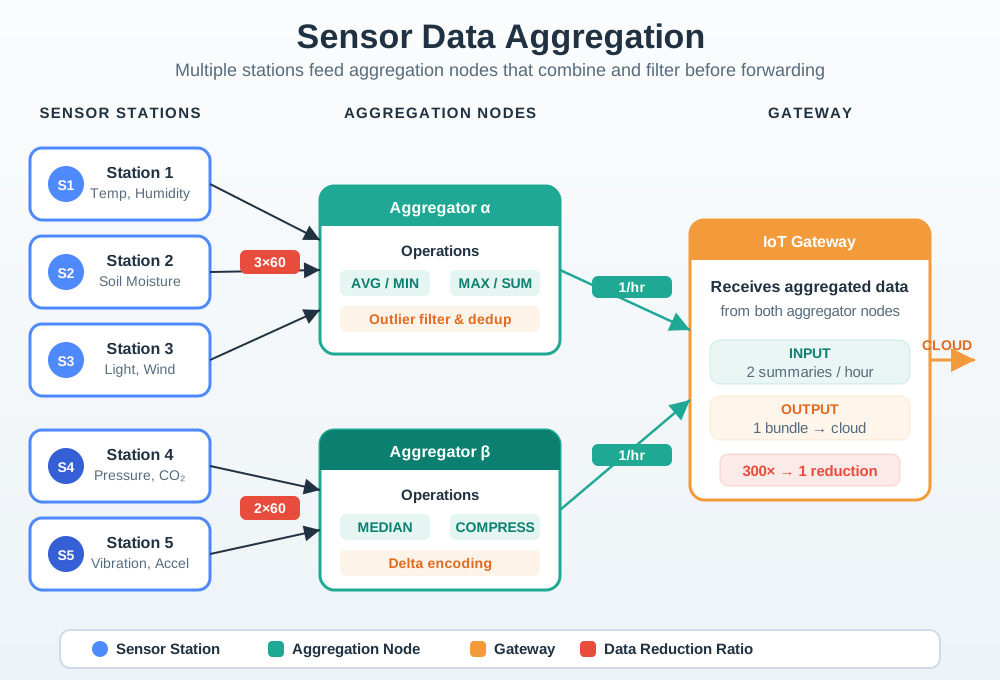
For agricultural IoT with 50 sensor stations bundling hourly instead of per-minute:
Temporal bundling: \(60 \text{ readings/hour} \to 1 \text{ reading/hour} = 60\times\) reduction
Transmission power impact:
- Individual transmissions: \(50 \times 60 \times 24 \times 30 = 2{,}160{,}000 \text{ tx/month}\)
- Bundled transmissions: \(50 \times 24 \times 30 = 36{,}000 \text{ tx/month}\)
\[\text{Power Savings} = \frac{2{,}160{,}000 - 36{,}000}{2{,}160{,}000} = 98.3\%\]
Battery life extension: \(\frac{2{,}160{,}000}{36{,}000} = 60\times\) longer battery life
At 1 mAh per 10 KB transmission, this reduces monthly transmission energy dramatically, extending battery life from months to years.
56.4 Industrial Vibration Monitoring Example
56.4.1 Scenario Parameters
| Parameter | Value |
|---|---|
| Number of sensors | 500 |
| Sampling frequency | 1 kHz (1,000 Hz) |
| Reading size | 16 bytes |
| Downsampling target | 10 Hz |
| Aggregation group size | 100 sensors |
| Aggregation output | 1 summary per group per second |
| Summary record size | 200 bytes |
56.4.2 Step-by-Step Calculation
Step 1: Raw Data Rate (Level 1)
- Raw rate = 500 sensors x 1,000 Hz x 16 bytes = 8,000,000 bytes/second
- Raw rate = 8 MB/s
- Per hour = 8 MB/s x 3,600 s = 28.8 GB/hour
Step 2: After Downsampling (Level 3)
Reduce sampling frequency from 1,000 Hz to 10 Hz (100x reduction):
- Downsample ratio = 1,000 Hz / 10 Hz = 100x
- Downsampled rate = 500 sensors x 10 Hz x 16 bytes = 80,000 bytes/s = 80 KB/s
- Per hour = 80 KB/s x 3,600 s = 288 MB/hour
Step 3: After Aggregation (Level 3)
Group 100 sensors into spatial clusters. Each cluster produces one 200-byte summary record per second (combining min/max/mean/RMS across the group):
- Number of groups = 500 sensors / 100 per group = 5 groups
- Aggregated rate = 5 groups x 1 summary/s x 200 bytes = 1,000 bytes/s = 1 KB/s
- Per hour = 1 KB/s x 3,600 s = 3.6 MB/hour
Total Reduction: 28,800 MB / 3.6 MB = 8,000x
56.4.3 Cost Savings Analysis
- Hourly data: 28.8 GB without edge -> 3.6 MB with edge (8,000x reduction)
- Daily data: 691 GB without edge -> 86.4 MB with edge (8,000x reduction)
- Monthly data: 20.7 TB without edge -> 2.6 GB with edge (8,000x reduction)
- Annual cloud cost: $24,883 without edge -> $3.11 with edge ($24,880/year saved)
Assuming $0.10/GB cloud ingress pricing
56.5 Knowledge Check: Data Reduction Calculations
## Sensor Aggregation Architecture
The following diagram shows how agricultural sensors feed into edge gateways for bundling:
56.6 Fog Node Downsampling Example
Another common scenario from the reference material:
Scenario: 100 fog nodes with 5 sensors each, downsampling from 10 readings/second to 1 reading/minute
- Raw: 100 nodes x 5 sensors x 10 Hz x 100 bytes = 500 KB/s = 43.2 GB/day
- Downsampled: 100 nodes x 5 sensors x (1/60) Hz x 100 bytes = 833 B/s = 72 MB/day
Reduction: 43,200 MB / 72 MB = 600x
56.7 Quality-Aware Data Filtering
Not all data is equal. Level 3 edge gateways can apply quality scoring to make filtering decisions.
56.7.1 Quality Score Components
| Factor | Weight | Scoring Method |
|---|---|---|
| Battery Voltage | 33% | voltage / max_voltage |
| Signal Strength | 33% | (dBm + 90) / 30 |
| Data Freshness | 34% | 1 - (age / max_age) |
56.7.2 Example Calculation
Reading parameters:
- Battery: 3.0V (rated 2.0-3.3V)
- Signal: -75 dBm (range -90 to -60)
- Age: 1,800 seconds (decay over 3,600 seconds)
Scores:
- Battery: 3.0 / 3.3 = 0.909
- Signal: (-75 + 90) / 30 = 0.500
- Freshness: 1 - (1,800 / 3,600) = 0.500
Weighted Quality Score:
- Weighted quality score = (0.33 x 0.909) + (0.33 x 0.500) + (0.34 x 0.500)
- Weighted quality score = 0.300 + 0.165 + 0.170 = 0.635
This score of approximately 0.64 falls in the “Acceptable” quality range.
56.7.3 Quality Score Explorer
Adjust the sensor parameters below to see how each factor affects the overall quality score:
56.7.4 Quality-Based Filtering Actions
| Score Range | Quality | Action |
|---|---|---|
| 0.0 - 0.4 | Poor | Filter out or deprioritize |
| 0.4 - 0.7 | Acceptable | Process normally |
| 0.7 - 0.9 | Good | Priority processing |
| 0.9 - 1.0 | Excellent | Critical data, immediate action |
Worked Example: Port Container Tracking Data Optimization
Scenario: A shipping port tracks 10,000 containers with GPS + temperature sensors.
Current System (Inefficient):
- Each container: GPS (lat/lon) + temperature reading every 60 seconds
- Data size: 32 bytes per reading
- Total: 10,000 containers x 1 reading/minute x 32 bytes = 320 KB/minute = 461 MB/day
Problem: Most containers are stationary for days. GPS coordinates do not change for 99% of readings.
Optimized Edge Processing:
Technique 1: Delta Encoding
- Only transmit when position changes >10 meters OR temperature changes >2 degrees C
- Result: 99% of readings filtered (containers stationary)
- New rate: 10,000 x 0.01 (1% moving/changing) x 32 bytes = 3.2 KB/min = 4.6 MB/day
- Reduction: 100x
Technique 2: Downsampling for Stationary Containers
- Moving containers: Report every 60 seconds (as before)
- Stationary containers: Report every 30 minutes
- Stationary rate: 9,900 stationary x (1/30) readings/min x 32 bytes = 10.6 KB/min = 15.3 MB/day
- Moving rate: 100 moving x 1/min x 32 bytes = 3.2 KB/min = 4.6 MB/day
- Total: 19.9 MB/day
- Combined reduction: 23x
Technique 3: Spatial Aggregation
- Group containers in same 100m x 100m grid cell
- Transmit grid-level summary + individual IDs
- Port layout: approximately 500 active grid cells
- Transmission: 500 cells x (GPS + count + temp_avg) x 48 bytes = 24 KB every 5 minutes = 6.9 MB/day
- Individual anomalies: 100 containers x 32 bytes/min = 4.6 MB/day
- Total: 11.5 MB/day
- Combined reduction: 40x
Final Architecture (Technique 3 – Spatial Aggregation + Anomaly Reporting):
- Grid summaries: 6.9 MB/day from 500 cells sending 48 bytes every 5 minutes
- Anomaly reports: 4.6 MB/day from 100 moving or anomalous containers at full rate
- Total optimized volume: 11.5 MB/day, which is a 40x reduction from 461 MB/day
Cost Impact:
Cellular IoT connectivity: $0.02/MB
- Original: 461 MB/day x 30 days x $0.02 = $276.60/month
- Optimized: 11.5 MB/day x 30 days x $0.02 = $6.90/month
- Savings: $269.70/month = $3,236/year
Edge gateway cost: $1,200 (one-time)
Payback period: 1,200 / 269.70 = 4.4 months
Additional Benefits:
- Battery life: Reduced transmissions extend sensor battery from 6 months to 2 years
- Alert latency: Moving container detection <5 seconds (was 2 minutes)
- Offline operation: 7-day local buffer survives network outages
Decision Framework: Choosing Data Reduction Techniques
Match your scenario to the optimal reduction strategy:
- High redundancy (99% unchanged values): Use delta encoding. Typical reduction: 100-1,000x. Example: GPS tracking stationary objects.
- High frequency sampling (kHz): Use downsampling. Typical reduction: 10-100x. Example: Vibration sensors.
- Multiple similar sensors (100+ temperature): Use spatial aggregation. Typical reduction: 10-100x. Example: Smart building HVAC.
- Noisy data (outliers, errors): Use quality filtering. Typical reduction: 2-10x. Example: Environmental sensors.
- Periodic patterns (daily cycles): Use temporal aggregation. Typical reduction: 10-100x. Example: Traffic counters.
- Binary events (door open/close): Use run-length encoding. Typical reduction: 50-500x. Example: Security systems.
- Mixed workload: Use a multi-stage pipeline. Typical reduction: 1,000-10,000x. Example: Industrial IoT.
Combination Strategy:
To calculate total data reduction from a multi-stage pipeline, multiply the effective reduction at each stage:
\[R_{total} = \prod_{i=1}^{n} R_i \times (1 - F_i)\]
where \(R_i\) is the reduction factor and \(F_i\) is the filter percentage at stage \(i\).
Example – Industrial vibration monitoring:
- Stage 1: Downsampling from 1 kHz to 10 Hz = 100x effective reduction
- Stage 2: Spatial aggregation from 100 sensors to 1 summary = 100x effective reduction
- Stage 3: Quality filtering removes 20% of the remaining data = 0.8x effective reduction
- Total: 8,000x effective reduction
Applied to 28.8 GB/hour raw data: 28,800 MB / 8,000 = 3.6 MB/hour
Technique Selection Flowchart:
- Start: What is your data pattern?
- High sampling rate (>100 Hz)? – Apply downsampling first
- Many similar sensors (>50)? – Apply spatial aggregation
- Values change slowly? – Apply delta encoding
- Known error patterns? – Apply quality filtering
- Need statistical summaries? – Apply temporal aggregation
- Result: Stack applicable techniques for compound reduction
Common Mistake: Over-Aggressive Aggregation Loses Critical Events
The Mistake: Students apply aggressive aggregation (hourly averages) that eliminates brief but critical events, rendering anomaly detection useless.
Real-World Failure: Cold chain monitoring for pharmaceutical shipment:
- Temperature sensors in refrigerated trucks
- Original sampling: Every 10 seconds
- Student design: “Aggregate to hourly averages to reduce data 360x.”
What Went Wrong:
Temperature profile during 1-hour period:
- Minutes 0-50: Stable 4 degrees C (refrigerator working)
- Minutes 51-55: Spike to 15 degrees C (door opened for loading)
- Minutes 56-60: Recovery to 6 degrees C (door closed)
Aggregated hourly average:
Numerator = (4 x 50) + (15 x 5) + (6 x 5) = 305 degree-minutes
Hourly average = 305 / 60 = 5.08 degrees C
Appears within spec (2-8 degrees C range)
Critical excursion completely hidden.
Consequence:
- $280,000 vaccine shipment compromised
- Aggregated data showed “within range”
- Actual temperature exceeded 10 degrees C for 5 minutes (fails FDA requirement)
- Product destroyed, company fined
The Correct Approach: Retain Min/Max/Mean
Instead of average only, transmit a statistical summary per window:
def intelligent_aggregation(readings):
    import math

    values = [value for _, value in readings]
    count = len(values)
    mean_val = sum(values) / count
    variance = sum((value - mean_val) ** 2 for value in values) / count

    return {
        "window_start": readings[0][0],
        "window_end": readings[-1][0],
        "count": count,
        "mean": mean_val,
        "min": min(values),
        "max": max(values),
        "stddev": math.sqrt(variance),
        "excursions": sum(
            1 for value in values if value > 10 or value < 2
        ),
    }
For the cold chain example, this summary reveals the problem immediately:
- Mean: 5.08 degrees C (looks fine)
- Max: 15 degrees C (exceeded 10 degrees C threshold)
- Excursions: 5 readings above threshold
Data Size Comparison:
- Raw (10-second samples): 360 readings x 8 bytes = 2,880 bytes. Captures spike: Yes.
- Mean only: 1 reading x 8 bytes = 8 bytes. Captures spike: No, the spike is hidden.
- Min/Max/Mean/Stddev/Excursions: 5 values x 8 bytes = 40 bytes. Captures spike: Yes.
Reduction: 2,880 / 40 = 72x (still excellent, but safe)
Aggregation Best Practices:
- Temperature: Min, max, mean, and excursion count to detect spikes and dips.
- Vibration: Min, max, RMS, and peak frequency to detect anomalies.
- Pressure: Min, max, mean, and rate of change to detect leaks.
- Flow rate: Total volume, max, min, and mean to detect blockages.
- GPS: Start and end position, max speed, and path distance to detect deviations.
The Lesson: Aggregation should summarize, not hide. Always include min/max/stddev in addition to mean, and count threshold excursions. For critical applications, consider “exception reporting” where brief anomalies trigger full-resolution data capture for that window.
56.8 Chapter Summary
Compound reduction from multiple techniques (downsampling, aggregation, filtering) multiplies together, enabling 8,000x+ data reduction in industrial scenarios.
Cost savings from edge processing can exceed $24,000/year for a single factory deployment with 500 high-frequency sensors.
Bundling transmissions at gateways reduces transmission count by 60x (minute-to-hourly), extending battery life proportionally and reducing network congestion.
Quality scoring enables intelligent filtering where poor-quality data is deprioritized while maintaining visibility into sensor health issues.
The compound reduction formula multiplies downsampling, aggregation, and the post-filter share to guide data pipeline design.
Key Takeaway
Data reduction at the edge combines multiple techniques – downsampling (reduce sampling frequency), aggregation (combine sensor streams into summaries), and filtering (remove bad data) – that multiply together for massive compound reduction. In this chapter’s running example, 100x downsampling, 100x aggregation, and 20% filtering turn 28.8 GB/hour of raw data into just 3.6 MB/hour while preserving meaningful insights.
For Kids: Meet the Sensor Squad!
“The Great Data Squeeze!”
Sammy the Sensor was in a panic. “I just measured the temperature 1,000 times in one second! That is a LOT of numbers to send!”
Max the Microcontroller laughed. “Sammy, did the temperature really change 1,000 times in one second?”
“Well… no. It was pretty much the same.”
“That is where I come in!” Max said proudly. “I use three super moves to shrink your data. First, Downsampling – instead of checking 1,000 times per second, I keep just 10. That is 100 times less data!”
“But what about all my sensor friends?” asked Sammy. “There are 500 of us!”
“Move number two: Aggregation! I group 100 of you together and write one little summary – the average, the highest, and the lowest readings. That is like writing one book report for an entire shelf of books!”
Lila the LED added: “And move three is Filtering, right Max? You throw away the bad readings?”
“Exactly! If Sammy sends a weird number because his wires got bumped, I toss it out. No bad data allowed!”
Bella the Battery grinned. “So instead of sending a MOUNTAIN of data, we send a tiny envelope. That saves me so much energy – I could last for YEARS!”
The Sensor Squad learned: You do not need to send every single reading. Smart squeezing keeps the important stuff and throws away the rest – saving power, money, and bandwidth!
56.9 Concept Relationships
Data reduction builds on:
- Edge Architecture - Level 3 edge computing provides the EFR (Evaluate-Format-Reduce) framework for data reduction
- Edge Compute Patterns - Filtering, aggregation, and downsampling patterns
Data reduction enables:
- Gateway Economics - 8,000x reduction justifies gateway ROI
- Power Optimization - Bundling 60 transmissions into 1 reduces power consumption by 98.3%
- Edge Deployments - Massive data reduction makes edge architectures practical
Parallel concepts:
- Compound reduction formula and Battery life calculation: Both use multiplicative factors for cumulative impact
- Quality scoring and Adaptive sampling: Both prioritize valuable data over noisy data
56.10 See Also
Related review chapters:
- Edge Review: Architecture - Seven-level reference model
- Edge Review: Gateway Security - Protocol translation and whitelisting
- Edge Review: Power Optimization - Bundling impact on battery life
- Edge Review: Storage Economics - Tiered storage leverages data reduction
Foundational chapters:
- Edge Data Acquisition - Sensor-level and gateway-level techniques
- Big Data Overview - Context for large-scale data management
Interactive tools:
- Edge Latency Explorer - Visualize latency vs bandwidth tradeoffs
56.11 What’s Next
| Current | Next |
|---|---|
| Edge Data Reduction Review | Edge Review: Gateway and Security |
Related chapters in this review series:
| Chapter | Focus |
|---|---|
| Edge Review: Architecture | Seven-level reference model |
| Edge Review: Power Optimization | Deep sleep and battery calculations |
| Edge Review: Storage and Economics | Tiered storage and ROI analysis |
Common Pitfalls
1. Setting CoV thresholds without considering downstream precision requirements
A change-of-value threshold of 1°C may seem reasonable but will miss a trending increase of 0.5°C per hour that indicates gradual bearing degradation. Set CoV thresholds based on the minimum meaningful change for the specific analytics use case.
2. Aggregating data that contains impulse events
Averaging 60 readings per minute suppresses sub-minute spikes (power surges, vibration transients) that are exactly the anomalies of interest. Apply anomaly detection before aggregation, or transmit raw data for a window around detected events.
3. Not validating that data reduction meets the use case requirement
Data reduction is only beneficial if the reduced dataset still enables the target analytics. Always validate reduced data against the full dataset on historical data before deploying reduction logic to production.