64 Edge Computing Quiz: Fundamentals
Putting Numbers to It
Quiz mastery targets are easiest to plan with threshold math:
\[ C_{\text{target}} = \left\lceil 0.8 \times N_{\text{questions}} \right\rceil \]
Worked example: For a 15-question quiz, target correct answers are \(\lceil 0.8 \times 15 \rceil = 12\). If a learner moves from 8/15 to 12/15, score rises from 53.3% to 80%, crossing mastery with four additional correct answers.
64.1 Learning Objectives
Key Concepts
- Edge computing: Processing data at or near the source of generation rather than sending it to a central cloud, reducing latency and bandwidth consumption.
- Fog computing: An intermediate processing tier between edge devices and cloud, typically implemented on gateways or local servers with more resources than sensor nodes but lower latency than cloud.
- Resource constraints: The limits on memory (typically 32 KB–4 MB for MCUs), processing power (8–240 MHz), and energy (battery or harvested) that determine which algorithms are deployable at the edge tier.
- Latency requirement: The maximum acceptable delay from a physical event to its detection and response — determines whether processing must occur at the edge (<10 ms), fog (<1 s), or cloud (>1 s).
- Bandwidth budget: The maximum data rate available for transmitting sensor data from edge devices to higher tiers, constrained by the wireless protocol, network plan, or energy cost of transmission.
By the end of this chapter, you will be able to:
- Calculate Data Volumes: Compute raw and processed data rates for sensor deployments
- Apply Reduction Techniques: Analyze downsampling, aggregation, and filtering effects
- Evaluate Architecture Decisions: Assess trade-offs in edge processing strategies
- Assess ROI Factors: Identify when edge computing provides cost benefits
For Beginners: How to Use This Chapter
What is this chapter? Foundation concepts and scenarios that demonstrate the business case for edge computing through worked examples and trade-off analysis.
When to use:
- Before attempting calculation-intensive quizzes
- To understand when edge computing makes economic sense
- To learn the key decision factors for edge vs cloud architecture
Recommended Prerequisites:
64.2 Knowledge Check
Test your understanding of data management concepts through the following scenario analysis.
Understanding Check: Edge Processing vs Cloud-Only Architecture
Scenario: Manufacturing plant monitors 500 CNC machines with vibration sensors (predictive maintenance). Each sensor generates 1 kHz samples (16 bytes/sample).
Cloud-Only Architecture (No Edge):
- Raw data rate: 500 sensors × 1000 Hz × 16 bytes = 8 MB/sec
- Per day: 8 MB/s × 86,400 s = 691 GB/day
- Annual uplink volume: 691 GB × 365 = 252 TB/year
- Network data cost (illustrative at $0.10/GB): 252 TB × $0.10/GB = $25,200/year
Problem: You’re sending raw vibrations to cloud. 99.9% is normal operation noise. Only 0.1% contains bearing failure signatures.
Edge Gateway Processing:
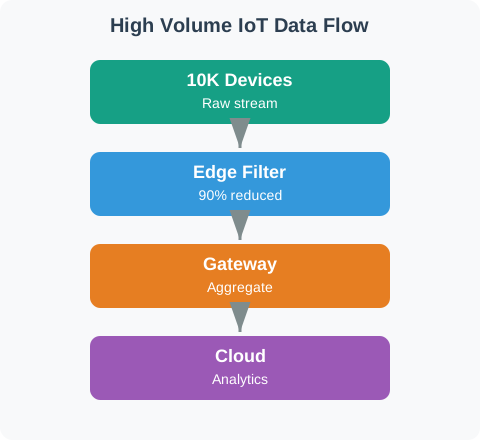
- Level 3 function 1: Downsample 1 kHz → 10 Hz to filter high-frequency noise.
- Level 3 function 2: Aggregate 100 sensors into one statistical summary each second.
- Level 3 function 3: Flag only abnormal vibration patterns.
- Normal operation: 200 bytes/s summary for 99.9% of the time.
- Anomaly operation: Forward the full 1 kHz stream for that machine during the 0.1% anomaly window.
- Normal cloud traffic: 200 bytes/s × 86,400 = 17 MB/day.
- Anomaly cloud traffic: 8 MB/s × 86.4 s/day = 691 MB/day.
- Total cloud traffic: 708 MB/day instead of 691 GB/day.
- Reduction factor: 976× fewer bytes sent upstream.
- Annual network data cost (illustrative at $0.10/GB): 708 MB × 365 × $0.10/GB = $26/year instead of $25,200/year.
But Wait—What About Edge Gateway Cost?
- Edge gateway hardware: $2,000 one-time for an Intel NUC or Raspberry Pi 4, a 256GB SSD for buffering, and an industrial enclosure.
- Year 1 savings: $25,200 - $26 - $2,000 = $23,174 saved.
- Year 2-5 savings: $25,200 - $26 = $25,174/year saved.
- 5-year TCO: $123,870 savings.
- ROI: 2000 ÷ 23174 = 8.6% of first-year savings.
- Payback period: 1 month.
The Hidden Benefit: Faster Alerts
- Cloud-only: Upload 691 GB → Analyze in cloud → Alert (latency: 5-30 min)
- Edge processing: Detect anomaly locally → Alert immediately (latency: < 1 sec)
- Business impact: Prevent bearing failure that would stop $500k/hour production line
Design Decision Snapshot:
- Data volume: Cloud-only sends 691 GB/day; edge processing sends 708 MB/day.
- Annual cost: Cloud-only costs about $25,200/year; edge processing costs about $26/year.
- Alert latency: Cloud-only responses arrive in 5-30 minutes; edge processing responds in under 1 second.
- Upfront cost: Cloud-only adds no gateway cost; edge processing requires a $2,000 gateway.
- Network dependency: Cloud-only is fully uplink-dependent; edge processing can buffer and tolerate outages.
Key Insight: Edge computing isn’t just about cost—it’s about data gravity. Moving 691 GB/day to cloud is slow and expensive. Processing locally where data is generated enables real-time decisions that prevent costly downtime.
When to Use Edge:
- High data velocity (kHz+ sampling)
- Real-time requirements (< 1s latency)
- Bandwidth-constrained locations
- Privacy/regulatory requirements (keep data local)
When Cloud-Only Works:
- Low data volume (KB/day)
- Batch processing acceptable (hourly/daily analytics)
- Unlimited bandwidth available
- No edge compute expertise
64.3 Common Misconception Analysis
Common Misconception: “Edge Computing Always Saves Money”
The Myth: Students often believe edge computing automatically reduces costs in all IoT deployments.
Real-World Data:
Alternative View: Data Volume Comparison at Scale
This visualization compares actual data volumes in high-volume versus low-volume scenarios to illustrate why edge computing ROI varies dramatically:
The roughly 300,000x difference in daily data volume between the vibration monitoring (691 GB/day) and temperature monitoring (0.0023 GB/day) scenarios explains why edge computing economics vary so dramatically across use cases.
Case Study: Smart Building Temperature Monitoring
Scenario 1: 1,000 rooms, 5-minute sampling
- Data rate: 1,000 sensors × 12 readings/hour × 8 bytes = 96 KB/hour ≈ 69 MB/month (≈0.84 GB/year)
- Network data cost (illustrative at $0.10/GB): 0.069 GB/month × $0.10/GB ≈ $0.007/month (≈$0.08/year)
- Edge gateway cost: $2,000
- Verdict: Edge gateway would take ~25,000 years to pay for itself (on bandwidth savings alone)
Scenario 2: 10 rooms, 1-second sampling with video analytics
- Data rate: 10 cameras × 30 fps × 1080p × 8 hours/day = 2 TB/day
- Network data cost (illustrative at $0.10/GB): 2000 GB/day × 30 days × $0.10/GB = $6,000/month ($72,000/year)
- Edge gateway cost: $2,000
- Verdict: Edge gateway pays for itself in 10 days
The Correct Mental Model:
- Data volume: Edge usually saves money above 10 GB/day; cloud is usually cheaper below 1 GB/day.
- Sampling rate: Edge favors kHz+ high-velocity streams; cloud-only works well for minute-level sampling.
- Sensor count: Edge economics improve at 100+ devices; cloud-only is often simpler below 20 devices.
- Real-time needs: Edge fits sub-second requirements; cloud-only fits minutes-to-hours workflows.
- Bandwidth: Edge helps when links are limited or costly; cloud-only is fine when bandwidth is abundant and cheap.
Rule of Thumb: Calculate the data reduction factor: - If reduction > 100× → Edge processing likely cost-effective - If reduction < 10× → Cloud-only likely cheaper - Between 10-100× → Evaluate latency, privacy, offline needs
Hidden Costs Students Miss:
- Edge maintenance: Firmware updates, security patches, hardware replacement (3-5 year lifecycle)
- Operational complexity: Managing distributed edge nodes vs centralized cloud
- Development cost: Edge ML model optimization vs cloud-scale training
- Scalability: Adding 1000 sensors to cloud = instant; adding 1000 edge gateways = logistics nightmare
Quantified Example: In a 2023 study of 47 industrial IoT deployments, 32% of edge computing projects had negative ROI after 3 years due to underestimated maintenance costs and overestimated data reduction factors. The successful projects (68%) shared a common trait: >500× data reduction and <1 second latency requirements.
Bottom Line: Edge computing is an architectural optimization, not a universal cost-saving solution. Always calculate your specific deployment’s data volume, reduction factor, and total cost of ownership before choosing edge over cloud.
Worked Example: Factory Deployment ROI Calculation
Scenario: A manufacturing plant is evaluating edge computing for their predictive maintenance system.
Current State (Cloud-Only):
- 200 CNC machines with vibration sensors
- Each sensor: 500 Hz sampling, 12 bytes/sample
- Raw data: 200 × 500 × 12 = 1.2 MB/s = 103.68 GB/day
- Cloud ingress cost: $0.12/GB = $12.44/day = $4,540/year
- Cloud processing: $0.05/GB = $5.18/day = $1,891/year
- Total annual cost: $6,431
Proposed Edge Gateway Solution:
- Edge hardware: 4 gateways @ $2,500 each = $10,000
- Edge processing: Downsample to 50 Hz, aggregate 50 machines per gateway
- Filtered data: 1.2 MB/s ÷ 10 (downsample) ÷ 4 (aggregation) = 30 KB/s = 2.59 GB/day
- New cloud costs: (2.59 GB × $0.12) + (2.59 GB × $0.05) = $0.44/day = $161/year
Cost-Benefit Analysis:
- Year 0: Edge setup costs $10,000, so net savings are -$10,000 and cumulative ROI is -100%.
- Year 1: Cloud costs $6,431; edge costs $661; net savings are $5,770 and cumulative ROI remains -42%.
- Year 2: Cloud costs $6,431; edge costs $661; net savings stay at $5,770 and cumulative ROI turns positive at +15%.
- Year 3: Cloud costs $6,431; edge costs $661; net savings stay at $5,770 and cumulative ROI rises to +73%.
- Year 5: Cloud costs $6,431; edge costs $661; net savings stay at $5,770 and cumulative ROI reaches +189%.
Payback period: 1.73 years (10,000 ÷ 5,770)
Intangible benefits not included:
- Alert latency reduced from 45 seconds to <1 second
- Prevented machine failures: ~2 per year @ $50,000 each = $100,000 saved
- Reduced downtime: 16 hours/year @ $25,000/hour = $400,000 saved
Real ROI including downtime prevention: Year 1 = +4,951% (($505,770 - $10,661) ÷ $10,000)
Decision Framework: When to Choose Edge vs Cloud-Only
Use this framework to evaluate your specific IoT deployment:
Factor Scoring:
- Data volume: Edge = 2 when a site produces more than 100 GB/day; Hybrid = 1 for 10-100 GB/day; Cloud = 0 below 10 GB/day.
- Real-time latency: Edge = 2 when responses must arrive in under 1 second; Hybrid = 1 for 1-10 seconds; Cloud = 0 above 10 seconds.
- Network reliability: Edge = 2 for frequent outages; Hybrid = 1 for occasional outages; Cloud = 0 when connectivity is consistently available.
- Bandwidth cost: Edge = 2 above $0.10/GB; Hybrid = 1 between $0.05 and $0.10/GB; Cloud = 0 below $0.05/GB.
- Data reduction potential: Edge = 2 above 100x; Hybrid = 1 between 10x and 100x; Cloud = 0 below 10x.
- Deployment scale: Edge = 2 above 100 devices per site; Hybrid = 1 for 20-100 devices; Cloud = 0 below 20 devices.
- Safety-critical timing: Edge = 2 for sub-second response; Hybrid = 1 for 1-10 second response; Cloud = 0 for monitoring-only cases.
- Local processing need: Edge = 2 when ML inference must run locally; Hybrid = 1 for aggregation/filtering; Cloud = 0 for raw collection only.
Scoring Guide:
- 12-16 points: Strong edge computing candidate
- 6-11 points: Hybrid architecture recommended
- 0-5 points: Cloud-only likely more cost-effective
Example Calculation: Manufacturing predictive maintenance: Data volume (2) + Latency (2) + Network (1) + Cost (2) + Reduction (2) + Scale (2) + Safety (2) + Processing (2) = 15 points → Strong edge candidate
Red Flags for Edge Computing:
- Total device count <50 across all sites
- Data already structured and small (e.g., JSON payloads <1 KB)
- No real-time requirements
- Unlimited free bandwidth available
- No local processing expertise on team
Common Mistake: Ignoring Edge Gateway Maintenance Costs
The Mistake: Students calculate bandwidth savings from edge computing ($25,200/year in our vibration example) but forget ongoing operational costs, leading to overly optimistic ROI projections.
Real-World Hidden Costs:
- Firmware updates: $800/year for four updates at two hours each.
- Security patches: $1,200/year for monitoring and quarterly patching.
- Hardware refresh: $2,000/year amortized across a five-year lifetime.
- Network connectivity: $600/year for a backup cellular link.
- On-site support: $2,400/year for two support visits.
- Total hidden costs: $7,000/year.
Impact on Our Example:
- Original calculation: $25,200 - $26 = $25,174 saved/year
- Realistic calculation: $25,200 - $26 - $7,000 = $18,174 saved/year
- Payback period: Changes from 1 month to 1.3 months (still excellent)
- 5-year TCO: $123,870 becomes $88,870 (28% reduction)
The Correct Approach:
- Annual net savings: subtract total maintenance from bandwidth savings.
- If annual net savings are zero or negative: edge hardware will not pay back.
- Payback formula: hardware cost divided by annual net savings.
- Five-year ROI formula: five years of net savings, minus hardware cost, divided by hardware cost.
- Maintenance example: firmware $800, security $1,200, hardware refresh $2,000, network $600, support $2,400.
- Worked result for this scenario: $2,000 hardware and $25,174 annual bandwidth savings give a 0.11-year payback (about 1.3 months) and a 4,443.5% five-year ROI.
Key Lesson: Even with realistic maintenance costs, edge computing is justified for high-volume scenarios. The mistake is not whether to use edge, but underestimating operational costs in the business case.
64.4 Interactive Edge ROI Calculator
Use this calculator to explore how data volume, reduction factor, and maintenance costs affect edge computing ROI for different deployment scenarios.
64.5 Concept Relationships
How Fundamentals Connect to Edge Economics
Key Decision Factors:
- Data Volume - Edge justified when >10 GB/day per site
- Data Reduction - Must achieve >100x reduction for cost savings
- Latency Requirements - Edge mandatory when <1 second response needed
- Privacy/Compliance - Edge keeps sensitive data on-premises
ROI Analysis Framework:
- Cloud Costs = Bandwidth + Processing + Storage
- Edge Costs = Hardware + Maintenance + Energy
- Break-Even = Hardware cost ÷ (Cloud savings - Edge ops)
Common Misconceptions:
- Edge does NOT always save money (see smart building example: 25,000 year payback!)
- Low-volume deployments (<1 GB/day) favor cloud-only
- Hidden costs: maintenance, firmware updates, hardware refresh
Builds on:
- Edge Compute Patterns Overview - Foundation concepts
- Edge IoT Reference Model - Architectural context
Enables:
- Edge Quiz: Data Calculations - Reduction factor formulas
- Edge Quiz: Power Optimization - Battery life TCO
64.6 See Also
Related Resources
Study Progression:
- This chapter - Start with business case and decision factors
- Edge Quiz: Data Calculations - Reduction formulas
- Edge Quiz: Power Optimization - Battery and security
- Edge Quiz: Comprehensive - Integration review
Decision Frameworks:
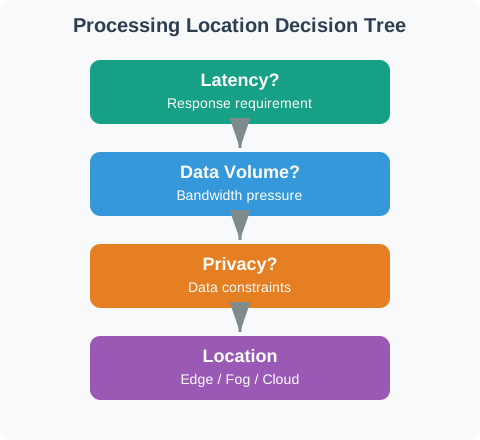
- Edge Architecture Review - Edge vs fog vs cloud decision tree
- Edge Calculations Review - ROI and break-even formulas
- Edge Patterns Practical - Interactive latency calculator
Real-World Examples:
- Factory Vibration Monitoring - $25K/year savings, 1-month payback
- Smart Building Temperature - NOT cost-justified (25,000 year payback)
- Video Surveillance - 2 TB/day raw data with 10-day payback period
Common Pitfalls
1. Assuming edge computing always reduces latency
Edge processing reduces latency only when the edge device is less congested than the cloud. A heavily loaded, slow gateway can add more latency than a lightly loaded cloud service. Measure end-to-end latency empirically before assuming edge wins.
2. Treating all microcontrollers as equivalent edge devices
An Arduino with 2 KB RAM and an ESP32 with 520 KB RAM are both ‘microcontrollers’ but have vastly different processing capabilities. Always specify the target hardware when discussing edge algorithm suitability.
3. Conflating fog and edge as the same tier
Edge (device-level, microcontroller, 32KB–4MB RAM) and fog (gateway-level, embedded Linux, 256MB–4GB RAM) differ by 3–4 orders of magnitude in resources. Questions and design decisions that fail to distinguish them will produce incorrect answers.
4. Ignoring the operational cost of edge infrastructure management
Edge devices are deployed in physically distributed, often inaccessible locations. Over-the-air (OTA) update capability, remote diagnostics, and automated failure recovery must be designed in from the start, not added retrospectively.
64.7 Summary
- Edge computing provides significant cost savings for high-volume, high-velocity data scenarios where data reduction factors exceed 100x
- ROI calculations must include hardware costs, maintenance overhead, and operational complexity—not just bandwidth savings
- The business case for edge computing is strongest when real-time latency requirements (< 1 second) combine with high data volumes
- Low-volume IoT deployments often achieve better economics with cloud-only architectures due to amortized infrastructure costs
- Data gravity—processing data where it’s generated—enables real-time decisions that prevent costly downtime in industrial applications
Key Takeaway
Edge computing is an architectural optimization, not a universal cost-saving solution. It excels when data reduction factors exceed 100x, real-time latency under 1 second is required, or privacy mandates keeping data local. For small deployments with low data volumes, cloud-only is typically cheaper. Always calculate your specific data volume, reduction factor, and total cost of ownership before committing to edge infrastructure.
For Kids: Meet the Sensor Squad!
“When Does Edge Computing Save Money?”
The Sensor Squad was having a debate at the Smart Building headquarters.
“We should put edge computers EVERYWHERE!” Sammy the Sensor declared enthusiastically.
“Hold on,” said Max the Microcontroller wisely. “Let me tell you a story about two buildings.”
“Building A has 1,000 temperature sensors that send tiny readings every 5 minutes. That is only 69 megabytes per month – less than one photo on your phone! Sending that to the Cloud costs almost nothing. Buying me as an edge gateway would cost $2,000 and take 25,000 YEARS to pay for itself. Ouch!”
“But Building B,” Max continued, “has 10 cameras streaming video 8 hours a day. That is 2 TERABYTES per day – like streaming 500 movies! Cloud costs would be $6,000 per month. Buying me would pay for itself in just 10 days!”
“So edge computing is not always the answer?” Lila the LED asked, surprised.
“Exactly!” Max nodded. “It depends on three things: How MUCH data (lots = edge wins), how FAST you need answers (instantly = edge wins), and how EXPENSIVE your internet is (costly = edge wins).”
Bella the Battery summed it up: “Think before you compute! Always do the math first – just like checking if you have enough allowance before buying a toy.”
What did the Squad learn? Edge computing saves money when there is lots of data or you need super-fast responses, but for small, simple systems, the Cloud can actually be cheaper. Always do the math first!
64.8 What’s Next
| Current | Next |
|---|---|
| Edge Quiz: Fundamentals | Edge Quiz: Data Calculations |
Related topics:
| Chapter | Focus |
|---|---|
| Edge Quiz: Power and Optimization | Battery life and TCO analysis |
| Edge Quiz: Comprehensive Review | Integration scenarios |