59 Edge Gateway & Security
59.1 Learning Objectives
By the end of this chapter, you will be able to:
- Design Gateway Architectures: Address the Non-IP Things challenge with multi-protocol edge gateways
- Evaluate Security Models: Compare fail-closed (whitelist) vs fail-open (blacklist) approaches
- Implement Layered Security: Apply defense-in-depth principles across device, network, edge, and storage layers
- Analyze Cost-Benefit Trade-offs: Compare gateway deployment against device replacement alternatives
Key Concepts
- Gateway as security perimeter: The role of the edge gateway as the boundary between the untrusted device network and the trusted cloud network, responsible for authenticating devices, validating data, and enforcing access control.
- Device certificate management: The provisioning, rotation, and revocation of X.509 certificates used to authenticate IoT devices to the gateway, requiring a scalable Public Key Infrastructure (PKI).
- TLS mutual authentication (mTLS): A TLS configuration where both the gateway and the cloud server authenticate each other’s certificates, preventing man-in-the-middle attacks on the northbound connection.
- Anomaly-based intrusion detection: Using statistical or ML-based anomaly detection on device communication patterns (message frequency, payload size, connection timing) to identify compromised or malfunctioning devices.
- Secure boot: A hardware-enforced verification that only cryptographically signed firmware executes on the gateway, preventing installation of malicious firmware through physical or OTA attack vectors.
59.2 Prerequisites
Before studying this chapter, complete:
- Edge Review: Architecture and Reference Model - Reference model context
- Edge Review: Data Reduction Calculations - Aggregation concepts
- Security and Privacy Overview - Security fundamentals
For Beginners: The Non-IP Things Problem
Imagine you want all the devices in your home to communicate, but they all speak different languages:
- Your smart thermostat speaks “Zigbee”
- Your door lock speaks “Z-Wave”
- Your old garage door speaks “Proprietary Legacy Protocol”
An edge gateway is like a translator that speaks all these languages and converts everything to English (IP/HTTP) so your cloud server can understand. Without it, you’d need to replace every device with an IP-compatible version, which is expensive and disruptive.
In factories, 96% of devices are non-IP, making gateways essential.
59.3 The Non-IP Things Challenge
59.3.1 Industrial Reality
Industrial environments contain legacy equipment using diverse protocols:
| Protocol | Domain | Type |
|---|---|---|
| Modbus | Manufacturing | Serial/TCP |
| BACnet | Building Automation | Standard (ASHRAE 135) |
| Profibus | Process Automation | Industrial Bus |
| CAN bus | Automotive/Machinery | Serial Bus |
| Zigbee, Z-Wave, BLE | Wireless Sensors | Short-range RF |
| Proprietary | Vendor-specific | Various |
Key statistic: In a typical 1000-device industrial IoT deployment, 960 devices (96%) lack IP connectivity and use proprietary protocols.
59.3.2 Solution Architecture: Multi-Protocol Edge Gateways
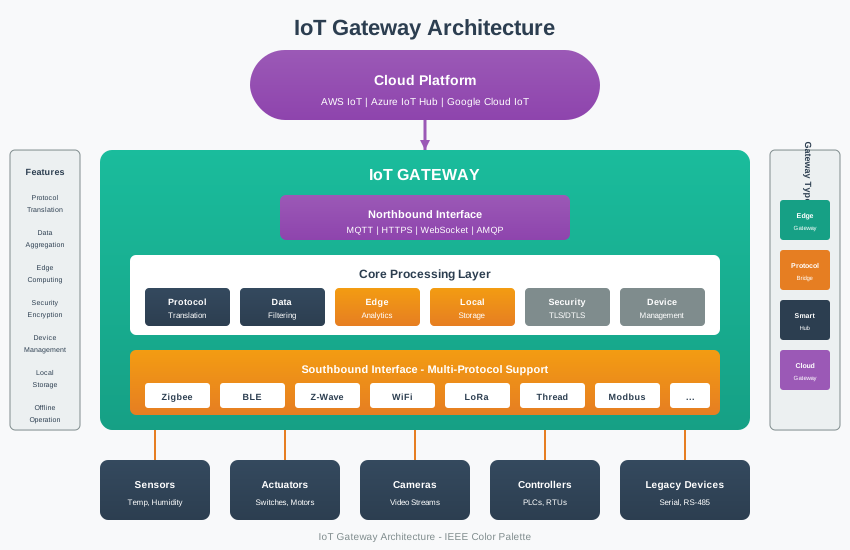
Gateway Architecture at a Glance
- Southbound device side: Modbus, BACnet, BLE, WiFi, LoRa, Thread, and other non-IP protocols feed into one gateway.
- Gateway core: Protocol translation, filtering, edge analytics, local storage, TLS/DTLS, and device management happen locally.
- Northbound cloud side: The gateway exposes standard IP interfaces such as MQTT, HTTPS, WebSocket, or AMQP.
- Operational win: Hundreds of legacy devices collapse into a small number of managed, secured cloud connections.
59.3.3 Gateway Capabilities (Level 2 + Level 3)
- Protocol translation: Modbus/BACnet/Proprietary to MQTT/HTTP
- Data aggregation: Combine multiple device streams
- Local processing: Filter, format, reduce data volume
- Security: Encrypted tunnels (VPN), firewall, certificate management
- Buffering: Handle intermittent connectivity
- Management: Centralized firmware updates, configuration
59.4 Cost-Benefit Analysis
### Cost Comparison Summary
| Approach | Initial Cost | Annual Operations | Management Complexity |
|---|---|---|---|
| Replace devices | $288,000+ | High (downtime) | Medium |
| Individual translators | $48,000 | $100,000+ (data plans) | Very High (960 devices) |
| Custom cloud adapters | $500,000+ | $50,000 (development) | High |
| Edge gateways | $30,000 | $10,000 | Low (20 gateways) |
Putting Numbers to It
The cost advantage of edge gateways over device replacement is dramatic when dealing with the Non-IP Things problem:
\[\text{Cost Savings} = \text{Device Replacement Cost} - \text{Gateway Deployment Cost}\]
For a 1,000-device industrial deployment with 96% non-IP devices:
Device replacement approach:
- \(960 \text{ devices} \times \$300/\text{device} = \$288{,}000\)
- Plus installation labor, production downtime, re-certification
Edge gateway approach:
- \(20 \text{ gateways} \times \$1{,}500/\text{gateway} = \$30{,}000\)
- Covers all 960 legacy devices through protocol translation
\[\text{Savings} = \$288{,}000 - \$30{,}000 = \$258{,}000 \text{ (89.6% reduction)}\]
Savings ratio: \(\frac{\$288{,}000}{\$30{,}000} = 9.6\times\) cheaper with gateways
Beyond initial costs, gateways reduce operational complexity from managing 960 individual cloud connections to just 20 gateway connections – a 48x reduction in management overhead.
59.4.1 Gateway Cost Explorer
Adjust the parameters below to see how gateway deployment costs compare to device replacement for your deployment scenario.
59.5 Gateway Security Architecture
59.5.1 Layered Security Foundations
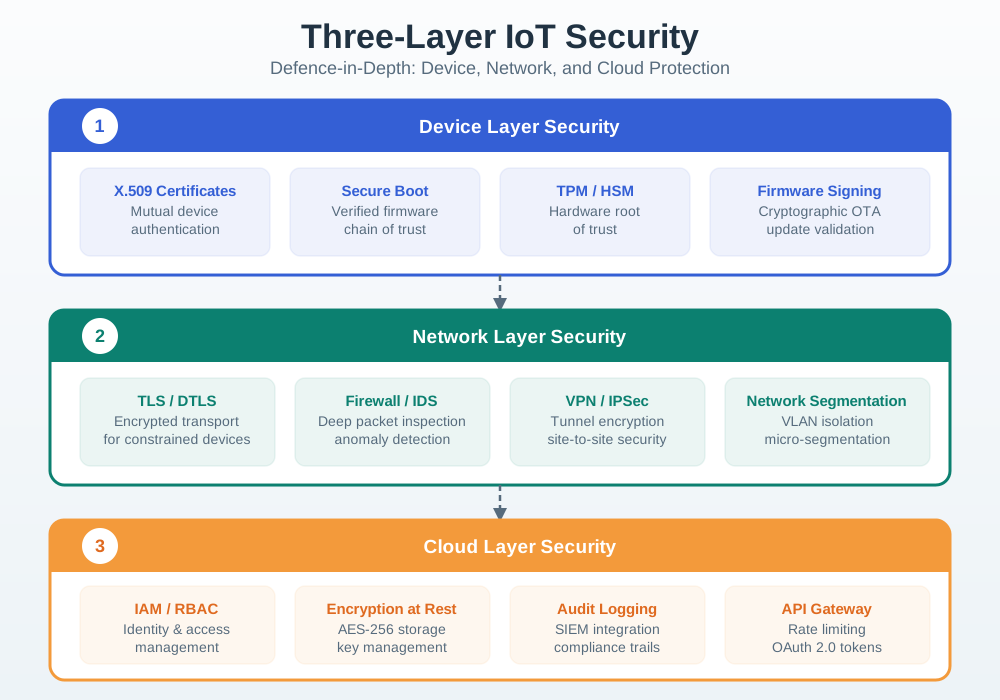
Layered Security Foundations
- Device layer: X.509 certificates, secure boot, TPM/HSM, and signed firmware updates protect identity and firmware integrity.
- Network layer: TLS/DTLS, firewalls/IDS, VPN/IPSec, and network segmentation protect traffic and isolate risk.
- Cloud layer: IAM/RBAC, encryption at rest, audit logging, and API gateways protect data and service access.
- Gateway policy: The next section adds fail-closed whitelisting at the edge gateway before any TLS session begins.
59.5.2 Fail-Closed Whitelisting
The gateway implements fail-closed security: default policy is DENY, and only explicitly allowed devices are permitted.
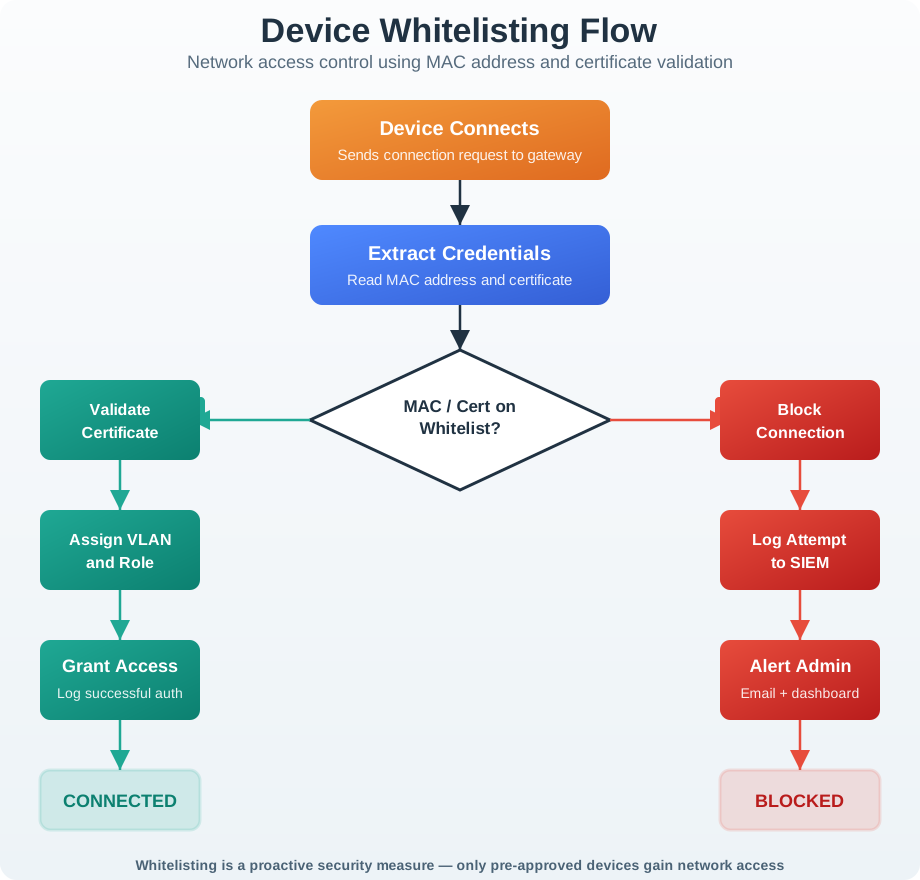
Whitelist Decision Flow
- Device attempts connection to the gateway.
- Gateway checks the MAC address against the approved whitelist.
- If the device is unknown, the gateway rejects the request immediately and logs the attempt.
- If the device is approved, the gateway starts TLS 1.3, validates the certificate, applies encryption, and opens the secure channel.
59.5.3 Security Check Sequence
- MAC address whitelist (Layer 2 - happens first)
- TLS handshake (only if whitelist passed)
- Certificate verification (only if TLS started)
- Data encryption (only if connection established)
Unknown devices are stopped at step 1.
### Attack Scenarios Prevented by Whitelisting
| Attack | Description | Result |
|---|---|---|
| Rogue Sensor | Attacker deploys unauthorized sensor to inject false data | Blocked at MAC whitelist |
| Man-in-the-Middle | Attacker intercepts traffic, impersonates gateway | Blocked (attacker MAC not whitelisted) |
| Device Spoofing | Attacker clones authorized device MAC | Passes whitelist (requires certificate pinning) |
59.6 Gateway Security Benefits
Gateways create a security perimeter that dramatically reduces the attack surface:
| Benefit | Without Gateways | With Gateways |
|---|---|---|
| Internet-facing devices | 960 (each a target) | 20 hardened gateways |
| Certificate management | 960 individual certs | 20 gateway certs |
| Authentication points | 960 distributed | 20 centralized |
| Firmware update targets | 960 heterogeneous | 20 standardized |
| Network isolation | None (direct exposure) | Legacy devices on local VLAN |
Hardening checklist for gateway deployments:
- Change default credentials on all gateways before deployment
- Disable UPnP/Plug and Play (enforces whitelisting)
- Restrict remote management to VPN-only access
- Automate firmware updates with staged rollouts
- Enable mutual TLS for all cloud connections
- Ensure physical tamper detection on gateway enclosures
Worked Example: Industrial Gateway Security Implementation
Scenario: Chemical processing plant with 500 Modbus sensors and 200 BACnet HVAC controllers needs secure edge gateway deployment.
Security Requirements:
- PLC sensors use legacy Modbus (no encryption)
- Building HVAC uses BACnet (no authentication)
- Must prevent unauthorized device connections
- Must encrypt all cloud communications
- Must survive device tampering attempts
Gateway Security Architecture:
Layer 1: Device Whitelisting (MAC Address)
ALLOWED_DEVICES = {
    "00:11:22:33:44:55": {"type": "modbus_plc", "zone": "reactor_1"},
    "00:11:22:33:44:56": {"type": "modbus_plc", "zone": "reactor_2"},
    # ... 698 more entries
}

def authenticate_device(mac_address):
    if mac_address not in ALLOWED_DEVICES:
        log_security_event(f"REJECTED: Unknown device {mac_address}")
        return False
return True- Result: 100% of rogue device attempts blocked at connection attempt
Layer 2: Protocol Translation with Validation
- Modbus requests validated against expected register ranges
- BACnet commands checked against authorized object IDs
- SQL injection / command injection filters
Layer 3: Network Segmentation
- OT network (sensors): VLAN 10, no internet access
- Gateway management: VLAN 20, restricted SSH access
- Cloud uplink: VLAN 30, TLS 1.3 only
Layer 4: Data Encryption
def encrypt_and_transmit(sensor_data):
    # At-rest encryption
    encrypted_local = aes_256_gcm.encrypt(sensor_data, local_key)
    db.store(encrypted_local)

    # In-transit encryption
    tls_context = ssl.SSLContext(ssl.PROTOCOL_TLS_CLIENT)
    tls_context.minimum_version = ssl.TLSVersion.TLSv1_3
    mqtt_client.tls_set_context(tls_context)
    mqtt_client.publish(topic, encrypted_local)
Layer 5: Certificate-Based Cloud Authentication
- X.509 certificates per gateway (not shared passwords)
- 90-day certificate rotation
- Private keys in TPM (Trusted Platform Module)
Incident Response:
Attack attempt detected (Month 6): - Unknown MAC address attempted connection: 10 attempts/hour - Whitelisting blocked all attempts (Layer 1 stopped attack) - Intrusion detection logged attempts - Security team notified via SMS within 2 minutes
Cost-Benefit Analysis:
| Security Component | Cost | Prevented Incident Cost |
|---|---|---|
| TPM chips (10 gateways) | $300 | Credential theft ($500K+) |
| Certificate management (annual) | $1,200 | Unauthorized access ($1M+) |
| VLAN switches | $5,000 | Lateral movement ($750K+) |
| Security monitoring | $8,000/year | Early detection ($200K+) |
| Total | $14,500 | $2.45M+ (potential) |
ROI: 16,797% (prevented one major incident)
59.6.1 Security Investment ROI Calculator
Estimate the return on investment for gateway security measures based on your deployment scale.
Decision Framework: Fail-Closed vs Fail-Open Security
| Factor | Fail-Closed (Whitelist) | Fail-Open (Blacklist) |
|---|---|---|
| Default policy | DENY all, allow specific | ALLOW all, deny specific |
| New device | Rejected until approved | Accepted until blocked |
| Security posture | Maximum (zero-trust) | Convenience-first |
| Administrative overhead | High (pre-register devices) | Low (add as needed) |
| Attack surface | Minimal | Large |
| Best for | Critical infrastructure, industrial | Consumer IoT, dynamic environments |
| Failure mode | Service disruption if list outdated | Security breach if threat unknown |
Decision Algorithm:
def select_security_model(criticality, device_count, change_frequency):
    if criticality == 'critical' or criticality == 'industrial':
        return 'FAIL_CLOSED'  # Always use whitelist for critical systems
    if device_count < 50 and change_frequency < 10:  # devices/month
        return 'FAIL_CLOSED'  # Manageable whitelist size
    if change_frequency > 100:  # High device churn
        return 'FAIL_OPEN'  # Whitelist maintenance impractical
    return 'FAIL_CLOSED'  # Default to secure
Common Mistake: Implementing Encryption Without Authentication
The Mistake: Students encrypt data (TLS/AES) but fail to authenticate devices, allowing man-in-the-middle attacks.
Vulnerable Design:
# WRONG: Encryption without authentication
mqtt_client.tls_set('/path/to/ca.crt')  # Only validates server
mqtt_client.connect(broker, 8883)
mqtt_client.publish(topic, encrypted_data)- Problem: Any device with the CA certificate can connect
- Attacker can impersonate legitimate device
Correct Design: Mutual TLS (mTLS)
# RIGHT: Encryption + Authentication
mqtt_client.tls_set(
    ca_certs='/path/to/ca.crt',  # Validates server
    certfile='/path/to/client.crt',  # Client certificate
    keyfile='/path/to/client.key'  # Client private key
)
mqtt_client.connect(broker, 8883)
Impact: Without device authentication, one compromised certificate allows attacker to inject false sensor data, potentially causing: - $500K+ in equipment damage (false shutdowns) - Safety incidents (spoofed sensor readings) - Data poisoning (corrupt historical analytics)
The Lesson: Encryption solves confidentiality. Authentication solves identity. You need both.
59.7 Chapter Summary
Edge gateways solve the Non-IP Things problem by translating diverse protocols (Modbus, BACnet, Zigbee) to standard IP, enabling 96% of industrial devices to connect without replacement.
Cost analysis shows gateway deployment ($30,000 for 20 gateways) is 10x cheaper than device replacement ($288,000) and operationally superior to individual translators.
Fail-closed whitelisting is the correct security model for industrial IoT: unknown devices are rejected immediately, before any encrypted connection negotiation begins.
Layered security (defense in depth) combines device security, network encryption, gateway whitelisting, and storage access control for comprehensive protection.
Security perimeter at gateways isolates hundreds of legacy devices from direct internet exposure, centralizing certificate and authentication management.
Key Takeaway
Edge gateways are the most cost-effective solution for integrating legacy industrial devices ($30,000 for 20 gateways vs $288,000 to replace 960 devices), and they create a critical security perimeter using fail-closed whitelisting. In this model, unknown devices are rejected at the MAC address check before any encrypted connection is attempted – stopping rogue sensors and impersonation attacks at the front door.
For Kids: Meet the Sensor Squad!
“The Gateway Guardian!”
The Sensor Squad was visiting a big factory. Sammy the Sensor noticed something strange. “Why do all these machines speak different languages? That one talks Modbus, that one talks Zigbee, and that old one speaks some weird language nobody else knows!”
“Welcome to the real world!” said Max the Microcontroller, who was working as the factory’s edge gateway. “96 out of every 100 factory devices don’t speak the internet’s language. That’s where I come in – I’m the translator!”
“Like at the United Nations?” Lila the LED asked.
“Exactly! The old machine says something in Modbus, and I translate it to MQTT so the cloud can understand. Without me, you’d have to replace every single machine – and that would cost a fortune!”
Just then, an unfamiliar device tried to connect. A red light flashed on Max’s screen.
“STOP RIGHT THERE!” Max announced. “You’re not on my guest list!”
“Guest list?” asked Bella the Battery.
“I use something called a whitelist. Only devices I already know are allowed to connect. If I don’t recognize you, the answer is NO. That’s called fail-closed security – the door stays locked unless I specifically unlock it for you.”
“So bad guys can’t sneak in pretending to be a sensor?” Sammy asked.
“Not on my watch! They get stopped before they can even say hello.”
The Sensor Squad learned: A gateway is like a bouncer AND a translator – it lets the right devices in, keeps the bad ones out, and helps everyone speak the same language!
59.8 See Also
Edge review series (this module):
- Edge Review: Architecture - Level 2/3 gateway capabilities and reference model
- Edge Review: Data Reduction - Gateway aggregation reduces bandwidth (2 MB/hour vs 28.8 GB/hour)
- Edge Review: Deployments - Gateway technology stack and deployment patterns
Security (cross-module):
- Security and Privacy Overview - Layered security model (defense in depth)
- Security Threats - Attack vectors and threat models
- Cryptography - TLS, AES-256, certificate-based authentication
- Authentication - Mutual TLS and device identity
Architecture (cross-module):
- Edge Fog Computing - Gateway role in fog architecture
59.9 What’s Next
| Direction | Chapter | Link |
|---|---|---|
| Next | Edge Review: Power Optimization | edge-review-power-optimization.html |
| Previous | Edge Review: Data Reduction Calculations | edge-review-data-reduction.html |
| Related | Edge Review: Architecture and Reference Model | edge-review-architecture.html |
| Related | Edge Review: Storage and Economics | edge-review-storage-economics.html |
Common Pitfalls
1. Using the same credentials for all devices in a fleet
Shared credentials mean a single compromised device exposes the entire fleet. Issue unique per-device certificates or pre-shared keys so that compromised devices can be individually revoked without affecting others.
2. Treating the gateway LAN as trusted
Assuming all devices on the gateway’s local network are legitimate allows a compromised device to attack others on the same network. Implement device-level mutual authentication even on the local LAN.
3. Skipping firmware signature verification to save flash space
Removing secure boot verification to save a few kilobytes of flash makes the gateway trivially exploitable via malicious firmware. The security benefit of signed firmware vastly outweighs the storage cost.
4. Not including gateway security in edge architecture reviews
Architecture reviews that focus only on data processing performance and ignore the security of the gateway’s management interfaces, firmware update channels, and cloud credentials will produce deployments vulnerable to common IoT attacks.