35 Production ML Monitoring
More
Depth: Practitioner
Progress saves as you read. Mark sections complete as you go; your progress appears in the sidebar.
A leak detector can score well in a notebook and still miss events after a sensor replacement changes its readings. Production ML monitoring watches the data, predictions, service path, and delayed outcomes after release. Its purpose is to reveal when the deployed claim no longer matches field evidence.
Firmware is the software installed on the sensing device. Latency means the time from a production request to its result.
35.1 Diagnose a Detector That Quietly Drifts
This section: Diagnose a Detector That Quietly Drifts — Follow Figure 35.1 from the incoming sensor data toward the model result and downstream action.
Follow Figure 35.1 from the incoming sensor data toward the model result and downstream action. The labelled problems belong to different places: data drift changes inputs, concept drift changes the relation between inputs and outcomes, service faults interrupt inference, and feedback gaps hide whether predictions were right. A single uptime graph cannot cover all four.
Suppose a pump detector usually receives vibration RMS values centred near 2.0 mm/s. After maintenance, the new sensor reports a median of 2.7 mm/s. The model service remains healthy and returns scores, yet its input distribution has moved by 0.7 mm/s, or 35% of the old median. Monitoring should separate this feature shift from an increase in true pump faults.
Choose a production record that can answer the distinction. Keep event identity, observation time, feature-recipe version, model version, score, threshold, predicted class, service latency, and any later confirmed outcome. Do not log personal or sensitive raw data merely because it is available. Retention and access should match the investigation need.
An alert needs a response. If score volume drops to zero, first check collection and inference health. If feature ranges move, compare device cohorts and recent firmware or sensor changes. If confirmed precision falls, examine both false alarms and labelling delay before changing the threshold. Each route has a different owner and rollback choice.
Use a small release comparison. The old model flags 40 of 1,000 daily records, while the candidate flags 65. That difference is 25 records, but it is not automatically improvement or drift. Review the alerts flagged by both models, those flagged only by the old model, those flagged only by the candidate, and confirmed outcomes. There are 25 candidate-only cases only if all 40 old alerts also occur among the candidate’s 65 alerts. A shadow run keeps candidate decisions from controlling equipment while those cases are examined.
Predict monitoring behavior before deployment. Send a fixture with the expected feature schema and confirm the model version and score appear in the record. Remove a required feature and expect a visible rejection rather than a guessed default. Shift the vibration fixture by 35% and confirm the chosen drift alert fires. Finally, delay outcome labels and verify that the dashboard marks performance as pending instead of treating missing feedback as success.
Set monitoring windows from event volume and response need. A tiny fleet may not produce enough confirmed failures for an hourly precision estimate, while a service-health counter can still be checked each minute. Show sample size beside every metric. A percentage based on two labelled events should not look as certain as one based on two thousand.
Threshold changes alter production behavior. Shadow a candidate threshold, count which records would change class, and inspect their confirmed outcomes. Store the approved value with the release. If alert volume becomes unmanageable, preserve the score distribution and reason instead of suppressing notices without evidence.
Plan rollback before drift occurs. Keep the prior compatible model and preprocessing package, define who can restore it, and state which monitoring result triggers that choice. Rollback can restore service while the team investigates; it does not erase the shifted data or explain its cause.
Monitor cohorts that can fail differently: sensor model, firmware release, site, installation age, and network path. A stable fleet-wide average can hide one small group collapsing. Protect privacy and avoid tiny published groups, but retain enough controlled detail for diagnosis. When an alert appears, compare it with deployments and maintenance changes before assuming the learned relation alone moved.
The monitoring system also requires monitoring. Send a known synthetic record on schedule, verify that collection, feature extraction, scoring, alert routing, and dashboard ingestion all report it, and mark the synthetic identity so it cannot trigger equipment action. Missing that canary means performance charts may be stale even when they still render.
Retain the canary result with the same production clock used by the monitoring display.
35.2 Start With the Story
This section: Start With the Story — Picture a pump monitor that worked well during a trial.
Picture a pump monitor that worked well during a trial. Months later, it starts sending too many warnings. The pump may have changed. The sensor may have aged. The weather may be different. A useful model can lose its fit after release.
Production use begins when a model affects real work. The team must watch the whole path. Check the input first. Then check the model result. Check the action that follows. Finally, learn whether that action helped. A score alone does not show this.
Set a baseline before release. Record normal input ranges. Record the rate of warnings and missed events. Name who reviews them. Set limits that call for a pause. Keep the previous safe choice ready if the new release harms the service.
Change can appear in several places. The real world may shift. The sensor may drift. People may use the product in a new way. Feedback may arrive late or only for easy cases. Each cause needs different evidence and a different response.
This first view treats monitoring as a clear loop. Real outcomes can be delayed, biased, or hard to label. The Practitioner layer builds the release and monitoring record. Under the Hood examines drift, feedback, thresholds, and rollback when the model and the world change together.
Monitor input ranges, warning rates, and missed events against a recorded baseline so a changed model has an owner and rollback path.
35.3 Production ML as Monitored Release
This section: Production ML as Monitored Release — Production ML monitoring is the evidence record that keeps an IoT model useful after deployment.
Production ML monitoring is the evidence record that keeps an IoT model useful after deployment. A trained model may pass validation and still fail later because sensors drift, firmware changes, users behave differently, network paths drop context, labels arrive late, or the edge device cannot keep latency and power inside the release boundary.
The review question is not "is the model accurate?" The useful question is what decision the model is allowed to influence, which input and feature evidence supports that decision, which metrics and alerts would show degradation, and who can roll back or retrain when the evidence changes.
If you only need the intuition, this layer is enough: production ML is approved when the model, data, system, feedback, rollback, owner, and retest trigger all support the same bounded operating decision.
Worked example: a predictive-maintenance model may be approved for one pump family, one accelerometer mount, a 2-second vibration window, a 200 ms gateway deadline, and an alert queue owned by maintenance. After release, a service visit can change the vibration baseline without changing the code. A reviewable monitoring plan would catch the feature shift, compare alert and missed-event rates against the approved baseline, check whether labels from maintenance tickets are delayed, and decide whether to roll back, narrow the rollout, or retrain. The production claim stays valid only while those data, model, runtime, feedback, and owner boundaries remain inside the release record.
A small canary release makes this concrete. The team can compare the new model against the old threshold on one line, keep both alert streams, review missed events by operating mode, and stop expansion if false alarms fall but missed faults rise.
The issue-and-response diagram in Figure 35.1 is a useful release review because it pairs each observed symptom with a bounded diagnostic action.
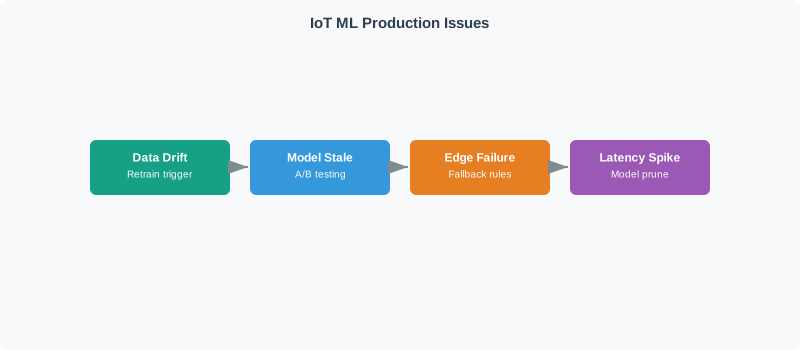
Read Figure 35.1 from changed evidence to response. Data drift calls for input and label review before retraining; stale model behavior calls for outcome comparison and a governed update; edge failure requires fallback and rollback; latency spikes may require profiling, pruning, or placement changes. Do not read the responses as automatic fixes—each is a hypothesis to test against the release boundary. This carries forward the chapter’s running narrative: production monitoring protects a decision by connecting signals, owners, diagnostic evidence, and reversible action.
Monitoring Boundaries
Data quality
Watch schema, units, missingness, sensor health, feature ranges, timestamp gaps, context fields, and source ownership.
Model behavior
Watch prediction distribution, confidence, calibration, rejection rate, false alarms, missed detections, drift, and label feedback.
System behavior
Watch latency, memory, power, queueing, connectivity, fallback path, edge/cloud handoff, update status, and telemetry completeness.
Release control
Watch version identity, rollout stage, rollback criteria, incident owner, retraining gate, audit record, and user-impact boundary.
Beginner Examples
Read the Beginner Examples material as a decision path rather than as isolated entries. First identify the operating condition in each entry and keep its units, timing, source, and assumed system state attached to it. Next compare the entries at the point where responsibility changes between device, gateway, network, analytic service, and operator; that hand-off is where apparently similar choices often produce different outcomes. Then follow the failure case: ask what becomes stale, delayed, unavailable, or unsafe, who detects it, and what evidence permits recovery. Finally connect the result to the chapter's running design record by naming the selected behavior, the rejected alternative, the measurement that justifies the choice, and the condition that forces a recheck. That order turns the examples or comparison into an auditable engineering argument.
- A vibration model can drift when a machine is serviced, a sensor is remounted, or the operating schedule changes.
- A mobile sensing model can degrade when device placement, battery saver behavior, or consented sensor access changes.
- An edge classifier can pass model metrics and still fail release if latency, memory, telemetry, or rollback is unproven.
- A feedback loop is useful only when labels, corrections, privacy limits, and retraining gates are documented.
Overview Knowledge Check
35.4 Production Monitoring Record
This section: Production Monitoring Record — A practical production ML monitoring record starts with the operational decision.
A practical production ML monitoring record starts with the operational decision. It then names the model version, input contract, feature contract, expected telemetry, alert thresholds, rollout stage, rollback path, feedback source, and retraining gate. The record should be short enough for operators to use during an incident.
Worked Review: Predictive Maintenance
A vibration model flags equipment for inspection. The monitoring record should keep the sensor mounting, feature windows, operating mode context, drift checks, alert routing, operator correction path, rollback rule, and maintenance owner visible. If a service visit changes machine behavior or sensor placement, the old release evidence should be considered stale until reviewed.
Worked Review: Edge Activity Model
A mobile or wearable classifier can be sensitive to device placement, sampling permissions, battery saver behavior, and user population. Production evidence should separate model quality from runtime quality: a high-confidence prediction is not useful if it arrives late, lacks context, violates privacy expectations, or cannot be corrected.
Practitioner Knowledge Check
35.5 Drift, Feedback, and Rollback
This section: Drift, Feedback, and Rollback — Under the hood, production ML fails when the meaning of its evidence changes.
Under the hood, production ML fails when the meaning of its evidence changes. Data drift changes inputs. Concept drift changes the relationship between features and outcomes. Label drift changes what operators call correct. Runtime drift changes whether the model can respond in time. Each boundary needs a different diagnosis and a different owner.
Feedback loops also need boundaries. Operator corrections, confirmed events, user reports, maintenance outcomes, and delayed labels can improve the next model only when they are traceable, privacy-reviewed, representative enough for the decision, and separated from unverified guesses.
A drift alarm is not a diagnosis by itself. The review should first decide whether the symptom is a broken sensor, a unit or schema change, a new operating regime, a threshold that no longer matches the alert cost, or an edge runtime problem that drops or delays features. For example, if confidence falls only during night shifts, the next step may be checking load patterns and label coverage, not retraining the full model immediately. If latency rises after a quantized model update, the issue may be packaging, batching, or hardware scheduling rather than concept drift.
Retraining also changes the release boundary. A new model should carry its training data window, label source, privacy review, feature code, threshold, held-out segments, canary results, and rollback rule into the release record. Teams should avoid training on the model's own unverified predictions because that can amplify previous mistakes. Delayed maintenance labels, operator overrides, and incident reviews are useful only when they are time-aligned with the original predictions and separated by site, device type, operating mode, and user impact. That evidence lets the owner choose rollback, threshold repair, data-quality repair, or retraining without hiding the tradeoff.
Data Drift
Input distributions move because sensors age, placement changes, calibration drifts, firmware changes, or context shifts.
Decision Drift
The model output stops matching operational value because the process, user population, cost, or policy changed.
Runtime Drift
The deployment boundary changes through latency, memory, power, queueing, connectivity, telemetry, or update behavior.
Release Drift
The release loses control when version identity, rollout scope, rollback rule, owner, or audit trail is missing.
Diagnosis Pattern
Read the Diagnosis Pattern material as a decision path rather than as isolated entries. First identify the operating condition in each entry and keep its units, timing, source, and assumed system state attached to it. Next compare the entries at the point where responsibility changes between device, gateway, network, analytic service, and operator; that hand-off is where apparently similar choices often produce different outcomes. Then follow the failure case: ask what becomes stale, delayed, unavailable, or unsafe, who detects it, and what evidence permits recovery. Finally connect the result to the chapter's running design record by naming the selected behavior, the rejected alternative, the measurement that justifies the choice, and the condition that forces a recheck. That order turns the examples or comparison into an auditable engineering argument.
- Place the symptom. Decide whether the issue is data quality, model behavior, runtime constraint, feedback quality, or release control.
- Preserve the old evidence. Keep the model version, feature contract, telemetry, labels, thresholds, and rollout scope available for comparison.
- Narrow the action. Roll back a bad release, repair a sensor contract, adjust a threshold only with evidence, or retrain only after labels and gates are reviewable.
- Record the next retest trigger. A future model, feature, firmware, population, threshold, privacy, or device change should reopen the monitoring record.
Under-the-Hood Knowledge Check
35.6 Summary
This section: Summary
- Production ML monitoring keeps an IoT model release tied to a bounded decision after deployment.
- A reviewable record includes input contract, feature meaning, model behavior, runtime limits, telemetry, feedback, rollback, ownership, and retest triggers.
- Drift can affect data, labels, decisions, runtime behavior, or release control, and each boundary needs different evidence.
- Canary and staged rollouts are useful only when the team records segment evidence and can stop, roll back, or narrow the release.
- Retraining should follow traceable feedback, label-quality checks, privacy boundaries, and approval gates.
Approve production ML only when data quality, model behavior, runtime constraints, feedback loops, rollback controls, owners, and retest triggers all support the same operational decision.
35.7 See Also
This section: See Also
IoT Machine Learning Pipeline
Connect production monitoring to sensing, labels, features, training, evaluation, deployment, feedback, and retraining evidence.
Edge ML and TinyML Deployment
Review model size, latency, power, telemetry, update, fallback, and release evidence for edge deployments.
Feature Engineering for ML
Trace production drift back to feature windows, units, labels, leakage controls, and operational meaning.
Anomaly Detection for IoT Systems
Review anomaly alerts, false alarms, missed detections, context shifts, model evidence, and response paths.
Find help
3 reviewed answers.
Where should I start in a module?
Open the module page from the sidebar to see its chapters in order. Use the module map to return to a topic you need.
Modules and pathsReviewed
What can I try when a project does not work?
Check the symptom, then work through the diagnostic steps. Keep the error message and the smallest example that reproduces it.
When you are stuckReviewed
How do interactive examples work?
Use the interactive guide to check how examples and simulations work before changing your project.
Interactive examples guideReviewed