36 Cloud Reference Model L5-L7
36.1 Learning Objectives
By the end of this chapter, you will be able to:
- Distinguish Cloud Data Layers: Explain IoT Reference Model Levels 5-7 (Data Abstraction, Application, Collaboration)
- Design Data Abstraction: Implement reconciliation, normalization, and indexing strategies for IoT data
- Build Cloud Applications: Create analytics dashboards, reporting systems, and control applications
- Integrate Business Processes: Connect IoT data with enterprise systems and business workflows
36.2 Prerequisites
Before diving into this chapter, you should be familiar with:
- Cloud Computing for IoT: Understanding cloud service models (IaaS, PaaS, SaaS) and deployment types
- Edge, Fog, and Cloud Overview: Knowledge of the three-tier architecture
- Data Storage and Databases: Familiarity with database technologies (relational, NoSQL, time-series)
For Beginners: What is “Data in the Cloud” for IoT?
Think of the cloud as a massive, always-on warehouse for your IoT data—but smarter.
Imagine your smart home has sensors everywhere: thermostats, door sensors, cameras, and motion detectors. Each device generates data constantly. Where does all this data go?
The Three-Stage Journey:
| Stage | What Happens | Real-World Analogy |
|---|---|---|
| Edge | Data collected at the source | Security cameras recording locally |
| Fog | Initial processing nearby | A local server summarizing “motion detected” |
| Cloud | Long-term storage & analysis | A central warehouse storing months of data for trends |
Why send data to the cloud?
- Storage: Your smart thermostat can’t store 5 years of temperature history—the cloud can
- Processing power: Complex AI analysis requires servers you can’t fit at home
- Access anywhere: Check your home security camera from vacation
- Integration: Combine data from multiple sources (weather + thermostat + schedule)
The IoT Reference Model Levels (5-7) explained simply:
- Level 5 (Data Abstraction): “Clean and organize the data” — Like sorting your mail before filing it
- Level 6 (Application): “Show me something useful” — Dashboards, alerts, reports
- Level 7 (Collaboration): “Connect to business” — Trigger work orders, update inventory systems
For Kids: Meet the Sensor Squad!
Cloud computing is like having a super-smart library in the sky that remembers everything and helps you find answers!
36.2.1 The Sensor Squad Adventure: The Magic Memory Castle
One day, Sammy the Sensor was feeling overwhelmed. “I’ve been measuring temperatures all week, and I can’t remember what happened on Monday!” she cried. Her tiny memory chip could only hold a few numbers at a time.
Bella the Battery had an idea. “Let’s send your measurements to the Cloud Castle! It’s a magical place high above the city where thousands of computers work together. They have SO much memory that they never forget anything!”
Max the Microcontroller helped Sammy pack her data into tiny digital packages. “We’ll send these through the internet, like paper airplanes flying up to the castle,” he explained. Lila the LED lit up the way as the data zoomed through Wi-Fi waves, bounced between cell towers, and finally arrived at the enormous Cloud Castle.
Inside the castle, friendly Cloud Helpers sorted Sammy’s temperature readings by date and time, stored them in giant digital filing cabinets, and even made colorful charts showing how the temperature changed each day. “Now you can ask the Cloud Castle about any day, any time, and it will remember!” cheered the team.
36.2.2 Key Words for Kids
| Word | What It Means |
|---|---|
| Cloud | Powerful computers far away that store data and do hard math for us |
| Upload | Sending your data UP to the cloud, like mailing a letter to a faraway friend |
| Dashboard | A screen that shows important information in easy pictures and charts |
| Analytics | When the cloud finds patterns and answers hidden in lots of data |
36.3 IoT Reference Model: Levels 5-7
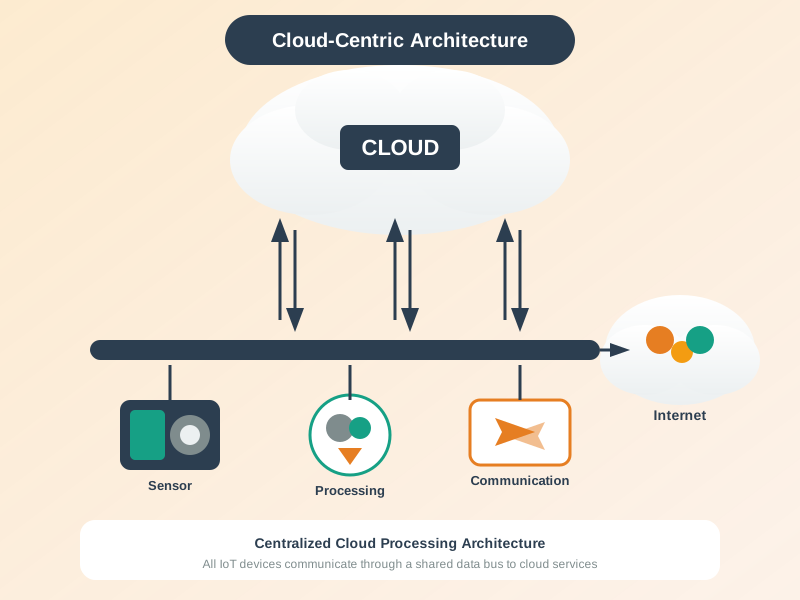
Previously, we focused on Levels 1-4 of the IoT, where raw dynamic data is generated in motion. In Level 5, we take this accumulated data and abstract it ready for analysis. As can be seen in the diagram, Level 5 is moving from Operational Technology into the Information Technology realm. We work with queries on datasets, rather than events driving the system.
36.3.1 Level 5: Data Abstraction
Level 5 is where raw IoT data becomes enterprise-grade information. Without this layer, every application team would write its own parsing logic for every sensor type – an approach that breaks down at scale.
Level 5 deals with:
- Reconciling data formats from different sources
- Normalization and standardizing formats and terminology
- Confirming completeness of data prior to analysis
- Data replication and centralized storage
- Indexing within databases to improve access times
- Security and access level management
Why Level 5 is the hardest layer to get right: In a real deployment, a single smart building might have BACnet HVAC controllers reporting temperatures in Fahrenheit every 60 seconds, Modbus power meters sending kWh readings in big-endian binary every 15 seconds, and Zigbee occupancy sensors emitting JSON events on state change. Level 5 must reconcile these three formats, three time granularities, and three data models into a unified schema before any dashboard can display “Building Energy per Occupied Hour.”
Decision: ETL vs ELT for IoT data
Most modern IoT deployments use ELT because sensor schemas change frequently (firmware updates add new fields) and cloud storage costs less than $0.02/GB/month. The transformation happens in query engines like Azure Stream Analytics or AWS Athena rather than in ingestion pipelines.
Putting Numbers to It
How much does data abstraction save in a multi-format IoT deployment?
Consider a global logistics company with 50,000 GPS trackers sending data in 3 different formats (JSON, CSV, Protocol Buffers):
Without Level 5 Abstraction (each analyst handles format conversion): \[ \text{Developer Hours} = 3 \text{ formats} \times 10 \text{ analysts} \times 20 \text{ hours/analyst} \] \[ = 600 \text{ developer-hours} = \$60,000 \text{ at } \$100/\text{hour} \]
With Level 5 Abstraction (one-time ingestion pipeline): \[ \text{Pipeline Development} = 1 \text{ engineer} \times 40 \text{ hours} = \$4,000 \] \[ \text{Savings} = \$60,000 - \$4,000 = \$56,000 \text{ (first project)} \]
Ongoing Benefits for 10 annual analytics projects:
Without a centralized abstraction layer, each new project team must independently handle format conversion. The pipeline build cost is paid once and reused across all projects:
\[ \text{Annual Cost Without Abstraction} = 10 \text{ projects} \times \$60,000/\text{project} = \$600,000 \] \[ \text{Annual Cost With Abstraction} = \$4,000 \text{ (one-time)} + \$0 \text{ (per project)} = \$4,000 \] \[ \text{First-Year Savings} = \$600,000 - \$4,000 = \$596,000 \]
Even conservatively, if each project only involves 2 analysts (not 10), the cost per project drops to $12,000, still yielding $116,000 in annual savings against a $4,000 investment. The one-time investment in Level 5 data abstraction eliminates repeated format-handling work across teams.
36.3.2 Try It: Data Abstraction ROI Calculator
Adjust the parameters below to see how Level 5 data abstraction impacts cost savings for your deployment:
36.3.3 Level 6: Application
Once data is cleaned and organized, it’s available to applications. Level 6 is where IoT data creates business value visible to end users. Applications at this level may:
- Provide back-end support for mobile apps
- Generate business intelligence reports
- Give analytics on business processes
- Provide system management and control for IoT systems
Real-world Level 6 example: Siemens MindSphere processes data from 1.5 million connected devices across manufacturing customers. The Level 6 applications include predictive maintenance dashboards (showing remaining useful life of CNC spindles), energy optimization tools (recommending off-peak production scheduling), and quality analytics (correlating vibration signatures with defect rates). Each application consumes the same Level 5 normalized data but presents different views for maintenance engineers, energy managers, and quality directors.
Common Level 6 architecture pattern: Most IoT platforms separate Level 6 into three sub-layers: (1) API gateway exposing RESTful endpoints for normalized data, (2) application logic implementing domain rules (threshold alerts, anomaly scoring, trend calculations), and (3) presentation layer rendering dashboards, reports, and mobile interfaces. This separation allows the same data API to serve both a real-time operations dashboard and a monthly executive report.
36.3.4 Level 7: Collaboration and Processes
Building on Levels 1-6, business processes span systems and involve multiple people. Level 7 allows for collaboration and processes beyond the IoT network and individual applications.
Why Level 7 matters: Levels 5-6 answer “what happened?” and “what is happening now?” Level 7 answers “what should we do about it?” by connecting IoT insights to business workflows. A temperature anomaly detected at Level 6 becomes a maintenance work order in SAP, a parts requisition in the supply chain system, and a notification to the facilities manager – all triggered automatically.
Level 7 integration example: When a connected elevator in a Schindler building detects abnormal vibration patterns (Level 4 accumulation, Level 5 normalization, Level 6 anomaly scoring), the Level 7 system automatically creates a service ticket in Schindler’s field management system, schedules a technician visit during low-usage hours, pre-orders replacement bearings from the parts warehouse, and notifies the building manager of the upcoming maintenance window. No human initiates this workflow – the IoT data flows directly into enterprise business processes.
36.4 Worked Example: Cloud Dashboard Data Pipeline
Worked Example: Designing Cloud Dashboard Data Pipeline for Multi-Region Deployment
Scenario: A global manufacturing company operates 8 factories across 3 continents (North America, Europe, Asia-Pacific). Each factory has 500+ sensors monitoring production lines. The company needs a unified cloud dashboard accessible from headquarters (London) showing real-time production metrics with less than 5-second data latency.
Given:
- Factories: 3 in USA (EST/CST/PST), 2 in Germany (CET), 3 in China/Japan (CST/JST)
- Sensors per factory: 500 sensors reporting every 5 seconds
- Total message volume: 8 factories × 500 sensors × 12 msg/min = 48,000 messages/minute
- Dashboard users: 50 executives in London viewing simultaneously
- Latency requirement: End-to-end data visibility within 5 seconds
- Refresh rate: Dashboard updates every 2 seconds for real-time feel
Steps:
- Calculate regional data volumes and latency budgets:
- Asia-Pacific → London: 280ms network RTT (undersea cables)
- USA → London: 120ms network RTT (transatlantic)
- Germany → London: 25ms network RTT (European backbone)
- Available processing time per region: 5000ms - RTT - 500ms rendering = variable budget
- Design edge aggregation strategy:
- Deploy edge gateway at each factory: aggregate 500 sensors to 10 KPI values every 2 seconds
- Pre-compute: production rate, defect count, energy consumption, uptime %, top 5 alerts
- Data reduction: 500 raw readings → 10 aggregates = 50× reduction
- New message rate: 8 factories × 10 metrics × 30/min = 2,400 messages/minute (vs. 48,000)
- Configure multi-region cloud architecture:
- Primary: Azure IoT Hub in West Europe (London-adjacent region)
- Regional hubs: Azure IoT Hub in East US, West Europe, East Asia
- Data flow: Factory → Regional Hub → Cosmos DB global replication → West Europe dashboard
- Cosmos DB consistency: Strong consistency for EU, Bounded staleness (5s) for US/APAC
- Design dashboard query strategy:
Dashboard connects to West Europe Cosmos DB only (single read region)
Query pattern:
SELECT * FROM metrics WHERE timestamp > NOW() - 10 seconds ORDER BY factory, timestampPre-materialized views: hourly/daily rollups computed by Azure Stream Analytics
Real-time panels: pull from Cosmos change feed via SignalR for push updates
- Calculate end-to-end latency by region:
- Asia-Pacific: 100ms (edge) + 280ms (RTT) + 50ms (Cosmos replication) + 500ms (render) = 930ms ✓
- USA: 100ms + 120ms + 50ms + 500ms = 770ms ✓
- Germany: 100ms + 25ms + 10ms + 500ms = 635ms ✓
- All regions within 5-second requirement with 4+ second margin
Result: London executives see unified global production dashboard with <1 second average latency. 50 concurrent users supported with single Cosmos DB read replica. Monthly cost: approximately $2,400 (IoT Hub: $800, Cosmos DB: $1,200, Stream Analytics: $400). Edge aggregation reduces cloud messaging costs by 95% compared to raw sensor ingestion.
Key Insight: For global IoT deployments, edge aggregation is critical for both latency and cost. Pre-compute KPIs at the factory level, transmit only aggregated metrics to cloud, and use globally-distributed databases with tuned consistency levels.
36.4.1 Try It: IoT Latency Budget Calculator
Estimate end-to-end latency for your IoT cloud deployment by adjusting edge processing time, network round-trip time, and rendering time:
36.5 Worked Example: Predictive Maintenance Dashboard
Worked Example: Cloud Analytics Dashboard for Predictive Maintenance Visualization
Scenario: An airline operates 150 aircraft with 2,000 sensors each monitoring engine health, hydraulics, and avionics. Maintenance engineers need a cloud dashboard to visualize anomaly predictions, prioritize inspections, and track component remaining useful life (RUL) across the global fleet.
Given:
- Fleet: 150 aircraft × 2,000 sensors = 300,000 sensor channels
- Data rate: Engine sensors at 1 Hz, others at 0.1 Hz during flight
- Average flight duration: 4 hours, 6 flights per aircraft per day
- Prediction model output: RUL estimates updated every 15 minutes per component
- Users: 25 maintenance engineers, 5 fleet managers
Steps:
- Define dashboard information architecture:
- Level 1 (Overview): Fleet heatmap - 150 aircraft in 10×15 grid, color-coded by health score (green 90-100%, yellow 70-89%, orange 50-69%, red <50%)
- Level 2 (Aircraft Detail): Single aircraft with 20 component groups, each showing RUL gauge
- Level 3 (Component Deep Dive): Time-series of specific sensor with anomaly overlays
- Navigation: Click aircraft → see components → click component → see sensors
- Design efficient data model for visualization:
- Pre-aggregate health scores at component level (2,000 sensors → 20 component scores per aircraft)
- Store in time-series DB with 15-minute buckets for trend queries
- Materialized view for fleet overview: 150 rows × 5 columns (aircraft_id, health_score, worst_component, RUL_days, alert_count)
- Query for heatmap:
SELECT aircraft_id, health_score FROM fleet_health ORDER BY health_score- returns in <50ms
- Implement progressive loading strategy:
- Initial load (300ms): Fleet heatmap + summary stats (4 API calls, parallel)
- On aircraft selection (+200ms): Fetch 20 component scores (1 API call)
- On component selection (+150ms): Fetch 672 trend points + anomaly annotations (2 API calls)
- Total drill-down time: <700ms from overview to component detail
- Configure refresh rates by panel priority:
- Fleet heatmap: Refresh every 5 minutes (RUL predictions update every 15 minutes)
- Alert queue: Refresh every 30 seconds (new anomalies need prompt visibility)
- Component gauges: Refresh every 60 seconds when aircraft panel is open
- Trend chart: No auto-refresh (historical data, user triggers reload)
- Design color scheme for maintenance context:
- Health score gradient: #27AE60 (100%) → #F1C40F (70%) → #E67E22 (50%) → #E74C3C (<50%)
- RUL thresholds: Green (>60 days), Yellow (30-60 days), Orange (14-30 days), Red (<14 days)
- Ensure 4.5:1 contrast ratio for all text labels per WCAG 2.1
Result: Maintenance engineers identify at-risk aircraft in <5 seconds via fleet heatmap color scan. Drill-down to specific component takes <1 second. Alert queue surfaces new anomalies within 30 seconds of model prediction. Dashboard reduces maintenance planning time by 40% compared to spreadsheet-based tracking.
Key Insight: Predictive maintenance dashboards must balance overview (fleet-wide health at a glance) with drill-down capability (sensor-level forensics). Pre-aggregate health scores to enable instant heatmap rendering. Design for the “worst-first” workflow where engineers scan for red/orange, not green.
36.6 Knowledge Check
Understanding Check: Cloud Data Abstraction (Level 5)
Scenario: Your smart agriculture deployment has 5,000 soil moisture sensors from 3 manufacturers. Manufacturer A reports in Fahrenheit and percentage, Manufacturer B in Celsius and decimal (0.0-1.0), Manufacturer C sends raw ADC values (0-4095). All send timestamps in different formats.
Think about:
- What Level 5 data abstraction tasks are required before analytics?
- How would you design a normalized schema for multi-manufacturer compatibility?
- What quality score would you assign to incomplete or out-of-range readings?
Key Insight: Level 5 reconciliation pipeline: (1) Format normalization: Convert all timestamps to ISO8601, all temperatures to Celsius, all moisture to percentage (0-100%). (2) Schema standardization: Create unified schema: {device_id, timestamp, temp_celsius, moisture_pct, quality_score}. (3) Validation & scoring: Reject temp < -40°C or > 60°C (physically impossible), moisture < 0% or > 100%. Quality score: 100 (perfect) - 40 (out of range) - 20 (stale > 1 hour) - 20 (missing fields). Without Level 5 abstraction, analysts would need custom code for each manufacturer—unscalable and error-prone.
Common Pitfalls
1. Using a reference model designed for enterprise IT for IoT deployments
Enterprise reference models assume always-on, high-bandwidth connectivity and managed devices. IoT deployments have intermittent connectivity, heterogeneous protocols, and unmanaged edge hardware — apply IoT-specific reference models that account for these constraints.
2. Treating the reference model tier boundaries as hard partitions
In practice, a smart gateway might implement the ‘edge tier’ and ‘fog tier’ functions of a reference model in the same hardware. The reference model describes logical responsibilities, not necessarily separate physical systems.
3. Ignoring the operational data flows in favour of analytics flows
Reference models often highlight the analytics data path (device → cloud → dashboard) but underrepresent the operational path (cloud → device firmware updates, configuration, commands). Both flows must be modelled and secured.
4. Selecting a reference model without considering regulatory compliance
Some industries (healthcare, energy, financial services) have regulations that constrain where data can be processed and stored. Verify that the reference model’s architecture choices (cloud region, data residency, audit logging) comply with applicable regulations before adopting it.
36.7 Summary
36.8 What’s Next
| If you want to… | Read this |
|---|---|
| Explore specific IoT reference model implementations | Cloud Data IoT Reference Model |
| Study cloud platform services implementing the model | Cloud Data Platforms and Services |
| Explore architecture gallery patterns | Cloud Data Architecture Gallery |
| Understand data quality within the model layers | Cloud Data Quality and Security |
| Return to the module overview | Big Data Overview |