22 Edge Placement and Cost Contracts
More
Depth: Practitioner
Progress saves as you read. Mark sections complete as you go; your progress appears in the sidebar.
22.1 Start With the Story
This section: Start With the Story — Picture a food plant with a camera watching sealed packs.
Place Each Job Where a Bad Link Cannot Break the Promise
Picture a food plant with a camera watching sealed packs. One job must stop a faulty pack before it leaves the line. Another job studies a week of images to find slow drift. The system owner must decide where each job runs and what each choice will cost.
Write one record for each job. Name the event, the person or machine that needs the result, the time limit, the data that must survive, and the owner of the running service. A fast stop may belong beside the line. A long study may use a distant service and a larger store.
Test the split during a lost wide-area link, a busy local computer, a full store, an old model, and a service restart. Check that the stop still happens on time and that later study can tell which image, rule, and version led to each result. Price the normal case and the failure case.
Keep urgent safe action close to the machine. A remote service can train, compare, and review, but it must not be the only path to a time-bound stop. Keep event time and source identity when work moves between places.
This opening does not choose hardware or prove the final bill. Practitioner turns each job into a placement and cost record. Under the Hood examines queues, transfer time, storage, service terms, and the evidence needed to change the split.
Keep urgent action beside the machine and test how link loss, local load, and support cost change placement.
22.2 Learning Objectives
This section: Learning Objectives
After this page, you should be able to:
- Prioritize hard latency and outage requirements before comparing edge and cloud costs.
- Build a placement worksheet for each function in an edge analytics pipeline.
- Separate safety justification from financial return-on-investment justification.
- Include lifecycle operations and evidence metadata in edge cost models.
22.3 Why Placement Follows Cost
This section: Why Placement Follows Cost — Edge Cost & Trade-offs provides the calculators, worked examples, visual reference gallery, and deployment pitfalls for practical edge computing.
Edge Cost & Trade-offs provides the calculators, worked examples, visual reference gallery, and deployment pitfalls for practical edge computing. This page narrows in on the deeper placement contract: which function runs where, why that tier is eligible, what cost claim supports it, and what evidence will explain local action later.
Use it when a design contains both fast local decisions and slower cloud analytics. A good edge architecture is not “edge everywhere”; it is a deliberate split where each function runs at the cheapest tier that still satisfies latency, bandwidth, privacy, reliability, and operational ownership.
22.4 Start With Failure Constraints
This section: Start With Failure Constraints — Practical edge design starts with a constraint, not with a preferred platform.
Practical edge design starts with a constraint, not with a preferred platform. If the requirement is a 20 ms safety response, the decision is nearly made: the detection and shutdown path must run at the device or local gateway because a cloud round trip can exceed the whole budget. If the requirement is low monthly cost for high-rate sensors, the edge earns its place by reducing raw streams into summaries or events before the uplink. If the requirement is privacy, the edge keeps sensitive raw data local and sends only derived features.
The most useful sequence is latency first, then data volume, then privacy and operational ownership. Latency decides whether cloud is even eligible. Data volume decides whether cloud-only is affordable. Privacy decides what cannot leave the site. Operations decide whether the chosen edge hardware can be monitored, updated, and replaced without turning every gateway into an unmanaged mini data center.
Intuition: the edge is justified when local action, local reduction, or local privacy changes the outcome. If none of those apply, cloud-first is usually cheaper and easier to operate.
Before assigning work to a tier, follow the decision-tree diagram in Figure 22.1 from failure and latency constraints rather than from available product names.
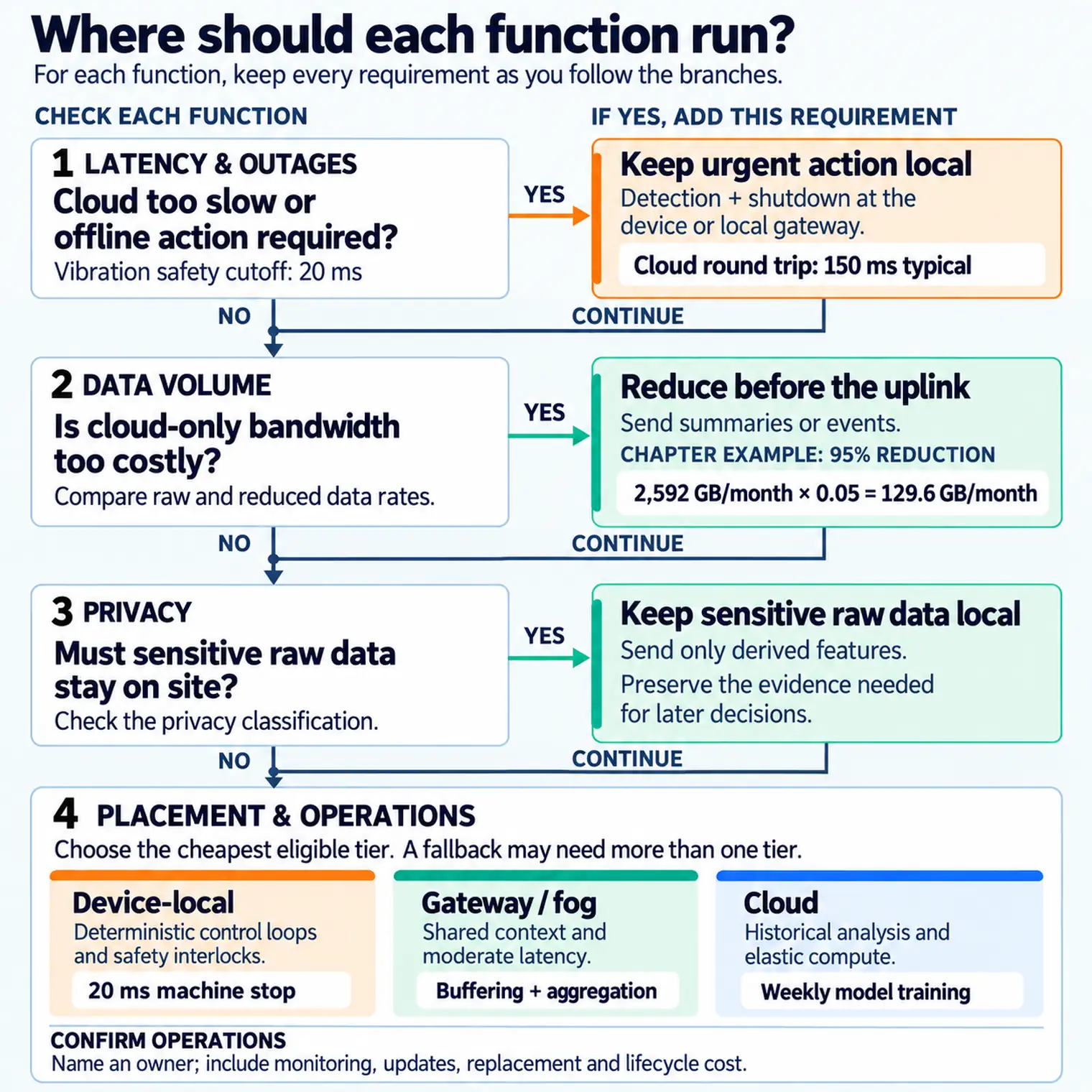
Read Figure 22.1 from the first constraint through each branch. A hard local deadline or loss-of-WAN requirement pushes the decision toward edge execution; shared context and moderate latency can support a fog or gateway tier; large historical analysis and elastic compute favour cloud placement. Data volume and privacy can redirect any branch, while an explicit fallback may require work at more than one tier. The result continues the chapter's running narrative: placement is a failure contract with measured costs, not a permanent label attached to an algorithm.
For a factory vibration system, a 20 ms machine stop belongs at the edge even if the cloud has better compute. The same deployment can still use the cloud for weekly model training because training benefits from historical data across many machines. For an environmental logger that sends one hourly summary over reliable broadband, cloud-only may be acceptable because latency and bandwidth do not force local processing. Good architecture is not “edge everywhere”; it is a deliberate split where each function runs at the cheapest tier that still meets the hard requirement.
22.5 Overview Knowledge Check
This section: Overview Knowledge Check
22.6 Placement Requirements Worksheet
This section: Placement Requirements Worksheet — For each data path, write a small worksheet before selecting hardware.
For each data path, write a small worksheet before selecting hardware. The worksheet should name the function, deadline, raw data rate, reduced data rate, privacy classification, failure mode, and owner. This prevents vague arguments such as “edge is faster” or “cloud is cheaper.” A function earns edge placement when a number proves it: the deadline is below realistic WAN latency, the uplink cost is large enough to justify hardware, raw data cannot leave the site, or offline behavior must keep working.
Function: vibration safety cutoff
Deadline: 20 ms end-to-end
Raw stream: 500 sensors * 1000 samples/s * 2 bytes = 1,000,000 bytes/s
Cloud RTT: 150 ms typical, worse under congestion
Decision: threshold + shutdown at edge; summaries + model training in cloud
Worked example: when hardware pays for itself
Raw monthly volume:
  1,000,000 bytes/s * 2,592,000 s/month = 2,592 GB/month

Edge features after filtering:
  95% reduction -> 129.6 GB/month

If bandwidth is $0.09/GB:
  Cloud-only bandwidth = 2,592 * $0.09 = $233/month
  Edge-hybrid bandwidth = 129.6 * $0.09 = $12/month
  Savings = $221/month before storage and compute

If gateways cost $5,000:
  Simple payback from bandwidth alone = $5,000 / $221 = 22.6 months
The payback improves when local processing also avoids failed safety requirements, lowers storage volume, or reduces cloud inference. It worsens when maintenance, spares, field replacement, or OTA operations are ignored. Treat edge hardware as a fleet with lifecycle cost, not a one-time purchase.
After the worksheet, choose the smallest deployment shape that satisfies the constraints. Device-local logic is best for deterministic control loops and safety interlocks. A gateway or fog node fits protocol translation, buffering, aggregation, and moderate inference across many sensors. Cloud fits model training, long-horizon analytics, dashboards, and cross-site optimization. Hybrid systems are common because a single application can contain all three classes at once.
Make the evidence contract explicit. The edge decision should preserve the threshold version, input window, clock source, and model hash that justified an action. The cloud should preserve the training window, rollout version, and rollback rule that produced any model pushed down to devices. Without those records, cost savings are easy to claim but difficult to defend after an incident.
22.7 Practitioner Knowledge Check
This section: Practitioner Knowledge Check
22.8 Under the Hood: The Real Edge Cost Model
This section: Under the Hood: The Real Edge Cost Model — The real edge cost model has four moving parts: latency risk, data-reduction value, hardware lifecycle, and evidence quality.
The real edge cost model has four moving parts: latency risk, data-reduction value, hardware lifecycle, and evidence quality. Latency risk is about worst-case behavior, not average behavior. A cloud path with a 150 ms average can spike above a second during congestion, DNS failures, cellular handover, or regional service incidents. If the control loop fails when the tail is bad, the function belongs locally even when cloud processing looks cheaper on a spreadsheet.
Data reduction value depends on whether the edge keeps the right information. A 95% reduction is useful only if summaries, features, or event windows preserve the diagnostic evidence that the cloud needs later. Reducing a vibration stream to FFT peaks may be correct for bearing monitoring, but reducing it to a single average can destroy the fault signature. The cost model must therefore pair each reduction rule with the decision it still supports.
Hardware lifecycle is the part many estimates miss. Gateways need spares, monitoring, certificates, OTA updates, rollback, field replacement, and security patching. A $5,000 gateway purchase is not the total cost; it is the start of a fleet. Evidence quality closes the loop: each edge action needs enough local metadata to explain what happened when cloud records arrive later.
Practitioner Knowledge Check
Keep safety justification separate from return-on-investment justification. A deployment may be required because cloud latency cannot meet a shutdown deadline even if the gateways take years to pay back. Another deployment may be optional because cloud latency is acceptable, but edge reduction pays back quickly on bandwidth. Mixing those two arguments hides risk: the financial model can be adjusted, but a missed control deadline can make the architecture invalid.
Practitioner Knowledge Check
Tail latency beats averages
Design against the worst tolerated response, not a happy-path median. Safety and control paths need deterministic local behavior.
Reduction must preserve evidence
Filtering, aggregation, FFT features, and event clips are only valid when they retain the evidence needed for later decisions.
Hardware is a fleet
Edge nodes require health checks, certificates, OTA rollout, rollback, spares, and replacement procedures.
Cloud still has a role
Training, cross-site correlation, dashboards, and long-term storage often stay in the cloud even when action runs locally.
One useful calculation is the break-even reduction factor. If raw telemetry costs $300 per month to move and store, and the edge fleet adds $120 per month in amortized hardware plus operations, the deployment must save more than $120 in cloud and bandwidth cost to be financially positive. If it also satisfies a hard safety requirement that cloud cannot meet, the decision may be justified even before the financial break-even point. Record both arguments separately: “required for latency” and “pays back in 18 months” are different claims.
Another useful check is reversibility. Cloud services can often be resized or redeployed quickly; physical edge fleets cannot. Before pushing complex local inference to thousands of gateways, prove that simpler rules fail, that OTA rollback works, and that the gateway can report health when partly offline. Practical edge architecture is therefore conservative: local where the constraints demand it, cloud where scale and operations are better, and fog where a shared site-level node gives enough locality without putting every feature on the smallest device.
22.9 Under-the-Hood Knowledge Check
This section: Under-the-Hood Knowledge Check
22.10 Release Checklist
This section: Release Checklist
Before approving an edge placement decision, verify these records:
- Each function names its deadline, tail-latency tolerance, raw data rate, reduced data rate, privacy class, failure mode, and owner.
- Safety placement claims and return-on-investment claims are stored separately.
- Edge reduction rules state which diagnostic evidence they preserve and what raw windows remain available for review.
- Fleet lifecycle costs include monitoring, certificates, OTA rollout, rollback, spares, field replacement, and security patching.
- Local actions record threshold version, model hash, input window, clock source, and rollback rule.
22.11 See Also
This section: See Also
- Edge Cost & Trade-offs for calculators, worked examples, and deployment pitfalls.
- Edge Processing Patterns for filtering, aggregation, event extraction, and compression patterns.
- Edge Acquisition Power and Gateways for gateway and power trade-offs.
- Modeling Edge Deployment for model placement and resource constraints.
22.12 Next
This section: Next — Return to Edge Cost & Trade-offs after the placement contract is clear, then continue to Modeling Edge Deployment for resource-constrained inference deployment.
Return to Edge Cost & Trade-offs after the placement contract is clear, then continue to Modeling Edge Deployment for resource-constrained inference deployment.
Find help
3 reviewed answers.
Where should I start in a module?
Open the module page from the sidebar to see its chapters in order. Use the module map to return to a topic you need.
Modules and pathsReviewed
What can I try when a project does not work?
Check the symptom, then work through the diagnostic steps. Keep the error message and the smallest example that reproduces it.
When you are stuckReviewed
How do interactive examples work?
Use the interactive guide to check how examples and simulations work before changing your project.
Interactive examples guideReviewed