32 Biomimetic Sensing: Lessons From Human Skin
More
Depth: Practitioner
Progress saves as you read. Mark sections complete as you go; your progress appears in the sidebar.
32.1 Start With the Decision
This section: Start With the Decision — Check the engineering price.
Check the engineering price. Many small sensors can improve cover but add wires and drift.
32.2 Route Overview
This section: Route Overview — This is part 1 of 2.
This is part 1 of 2. Continue with Biomimetic Sensing: BioTac Tactile Systems.
32.3 Part Objectives
This section: Part Objectives
- Evaluate nature’s perfect sensor: human skin with range, error, power, and interface evidence.
- Validate skin-to-iot design framework with a concrete scenario and pass criteria.
32.4 Start With the Measurement Story
This section: Start With the Measurement Story — Machine learning means using examples to build a rule that can score new data.
Machine learning means using examples to build a rule that can score new data. Picture a robot hand that must feel a light touch, a firm grip, and a slip without sending every raw signal to a remote computer.
Start with the natural ability, not the animal or body part. Name what is sensed, over what range and time, and which action it supports. Then borrow only the useful pattern, such as many scales, local change sensing, or spare paths.
Check the engineering price. Many small sensors can improve cover but add wires and drift. Local processing can cut messages but may hide detail. A learned rule can spot patterns, yet it can fail on new surfaces or damage.
This robot-hand story cannot prove that biology is perfect or that copying a shape will work. It does not set materials, layout, power, training data, or safe force. Those need physical tests.
Use the Practitioner sections to build the nature-to-device record. Use Under the Hood for receptor timing, materials, local processing, and failure. The deeper work tests the borrowed rule without treating nature as a finished product plan.
Walk one touch test. Press one spot. Press two spots. Press very lightly. Press harder. Hold the press. Release it fast. Slide the object. Change the surface. Add a small cut. Block one sensor. Check whether the hand still works. Record raw values. Record local features. Send only what the grip needs. Keep an alarm path. Try an unseen object. Watch for a false grip. Watch for a missed slip. Lower power. Repeat the test. Raise wear. Repeat again. Compare the natural idea with the built result. Keep only the part that helps.
Biomimetic sensing starts by asking what nature already solves well: detecting touch, vibration, chemicals, orientation, flow, or light under messy conditions. The engineering task is to borrow the principle, then prove it fits the device.
32.5 In 60 Seconds
This section: In 60 Seconds — Human skin uses several receptor types with different response properties.
Human skin uses several receptor types with different response properties. Four major mechanoreceptors support touch. IoT designers can learn four key principles from this biological masterpiece: use multi-scale sensing (different sensors for different frequencies), implement adaptive response (slow-adapting for absolutes, fast-adapting for changes), build redundancy for graceful degradation, and process data hierarchically at the edge before sending to the cloud.
The mathematical gist. Sampling at can preserve only frequencies below without folding. This chapter’s 1,000 samples/s raw stream has a 500 Hz Nyquist ceiling; after decimation to 100 samples/s the ceiling is 50 Hz. A 55 Hz vibration that survives the chapter’s edge-set 50 Hz filter reappears at Hz, so a production filter normally leaves a transition guard band.
32.6 Key Concepts
This section: Key Concepts
- Biomimetic Sensing: Design of artificial sensors inspired by biological sensory systems; examples include electronic noses (gas sensor arrays), artificial skin (tactile arrays), and whisker-based tactile sensors modeled on animal vibrissae.
- Electronic Nose (e-Nose): An array of partially cross-selective gas sensors whose combined response pattern is analyzed with machine learning to identify complex odor mixtures, mimicking the mammalian olfactory system.
- Neuromorphic Sensing: Sensor architectures inspired by biological neural processing where events are only triggered when the stimulus changes (like retinal ganglion cells), dramatically reducing data volume compared to frame-based cameras.
- Tactile Sensor Array: A grid of pressure-sensitive elements measuring distributed force across a surface; used in robotic hands, prosthetics, and surface quality inspection; mimics receptor distribution in human skin.
- Artificial Lateral Line: An array of pressure and flow sensors inspired by the fish lateral line organ; enables underwater robots to sense hydrodynamic disturbances and track moving objects without visual contact.
- Compound Eye Camera: An imaging system using multiple small lenses covering a wide field of view, inspired by insect compound eyes; provides near-180 degree vision in an ultra-thin profile.
- Bioinspired Signal Processing: Computational algorithms derived from biology, such as spiking neural networks for event-driven sensor data, providing energy efficiency by only computing in response to input changes.
- Whisker Sensor: A flexible cantilever beam with strain gauges at the base, mimicking sensory whiskers of rodents; used on mobile robots for proximity and texture detection in low-visibility environments.
Learning Objectives
This section: Learning Objectives
- Explain how human skin’s sensor architecture inspires IoT design
- Apply the four biomimetic design principles to sensor system design
- Design multi-scale sensing systems combining different sensor types
- Implement hierarchical data processing from edge to cloud
- Create redundant sensor systems that degrade gracefully
32.7 For Beginners: Biomimetic Sensing
This section: For Beginners: Biomimetic Sensing — “Biomimetic” means learning from nature.
“Biomimetic” means learning from nature. Your skin contains millions of tiny sensors that detect pressure, temperature, and texture, all while using incredibly little energy. Engineers study how biological systems sense the world to design better IoT sensor networks. For example, just as your skin uses different sensor types for different jobs, a smart building might use a mix of temperature, motion, and light sensors working together.
- Start With the Measurement Story
- In 60 Seconds
- Key Concepts
- For Beginners: Biomimetic Sensing
- Prerequisites
- Nature’s Perfect Sensor: Human Skin
- Lessons from Biology
- Skin’s Multi-Scale Sensor Architecture
- Checkpoint: Skin as a Sensor Network
- Key Biomimetic Design Principles
- Checkpoint: Four Design Principles
- Skin-to-IoT Design Framework
This chapter has five stops:
- First inspect skin as a reference design: different touch receptors respond to different stimuli.
- Then you convert biology into four engineering principles: multi-scale sensing, adaptation, redundancy, and edge-before-cloud processing.
- Next you test the ideas with BioTac, calculators, and the 333x processing example.
- After that you stress-test event-driven designs with Observe rate limiting, quizzes, and project patterns.
- Finally you review relationships, pitfalls, and the next sensor topics to study.
Checkpoints recap the design decisions; widgets carry the arithmetic.
32.8 Prerequisites
This section: Prerequisites
- Sensor Introduction: Basic sensor concepts and terminology
- Electronics Fundamentals: Understanding of analog and digital signals
32.9 Nature’s Perfect Sensor: Human Skin
This section: Nature’s Perfect Sensor: Human Skin — Start with the biological baseline before choosing parts.
Start with the biological baseline before choosing parts. Do not copy skin literally; notice how it uses structure, adaptation, redundancy, and local processing.
Before designing IoT sensors, consider the most sophisticated sensing system ever evolved: human skin. Understanding nature’s solution provides profound insights for engineering better sensor systems.
32.10 Lessons from Biology
This section: Lessons from Biology — This biological sensor network puts most IoT systems to shame in terms of efficiency, robustness, and adaptability.
Your skin contains different sensory receptors that respond to touch, pressure, vibration, pain, and temperature:
- Detects a range of pressures and vibrations through receptors with different sensitivities.
- Responds in 1-500 ms (adapts to stimulus type)
- Responds to mechanical, thermal, and painful stimuli through different receptor types.
- Self-heals and recalibrates continuously (no maintenance required)
This biological sensor network puts most IoT systems to shame in terms of efficiency, robustness, and adaptability.
32.11 Skin’s Multi-Scale Sensor Architecture
This section: Skin’s Multi-Scale Sensor Architecture — Human skin does not rely on a single sensor type.
Human skin does not rely on a single sensor type. Use Figure 32.1 to see why: inspect the tissue layers first, then the receptor positions, and finally the different stimulus labels associated with those positions.
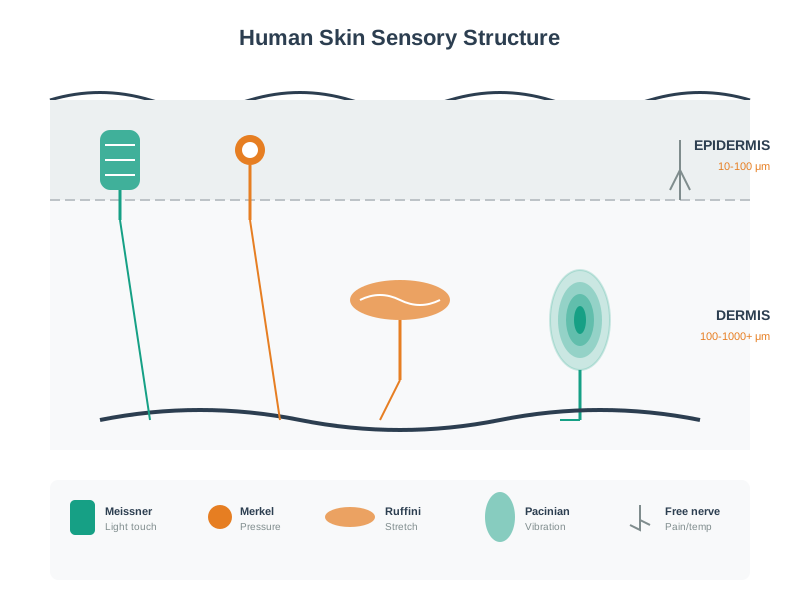
Human skin layers locate light-touch, pressure, stretch, vibration and pain/temperature sensing within the epidermis and dermis at different depths.
Read Figure 32.1 from surface to depth. Near-surface Merkel and Meissner receptors support fine contact and changing touch, deeper Ruffini and Pacinian structures respond to stretch and vibration, and free nerve endings contribute temperature and pain signals. The architecture distributes sensing by modality and dynamics; it does not ask one universal element to preserve every property of contact. That is the biomimetic principle the engineering mapping makes explicit.
Mapping Biological Sensors to Engineering:
| Skin Receptor | Sensation | Adaptation | Engineering Equivalent | Key Property |
|---|---|---|---|---|
| Merkel discs | Light touch, texture | Slow adapting | Strain gauge, pressure sensor | High spatial resolution (0.5mm) |
| Meissner corpuscles | Flutter, slip detection | Fast adapting | Vibration sensor (10-50 Hz) | Detects when objects slip from grasp |
| Pacinian corpuscles | Deep vibration | Very fast adapting | Accelerometer (50-500 Hz) | Maximum sensitivity at 200-300 Hz |
| Ruffini endings | Skin stretch, hand shape | Slow adapting | Strain sensor, force sensor | Directional sensitivity |
| Free nerve endings | Pain, temperature | Multi-modal | Thermistor, damage detector | Wide temperature range (~5°C to 50°C, with pain responses beyond) |
Receptor type is only half the architecture; response over time is the other half. Read Figure 32.2 to compare fast- and slow-adapting responses, following each path from the applied stimulus to the persistence or decay of its reported signal.
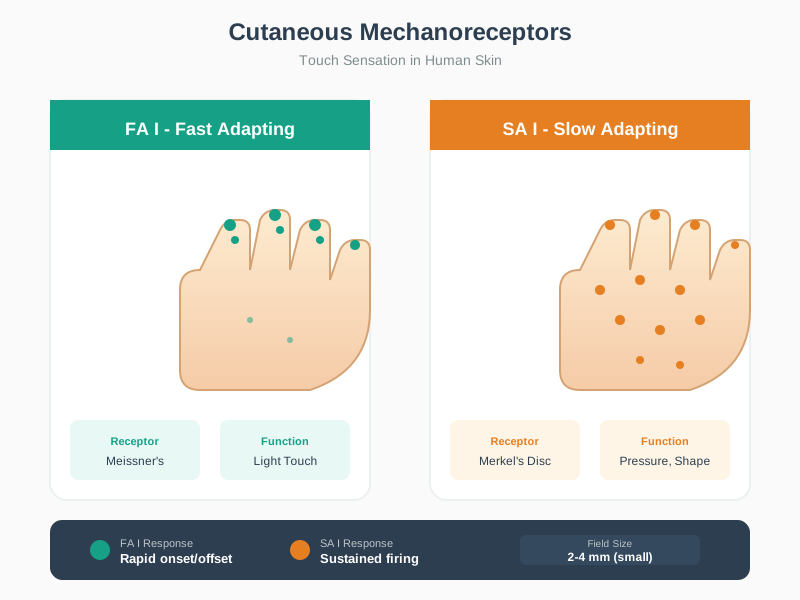
Diagram comparing fast-adapting and slow-adapting cutaneous mechanoreceptors in a fingertip. Fast-adapting receptors near the surface support light touch and rapid response, while slow-adapting receptors support sustained pressure and shape sensing.
Read the two paths in Figure 32.2 side by side. The fast-adapting path emphasises change and then quiets during a steady condition, whereas the slow-adapting path continues to represent sustained pressure or shape. An IoT analogue therefore needs both event evidence and baseline evidence when the application cares about transitions and persistent state. This comparison leads directly into the chapter’s adaptive-sampling pattern: report fast changes promptly without discarding the slower absolute measurement.
Checkpoint: Skin as a Sensor Network
You now know:
- Skin combines several specialized receptor types instead of relying on one universal receptor.
- Different receptors cover different jobs: pressure, flutter, vibration, stretch, pain, and temperature.
- Skin offers varied sensitivity and adaptation through specialized receptors; do not treat it as one sensor with a single mass range, response time, or power rating.
32.12 Key Biomimetic Design Principles
This section: Key Biomimetic Design Principles
Analyzing human skin reveals four critical principles for IoT sensor design:
32.12.1 Multi-Scale Sensing
Biological Insight: Skin uses different receptors for different frequency ranges (0.5 Hz to 500 Hz). No single receptor handles everything.
IoT Application:
Start by don’t use one sensor type for all conditions. Finally combine sensors with different response times.
- Slow/static: Temperature (minutes), soil moisture (hours).
- Medium/quasi-static: Vibration monitoring (1-10 Hz), door sensors.
- Fast/dynamic: Accelerometer (100+ Hz), acoustic sensors (kHz).
Real Example - Predictive Maintenance:
System combines three sensing scales:
- Slow thermal drift: Temperature sensor sampled once per minute.
- Medium mechanical change: Low-frequency vibration sampled around 10 Hz for bearing wear.
- Fast structural events: High-frequency accelerometer sampled around 1000 Hz for crack detection.
The useful insight is not the exact numbers; it is that one sensor stream cannot see every time scale.
32.12.2 Slow and Fast Sensor Adaptation
Biological Insight: Merkel discs (slow adapting) continuously report pressure, while Pacinian corpuscles (fast adapting) only respond to changes. This saves neural bandwidth.
A touch receptor also encodes more than “pressed” or “not pressed.” For a stronger indentation, the nerve fires a denser burst of spikes; as the stimulus becomes familiar, that pulse density decays. The engineering analogy is an event stream whose rate carries amplitude at the moment of change, while adaptation keeps a steady condition from consuming bandwidth forever.
IoT Application:
- Use slow-adapting (DC-coupled) sensors for absolute measurements:
- Room temperature, water level, battery voltage
- Use fast-adapting (AC-coupled) sensors for change detection:
- Motion sensors (PIR), vibration, acoustic events
- Energy savings: Fast-adapting sensors can sleep between events
Design Pattern - Adaptive Sampling:
Use two reporting paths instead of one constant stream:
- Slow path: read temperature on a schedule and publish the absolute value.
- Fast path: keep the camera asleep until motion or vibration crosses a threshold.
- Idle path: if nothing changes, return the node to deep sleep instead of transmitting “nothing happened.”
This is the engineering version of slow-adapting skin receptors reporting baselines while fast-adapting receptors report only changes.
32.12.3 Redundancy and Graceful Failure
Biological Insight: Skin has overlapping sensor coverage. Damage to one receptor type doesn’t cause total failure.
IoT Application:
Start with Sensor fusion: Combine multiple sensors for critical measurements.
Start by iMU = accelerometer + gyroscope + magnetometer. Finally indoor localization = Wi-Fi RSSI + BLE beacons + barometric altitude.
Start with Fail-safe design: System continues with reduced accuracy if one sensor fails.
Real Example - Autonomous Vehicles:
Redundant perception in practice:
- LiDAR: High-resolution primary distance sensing.
- Radar: Lower-resolution backup that still works in fog and rain.
- Camera: Context, color, signs, lanes, and object type.
If LiDAR fails, the vehicle should reduce speed and continue with radar plus camera rather than failing silently.
32.12.4 Edge-Before-Cloud Processing
Biological Insight: Significant signal processing occurs in nerve endings and spinal cord before reaching the brain. Only important signals trigger cortical attention.
Skin receptors send touch information along axons to the spinal cord; their signals are processed through neural pathways rather than forwarded as individual sensor readings. Instead, processing happens in layers:
- Receptor level --- Mechanoreceptors convert pressure to electrical impulses (analog-to-digital conversion)
- Peripheral nerve --- First filtering: only significant changes pass through (edge detection)
- Spinal cord --- Pattern recognition: “Is this pain? Temperature change? Vibration?”
- Thalamus --- Data fusion: combines touch + temperature + pain into a unified sensation
- Cortex — conscious perception follows processing of signals from specialized skin receptors.
This suggests a bandwidth lesson for IoT: specialized skin receptors and neural pathways process different stimuli, but their activity cannot be converted into a 99% telemetry-filtering rate.
IoT Application:
- Don’t send raw sensor data to cloud! Process locally:
- Sensor level: Hardware filtering (RC circuits, op-amps)
- Edge MCU: Thresholding, averaging, anomaly detection
- Gateway: Data fusion, time-series compression
- Cloud: Long-term analytics, model training
Quantified Impact --- Smart Factory:
Raw to cloud
100 sensors at 1,000 samples/sec produce 100,000 readings/sec.
Stage 1: decimate
Hardware filtering reduces 100,000 readings/sec to 10,000 samples/sec.
Stage 2: edge filter
Discarding normal behavior reduces 10,000 samples/sec to 500 samples/sec.
Stage 3: compress and batch
Gateway processing reduces 500 samples/sec to about 150 messages/sec.
The result is a 99.85% reduction. At $0.50 per million messages, the monthly ingestion cost drops from about $129,600 to about $194.
This section:
Checkpoint: Four Design Principles
You now know:
- Multi-scale sensing separates slow, medium, and fast phenomena instead of forcing one stream to do every job.
- Fast-adapting channels report changes; slow-adapting channels preserve absolute state.
- Redundancy and edge-before-cloud processing keep systems useful when one sensor fails or raw data volume is too high.
32.12.5 Processing Savings Calculator
Use this calculator to estimate the bandwidth and cost savings from applying biomimetic hierarchical processing to your IoT sensor deployment.
32.13 Skin-to-IoT Design Framework
This section: Skin-to-IoT Design Framework — Use Figure 32.3 to decide where a biomimetic sensor system should process evidence by reading from local perception and sensing upward toward integration and central analytics.
Use Figure 32.3 to decide where a biomimetic sensor system should process evidence by reading from local perception and sensing upward toward integration and central analytics.
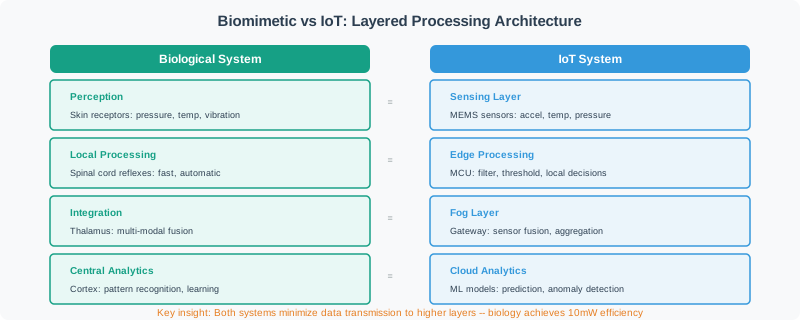
Layered processing architecture comparison showing biological system layers (perception, local processing, integration, central analytics) mapped to equivalent IoT system layers (sensing, edge, fog, cloud)
Read Figure 32.3 from the physical boundary upward. Receptors align with IoT sensors. Local biological processing aligns with edge filtering and event detection. The next layer pairs biological integration with fog or gateway work. Central interpretation then aligns with cloud analysis. The pattern turns adaptation into a system rule: process evidence close to its source when that is safe, then send only what the higher layer needs.
32.14 Continue to the Next Part
This section: Continue to the Next Part — Carry this evidence into Biomimetic Sensing: BioTac Tactile Systems, which begins with SynTouch BioTac Tactile Sensor.
Carry this evidence into Biomimetic Sensing: BioTac Tactile Systems, which begins with SynTouch BioTac Tactile Sensor.
Find help
3 reviewed answers.
Where should I start in a module?
Open the module page from the sidebar to see its chapters in order. Use the module map to return to a topic you need.
Modules and pathsReviewed
What can I try when a project does not work?
Check the symptom, then work through the diagnostic steps. Keep the error message and the smallest example that reproduces it.
When you are stuckReviewed
How do interactive examples work?
Use the interactive guide to check how examples and simulations work before changing your project.
Interactive examples guideReviewed