14 NFC Protocols: Handover Boundaries
More
Depth: Practitioner
Progress saves as you read. Mark sections complete as you go; your progress appears in the sidebar.
14.1 Start With the Decision
This section: Start With the Decision — An NFC tap is a short-range radio exchange.
An NFC tap is a short-range radio exchange. The reader starts that exchange and a tag responds. A mode sets their roles; handover uses the tap to set up another link that carries data. Polling looks for a target, and anti-collision helps the reader select one tag when several respond. This part follows the handover boundary and the activation mistakes that make a tap fail in the field.
14.2 Route Overview
This section: Route Overview — This is part 2 of 2.
This is part 2 of 2. Review NFC Protocols: Mode Foundations for the preceding evidence.
14.3 Learning Objectives
This section: Learning Objectives
- Test handover boundary with a concrete scenario and pass criteria.
- Validate design review checklist with a concrete scenario and pass criteria.
14.4 Chapter Roadmap
This section: Chapter Roadmap
- Handover Boundary
- Polling, Anti-Collision, and Activation
- Common Activation Mistakes
- Initiator, Target, and Passive Communication
- Quick Check: NFC Role
- Tag Types, Technologies, and NDEF
- Technology Matrix and Compatibility Evidence
- Reader/Writer Tag Choices
- NDEF Message Structure
- NDEF Design Rule
- Trust Boundaries
- Release Evidence
- Knowledge Check
- Match Modes to Responsibilities
- Order the NFC Reader/Writer Flow
- Common Pitfalls
- Assuming Every NFC Device Supports Every Mode
- Confusing NDEF With Authorization
- Skipping Write Verification
- Letting Handover Hide the Real Failure
- Design Review Checklist
- Summary
- Key Takeaway
- Concept Relationships
- See Also
- What’s Next
14.5 Handover Boundary
This section: Handover Boundary — Handover is a boundary pattern, not a promise that NFC will carry the whole session.
Handover is a boundary pattern, not a promise that NFC will carry the whole session. NFC carries enough information to identify the peer, select a carrier, or pass a setup token. The other bearer owns discovery completion, encryption, reconnect behavior, and bulk data exchange.
Figure 14.1 shows where an NFC tap hands setup to another carrier.
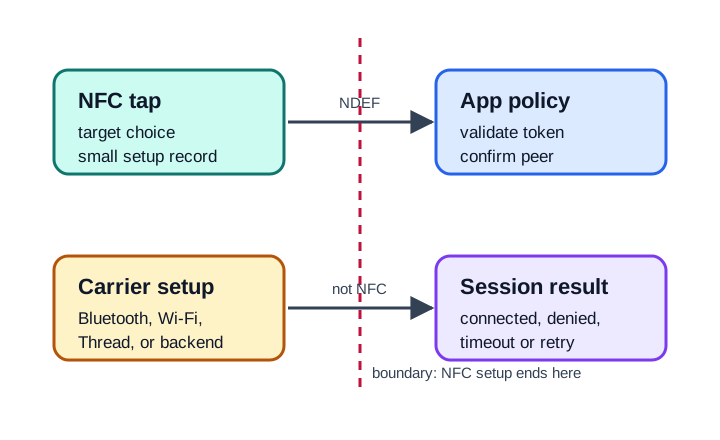
The tap selects a target and carries a small setup record. The app then validates the token or record and confirms the intended peer under its policy. That is the end of the NFC evidence: Bluetooth, Wi-Fi, Thread, or a backend must establish the later session. Record whether that carrier connected, was denied, timed out, or retried, and keep the result separate from the tap log. A successful NDEF exchange does not prove that the follow-on link is secure or usable. The boundary makes failures assignable to the tap, app check, or carrier setup.
For IoT products, this distinction matters during review:
14.6 Polling, Anti-Collision, and Activation
This section: Polling, Anti-Collision, and Activation — Before an NDEF record, APDU, or peer message can be exchanged, the reader must find and activate a target.
Before an NDEF record, APDU, or peer message can be exchanged, the reader must find and activate a target. Keep this level of detail in design reviews; diving into every modulation bit is usually unnecessary unless you are building reader firmware.
Figure 14.2 divides a tap into polling, selection, activation, and exchange states.
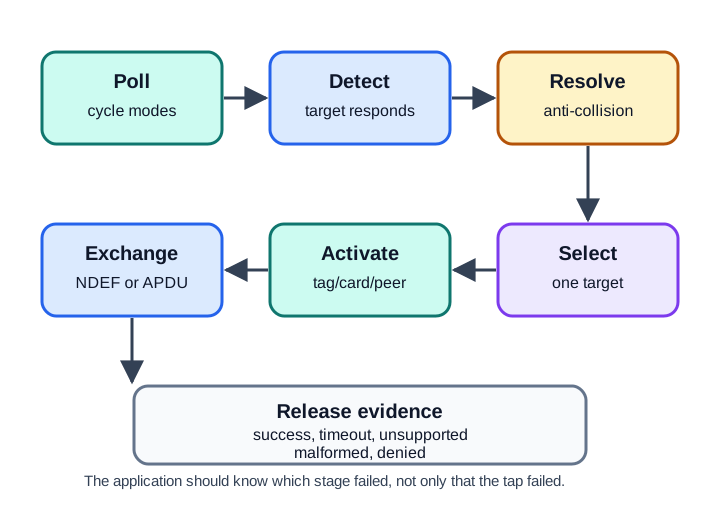
The activation loop in Figure 14.2 begins with reader polling across NFC modes. Detection is followed by anti-collision so the reader selects one target before protocol activation and application data exchange. Release returns it to polling and saves the stage, input, decision, and reason. The failure examples distinguish a malformed TLV, which the parser rejects, from an unknown URI host, which policy rejects. A successful Type 2 read of a setup URI only establishes that data arrived. The app still needs an authenticated session and backend work-order approval before taking a service action, so log where a failed tap stopped.
The activation sequence is reader-driven:
- Poll: The reader cycles through supported technologies such as NFC-A, NFC-B, NFC-F, or NFC-V.
- Detect response: A compatible target answers with enough information to continue selection.
- Resolve collisions: If more than one target responds, the reader selects one target at a time.
- Activate protocol: The reader moves into the protocol needed for tag memory, ISO-DEP, or peer exchange.
- Exchange data: Only after activation does the application see NDEF records, APDU responses, or peer payloads.
- Release or retry: The system records success, timeout, unsupported tag, malformed payload, or user-cancel evidence.
- Assuming the closest tag is always the selected tag when multiple targets are inside the field.
- Writing application logic that cannot distinguish “no tag,” “unsupported tag,” “activation failed,” and “payload rejected.”
- Treating a UID or serial-like value as a durable identity without a clone-resistance design and an application-side validation step.
14.7 Initiator, Target, and Passive Communication
This section: Initiator, Target, and Passive Communication — Every NFC exchange has an initiator that starts and drives the exchange and a target that responds.
Every NFC exchange has an initiator that starts and drives the exchange and a target that responds. In passive communication mode, only the initiator generates the 13.56 MHz field; the target replies by load modulation, varying how much energy it draws from the initiator field. This is the same operating idea that lets an unpowered HF RFID tag answer a reader.
This distinction explains several field failures. A phone can read an unpowered sticker because the phone is the initiator generating the field and the passive tag load-modulates a reply. At a cabinet reader or payment terminal, the fixed reader creates the field and sends commands; the phone acts as the card-emulation target and answers only through an allowed card application. Having a battery does not mean the phone owns the field.
Diagnose NFC failures from the bottom upward:
- No target reported: inspect field coupling, antenna orientation, tag technology support, shielding, mounting surface, and polling configuration.
- Target reported but no NDEF or APDU response: inspect activation, tag type mapping, memory access, ISO-DEP application selection, and record format.
- Payload parsed but action denied: inspect application policy, technician session, object state, authorization, and fallback.
- Handover tap succeeds but setup fails later: inspect peer identity, carrier pairing, session protection, timeout behavior, and rollback.
For card emulation, release evidence should record which application was selected, what happens when the reader asks for an unsupported application, whether user presence is required, and what audit event is emitted for declined or ambiguous taps. A successful “phone seen by reader” test can still hide a credential-policy failure.
14.8 Quick Check: NFC Role
This section: Quick Check: NFC Role
14.9 Tag Types, Technologies, and NDEF
This section: Tag Types, Technologies, and NDEF — Tag type, RF technology, and NDEF record type are different decisions.
Tag type, RF technology, and NDEF record type are different decisions. They often get collapsed into one phrase, which leads to weak reviews.
14.10 Technology Matrix and Compatibility Evidence
This section: Technology Matrix and Compatibility Evidence — Beneath the modes are RF technologies inherited from HF RFID smart cards.
Beneath the modes are RF technologies inherited from HF RFID smart cards. A tap works only when both sides share a supported technology.
| Technology | Based on | Notes |
|---|---|---|
| NFC-A | ISO/IEC 14443 Type A | Common MIFARE and NTAG family; 106 kbps base rate with modified Miller/OOK signaling. |
| NFC-B | ISO/IEC 14443 Type B | Used by many ID and banking-card systems; NRZ/BPSK signaling. |
| NFC-F | JIS X 6319-4, FeliCa | 212/424 kbps; common in Japanese transit and payment deployments. |
| NFC-V | ISO/IEC 15693 | Vicinity-card family; longer practical coupling distance at lower data rate. |
Turn this matrix into release evidence. A field-service app might support low-cost Type 2 labels for equipment lookup, a phone wallet credential for cabinet access, and an NFC handover tag for a Bluetooth sensor. Those are not one test. The label path needs reader/writer tests with the actual tag family, record size, lock state, and mounting surface. The cabinet path needs card-emulation tests against the installed readers and accepted application identifiers. The sensor setup path needs a handover test that proves the NFC record leads to the intended Bluetooth device, not merely that the tag can be read.
Write each result as a small compatibility record: mode=reader/writer, technology=NFC-A, tag_type=Type 2, payload=URI, max_length_checked=true, write_locked=true, fallback=manual asset search. For card emulation, record the reader model or class, selected application, declined-reader behavior, and audit event. For handover, record the carrier chosen, device identity check, timeout behavior, and rollback if the follow-on link fails.
14.11 Reader/Writer Tag Choices
This section: Reader/Writer Tag Choices
Choose tags from the evidence your workflow needs:
- Simple public pointer: A URI or short text record can use a small widely supported tag. Locking after write may be appropriate when the content should not change in the field.
- Field-updated asset state: Prefer a tag and workflow that can verify write success, preserve a previous known-good value, and recover from interrupted writes.
- Structured device commissioning: Store a compact identifier or setup token, then let the application fetch policy from a trusted service or local controller.
- Access or entitlement decision: Do not rely on tag memory alone. Use an explicit credential model, challenge-response design, or backend check as required by the system.
14.12 NDEF Message Structure
This section: NDEF Message Structure — NDEF is a message format.
NDEF is a message format. It is not encryption, not anti-collision, and not proof that the tap should be trusted. A message contains one or more records. Each record identifies its type and carries a payload.
Common record patterns include:
URI record
  Purpose: open or route to a resource
  Review point: validate scheme, host, and expected path

Text record
  Purpose: carry a short human-readable value
  Review point: handle language, length, and unexpected characters

MIME record
  Purpose: carry application-specific structured data
  Review point: parse with a strict schema and reject unknown fields

Handover record
  Purpose: carry setup data for another bearer
Review point: confirm the follow-on connection before changing statePut the smallest useful claim on the tag. The tag can identify an object or propose an action; the application should verify whether that action is allowed in the deployment context.
14.13 Trust Boundaries
This section: Trust Boundaries — The tap is intentional, but the data is still external input.
The tap is intentional, but the data is still external input. Treat reader/writer, card emulation, and handover flows as separate trust-boundary reviews.
14.14 Release Evidence
This section: Release Evidence — NFC failures often appear as “the tap did not work.” Good release evidence makes those failures diagnosable before field rollout.
NFC failures often appear as “the tap did not work.” Good release evidence makes those failures diagnosable before field rollout.
Figure 14.3 combines reader compatibility, protocol traces, and policy outcomes.
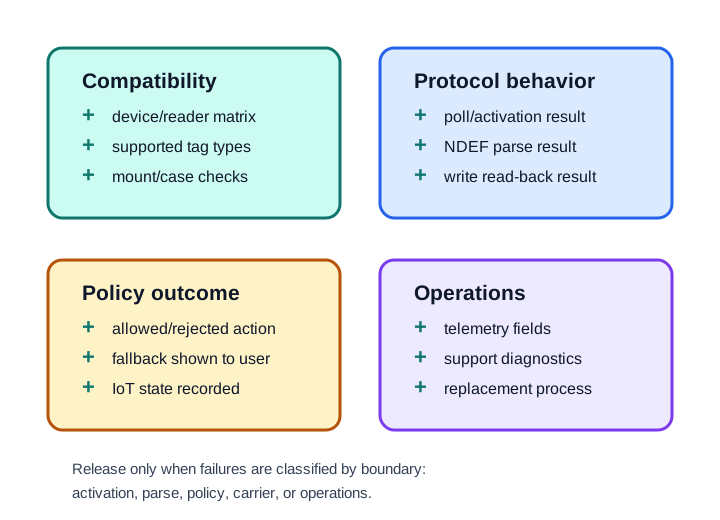
Compatibility names the device and reader matrix, supported tag types, and the final mount or phone-case conditions. Protocol evidence records polling, activation, NDEF parsing, and write read-back rather than a single pass flag. Policy evidence includes both an allowed and rejected action and the fallback route. These records need to describe the same release setup: changing a tag family, reader firmware, or mounting surface can invalidate an earlier result. A tap that worked once is only one observation; the matrix and negative cases show what can be promised to users.
Capture evidence in four areas:
14.15 Knowledge Check
This section: Knowledge Check
14.16 Match Modes to Responsibilities
This section: Match Modes to Responsibilities
14.17 Order the NFC Reader/Writer Flow
This section: Order the NFC Reader/Writer Flow
Common Pitfalls
This section: Common Pitfalls
Some devices expose reader/writer mode but not general-purpose peer-to-peer services. Some readers only activate specific tag technologies. Verify the mode and technology matrix for the deployment, then document fallback behavior.
An NDEF URI, text record, or MIME payload can be well formed and still be wrong for the target device, user, location, or workflow. Parse first, validate second, act third.
For writable tags, a successful write command is not enough release evidence. Read the tag back, parse the resulting NDEF message, and record what the application will do if the write is interrupted.
If an NFC-assisted setup fails after the tap, separate NFC parse failures from carrier connection failures and application authorization failures. The support path needs to know which boundary failed.
14.18 Design Review Checklist
This section: Design Review Checklist
Use this short checklist before approving an NFC mode decision:
- Mode: Name reader/writer, card emulation, peer-to-peer, or handover. Identify the field generator and command initiator.
- Target technology: List supported tag technologies or card protocols, plus unsupported cases that users may encounter.
- Payload: Define the NDEF records, schemas, maximum accepted length, and rejection behavior.
- Trust boundary: State which component validates the tap and which component is allowed to change IoT state.
- Fallback: Provide a visible path for no tag, unsupported tag, malformed payload, denied action, and follow-on carrier failure.
- Evidence: Attach device coverage, activation logs, parse results, write verification, telemetry fields, and field-test notes.
14.19 Summary
This section: Summary
This chapter covered NFC modes and protocols as a layered design problem:
- Reader/writer mode is for passive tags and reader-driven tag memory access.
- Card emulation mode is for devices that answer external readers as contactless card applications.
- Peer-to-peer and handover must be treated as explicit capabilities, with NFC usually carrying only small setup data in modern IoT workflows.
- NDEF is a portable message format, not a trust decision.
- Activation evidence explains whether the system failed to find a target, activate a protocol, parse a payload, or authorize an action.
- Release evidence should cover compatibility, protocol behavior, policy outcome, fallback, telemetry, and operations.
14.20 Key Takeaway
This section: Key Takeaway — NFC mode selection should match the interaction: reader-writer, peer-to-peer, and card-emulation patterns create different security, data, and user-flow obligations.
NFC mode selection should match the interaction: reader-writer, peer-to-peer, and card-emulation patterns create different security, data, and user-flow obligations.
14.21 Concept Relationships
This section: Concept Relationships
Builds On:
- RFID Fundamentals - HF RFID, tag selection, reader timing, and standards context.
- NFC Fundamentals - NFC range, tap intent, and basic active/passive behavior.
Enables:
- NFC Tags and NDEF - Tag family, capacity, record structure, and write-state decisions build on mode choice.
- NFC Communication and IoT Integration - Tap payloads need application policy, controller behavior, and follow-on carrier evidence.
- NFC Security and Comparisons - Threat models and controls depend on the operating mode and trust boundary.
Related Concepts:
- Bluetooth, Wi-Fi, and Thread commissioning often use NFC as a setup input rather than as the long-running connection.
- NDEF records should be schema-checked before they drive IoT actions.
- Tag type choice should be documented with compatibility and release evidence, not only with memory size.
14.22 See Also
This section: See Also
Standards and Specifications:
- NFC Forum Specifications - NDEF, tag operation, LLCP, and handover specifications.
- ISO/IEC 14443 - Proximity card communication used by many NFC systems.
- ISO/IEC 18092 - NFC Interface and Protocol specification.
Practice:
- Read a known NFC tag with a phone reader app and identify the record type, payload length, and tag technology.
- Write a test tag with a short URI record, read it back, and document the parse result and fallback if the record is malformed.
- For a handover design, write down exactly what NFC carries and what the follow-on bearer must prove before the application acts.
14.23 What’s Next
This section: What’s Next
14.24 Continue Your Route
This section: Continue Your Route — This is the last part of this chapter.
This is the last part of this chapter. Return to NFC Protocols: Mode Foundations or continue from the RFID, NFC and UWB Module Guide.
Find help
3 reviewed answers.
Where should I start in a module?
Open the module page from the sidebar to see its chapters in order. Use the module map to return to a topic you need.
Modules and pathsReviewed
What can I try when a project does not work?
Check the symptom, then work through the diagnostic steps. Keep the error message and the smallest example that reproduces it.
When you are stuckReviewed
How do interactive examples work?
Use the interactive guide to check how examples and simulations work before changing your project.
Interactive examples guideReviewed