33 802.15.4 Knowledge Checks
33.1 Start With the Wireless Story
Use these questions to practice reading 802.15.4 as an evidence chain. Decide whether the prompt is about PHY limits, MAC timing, frame budget, security, coexistence, or deployment proof, then choose the answer that protects the low-power link.
IEEE 802.15.4 network performance depends critically on three design decisions: device type (FFD for routing vs RFD for low-power end nodes), network mode (beacon-enabled for scheduled access vs non-beacon for event-driven sleep), and channel planning (keeping utilization under 30% to avoid CSMA/CA collision cascades). Mastering these trade-offs is essential for deploying reliable, long-lived sensor networks.
33.2 Knowledge Check
Test your understanding of fundamental concepts.
33.3 Understanding Check: Smart Building Sensor Network Troubleshooting
Scenario: A smart building deploys 200 occupancy sensors using 802.15.4-based Zigbee, with each sensor reporting motion every 2 seconds. The network architect notices consistent transmission failures on some sensors despite good signal strength.
Think about the evidence in order. First establish how CSMA/CA behaves when 200 devices compete for airtime. Next calculate the channel occupancy created by 100 transmissions per second on a 250 kbps channel. Finally explain why collision and backoff costs rise nonlinearly as occupancy approaches saturation. This order separates payload capacity from the time and coordination overhead that actually govern access.
Key Insight: CSMA/CA collision avoidance breaks down under heavy contention, not bandwidth limits:
Channel utilization analysis: Begin with 200 sensors reporting once every two seconds, which produces 100 transmission attempts per second. If each attempt occupies 5–10 ms, those attempts demand 50–100% of the available channel time before retransmissions are included. At that load, overlapping attempts and repeated clear-channel assessments make a high collision rate plausible; the exact rate must be measured for the chosen traffic, MAC settings, and RF environment.
CSMA/CA Breakdown: When a sensor senses a busy channel, it waits for a randomized backoff before trying again. Under sustained load, trace the failure sequence from repeated busy assessments, through longer accumulated waits, to exhausted retry limits and dropped reports. Latency also becomes variable because each device sees a different contention history. Record CCA failures, retries, drops, and delivery latency rather than describing the channel as literally always busy.
Evaluate controls in order of evidence. First reduce or stagger the reporting rate and measure whether contention clears. Next consider independent PANs on carefully selected channels when the installation can support the extra coordinators and coexistence plan. Use beacon scheduling or guaranteed time slots only for traffic whose timing requirement and device support justify the added coordination. Each control still requires installed measurements; none guarantees a particular collision rate by name alone.
Why bandwidth is NOT the bottleneck: 200 sensors × 50 bytes/2s = 5 KB/s, only 16% of 250 kbps (31.25 KB/s) raw capacity. CSMA/CA overhead, not data rate, causes failures.
Verify your understanding by changing one condition at a time. Explain why doubling the reporting frequency can increase collisions by more than twofold once retries add more traffic. Then state what beacon-enabled GTS would reserve, which critical flows would receive it, and what unscheduled traffic remains. Finally predict the direction of CCA failures, retries, and latency after adding 100 sensors, and name the counters needed to test that prediction.
Scenario: You’re choosing an 802.15.4-based protocol for a smart home system. Zigbee, Thread, and 6LoWPAN all use identical 802.15.4 PHY/MAC layers (same radio chips, same 2.4 GHz frequency, same 250 kbps data rate). Yet they behave very differently at the network level.
Think about: First, What happens above the 802.15.4 MAC layer that differentiates these protocols? Next, How does addressing architecture affect internet connectivity requirements? Then, Why would a developer choose one protocol over another if the radio hardware is identical?
Key Insight: The critical difference is addressing and internet connectivity, not radio characteristics:
Zigbee Architecture: First, Addressing: Proprietary 16-bit (0x1234). Next, Network layer: Custom Zigbee routing protocol. Then, Internet connectivity: REQUIRES translation gateway. After that, Data flow: [Sensor] ←Zigbee→ [Hub translates Zigbee→IP] ←Wi-Fi→ [Internet]. Finally, Sensors cannot be directly addressed from internet.
Thread/6LoWPAN Architecture: First, Addressing: Standard IPv6 128-bit (2001:db8::1234). Next, Network layer: IPv6 with RPL routing + 6LoWPAN header compression. Then, Internet connectivity: Native end-to-end IP. After that, Data flow: [Sensor] ←IPv6→ [Border Router] ←Internet→ [Cloud]. Finally, Sensors have global IPv6 addresses, directly accessible.
Why radio characteristics are identical: All three protocols share the same IEEE 802.15.4 foundation: First, Frequency: 2.4 GHz (all three). Next, Modulation: O-QPSK (all three). Then, Data rate: 250 kbps (all three). After that, Range per hop: ~10-75m (all three). Finally, Topology support: Mesh, star, tree (all three).
Practical implications: First, Zigbee: Established ecosystem (Philips Hue), requires proprietary hub, isolated from IP networks. Next, Thread: Apple/Google backing, native IPv6, direct cloud connectivity, newer ecosystem. Then, 6LoWPAN: Generic IPv6 over 802.15.4, flexible for custom applications.
Verify Your Understanding: First, How does IPv6 header compression (6LoWPAN layer) fit 40-byte IPv6 headers into 127-byte 802.15.4 frames? Next, Why can’t Zigbee devices communicate directly with cloud services without a hub? Then, If all three use the same radio chips, why can’t a single device run Zigbee, Thread, AND 6LoWPAN simultaneously?
Scenario: A warehouse deploys 802.15.4 asset trackers requiring 5+ year battery life on a single CR2032 coin cell (225 mAh). Devices only transmit location updates when assets physically move (2-3 times per day average). Most of the time, assets sit stationary on shelves.
Think about: First, How does device type (FFD vs RFD) affect power consumption through routing responsibilities? Next, Why does beacon-enabled mode waste power for event-driven applications? Then, What is the energy cost of waking up 5,760 times per day vs 2-3 times per day?
Key Insight: RFD in non-beacon mode maximizes battery life for sporadic, event-driven transmissions:
Device Type Power Impact:
RFD (Reduced Function Device): First, Role: End device only, cannot route for others. Next, Sleep behavior: Deep sleep 99.99% of time. Then, Wake triggers: Only when asset moves. After that, Power: ~5 µA sleep, 20 mA transmit for 15ms. Finally, Battery life: 5+ years ✓.
FFD (Full Function Device): First, Role: Can route, coordinate, or act as end device. Next, Sleep behavior: Must wake periodically to check for routing requests. Then, Power: ~500 µA average (100× higher than RFD). After that, Battery life: 1-2 months (NOT 5+ years).
Network Mode Power Impact:
Non-Beacon Mode (recommended): First, Wake-ups per day: 2-3 (only when asset moves). Next, Power per day: 2-3 transmissions × 15ms × 20 mA = ~0.01 mAh. Then, Battery life: 225 mAh / 0.01 mAh/day = 22,500 days = 61 years (battery self-discharge limits to 5-10 years).
Beacon-Enabled Mode: First, Wake-ups per day: 5,760 (every 15 seconds to listen for beacons). Next, Power per day: 5,760 × 5ms × 20 mA = ~0.5 mAh. Then, Battery life: 225 mAh / 0.5 mAh/day = 450 days = 1.2 years (fails 5-year requirement).
Why beacon mode kills batteries for event-driven apps: Even though the asset only moves 2-3 times/day, the device must wake 5,760 times/day just to listen for beacons it doesn’t need. This is 2,000× more wake-ups than necessary!
Verify Your Understanding: First, Why can’t FFD coordinators ever use battery power for 5+ year deployments? Next, How would battery life change if assets moved 10 times/day instead of 2-3 times/day in non-beacon mode? Then, What happens if you deploy RFD non-beacon devices but forget they need an FFD coordinator (which requires mains power)?
-
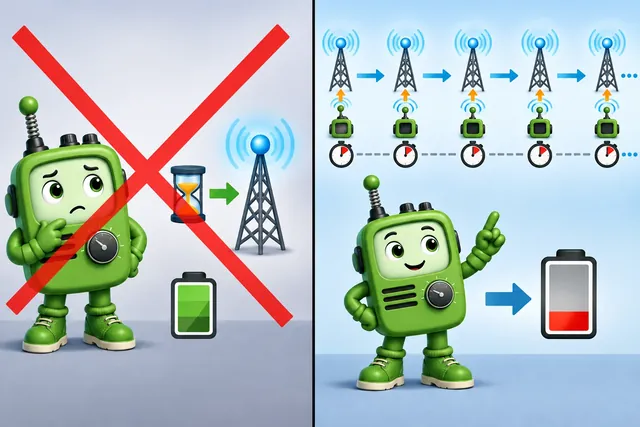
Wrong idea: beacon mode costs no more when a sensor reports every fifteen minutes. It fails because the sensor must wake for every beacon, which adds listen current.
Sammy the Sensor wants to make sure you remember the big ideas! Think of an 802.15.4 network like a school cafeteria at lunch:
First, CSMA/CA is like the “raise your hand” rule. Before you talk, you listen to see if anyone else is talking. If the cafeteria is quiet, go ahead! If someone else is talking, you wait a random amount of time and try again. The more kids in the cafeteria, the longer everyone waits.
First, FFD vs RFD is like teachers vs students. Teachers (FFDs) stay in the cafeteria all day and help pass messages. Students (RFDs) pop in, grab their lunch, and leave quickly — that saves their energy for the rest of the day.
First, Thread vs Zigbee is like two different school systems built on the same building. Thread gives every student a standard phone number (IPv6 address) so anyone in the world can call them directly. Zigbee uses its own internal intercom system — you need a secretary (gateway) to translate calls from outside.
Bella the Battery reminds you: “If you make a battery-powered sensor act like a teacher (FFD) instead of a student (RFD), its battery will die in months instead of years!”
33.4 Summary
Start the final review with contention: raw PHY rate alone does not predict delivery when many devices compete, and higher reporting frequency can amplify retries and backoff nonlinearly. Then separate stack boundaries. 6LoWPAN-based IPv6 stacks use a border router for IP connectivity, while Zigbee application traffic normally crosses a gateway that maps between protocol domains. Next connect device role to energy: an RFD can support a long-sleep leaf design, but its actual duty cycle must be measured rather than assumed. Finish at resilience: the PAN coordinator owns unique network-formation responsibilities, so the product needs an explicit recovery or replacement plan for its loss.
33.5 What’s Next
Continue the IEEE 802.15.4 journey in the order that matches your evidence gap. Begin with IEEE 802.15.4 Overview and Introduction when the protocol-stack boundary is unclear. Move to IEEE 802.15.4 Features and Specifications for PHY/MAC details and calculations. Use IEEE 802.15.4 Pitfalls and Best Practices to diagnose deployment mistakes, then finish with IEEE 802.15.4 Advanced Topics when group testing or more advanced contention controls are justified.