19 Wi-Fi Certification and Compliance

More
Depth: Practitioner
Progress saves as you read. Mark sections complete as you go; your progress appears in the sidebar.
19.1 Start With the Wireless Story
This section: Start With the Wireless Story — Certification work manages evidence.
Certification work manages evidence. Firmware is software stored inside a device. Start by separating the IEEE standard, Wi-Fi Alliance feature claims, regional radio approval, module reuse, and product records. This keeps a release decision from confusing compatibility with legal approval.
19.2 In 60 Seconds
This section: In 60 Seconds — Wi-Fi certification has three evidence lanes.
Wi-Fi certification has three evidence lanes. IEEE 802.11 defines the technical family. A Wi-Fi Alliance program checks that selected features work with other approved products. Regional radio approval checks whether one product setup may be sold in a target market. That setup includes the radio, antenna, firmware, enclosure, and labels. None of these lanes alone proves that a device will work well at its real site.
Keep four questions separate. A standard says how a technology should behave. Certification checks a named set of product claims. Radio approval says whether one setup may transmit in one market. A site test checks the final device in the place where people will use it. Passing one question does not answer the other three.
Imagine that a team changes the antenna. The old radio report may no longer fit. A new enclosure can change the result too. Firmware can alter channels or power. A new country brings different radio rules. A new building brings different access points and interference. Record each change, its owner, and the evidence that must be checked again.
Keep the record narrow. Name the exact product. Name the exact market. Name the exact evidence.
Use this chapter as a review reference. The goal is not to memorize every program name or channel table. The goal is to record which Wi-Fi capabilities are being claimed, which test evidence supports them, which markets and hardware variants are in scope, and which changes force retesting.
19.3 Learning Objectives
This section: Learning Objectives
By the end of this chapter, you will be able to:
- Separate IEEE standards, Wi-Fi Alliance certification, regional radio authorization, and site acceptance
- Identify the product evidence needed before a Wi-Fi feature claim can be trusted
- Explain why a certified radio module does not automatically certify every host product
- Review Wi-Fi security and onboarding claims for IoT devices
- Write a bounded certification evidence record for a product release
19.4 Certification Evidence Route
This section: Certification Evidence Route — Use Figure 19.1 as the review route for Wi-Fi certification decisions.
Use Figure 19.1 as the review route for Wi-Fi certification decisions.
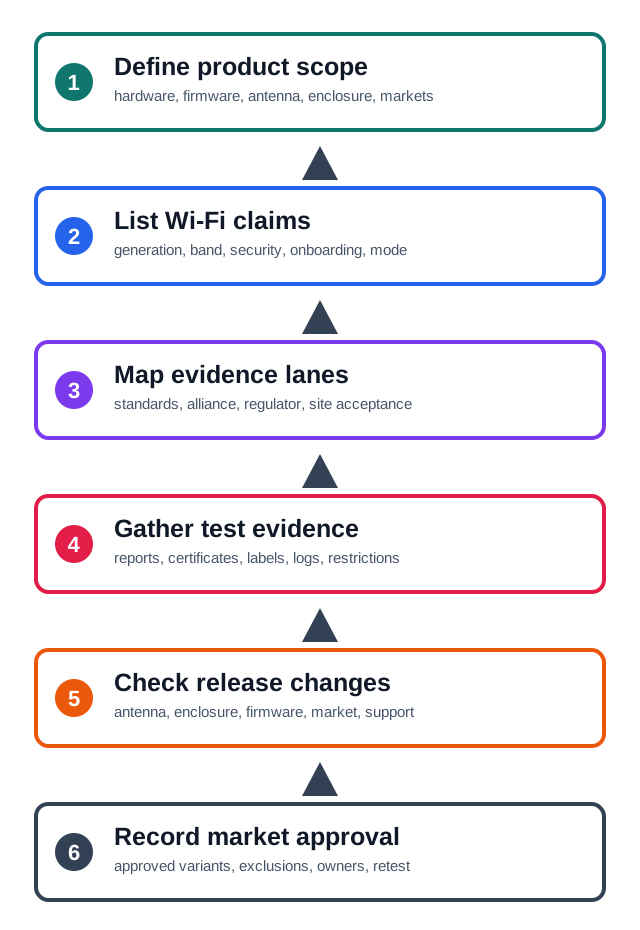
Read Figure 19.1 left to right: freeze the product scope before listing claims, map each claim to its evidence lane, and gather the matching artifacts. The release-change check then decides whether those artifacts still apply; only the final market-approval record states the accepted variants, exclusions, owner, and retest trigger.
A strong certification review follows the route:
- Define the exact product, radio module, antenna, enclosure, firmware, power settings, and market scope
- List the Wi-Fi claims being made, such as generation, band, security mode, onboarding method, mesh behavior, or roaming support
- Map each claim to the correct evidence lane: standards, Wi-Fi Alliance program, regional radio authorization, security review, or site acceptance
- Gather test reports, certificates, firmware records, labeling evidence, user controls, and restrictions
- Check whether the current release changed any item that invalidates previous evidence
- Record what is approved, what is excluded, and when the evidence must be refreshed
19.5 Evidence Map
This section: Evidence Map — Use Figure 19.2 when a certification claim spans more than one evidence lane.
Use Figure 19.2 when a certification claim spans more than one evidence lane.
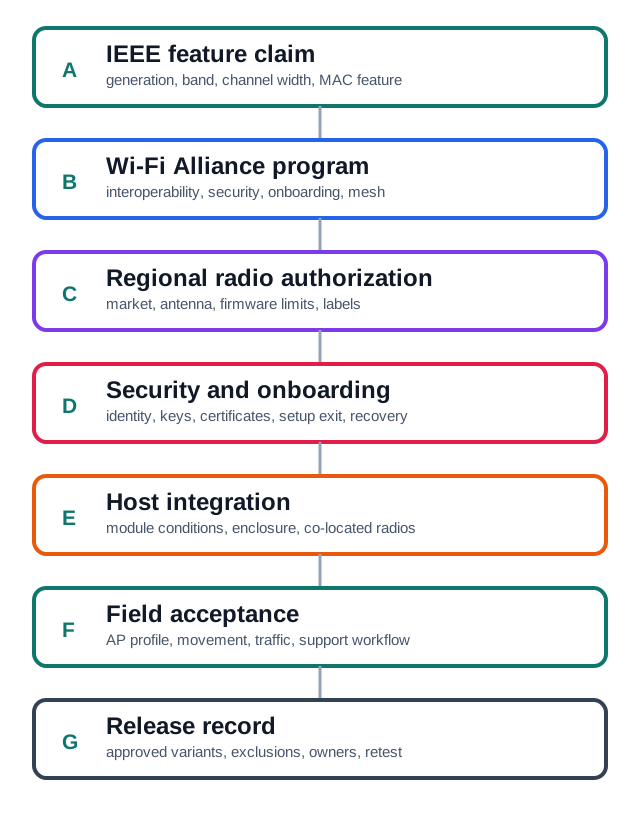
In Figure 19.2, the IEEE, Alliance, and regional-authorization lanes establish specification, interoperability, and legal-transmission evidence. Security and onboarding, host integration, and field acceptance cover different product risks. The release record binds all seven lanes to one hardware, antenna, enclosure, firmware, market, and support scope.
The map keeps the lanes separate:
- IEEE feature claim: which amendment, band, channel width, power behavior, or MAC feature is being cited
- Wi-Fi Alliance program: which interoperability, security, onboarding, mesh, roaming, or generation program was tested
- Regional radio authorization: which market, equipment class, antenna set, firmware limits, label, and user restriction apply
- Security and onboarding: which authentication, key management, certificate, provisioning, and recovery behavior is supported
- Host integration: whether a module is used as approved, or whether enclosure, antenna, power, cable, or firmware changes require more evidence
- Field acceptance: whether the product works in the intended site, with the intended APs, client mix, traffic, and support workflow
- Release record: which product variants are approved and which future changes force review
19.6 What Certification Proves
This section: What Certification Proves — Certification language is easy to overread.
Certification language is easy to overread. Treat each claim as scoped evidence.
IEEE standard support:
- Proves that a product claims or implements behavior from a standards family
- Does not prove that every optional feature is present
- Does not prove that the device performs well in a specific building or fleet
Wi-Fi Alliance certification:
- Proves that a product passed a defined program for selected capabilities
- Can cover programs such as generation certification, WPA security, Easy Connect, Direct, EasyMesh, Passpoint, or roaming-related behavior
- Does not replace regional radio authorization or deployment acceptance testing
Regional radio authorization:
- Proves that a particular product configuration is authorized for a market under the applicable radio rules
- Depends on the radio, antenna, enclosure, firmware controls, labeling, and user instructions
- Does not prove interoperability with every AP, controller, mobile device, or cloud workflow
Site acceptance:
- Proves that the product works in the intended environment under a defined acceptance plan
- Must test the actual APs, security mode, channel plan, traffic pattern, roaming path, enclosure, and support workflow
- Does not replace product certification or market authorization
19.7 Product Scope Record
This section: Product Scope Record — Start every review with the product scope.
Start every review with the product scope. Without this record, certification evidence becomes hard to trust.
Record:
- Product name, hardware revision, radio chipset or module, and firmware build
- Antenna type, cable, connector, gain, placement, and whether the antenna is fixed or replaceable
- Enclosure material, mounting position, power supply, and any shielding or co-located radios
- Supported bands, modes, security settings, onboarding methods, and regional configuration controls
- Target markets and whether the same SKU or region-specific SKUs will be used
- Labels, user instructions, installation restrictions, and support workflow
- Evidence owner and retest trigger list
Retest triggers include:
- Antenna, enclosure, board, cable, or radio-module change
- Firmware change that affects channel, power, band, country, DFS, security, onboarding, or coexistence behavior
- New market, new label, new installation orientation, or new mounting accessory
- Changed AP/controller profile, security policy, provisioning flow, or site acceptance requirement
19.8 Standards And Feature Claims
This section: Standards And Feature Claims — Do not approve a product from the generation name alone.
Do not approve a product from the generation name alone. A Wi-Fi generation describes a family of possible capabilities; the product evidence must say which capabilities are actually implemented and approved.
Review feature claims with these questions:
- Which band is used in this product configuration?
- Which channel widths are enabled by firmware and regional setting?
- Which security modes are supported and required for the target customers?
- Does the client actually support the claimed feature, or is the feature only available on the AP?
- Is the feature mandatory for the certification program, optional, or only a marketing claim?
- Does the application benefit from the feature in this device class?
- Was the behavior validated with the intended AP/controller and traffic pattern?
Examples:
- A Wi-Fi 6 claim is not enough for a battery-sensor approval. Check Target Wake Time support, AP support, firmware behavior, wake schedule, missed-downlink behavior, and application delay tolerance.
- A Wi-Fi 7 claim is not enough for a camera approval. Check client capability, AP capability, channel plan, backhaul, Multi-Link Operation behavior if used, and whether wider channels are allowed and useful in the target market.
- A Wi-Fi HaLow claim is not enough for a long-range sensor approval. Check regional sub-GHz rules, antenna limits, gateway availability, throughput need, roaming need, and installed coverage.
19.9 Security And Onboarding Evidence
This section: Security And Onboarding Evidence — Security certification should be reviewed as an operating workflow, not just as a logo.
Security certification should be reviewed as an operating workflow, not just as a logo.
For WPA-Personal style deployments, collect:
- Required minimum security mode
- Password or key rotation process
- Behavior for lost devices and returned devices
- Onboarding flow for devices without screens
- Support process for failed joins and factory reset
For Enterprise deployments, collect:
- Identity source, EAP method, certificate lifecycle, and revocation process
- RADIUS or authentication service ownership
- VLAN, firewall, and policy assignment evidence
- Clock, certificate, and firmware-update dependencies
- Support process when a device certificate expires or is revoked
For onboarding programs such as Easy Connect, collect:
- Who acts as configurator
- How bootstrap data is protected
- Whether QR, NFC, BLE, or another path is used
- How the device exits setup mode
- How support staff recover from partial setup
Strong security review statement:
- “WPA3-Enterprise is approved only for the named clinical scanner release. Each device has its own identity. Evidence covers certificate setup, cancellation, separated access, and support for expired certificates.”
Weak security review statement:
- “Use WPA3 because it is more secure.”
19.10 Regional Radio Evidence
This section: Regional Radio Evidence — Regional radio evidence is market-specific.
Regional radio evidence is market-specific. A device that is acceptable in one market may need different settings, labels, tests, or restrictions in another.
For each target market, record:
- Radio authorization path and test lab record
- Exact product variant covered by the report
- Enabled bands, channel behavior, power settings, and user controls
- Antenna configuration and installation restrictions
- Label, electronic label, packaging, and user instructions
- Whether indoor, outdoor, fixed, mobile, or portable use is in scope
- Coexistence and unwanted-emission evidence for co-located radios
- Who maintains the record when rules, firmware, or hardware change
Avoid copying region tables into the chapter as fixed truth. They age quickly. Use official regulator and test-lab documents for the release under review.
19.11 Module Versus End Product
This section: Module Versus End Product — A pre-certified module can reduce review work, but it does not remove the need to review the host product.
A pre-certified module can reduce review work, but it does not remove the need to review the host product.
Module evidence is strongest when:
- The host uses the approved antenna type and placement limits
- The host does not add unreviewed gain, cable loss changes, shielding, or co-located radios
- Firmware does not expose unauthorized band, channel, power, or country controls
- Labeling and user instructions preserve the module restrictions
- The host integration has been checked for emissions, power, and coexistence effects
Module evidence is weak when:
- The host uses a different antenna or enclosure without review
- A service menu lets users change region, power, or channel behavior
- The final product includes another radio close to the Wi-Fi antenna
- The product team treats the module certificate as approval for every market and SKU
19.12 Test Package Checklist
This section: Test Package Checklist — The acceptance record should name the evidence, not just the outcome.
Before sending a product to a lab or accepting a test report, confirm that the evidence package includes:
- Final or representative hardware samples
- Firmware build and radio configuration lock state
- Antenna drawings, antenna gain record, cable record, and installation orientation
- User controls and service controls that affect radio behavior
- Security and onboarding configuration used during testing
- Photos, block diagram, label drafts, and user instructions
- Power supply and accessory list
- Co-located radio list and duty behavior
- Market list and SKU mapping
- Failure disposition process if the lab finds an issue
The acceptance record should name the evidence, not just the outcome. “Passed lab testing” is too vague. “Firmware build A, antenna set B, enclosure C, and market list D are covered by report E” is reviewable.
19.13 Worked Review: Clinical Scanner Fleet
This section: Worked Review: Clinical Scanner Fleet
Scenario:
- Handheld scanners move through a clinical site
- Each scanner joins managed Wi-Fi using device identity
- The product team cites WPA3-Enterprise and Wi-Fi certification as sufficient approval
Review:
- Wi-Fi certification helps establish interoperability for selected programs
- WPA3-Enterprise evidence must include identity, certificate, revocation, authentication service, segmentation, and support workflow
- Movement requires site acceptance with AP/controller behavior, roaming or reconnect logs, application continuity, and failure recovery
- The final approval must name the scanner hardware, firmware, security profile, AP/controller profile, and site acceptance conditions
Bounded decision:
- Approve the scanner release only for the named hardware and firmware, with the approved certificate lifecycle, segmented network policy, AP profile, and acceptance route
- Exclude sites that use a different security profile or controller behavior until they pass the same evidence review
19.14 Worked Review: Multi-Market Sensor
This section: Worked Review: Multi-Market Sensor
Scenario:
- A small sensor will ship to several markets
- The design uses a certified Wi-Fi module
- The final enclosure changes the antenna location
Review:
- The module certificate is useful evidence, but the host integration must still be checked
- The changed antenna location can affect emissions, sensitivity, and installation restrictions
- Each market needs its own authorization record, labeling evidence, and firmware controls
- The release record must prevent unsupported region or power changes after shipment
Bounded decision:
- Approve only the SKUs whose antenna, enclosure, firmware lock, labels, user instructions, and market reports match the evidence package
- Retest or re-review any SKU with a different enclosure, antenna, firmware region control, or co-located radio behavior
19.15 Knowledge Check: Evidence Lanes
This section: Knowledge Check: Evidence Lanes
19.16 Knowledge Check: Security Claims
This section: Knowledge Check: Security Claims
19.17 Match Claim To Evidence
This section: Match Claim To Evidence
19.18 Order The Certification Review
This section: Order The Certification Review
19.19 Common Mistakes
This section: Common Mistakes — Compare the crossed-out copied region table with the live evidence board beside the shipping box.
Compare the crossed-out copied region table with the live evidence board beside the shipping box. Which record would you trust for the place where this device will ship?
-

Wrong: A copied rule table stays current. Check today's release records.
The old table on the left is crossed out. The board on the right checks radio, test, device, place, and coordination records for this product. The picture warns against carrying an old channel or power claim into a new market; the logo mistake below is a second reason to name the exact evidence lane. Treating a logo as full approval:
- A logo may prove a selected interoperability program
- It does not prove market authorization or site behavior
Corrective action: map the logo to the exact program and then check the missing evidence lanes.
Using stale region tables:
- Channel, power, device-class, indoor, outdoor, and coordination rules change
- Copied tables can be wrong by the time a product ships
Corrective action: use current regulator, test-lab, and certification records for the release.
Ignoring host integration:
- A module certificate may depend on antenna, firmware, label, and installation restrictions
- Enclosure and co-located radio changes can change the evidence need
Corrective action: compare the final host to the approved module conditions.
Approving security by protocol name:
- WPA3, 802.1X, or Easy Connect names do not prove the support workflow
- Lost-device, returned-device, expired-certificate, and failed-onboarding paths still need records
Corrective action: review identity lifecycle, setup exit, support recovery, and revocation evidence.
Skipping field acceptance:
- Product certification does not prove behavior in a real site
- Roaming, retries, AP compatibility, segmentation, and application continuity still matter
Corrective action: require acceptance logs from the intended AP/controller and device workflow.
19.20 Review Checklist
This section: Review Checklist
Before accepting a Wi-Fi certification answer, confirm that it:
- Names the exact product variant, radio, firmware, antenna, enclosure, and target markets
- Separates IEEE standards, Wi-Fi Alliance programs, regional radio authorization, and site acceptance
- States which Wi-Fi features are implemented, certified, optional, excluded, or only planned
- Checks security identity, onboarding, revocation, support recovery, and segmentation behavior
- Handles module evidence as scoped component evidence, not blanket product approval
- Checks labels, user instructions, firmware locks, service controls, and market restrictions
- Avoids fixed range, channel, power, timeline, budget, or market-access promises unless supported by current release evidence
- Records approved variants, exclusions, evidence owner, and retest triggers
- Uses current official sources for standards and regional rules
- Avoids hidden sections, stale generated figures, generic diagram/code quizzes, unsupported widgets, and mobile-hostile reference grids
19.21 Official Sources To Verify
This section: Official Sources To Verify
Use current primary sources when preparing a real release:
- Wi-Fi Alliance Certification
- IEEE 802.11 Working Group
- The current regulator portal, test-lab report, and authorization record for each target market
19.22 Standard, Certification, and Regulation Are Three Things
This section: Standard, Certification, and Regulation Are Three Things — Three separate bodies stand behind a working Wi-Fi product.
Three separate bodies stand behind a working Wi-Fi product. The IEEE writes the 802.11 standard, the Wi-Fi Alliance runs certification programs for interoperability, and government regulators authorize transmission within market-specific rules. Return to Figure 19.2 to place those three claims beside the product evidence they do not replace.
Read Figure 19.2 from the IEEE claim through Alliance certification and regional radio authorization, then continue across security and onboarding, host integration, field acceptance, and release control. The first three lanes answer specification, interoperability, and legal-transmission questions; none proves that the assembled IoT product works safely in its installed service. The map connects institutional evidence to the chapter’s bounded-release rule: each claim needs its own artifact, scope, owner, and retest trigger.
The review record should name the evidence lane, the artifact, and the product scope. For example, a WPA3 claim may point to a Wi-Fi Alliance program result, while legal shipment points to a market authorization report tied to a specific antenna, enclosure, firmware lock, label, and user instruction set. The same product can pass one lane and remain unapproved in another.
That separation also protects maintenance. If a firmware update changes country control, security onboarding, transmit power, or supported channels, the release owner can identify which evidence lane needs review instead of assuming the old certificate covers the new behavior. Evidence stays auditable after release.
Keep them straight: IEEE writes it, Wi-Fi Alliance certifies interoperability, regulators authorize transmission. Passing one does not grant the others.
19.22.1 Overview Knowledge Check
19.23 Generation Names and Feature Certifications
This section: Generation Names and Feature Certifications — Beyond generations, distinct programs certify features: WPA2 and WPA3 (security), Wi-Fi Enhanced Open (OWE), Wi-Fi Easy Connect (DPP onboarding), and Passpoint (network discovery and secure connection).
The Wi-Fi Alliance’s generation names map to IEEE amendments, and there are separate certifications for security and features an IoT product may need to claim:
| Marketing name | IEEE amendment | Bands |
|---|---|---|
| Wi-Fi 4 | 802.11n | 2.4 & 5 GHz |
| Wi-Fi 5 | 802.11ac | 5 GHz |
| Wi-Fi 6 / 6E | 802.11ax | 2.4/5 GHz; 6E adds 6 GHz |
| Wi-Fi 7 | 802.11be | 2.4/5/6 GHz |
Beyond generations, distinct programs certify features: WPA2 and WPA3 (security), Wi-Fi Enhanced Open (OWE), Wi-Fi Easy Connect (DPP onboarding), and Passpoint (network discovery and secure connection). An IoT device datasheet that says “Wi-Fi 6, WPA3, Easy Connect” is claiming three separate certifications; verify each in the Alliance product record.
For a product review, turn each advertised phrase into a row in a claim matrix. The row should say whether the capability is implemented in the device, certified by a named program, enabled in the shipping firmware, allowed in the target markets, and validated with the intended AP or controller profile. A feature that is only present in the chipset data sheet is not the same as a feature approved in the final product.
Keep module evidence separate from finished-product evidence. A certified module can reduce test effort, but the reviewer still checks antenna conditions, enclosure effects, co-located radios, service-menu controls, labels, and region locks. The release record should state which host variants inherit module evidence and which variants need another lab or engineering review.
Worked example. A smart-lock vendor wants headless onboarding and modern security. They target three certifications: Wi-Fi 6 (interoperable ax radio), WPA3-Personal (SAE authentication), and Wi-Fi Easy Connect (DPP provisioning with a QR code as one bootstrap method). Each is tested independently, so the vendor cannot assume passing the radio test grants the security or onboarding marks — they must certify each capability the product advertises.
19.23.1 Practitioner Knowledge Check
19.24 Regulatory Domains, EIRP, and DFS Compliance
This section: Regulatory Domains, EIRP, and DFS Compliance — Regulatory rules are what actually constrain a shipping radio, and they differ by region.
Regulatory rules are what actually constrain a shipping radio, and they differ by region. A device carries a regulatory domain that sets which channels it may use and at what EIRP (equivalent isotropically radiated power). For example, 2.4 GHz is capped near 100 mW (20 dBm) EIRP in Europe; parts of the 6 GHz band are restricted to low-power indoor use; and 5 GHz UNII-2 channels require DFS (dynamic frequency selection) to protect radar.
DFS is a hard compliance requirement, not a feature toggle: on those channels a device must perform a channel-availability check before transmitting and must vacate within seconds if it detects radar. A product certified in one region can be illegal in another if it enables channels or power levels not permitted there — which is why firmware locks radios to the shipping regulatory domain.
The practical control is a release-state ledger. Record the regulatory domain source, who can change it, whether users or installers can override it, which firmware build was tested, and which evidence proves DFS, indoor/outdoor restrictions, antenna gain, and power limits are enforced. If those controls move from factory firmware to cloud policy or installer tooling, the compliance evidence must move with them.
Do not treat channel tables in learning material as release authority. For a real product, the authority is the current regulator record, test-lab report, certification program result, and the exact product configuration being shipped. The chapter can teach the review pattern; the release file must carry the current market-specific facts.
Worked example. An access point tested and sold for the US enables 5 GHz channels and power levels the FCC allows. Deploying that same firmware in the EU could violate local EU rules and harmonized ETSI channel, EIRP, or DFS limits. The correct path is a region-locked build or a reliably determined, locked regulatory domain so the radio only ever uses channels and power its local regulator authorizes. Certification interoperability and legal operation are different obligations that must both be met.
19.24.1 Under-the-Hood Knowledge Check
19.25 Summary
This section: Summary — Wi-Fi certification is not one approval.
Wi-Fi certification is not one approval. It is a set of evidence lanes. IEEE standards define technical behavior. Wi-Fi Alliance programs verify selected interoperability and security capabilities. Regional radio authorization ties a product configuration to a market. Site acceptance proves that the device works in the intended deployment.
The strongest review names the product variant, states the claims, maps each claim to evidence, records exclusions, and lists the changes that force another review.
19.26 Key Takeaway
This section: Key Takeaway — Wi-Fi Certification Reference should review Wi-Fi choices against standards, channels, airtime, density, security, power, mesh behavior, certification needs, and deployment evidence.
Wi-Fi Certification Reference should review Wi-Fi choices against standards, channels, airtime, density, security, power, mesh behavior, certification needs, and deployment evidence.
19.27 What’s Next
This section: What’s Next — Use Wi-Fi Standards Evolution to review the generation and feature history behind certification claims.
Use Wi-Fi Standards Evolution to review the generation and feature history behind certification claims.
Use Wi-Fi Security and Provisioning to review authentication, onboarding, and credential lifecycle choices.
Use Wi-Fi Deployment Planning to connect product evidence to site survey and acceptance evidence.
Use Wi-Fi 6E and Wi-Fi 7 for IoT and Wi-Fi HaLow when certification decisions depend on newer bands or IoT-specific Wi-Fi variants.
Use End-to-End Test Strategy and Privacy and Regulatory Fundamentals for broader release evidence practices.
Find help
3 reviewed answers.
Where should I start in a module?
Open the module page from the sidebar to see its chapters in order. Use the module map to return to a topic you need.
Modules and pathsReviewed
What can I try when a project does not work?
Check the symptom, then work through the diagnostic steps. Keep the error message and the smallest example that reproduces it.
When you are stuckReviewed
How do interactive examples work?
Use the interactive guide to check how examples and simulations work before changing your project.
Interactive examples guideReviewed