6 Cellular Spectrum for IoT
More
Depth: Practitioner
Progress saves as you read. Mark sections complete as you go; your progress appears in the sidebar.
6.1 Start With the Wireless Story
This section: Start With the Wireless Story — Picture a basement meter and a tracker on a moving van.
Picture a basement meter and a tracker on a moving van. Both use cellular service, but they may need different bands and network features. The right choice starts with the field job, not the newest label.
Radio frequency is the rate at which a radio wave repeats. Bandwidth means the span of frequencies or data capacity available to a link. Lower bands often reach through walls better, but the result still depends on the site, antenna, case, operator, and service. Start with region, movement, data rate, send pattern, power goal, and network lifetime. Check that the final module and antenna support the bands the chosen operator truly uses.
Use this short review path:
- Where will the device work?
- Does it stay in one region?
- Which operators serve that place?
- Which bands do they use there?
- Does the module support those bands?
- Does the final antenna support them?
- How much data must move?
- Must the device roam?
- Can it fall back safely?
- What network change starts a retest?
A band name does not prove indoor reach. An operator map does not prove the final mounting point. Practitioner compares band support, service modes, roaming, and lifecycle. Under the Hood covers duplexing, channel width, path loss, and narrowband modes. Those details can change the choice. They do not replace a site test with the final device.
Retell the band choice from the field. Begin with the country. Name the exact site. Name the operator choices. Check the service sold there. Check the bands used there. Check the module band list. Check the antenna band list. Check the final case. Check the final mounting point. Keep that evidence together.
Then describe the data job. Name the message size. Name the send rate. Name the reply need. Name the allowed delay. Name the battery goal. Name any fast alarm. Name any large update. Name any need to move. Name any need to roam. These needs shape the band choice.
Then check the radio path. A lower band may lose less through walls. A higher band may offer more space. The antenna still sets a limit. The case can add loss. Soil can add loss. A body can add loss. Metal can block a path. Network load can change service. Weather can change some sites. Only a field test joins these facts.
Then check the service life. An operator may move a service. A band may be reused. An old network may close. A module may lack a new mode. A roaming deal may change. A SIM plan may change. A new region may use other bands. A product plan must name these risks. It must name a fallback. It must name a retest date.
Finish with the release record. It names the workload. It names the site class. It names the chosen operator. It names the tested band. It names the final unit. It names the field result. It names the owner. It names the approved limit. It names the next review trigger. That record, not a band label, supports release.
Cellular spectrum is not just coverage color on a map. For IoT, the useful story is which band reaches the device, which duplexing and bandwidth model the operator supports, and what evidence shows NB-IoT, LTE-M, or broadband cellular fits the deployment.
6.2 In 60 Seconds
This section: In 60 Seconds — Cellular IoT uses licensed operator spectrum when a design needs wide-area coverage, managed network operation, mobility support, or deep indoor reach that would be difficult to provide with a private unlicensed network.
Cellular IoT uses licensed operator spectrum when a design needs wide-area coverage, managed network operation, mobility support, or deep indoor reach that would be difficult to provide with a private unlicensed network. The band matters because radio frequency affects path loss, building penetration, antenna size, available bandwidth, and which technologies an operator can offer in a region.
For most low-data-rate IoT systems, the strongest answer is not “use the newest cellular generation.” It is a documented fit between the device workload, available operator bands, coverage evidence, module band support, roaming assumptions, power behavior, and retest plan.
6.3 Learning Objectives
This section: Learning Objectives
By the end of this chapter, you will be able to:
- explain why licensed cellular spectrum is attractive for some IoT deployments
- separate band physics from operator availability and device certification
- compare low-band, mid-band, and high-band cellular choices for IoT use cases
- describe where NB-IoT, LTE-M, and 5G RedCap fit in cellular spectrum planning
- review spectrum refarming, roaming, and fallback assumptions without making brittle claims
- build an evidence record for cellular IoT band selection
6.4 Why Spectrum Is A Design Decision
This section: Why Spectrum Is A Design Decision — Cellular spectrum is not just a frequency label on a modem data sheet.
Cellular spectrum is not just a frequency label on a modem data sheet. It affects:
- whether the device can hear the serving cell at the intended location
- how much link margin remains after walls, soil, enclosures, vegetation, and body loss
- whether the selected operator supports NB-IoT, LTE-M, 5G RedCap, or another service on that band
- how much payload and firmware-update traffic the technology can reasonably carry
- whether the device can roam or must stay on one operator network
- how long the design can survive operator refarming and legacy-network retirement
- what certification, antenna, SIM/eSIM, and provisioning steps are required
A review-ready spectrum decision should name the deployment region, operator options, supported module bands, technology, expected traffic pattern, field-measurement evidence, and retest triggers.
6.5 Cellular Spectrum Review Map
This section: Cellular Spectrum Review Map — Before comparing cellular spectrum options, inspect Figure 6.1 to keep band availability, operator support, device capability, coverage, and service evidence aligned.
Before comparing cellular spectrum options, inspect Figure 6.1 to keep band availability, operator support, device capability, coverage, and service evidence aligned.
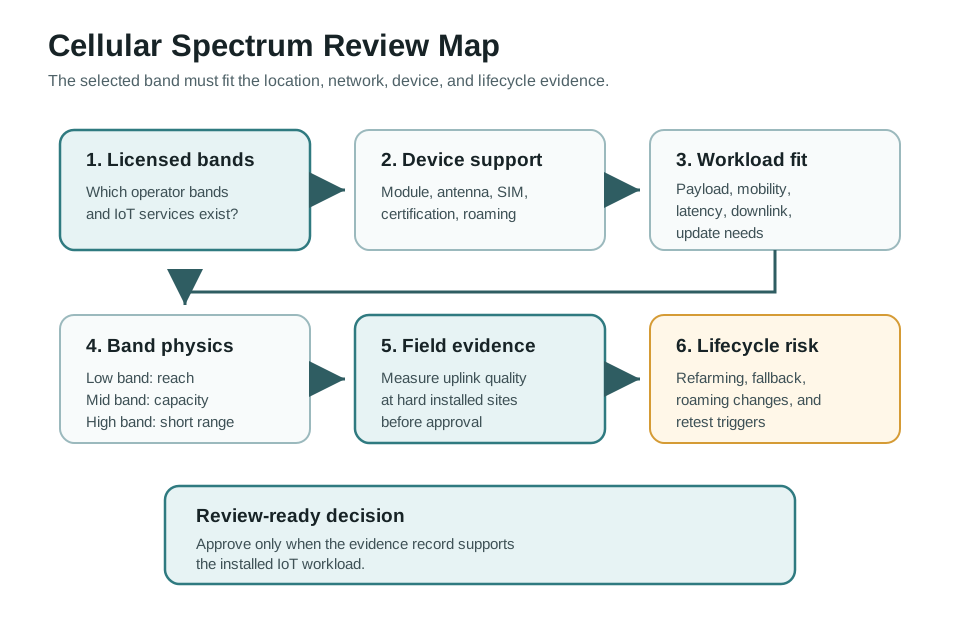
Read Figure 6.1 from regional and operator constraints through modem bands and installed signal observations to application behaviour. This connects spectrum labels to the network and hardware that can actually use them.
Use Figure 6.1 to keep the review grounded. The selected technology is only one part of the answer; operator support, device bands, coverage measurements, and operational assumptions must also line up.
6.6 Licensed Spectrum And IoT
This section: Licensed Spectrum And IoT — Licensed cellular bands are assigned to operators by national or regional regulators.
Licensed cellular bands are assigned to operators by national or regional regulators. The operator manages interference, site planning, authentication, roaming agreements, and network lifecycle. This can be valuable for IoT designs that must work across a city, road network, utility territory, campus, or moving asset route.
Licensed spectrum does not automatically make an IoT link reliable. The design still depends on:
- signal strength and signal quality at the installed location
- uplink coverage, not just downlink coverage shown on a consumer map
- network support for the intended IoT service in that region
- congestion, attach behavior, sleep behavior, and retry policy
- antenna placement, enclosure loss, and installation quality
- operator roadmap and contractual service terms
The review should treat the operator network as managed infrastructure, not as magic coverage.
6.7 Band Families
This section: Band Families — Low-band cellular spectrum, often below about 1 GHz, is commonly attractive for IoT because it has lower path loss and better obstacle penetration than higher-frequency bands at the same distance.
Low-band cellular spectrum, often below about 1 GHz, is commonly attractive for IoT because it has lower path loss and better obstacle penetration than higher-frequency bands at the same distance. It is a frequent candidate for meters, remote sensors, agriculture, building systems, and other devices that send small payloads from difficult locations.
Mid-band spectrum provides more bandwidth and capacity than low-band spectrum, but usually needs denser cell sites for comparable coverage. It can be appropriate for mobile trackers, gateways, industrial devices, or richer telemetry when the deployment has measured coverage and the device power budget can support the behavior.
High-band and mmWave spectrum provide very high bandwidth but short reach and weak obstruction penetration. This can be useful for fixed high-throughput systems with deliberate site planning, but it is rarely the first choice for sparse battery sensors, basement meters, buried devices, or wide-area low-rate telemetry.
The useful question is not “which band is best?” The useful question is “which available band leaves enough margin for this device, traffic, location, and lifecycle?”
6.8 Technology Fit
This section: Technology Fit — NB-IoT uses narrow bandwidth and coverage-focused behavior for small, infrequent payloads.
NB-IoT uses narrow bandwidth and coverage-focused behavior for small, infrequent payloads. It can be a good fit for static or slowly changing devices such as meters, environmental sensors, and status monitors when the operator supports the service and the application can tolerate its latency and mobility limits.
LTE-M uses wider bandwidth than NB-IoT and supports a broader set of mobility and throughput needs. It can be a better fit for trackers, wearables, alarm panels, mobile assets, and devices that occasionally need more responsive downlink or larger data transfers.
5G RedCap is a reduced-capability 5G option for devices that need more capability than low-rate LPWAN-style cellular but less complexity than full-feature 5G user equipment. It is more relevant to industrial sensors, cameras, gateways, and mid-tier connected devices than to tiny periodic sensors.
The review should avoid treating these technologies as a ranking. They answer different constraints.
6.9 Multiple Access And Spectrum Use
This section: Multiple Access And Spectrum Use — Cellular generations also changed how users share spectrum.
Cellular generations also changed how users share spectrum. Early systems separated users by fixed frequency channels. Later systems added time slots, spreading codes, and then flexible scheduling across many orthogonal subcarriers. The practical design lesson is simple: modern cellular networks can allocate radio resources more flexibly, but device performance still depends on coverage, scheduling, power state, payload size, and network support.
A useful historical review separates four levers that grew mobile capacity: obtain more licensed spectrum, improve spectral efficiency, reduce the coded bit rate needed for each voice call, and migrate traffic toward newer air interfaces as 3G and 4G service becomes available. One teaching sketch places 1G service around 800 MHz with about 50 MHz, 2G around 1900 MHz with about 120 MHz, 3G around 1700/2100 MHz with about 50/45 MHz, and 4G around 2500 MHz with about 194 MHz. Treat those figures as a regional historical example, not as a universal band plan. The transferable habit is to ask how much spectrum exists, how efficiently it is shared, how many bits the service really needs, and which generation or service mode the deployed devices can actually use.
Older 3G and 4G teaching material often shows standards logos because the air interface was also an ecosystem choice. 3GPP carried the GSM/UMTS/LTE path that became the mainstream LTE and 5G cellular-IoT base, while 3GPP2 carried the CDMA2000 branch. For IoT reviews, the lesson is not to memorize every historical branch; it is to connect the label on a module or operator service to the standards family, spectrum band, deployed network, and lifecycle evidence. LTE also made the OFDMA resource-block view central: users are scheduled over many small time-frequency resources rather than being assigned one simple channel for the whole service.
A legacy cellular-data note is useful when reading older deployment tables. GPRS added packet-switched data service to GSM as a 2.5G step, EDGE improved the 2G data path, WCDMA/UMTS and HSPA formed the common 3G branch, and LTE removed the 3G RNC layer by moving radio control into the eNodeB/EPC architecture. Treat headline rates such as 64-114 kbps for GPRS or much higher LTE class rates as deployment-era approximations that still need operator, band, signal, and device evidence.
For IoT learners, the key distinctions are:
- FDMA style sharing separates users by fixed frequency channels
- TDMA adds time sharing on a carrier
- CDMA uses spreading codes and interference management
- OFDMA schedules users across small frequency-time resources
- modern cellular IoT performance claims must still be checked against the actual network and device behavior
The voice-rate lever belongs in that same capacity story. Source-filter speech models and linear predictive coding shrink voice by sending compact vocal-tract and excitation parameters instead of every sample. Review the details in Voice and Audio Compression for IoT and Audio Features for Edge AI, then bring the lesson back here: fewer coded bits per call free radio resources only when quality, delay, packet overhead, and loss still meet the service boundary.
The historical CDMA story is also a reminder that a radio technique becomes a deployed generation only through standards, silicon, licensing, operator adoption, and handset support. Qualcomm and Irwin Jacobs are often used as the case study for championing code-division cellular into commercial 3G-era systems; for IoT reviews, treat that as an ecosystem lesson rather than as proof that any named air interface will automatically win in production.
Do not accept a capacity claim based only on a theoretical spectral-efficiency number. Ask what payloads, reporting intervals, retry rates, coverage classes, and operator limits are assumed.
6.10 Selection Evidence Flow
This section: Selection Evidence Flow — Before choosing a cellular band or technology profile, inspect Figure 6.2 to order regulatory, operator, device, coverage, traffic, and power checks.
Before choosing a cellular band or technology profile, inspect Figure 6.2 to order regulatory, operator, device, coverage, traffic, and power checks.
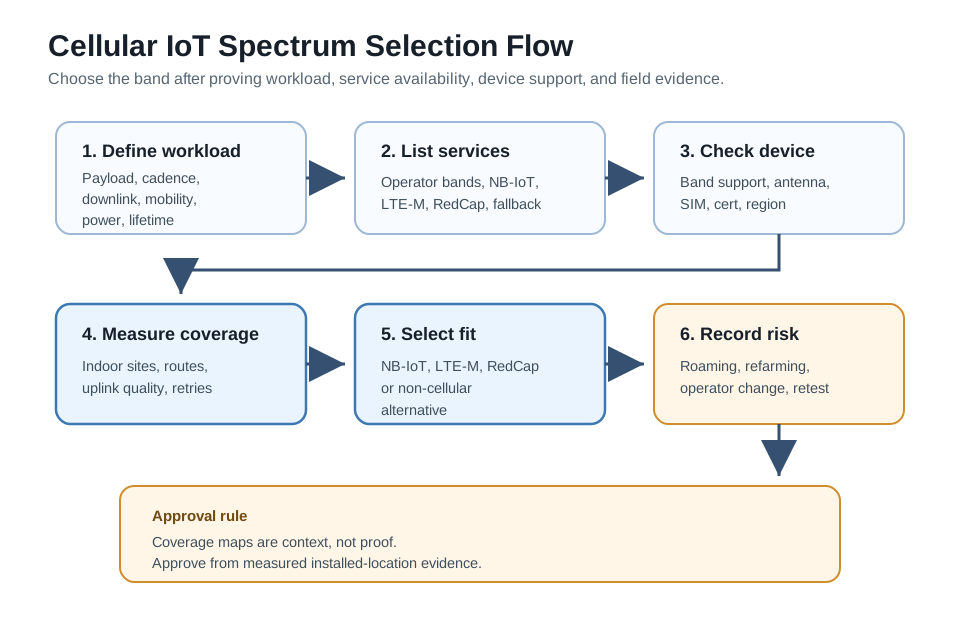
Read Figure 6.2 from regional availability through modem capability and network evidence to service validation. The sequence connects a nominally supported band to an operator path and deployed workload that have both been proven.
Use Figure 6.2 when comparing NB-IoT, LTE-M, RedCap, or a non-cellular alternative. The flow prevents a common mistake: choosing a technology before proving that the needed band and service are available where the device will actually operate.
6.11 What The Review Must Prove
This section: What The Review Must Prove — If the answer says only “NB-IoT has good coverage” or “LTE-M is faster,” it is not review-ready.
A cellular spectrum review should answer:
- Which countries, regions, campuses, routes, or sites are in scope?
- Which operators provide cellular IoT service there, and on which relevant bands?
- Does the chosen module support those bands and the selected service mode?
- Are antenna, enclosure, and installation constraints included in the link evidence?
- Is uplink performance measured at representative hard locations?
- Does the workload need mobility, downlink reachability, firmware updates, voice, or low latency?
- Are SIM, eSIM, roaming, private APN, security, and provisioning assumptions documented?
- What happens if an operator refarms spectrum, retires fallback service, or changes roaming terms?
- What field measurements must be repeated after firmware, antenna, enclosure, operator, or site changes?
If the answer says only “NB-IoT has good coverage” or “LTE-M is faster,” it is not review-ready.
6.12 Spectrum Refarming And Lifecycle
This section: Spectrum Refarming And Lifecycle — Operators can retire older services and reuse spectrum for newer generations.
Operators can retire older services and reuse spectrum for newer generations. This matters for long-lived IoT because a field device may remain deployed for many years while 2G, 3G, LTE, and 5G roadmaps continue to change.
A lifecycle-ready design should record:
- whether the device depends on a legacy fallback technology
- whether the selected operator has a published service-support plan
- whether the module firmware and certification support the intended future network modes
- whether replacement, firmware update, or SIM-profile changes are practical in the field
- which events trigger a renewed coverage and connectivity review
Avoid designing a new long-lived deployment around a fallback network that may disappear before the device fleet reaches end of life.
6.13 Roaming And Regional Band Support
This section: Roaming And Regional Band Support — Global IoT products need more than a generic “cellular” modem.
Global IoT products need more than a generic “cellular” modem. They need a region and operator plan. Band support differs across countries, and roaming support differs by technology, operator agreement, SIM profile, and network configuration.
Before accepting a roaming design, check:
- the countries or routes where the device will operate
- the bands and services supported by the module in each region
- whether NB-IoT, LTE-M, LTE, or 5G service is available through the chosen connectivity provider
- whether the device must recover from attach failures, forbidden networks, or weak coverage
- whether certification and regulatory requirements are different across markets
For a fixed single-country deployment, a simpler module may be enough. For a cross-border fleet, narrow band support can become a reliability problem.
6.14 Worked Review: Basement Meter
This section: Worked Review: Basement Meter
Prompt: “Use cellular for basement water meters because the operator coverage map shows service in the town.”
Review path:
- Identify the hardest installation locations, such as basements, vaults, meter cupboards, and shielded plant rooms.
- List the operator bands and IoT services actually available in the service area.
- Confirm that the chosen module and antenna support those bands.
- Measure uplink signal quality from representative hard locations, not only outdoor coverage.
- Compare NB-IoT and LTE-M against the payload, downlink, update, mobility, and battery requirements.
- Record retry, sleep, provisioning, and field-maintenance behavior.
- Retest after enclosure, antenna, firmware, operator, or building-condition changes.
Accepted answer: “The design is review-ready only when measured hard-location coverage and module/operator support prove the selected band and service can carry the meter workload with margin.”
6.15 Worked Review: Mobile Asset Tracker
This section: Worked Review: Mobile Asset Tracker — Accepted answer: “Low band may be valuable, but a tracker also needs mobility and regional service evidence.
Prompt: “Use the lowest cellular band because low band gives the best IoT result.”
Review path:
- Separate range needs from mobility, handover, reporting rate, and downlink needs.
- Check whether the asset moves across operators, countries, indoor spaces, roads, or rural areas.
- Verify module band support and roaming support for the expected route.
- Compare LTE-M, NB-IoT, LTE fallback, and 5G options against attachment time, mobility, power, and payload needs.
- Test the device on representative routes and stationary weak-signal locations.
- Record failure behavior when the preferred band or operator is not available.
Accepted answer: “Low band may be valuable, but a tracker also needs mobility and regional service evidence. The selected spectrum plan must prove both coverage and operational behavior.”
6.16 Common Mistakes
This section: Common Mistakes
- Choosing a cellular technology before checking local operator support
- Reading a consumer coverage map as proof of installed-device uplink coverage
- Assuming NB-IoT and LTE-M are interchangeable because both are cellular IoT
- Ignoring antenna placement, enclosure loss, and installation depth
- Treating mmWave bandwidth as useful for tiny periodic sensor payloads
- Designing new long-lived devices around legacy fallback networks
- Buying a narrow-band module for a product that must roam across regions
- Accepting capacity or battery-life claims without payload, retry, sleep, and coverage assumptions
6.17 Knowledge Check: Spectrum Fit
This section: Knowledge Check: Spectrum Fit
6.18 Match The Spectrum Choice To The Evidence
This section: Match The Spectrum Choice To The Evidence
6.19 Order The Cellular Spectrum Review
This section: Order The Cellular Spectrum Review
6.20 Review Checklist
This section: Review Checklist
Before approving a cellular spectrum choice, confirm that the record includes:
- deployment locations, routes, and hardest installed environments
- selected operator, service mode, bands, and module support
- traffic profile, downlink needs, mobility needs, and firmware-update assumptions
- antenna, enclosure, and installation evidence
- field measurements from representative weak or obstructed locations
- roaming, provisioning, SIM/eSIM, and attach-recovery behavior
- lifecycle and refarming assumptions
- retest triggers and owner
6.21 Licensed Bands, Duplexing, and NB-IoT’s Home
This section: Licensed Bands, Duplexing, and NB-IoT’s Home — Cellular IoT commonly runs in licensed spectrum assigned to operators, organised into numbered 3GPP bands (for example Band 20 at 800 MHz, Band 8 at 900 MHz, Band 3 at 1800 MHz).
Cellular IoT commonly runs in licensed spectrum assigned to operators, organised into numbered 3GPP bands (for example Band 20 at 800 MHz, Band 8 at 900 MHz, Band 3 at 1800 MHz). The operator manages access and interference, but coverage and quality still require site tests. An operator-managed service requires an operator agreement; an authorized private cellular network can instead be self-deployed.
Cellular bands use frequency-division duplex (FDD) or time-division duplex (TDD). FDD gives uplink and downlink paired frequencies and permits full-duplex operation, though an NB-IoT device may use half-duplex FDD. TDD separates uplink and downlink in time on an unpaired carrier. Many low-band NB-IoT and LTE-M deployments use FDD bands.
The two dominant cellular-IoT technologies fit into this spectrum differently: NB-IoT occupies one 180 kHz resource block, while LTE-M uses six resource blocks (1.08 MHz of occupied resource-block bandwidth within a 1.4 MHz LTE channel) — both narrower than common LTE broadband carriers. To see why bandwidth alone does not identify the deployment, inspect the three operator placement choices in Figure 6.3 before making a coverage or compatibility claim.
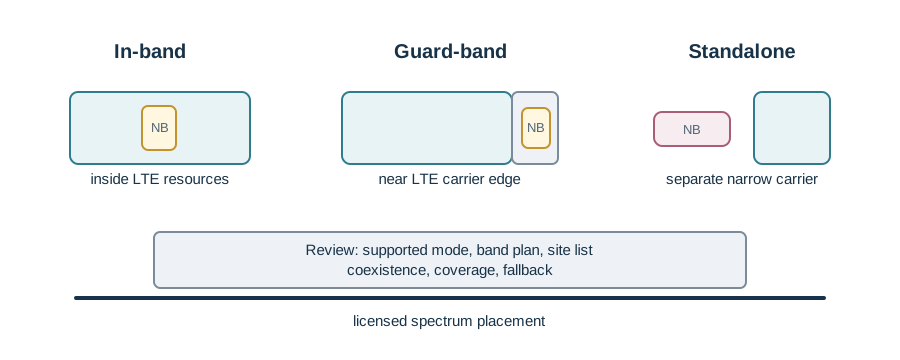
Read Figure 6.3 from in-band to guard-band to standalone. In-band consumes a resource block inside an LTE carrier; guard-band uses otherwise protected spectrum at the carrier edge; standalone uses a separate narrow carrier, often refarmed spectrum. The radio technology is still NB-IoT in every lane, but the operator’s mode changes the available band, site support, and coexistence assumptions. That distinction carries the chapter from spectrum vocabulary into the deployment evidence a product team must obtain.
Review example. A basement meter fleet should not start with “NB-IoT or LTE-M?” It should start with the hardest locations, the available operator bands, and measured uplink evidence. If low-band service leaves 18 dB of link margin at a shallow cupboard but only 4 dB in a concrete basement, the spectrum decision is not proven until the hard basement case is tested with the final antenna and enclosure.
The operator layer matters as much as the physics. A module may list many bands, but the chosen operator may offer NB-IoT on one band, LTE-M on another, and roaming only through specific partners. A review-ready record ties the band to the service mode, SIM or eSIM profile, attach behavior, and lifecycle plan instead of treating “cellular” as one universal network.
Core idea: cellular IoT is licensed spectrum + FDD/TDD duplexing, and NB-IoT is engineered to tuck a 180 kHz carrier inside, beside, or in place of existing LTE.
6.21.1 Overview Knowledge Check
6.22 The Three NB-IoT Deployment Modes
This section: The Three NB-IoT Deployment Modes — Worked example.
NB-IoT’s 180 kHz carrier (one LTE resource block) can be placed three ways, and an operator picks per site:
| Mode | Where the 180 kHz sits | Typical use |
|---|---|---|
| In-band | One resource block inside a live LTE carrier | Fastest rollout - a software feature on existing eNodeBs |
| Guard-band | In the unused guard band at a carrier's edge | Adds NB-IoT capacity without spending LTE resource blocks |
| Standalone | A dedicated carrier (e.g. a refarmed 200 kHz GSM channel) | Typically the best link budget; reuses spectrum freed from 2G |
Worked example. An operator running a 10 MHz LTE carrier (50 resource blocks) enables NB-IoT in-band by dedicating a single 180 kHz block — 1 of 50 resource blocks, or 2% of their 9 MHz occupied bandwidth (1.8% of the nominal 10 MHz channel) — potentially using existing LTE infrastructure if it supports the feature. A rural operator instead refarms an old 200 kHz GSM channel to run NB-IoT standalone; its coverage must still be measured. Same technology, three spectrum strategies.
For a device team, the deployment mode is not usually a setting they control; it is operator evidence they must ask for or infer from the service offer. The practical checklist is: which service mode is sold in the target region, which bands the module supports there, whether the antenna is tuned for those bands after enclosure assembly, and whether attach and uplink success are measured in the expected weak locations.
Field comparison. Suppose ten meters send a 40-byte reading once per day. Outdoor testing might show all ten attach and send quickly on LTE-M. In the basement set, six may attach reliably on LTE-M, while nine attach on the operator’s NB-IoT low-band service but with longer latency. The right answer depends on the workload: a daily meter can tolerate latency to gain coverage, while an alarm device may need the more responsive service if measured coverage is still adequate.
6.22.1 Practitioner Knowledge Check
6.23 Half-Duplex FDD Example and the 180 kHz Choice
This section: Half-Duplex FDD Example and the 180 kHz Choice — NB-IoT supports half-duplex FDD and TDD.
NB-IoT supports half-duplex FDD and TDD. In half-duplex FDD, uplink and downlink use paired frequencies, but the device never transmits and receives at the same instant. That lets the modem omit the costly RF duplexer and simplify the front end — cutting cost and power, which matters more than simultaneous throughput for a meter that sends a few bytes a day.
Why 180 kHz? It is exactly one LTE resource block, so NB-IoT drops cleanly into the LTE frame structure (the in-band and guard-band modes) with no redesign of the host carrier. Concentrating the device’s limited transmit power into that narrow band also raises power spectral density, which — together with message repetitions — is how NB-IoT buys its famous deep-coverage link budget.
Worked example. A basement water meter can’t reach the tower on a wide, full-power LTE channel. On NB-IoT the same modem pours its power into 180 kHz and repeats the transmission many times; the receiver integrates the repeats, recovering data that a wideband link would lose in the noise. The narrow band is not a limitation here — it is the mechanism that makes deep-indoor cellular IoT work.
The trade-off is time and energy. Repetition can recover a weak uplink, but each repeated transmission keeps the radio active longer and may delay the final delivery. That is acceptable for a daily meter reading, less acceptable for a door alarm, and often wrong for firmware updates. Spectrum review should therefore record not just “message delivered,” but attach time, transmit duration, retries or repetitions, downlink reachability, and battery impact.
Half-duplex behavior has a similar review consequence. A device that is transmitting cannot simultaneously receive a command, so downlink timing depends on network scheduling, device sleep state, and application expectations. If the product needs an immediate command response, the team must prove that the selected technology and band plan meet that latency, not just that the module can register on the network.
6.23.1 Under-the-Hood Knowledge Check
6.24 Summary
This section: Summary — Cellular spectrum selection is an evidence problem, not a slogan about the newest generation or the lowest frequency.
Cellular spectrum selection is an evidence problem, not a slogan about the newest generation or the lowest frequency. Low-band cellular is often helpful for wide-area and difficult indoor IoT, but only if the operator service, module support, antenna design, workload, and field measurements support the choice. NB-IoT, LTE-M, and 5G RedCap serve different device classes. A strong review records the available bands, service support, coverage evidence, roaming assumptions, lifecycle risks, and retest plan.
6.25 Key Takeaway
This section: Key Takeaway — Cellular Spectrum for IoT should tie mobile wireless fundamentals to spectrum, propagation, link budget, coverage planning, licensing, power, and deployment evidence.
Cellular Spectrum for IoT should tie mobile wireless fundamentals to spectrum, propagation, link budget, coverage planning, licensing, power, and deployment evidence.
6.26 Concept Relationships
This section: Concept Relationships
- Electromagnetic waves explain why frequency affects path loss and penetration.
- Frequency licensing explains the difference between managed cellular bands and shared unlicensed bands.
- Propagation design turns spectrum choice into measured link margin and placement decisions.
- Cellular IoT fundamentals connect bands to NB-IoT, LTE-M, RedCap, power states, and network behavior.
- Coverage planning labs validate the selected band and technology with field evidence.
6.27 What’s Next
This section: What’s Next
- Electromagnetic Waves and Spectrum Basics reviews the radio-wave foundations behind frequency and path loss.
- IoT Frequency Bands and Licensing compares licensed, unlicensed, and shared-spectrum rules.
- Propagation and Design applies spectrum trade-offs to coverage, margin, and placement decisions.
- Cellular IoT Fundamentals explains NB-IoT, LTE-M, and 5G cellular IoT architecture.
- LPWAN Fundamentals compares cellular LPWAN choices with unlicensed LPWAN alternatives.
Find help
3 reviewed answers.
Where should I start in a module?
Open the module page from the sidebar to see its chapters in order. Use the module map to return to a topic you need.
Modules and pathsReviewed
What can I try when a project does not work?
Check the symptom, then work through the diagnostic steps. Keep the error message and the smallest example that reproduces it.
When you are stuckReviewed
How do interactive examples work?
Use the interactive guide to check how examples and simulations work before changing your project.
Interactive examples guideReviewed