32 IEEE 802.15.4: Roles, Sleep, and Topology

More
Depth: Practitioner
Progress saves as you read. Mark sections complete as you go; your progress appears in the sidebar.
32.1 Start With the Decision
This section: Start With the Decision — Group tests fail when faults are dense or roles keep changing.
Group tests fail when faults are dense or roles keep changing. A role states what a device does in the network, such as forwarding others’ data. Device sleep turns its radio off to save power. A channel is a slice of radio spectrum; topology is the pattern of links among devices. Those choices guide the diagnosis.
32.2 Route Overview
This section: Route Overview — This is part 2 of 2.
This is part 2 of 2. Review IEEE 802.15.4: Collision Analysis for the preceding evidence.
32.3 Learning Objectives
This section: Learning Objectives
- Recognize when group testing is a poor fit.
- Choose device roles, sleep bounds, frequency, and topology.
32.4 Chapter Roadmap
This section: Chapter Roadmap
- When Group Testing Is A Poor Fit
- Device Roles And Sleep Boundaries
- Frequency And Topology Decisions
- Frame, Security, And Adaptation Overhead
- Evidence Record
- Worked Example: Event Burst In A Warehouse
- Worked Example: Scheduled Metering Window
- Review Checklist
- Common Mistakes
- Knowledge Check
- Matching Quiz
- Ordering Quiz
- Scheduling Time to Tame Collisions
- Beacon Order, Superframe Order, and Duty Cycle
- Slotted CSMA/CA and the GTS Trade-off
- Summary
- Key Takeaway
- Concept Relationships
- What’s Next
32.5 When Group Testing Is A Poor Fit
This section: When Group Testing Is A Poor Fit — Group testing is not a universal replacement for CSMA/CA.
Group testing is not a universal replacement for CSMA/CA.
It is a poor fit when:
- most devices are active at once
- latency must be very low
- devices cannot stay awake for multiple queries
- the receiver cannot distinguish reliable group responses
- device identities or test patterns are not stable
- false positives or missed responses would be hard to correct
- the same result can be achieved by scheduling or spreading application traffic
Treat group testing as an advanced review option. It belongs in a design only when the evidence shows sparse activation and the bounded test proves the extra mechanism helps.
32.6 Device Roles And Sleep Boundaries
This section: Device Roles And Sleep Boundaries — Advanced 802.15.4 design often fails when device roles are chosen from features rather than power and topology evidence.
Advanced 802.15.4 design often fails when device roles are chosen from features rather than power and topology evidence.
A full-function device can coordinate and may route when an upper-layer stack supplies routing. A device serving as coordinator or router usually needs more listening time and more responsibility for network state.
A reduced-function device is simpler. It is usually a leaf end device and can sleep aggressively when the application permits.
Review questions:
- Which devices must route or coordinate?
- Which devices can be leaf nodes?
- Which devices have stable power?
- Which devices must sleep for long periods?
- What happens when a sleepy device misses a parent, beacon, or retry window?
- Is routing responsibility placed on devices with enough energy and link quality?
Do not make every device a router for flexibility. Routing responsibility has energy, memory, and reliability consequences.
32.7 Frequency And Topology Decisions
This section: Frequency And Topology Decisions — 802.15.4 deployments may use 2.4 GHz or regional sub-GHz bands, depending on hardware and regulatory availability.
802.15.4 deployments may use 2.4 GHz or regional sub-GHz bands, depending on hardware and regulatory availability.
Review frequency choice with deployment evidence:
- expected range
- wall, foliage, equipment, and ground effects
- antenna placement
- local interference
- required data rate
- channel availability
- regional band availability
- gateway density
Use topology evidence too:
- star can be simpler but depends on coordinator reach
- mesh can extend coverage but adds routing overhead and parent-child complexity
- cluster-tree designs can organize large deployments but require careful role placement
- beacon-enabled networks need timing discipline
Do not choose frequency or topology from a generic rule. The right answer depends on measured link margin, deployment layout, traffic pattern, and maintenance constraints.
32.8 Frame, Security, And Adaptation Overhead
This section: Frame, Security, And Adaptation Overhead — 802.15.4 frames are small.
802.15.4 frames are small. Advanced design must account for the overhead that remains after addressing, security, adaptation, and application metadata.
Review these items before accepting a payload design:
- address mode
- PAN identifier use
- sequence number and acknowledgments
- security header and frame counter
- message integrity code length
- adaptation headers for higher-layer protocols
- fragmentation when payloads exceed one frame
- retransmission behavior after fragmentation
Small frames are a feature for low-power radio links, but they make hidden overhead dangerous. If a design claims that a payload fits, verify the actual frame layout and worst-case header combination.
32.9 Evidence Record
This section: Evidence Record — To make an advanced-mechanism decision reviewable, inspect Figure 32.1 before closing the test.
To make an advanced-mechanism decision reviewable, inspect Figure 32.1 before closing the test. It gathers the traffic burst, radio symptoms, chosen intervention, and outcome in one chain.
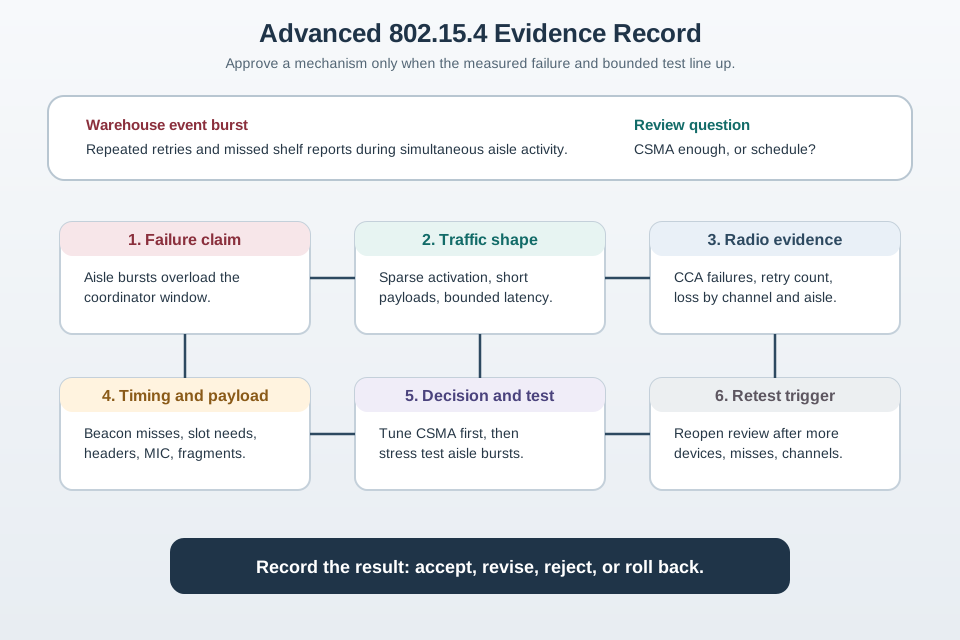
Read Figure 32.1, read from workload shape through retry, loss, timing, and payload evidence, then compare the selected mechanism with the bounded test result. The final limits and retest trigger connect a one-time experiment to an operational decision that can be revisited.
Use Figure 32.1 before approving an advanced mechanism.
A useful record includes:
- observed failure
- affected device group
- traffic shape and burst pattern
- channel and link evidence
- timing, retry, and latency evidence
- frame and payload evidence
- chosen mechanism
- bounded test result
- rollback or fallback path
- trigger that reopens the review
32.10 Worked Example: Event Burst In A Warehouse
This section: Worked Example: Event Burst In A Warehouse — Scenario: a warehouse has many 802.15.4 shelf sensors.
Scenario: a warehouse has many 802.15.4 shelf sensors. Most are quiet, but a handling event wakes a small group in the same aisle. During these bursts, the coordinator sees repeated retries and occasional missed reports.
Weak response:
- assume every miss is interference
- raise transmit power everywhere
- make all nodes route
- add a complex collision-identification method without measuring burst shape
Evidence-first review:
- measure how many devices wake during each burst
- compare retry counts during quiet and active periods
- check whether misses cluster by aisle, parent, channel, or time
- verify whether the coordinator is overloaded
- test application-level jitter before changing MAC behavior
- test CSMA/CA tuning before adding a new collision-identification scheme
- consider scheduled reporting if bursts are predictable
- consider sparse identification only if the active set must be known and remains small
Accepted decision example:
- spread non-urgent reports across a short randomized window
- keep routing responsibility on powered devices
- add a bounded stress test for simultaneous aisle events
- record the retry and loss thresholds that reopen review
32.11 Worked Example: Scheduled Metering Window
This section: Worked Example: Scheduled Metering Window — Scenario: a utility-style deployment needs periodic readings from a bounded set of meters.
Scenario: a utility-style deployment needs periodic readings from a bounded set of meters. The timing window is known, but contention causes long tail latency when many meters report at the same time.
Evidence-first review:
- identify which readings require bounded timing
- measure the normal and worst-case reporting window
- separate urgent state changes from routine readings
- check whether devices can synchronize reliably
- verify whether a beacon schedule is stable enough
- reserve scheduled access only for the time-sensitive subset
- leave routine or delayed reports on contention access when possible
Accepted decision example:
- use scheduled windows for priority readings
- keep low-priority reports on contention access
- track missed beacons and slot misses
- define a fallback path when a device misses its window
- retest after device count, reporting frequency, or channel plan changes
32.12 Review Checklist
This section: Review Checklist
Before accepting an advanced 802.15.4 decision, verify that:
- the observed failure is specific and measured
- the evidence distinguishes collision, weak link, routing, scheduling, and frame-size causes
- the chosen mechanism is the smallest one that fits the evidence
- device roles match power source, topology, and sleep needs
- frequency and topology choices are tied to deployment evidence
- scheduled access has beacon, synchronization, and recovery evidence
- collision-identification assumptions are explicit
- sparse activation is measured, not assumed
- frame and security overhead are counted in the actual payload budget
- normal, burst, stale, missed, and recovery cases were tested
- the design includes a fallback or rollback path
- the review record says what change should reopen the decision
32.13 Common Mistakes
This section: Common Mistakes
Avoid these patterns:
- treating group testing as a default 802.15.4 feature
- using theoretical query counts without timing and RF error evidence
- applying sparse collision methods when most devices are active
- making battery devices route without energy evidence
- assuming sub-GHz or 2.4 GHz is always better
- hiding frame overhead behind a payload-size claim
- scheduling every device when only a few traffic classes need bounded timing
- ignoring missed beacons and synchronization recovery
- comparing mechanisms without the same traffic and device-count assumptions
32.14 Knowledge Check
This section: Knowledge Check
32.15 Matching Quiz
This section: Matching Quiz
32.16 Ordering Quiz
This section: Ordering Quiz
32.17 Scheduling Time to Tame Collisions
This section: Scheduling Time to Tame Collisions — Before choosing beacon mode, inspect Figure 32.2 to ask where shared access, reserved sends, and sleep fit in one cycle during a burst.
Before choosing beacon mode, inspect Figure 32.2 to ask where shared access, reserved sends, and sleep fit in one cycle during a burst.
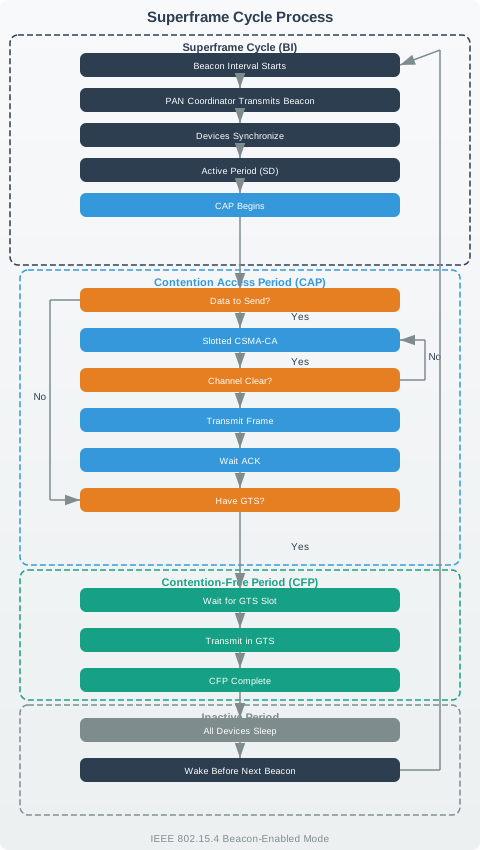
Read Figure 32.2 from the beacon through the active time and into sleep. The CAP keeps shared access, while the optional CFP gives GTS windows to named devices. In the worked case, 12 sensors - 2 safety sensors = 10 sensors remain in the CAP while the two safety sensors use one GTS each. The inactive span then creates a planned sleep chance. A GTS does not make the radio faster; it replaces a random wait with ownership of a set window.
Worked example. Suppose twelve shelf sensors normally report by contention, but two safety sensors must deliver one short status frame within a 100 ms control window. If all twelve wake together, the safety frames compete with routine frames and their delay depends on random backoff. If the coordinator uses a beacon schedule and reserves one GTS for each safety sensor, those two frames move out of contention. The remaining ten devices can still use the CAP, while the safety sensors wait for their assigned CFP windows. The schedule has not increased capacity; it has protected the traffic class whose lateness would matter most.
The design review should therefore ask two questions before approving GTS. First, is the urgent traffic predictable enough to reserve? A one-frame status update every beacon interval is a better fit than a burst whose size changes wildly. Second, is the reserved airtime worth removing from contention? An idle GTS wastes a slot that CAP traffic could have used, so a schedule that reserves time "just in case" can reduce throughput and still fail to solve the measured problem.
Power-saving MAC designs use the same rendezvous trade-off under different names. In a non-beacon tracking pattern, a sender keeps enough asynchronous wake-up or polling behavior to find a receiver without a shared schedule, which saves coordination but can waste sender airtime while it waits. Beacon tracking moves the cost to a synchronous coordinator rhythm: nodes wake near beacons, learn the active window, and sleep through the inactive part if the beacon is reliable. Global synchronization extends that idea across more hops or a wider mesh, reducing guesswork but adding clock-drift and synchronization-message overhead. Long preamble emulation takes the opposite asynchronous route by making the sender's wake-up signal long enough for a sleeping receiver to notice during a periodic check. None of these labels is a free power mode; each must be reviewed against latency, beacon loss, hidden terminals, clock drift, and the measured radio-on time.
Big idea: beacons create a shared schedule. Contend in the CAP, reserve a GTS for deadline-critical data, and let devices sleep through the inactive part of the beacon interval when the timing plan allows it.
Overview Knowledge Check
32.18 Beacon Order, Superframe Order, and Duty Cycle
This section: Beacon Order, Superframe Order, and Duty Cycle — Two parameters set the timing.
Two parameters set the timing. The Beacon Interval (BI) is how often beacons repeat; the Superframe Duration (SD) is how much of that interval is active. Both scale from a base of 960 symbols, so a small change in Beacon Order or Superframe Order doubles or halves the timing. In the 2.4 GHz PHY, one symbol is 16 µs, so symbol arithmetic turns directly into schedule time.
BI = 960 × 2^BOsymbols (Beacon Order, 0–14)SD = 960 × 2^SOsymbols (Superframe Order, withSO ≤ BO)- Active duty cycle =
SD / BI = 2^(SO−BO); whenBO > SOan inactive remainder exists, during which devices may sleep if their traffic and roles permit.
Low-duty-cycle example. Choose BO = 6, SO = 0. Then BI = 960 × 64 = 61440 symbols, or 61440 × 16 µs = 983.04 ms between beacons. The active duration is SD = 960 symbols, or 15.36 ms. The active duty cycle is SD / BI = 2^(0−6) = 1/64 = 1.5625%. For a sleepy metering device that only needs a short periodic exchange, this is the point of beacon mode: the device can wake near the beacon, communicate during the active part, and sleep for most of the roughly one-second interval.
Slot-sizing example. A different deployment might choose BO = 6, SO = 3. The beacon interval stays 983.04 ms, but SD = 960 × 8 = 7680 symbols, or 122.88 ms active. Because the active superframe has 16 slots, each slot is 7680 / 16 = 480 symbols, or 7.68 ms. If three alarm devices each receive one one-slot GTS, the CFP reserves about 3 × 7.68 = 23.04 ms of active time. That is useful if those alarms are real-time traffic; it is harmful if the alarms are rare and ordinary reports are now squeezed into a smaller CAP for no measured reason.
The CFP can hold up to seven GTS, each one or more slots, allocated by the coordinator. That limit forces prioritization. A reviewer should not approve "one slot for every important device" unless the count, slot length, frame exchange, and beacon reliability have been checked. A practical schedule table should name the device, traffic class, slot count, beacon order, superframe order, expected payload, acknowledgment behavior, and fallback if the device misses the beacon or its GTS.
Use the timing arithmetic to reject vague designs. "Low power" is not enough; calculate the active fraction. "Bounded latency" is not enough; calculate how long a device may wait for the next beacon and whether its frame fits in the assigned slot. "Seven slots are available" is not enough; calculate what remains for CAP traffic after the CFP reservation.
Practitioner Knowledge Check
32.19 Slotted CSMA/CA and the GTS Trade-off
This section: Slotted CSMA/CA and the GTS Trade-off — Inside the CAP, beacon-enabled nodes use slotted CSMA/CA.
Inside the CAP, beacon-enabled nodes use slotted CSMA/CA. The random backoff is no longer an arbitrary delay; it is counted in beacon-aligned backoff periods. In 802.15.4, the MAC backoff period is 20 symbols, so at 2.4 GHz one backoff period is 20 × 16 µs = 320 µs. Devices still pick random backoff values, but those values start and end on shared boundaries derived from the beacon. This reduces timing ambiguity and lets the coordinator define where contention is allowed.
Slotted CSMA/CA also uses a contention window. A device must see the channel idle for two consecutive clear-channel assessments before it transmits. If either assessment finds the channel busy, the device increases its backoff attempt and tries again later, subject to the configured limits. The exchange must also fit before the CAP ends. A frame that would start too late in the CAP is deferred, because the MAC cannot let a contention exchange run into the CFP where other devices may own GTS reservations.
CAP boundary example. In the BO = 6, SO = 3 schedule above, each active slot is 7.68 ms. If the CAP is nearly over and a device still needs random backoff, two clear CCAs, data transmission, turnaround, acknowledgment, and inter-frame spacing, the safe answer may be to wait for the next superframe. That looks conservative, but it protects the CFP. Without that boundary rule, a late CAP frame could collide with a device that has been promised contention-free airtime.
GTS removes contention for the owner, but it does not remove every failure mode. The owner must hear beacons, keep time with the coordinator, and have a frame exchange that fits inside the assigned slot count. The coordinator must track which devices own which slots and must reclaim or reassign unused reservations. A hidden coordinator, interference near beacon time, or excessive clock drift can make a scheduled design worse than CAP contention because devices now wait for windows they cannot reliably observe.
Control-loop example. A machine-guard sensor must report once per cycle before a controller decides whether motion may continue. In unslotted contention, the frame may arrive quickly when the channel is quiet, but the tail latency grows when unrelated devices wake together. With one GTS per beacon interval, the guard sensor waits for its reserved CFP window and transmits without backoff. The worst-case wait until the next scheduled slot is roughly one beacon interval, plus the frame exchange, so the reviewer can compare that bound with the control deadline. If the deadline is 50 ms and the beacon interval is 983 ms, the schedule is too slow even though it is contention-free; if the deadline is one second and the slot is reliable, the same schedule may be acceptable.
The engineering trade-off is therefore explicit: CAP provides statistical access for flexible traffic; GTS provides bounded access for a small number of predictable flows. A good advanced design uses both. It keeps routine or delayed data in CAP, reserves GTS only for traffic whose deadline has been measured, and records what happens when a device misses a beacon, loses its slot, or temporarily has more data than the reserved slot can carry.
Under-the-Hood Knowledge Check
32.20 Summary
This section: Summary — Advanced 802.15.4 decisions should be made from measured behavior.
Advanced 802.15.4 decisions should be made from measured behavior. Use CSMA/CA tuning for contention that still fits the normal model. Use beacon scheduling or guaranteed slots only when timing is predictable and synchronization evidence is strong. Treat group testing as a specialized sparse collision-identification model, not a default MAC feature. Review device roles, frequency, topology, frame overhead, and security overhead with the same discipline: state the failure, collect evidence, test the bounded change, and record the retest trigger.
32.21 Key Takeaway
This section: Key Takeaway — 802.15.4 Advanced Topics should connect 802.15.4 frame structure, addressing, topology, MAC behavior, power use, security, coexistence, and deployment evidence before selecting the stack.
802.15.4 Advanced Topics should connect 802.15.4 frame structure, addressing, topology, MAC behavior, power use, security, coexistence, and deployment evidence before selecting the stack.
32.22 Concept Relationships
This section: Concept Relationships
This chapter connects to:
- 802.15.4 Fundamental Operation for CSMA/CA, association, acknowledgments, and beacon behavior.
- 802.15.4 Features and Specifications for frame fields, addressing, security, and PHY/MAC limits.
- 802.15.4 Deployment Considerations for link budget, topology, channel planning, and site evidence.
- 802.15.4 Pitfalls and Best Practices for common design failures and review patterns.
- 802.15.4 Topic Review for broader review questions after the advanced mechanisms are clear.
32.23 What’s Next
This section: What’s Next — Continue with 802.15.4 Pitfalls and Best Practices to review failure patterns that often appear after advanced mechanisms are added.
Continue with 802.15.4 Pitfalls and Best Practices to review failure patterns that often appear after advanced mechanisms are added.
32.24 Continue Your Route
This section: Continue Your Route — This is the last part of this chapter.
This is the last part of this chapter. Return to IEEE 802.15.4: Collision Analysis or continue from the wifi-mobile module index.
Find help
3 reviewed answers.
Where should I start in a module?
Open the module page from the sidebar to see its chapters in order. Use the module map to return to a topic you need.
Modules and pathsReviewed
What can I try when a project does not work?
Check the symptom, then work through the diagnostic steps. Keep the error message and the smallest example that reproduces it.
When you are stuckReviewed
How do interactive examples work?
Use the interactive guide to check how examples and simulations work before changing your project.
Interactive examples guideReviewed